Emotional Response

Your constantly-updated definition of Emotional Response and collection of videos and articles.
Be a conversation starter: Share this page and inspire others!

197 Shares

What is Emotional Response?

Emotional response in user experience design refers to feelings, reactions and experiences users have when they interact with a product or service. Designers create interfaces and interactions that evoke specific emotions to make more engaging and meaningful user experiences that consider users’ emotional needs and desires.  

Author and Human-Computer Interaction Expert, Professor Alan Dix explains why emotions matter in design:  

Transcript
   

Why are Users Emotionally Responsive?

In the realm of user experience (UX) design and user interface (UI) design, emotional response plays a pivotal role. It contributes significantly to the overall user experience. Logic and action aren’t the only factors that drive human users and customers of products and services. The feelings that users respond with to a digital product—such as a website or mobile app—impact several key dimensions. Emotional reactions, and responses, can be profound in such areas as user satisfaction and customer loyalty, and extend to brand perception.
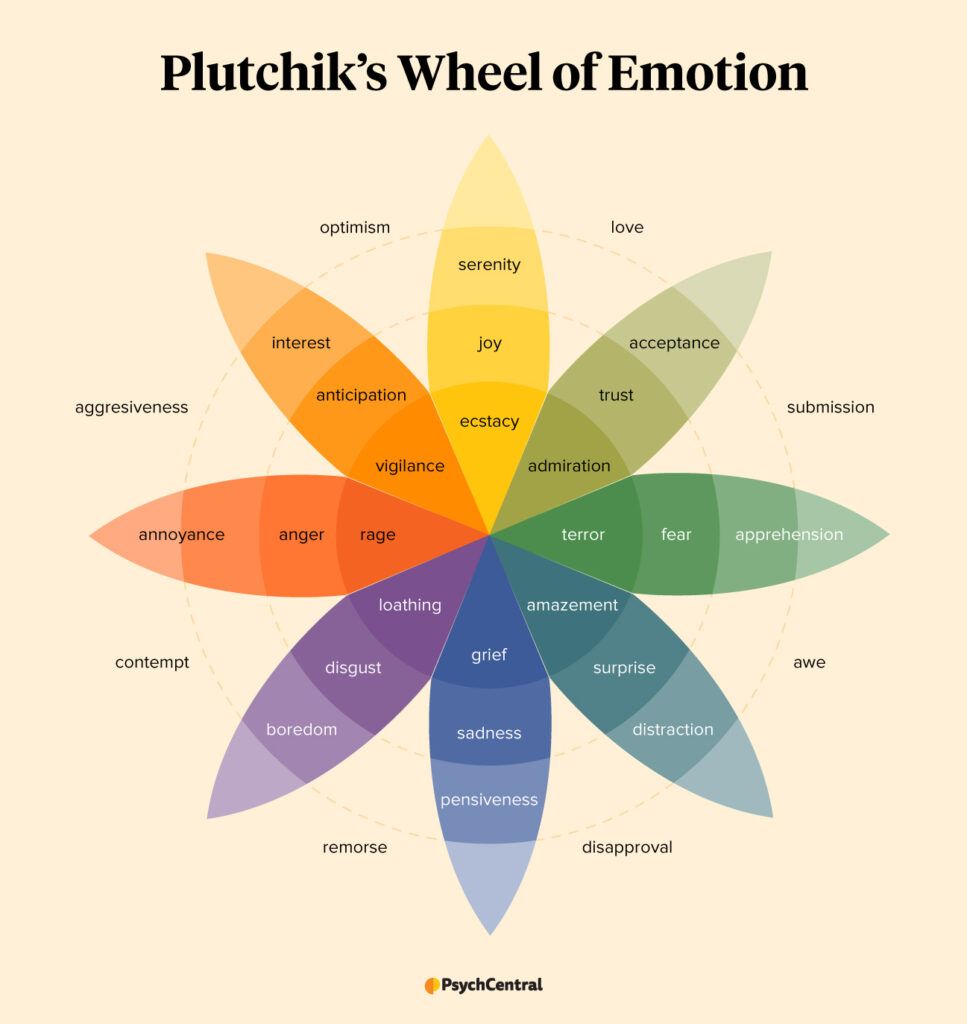
An image showing Plutchik's Wheel of Emotions

Plutchik’s Wheel of Emotion captures the range and complexity of human emotions.

© PsychCentral, Fair Use

There are many feelings on the wheel of emotions. A positive emotional response can lead to increased product stickiness, higher tolerance for minor usability issues, and improved product adoption. On the other hand, a negative emotional response can drive users away, and result in lost opportunities and lower revenue. If the negative emotions that users experience are bad enough—and enough users experience such negative responses—a brand that doesn’t take corrective action immediately can even suffer marketplace failure.  

Feelings are extremely important, although they don’t account for everything. Functionality and usability are also essential in a final product. Accessibility is also a massive consideration for designers to account for in their design work. However, it’s equally critical to design for emotion to create positive and memorable experiences. Users’ emotions, intuition and memories greatly influence their decision-making process throughout the various touchpoints where they encounter brands. Product designers and service designers need to understand how the choices users make to engage with brands tend to hinge on their emotional responses to design solutions.  

What are the Challenges of Designing for Emotions?

By nature, it’s challenging to know, and thus, design for how users will respond emotionally to a product. The main challenge is to understand and predict the wide range of emotional responses users may have. Feelings are complex. They can vary greatly from person to person. People can have many different feelings about designs, for instance. These notions can depend on idiosyncrasies and matters that these users might not be able to explain themselves—such as gut reactions. That makes it difficult to create a one-size-fits-all emotional design. Also, cultural, social and other personal factors can influence emotions, which further complicates the design process. 

Professor Alan Dix explains the need to consider culture in design: 

Copyright
Transcript
  

Another challenge for designers is how to balance emotional appeal with functionality and usability. While a visually appealing design might evoke positive emotions, it will matter little if it compromises the functionality or usability of the product.  

Yet another challenge is to identify the specific emotions that are most relevant to a product or service. Different products and industries may prompt different emotional responses. Some will be clearer than others. For example, a meditation app may aim to evoke feelings of calmness and relaxation. Meanwhile, a fitness app will be more likely to aim for feelings of motivation and empowerment for its users. It’s critical to understand the target audience and their emotional needs, to design for the desired emotional responses. 
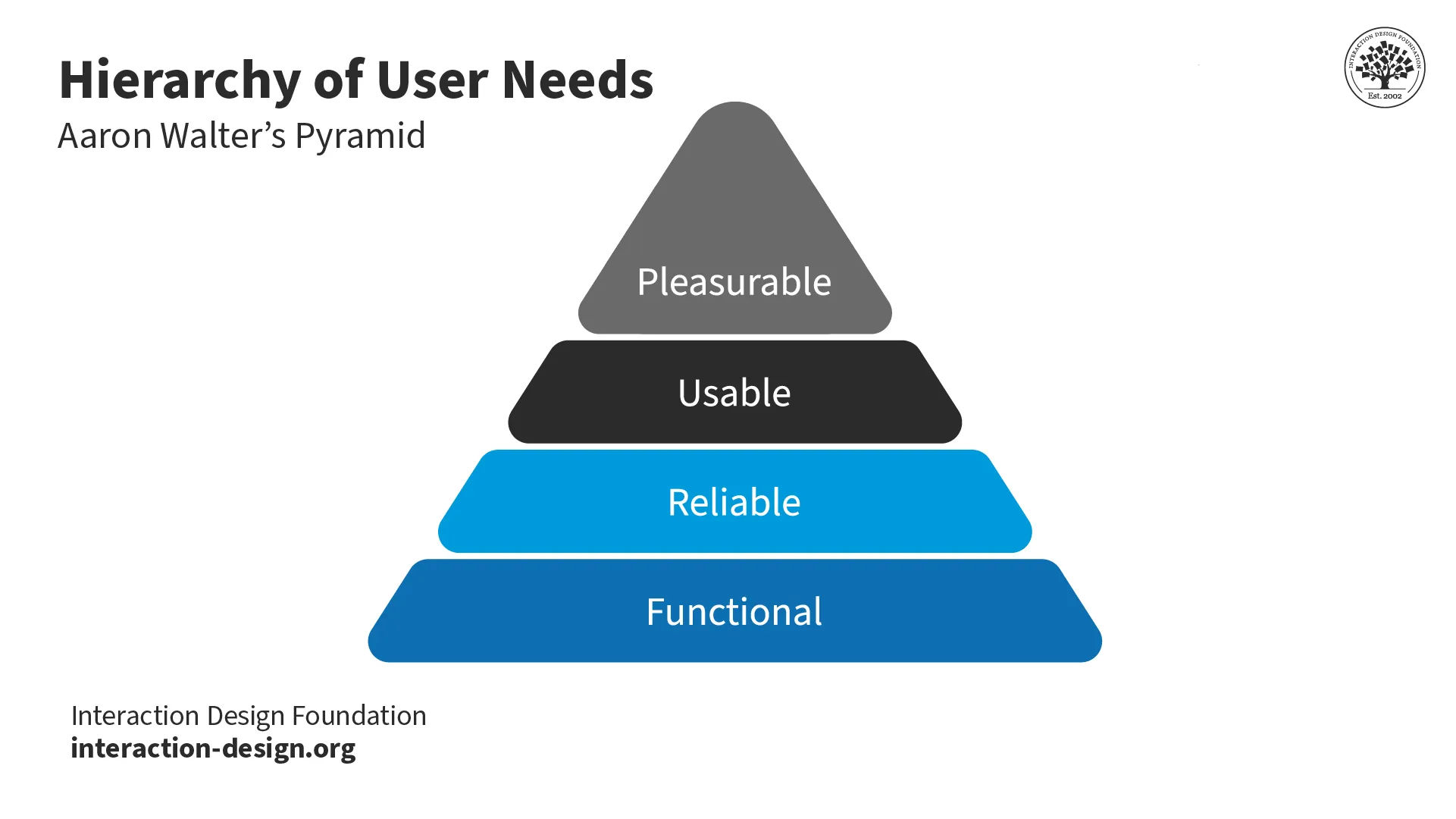
An image showing Aaron Walter's Hierarchy of User Needs.

Aarron Walter, author of Designing for Emotion, represents the pyramid of needs users expect.

© Interaction Design Foundation, CC BY-SA 4.0

Hand in hand with emotional responses is the need to design for context. Consider the emotional situations users can find themselves in when they use—for example—a driving app or GPS. Driving, a potentially stressful and even hazardous activity, tends to call for features that keep users informed well in advance and calm. A digital application needs to prove its designers have empathy with drivers at the level that it accounts for their emotional responses. It also must stay at least a step ahead of the many uncertainties and frustrations that come with road use. 

CEO of Experience Dynamics, Frank Spillers explains the value of when designers consider the context of use: 

Transcript
 

Examples of Emotional Responses in UX Design

Beyond the personal quirks, preferences and peeves of individuals, the types of emotional responses users are likely to have can vary depending on the context and the specific product or service. They also show how emotional design can significantly impact perception and overall experience with a product or service. 

These are typical emotional responses that users experience: 

  1. Joy and delight: A well-designed mobile game that brings joy and excitement through engaging gameplay, vibrant visuals and rewarding achievements.  

  1. Trust and confidence: A banking app that instills trust and confidence. It does this through secure login processes, clear and transparent communication of financial information, and reliable customer support. 

  1. Motivation and empowerment: A fitness app that motivates and empowers users to achieve their health and fitness goals. It does so through personalized workout plans, progress tracking and positive reinforcement.  

  1. Frustration and disappointment: A poorly designed e-commerce website that frustrates users with confusing navigation, slow loading times and unclear product descriptions. These lead to a disappointing shopping experience and abandoned carts.  

Apple is a notable example of a brand that has incorporated emotional design into their products. From the sleek look and feel of their devices to the intuitive user interfaces, Apple creates an enjoyable experience. Also, they form a strong emotional connection with their customers, many of whom are loyal to the Apple brand. Apple’s products have become synonymous with innovation, quality and reliability. These are attributes that have helped Apple build a loyal and devoted following.
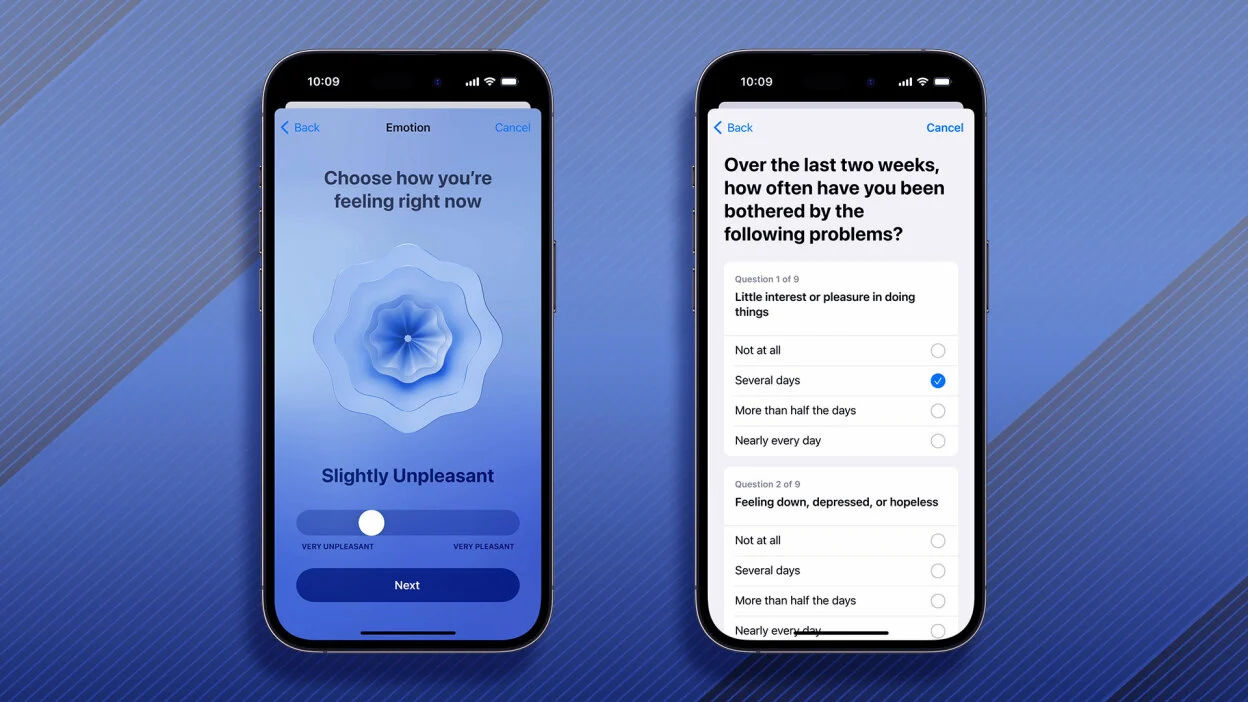
An image of two mobile phone screens.

Apple has a strong brand presence to cater to how it appeals to users. Apple’s Mental Wellbeing feature lets users journal their emotions and moods, and facilitates mental health self-assessments.

© Mashable composite; Shutterstock / i_fleur, Fair Use

Amazon is another prominent example of a brand that understands the importance of emotional design. With features such as one-click checkout and personalized product recommendations, Amazon creates an effortless shopping experience. Meanwhile, Amazon also provides their customers with a sense of convenience and satisfaction. Additionally, they offer excellent customer support, which helps build trust and confidence in the brand. 
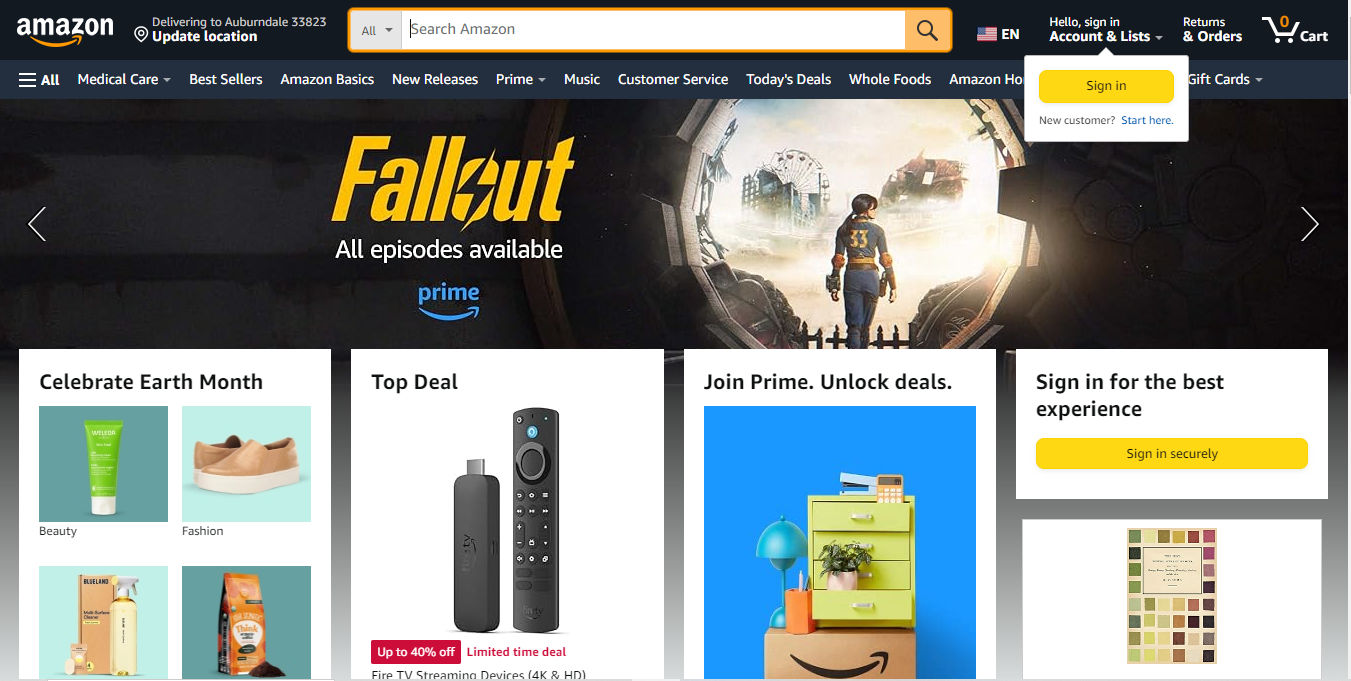
A screenshot of Amazon.com's home page.

Amazon appeals to a wide range of customers with its signature features such as one-click checkout and personalized sign-in experience.

© Amazon.com, Fair Use

How UX Designers Address Emotional Response

There are various strategies and techniques to create designs that resonate with users on an emotional level.  

Conduct User Research

UX research divides between quantitative research and qualitative research. UX research activities include interviews, surveys and usability testing. From solid research, designers can gain insights into users' emotional needs, preferences and pain points. Designers’ findings help them understand how users currently experience and respond emotionally to the product or service. From there, they can make informed design decisions to construct good user experiences in their UX design work. 

UX Strategist and Consultant, William Hudson explains user research in this video: 

Transcript
 

Apply the Principles of Emotional Design

Don Norman—the father of UX design—proposes these principles in his book Emotional Design: Why We Love (or Hate) Everyday Things. Norman suggests that emotional design can fit into three levels: visceral, behavioral and reflective.  

  1. Visceral level: This is about designing for immediate, instinctual emotional responses. It focuses on aesthetics, visual appeal and sensory elements that evoke emotional reactions in users. For example, product designers can use vibrant colors, engaging animations and pleasing visual layouts to create a positive visceral response.  

  1. Behavioral level: This is about designing for the emotional experience during interaction. When designers work at this level, they consider the users’ goals, motivations and the overall usability of the product. Designers aim to create seamless and enjoyable experiences that align with their users’ emotional needs and expectations.  

  1. Reflective level: This is about designing for the emotional impact and meaning that a product or service has on users after the interaction. It considers the users’ reflection, satisfaction and long-term emotional connection with the product. Designers aim to create a lasting positive impression and emotional attachment.  
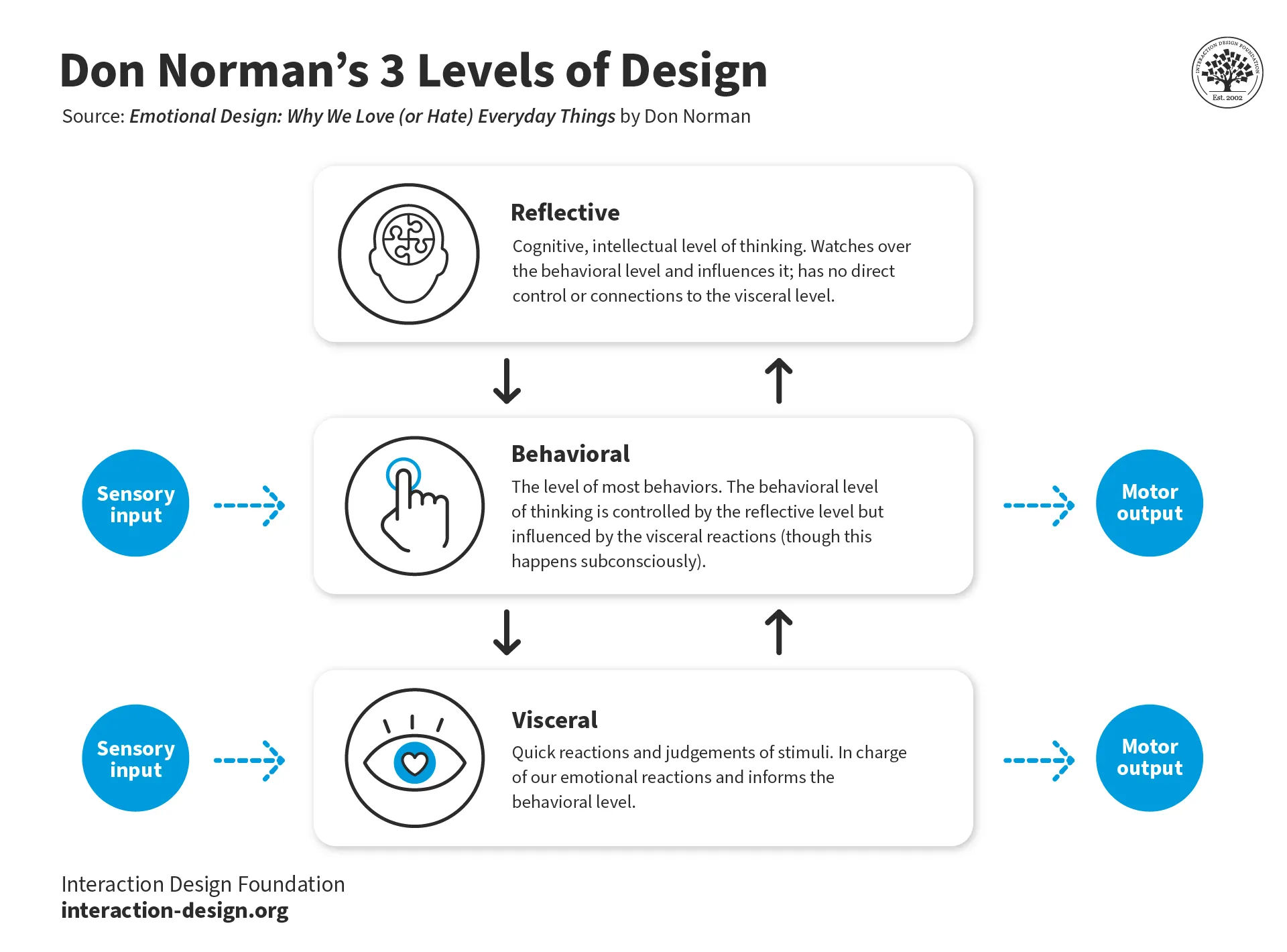
An illustration of Don Norman's 3 Levels of Design.

© Interaction Design Foundation, CC BY-SA 4.0

Use Personalization to Tailor the User Experience

Designers fine-tine products or services to individual users' preferences and behaviors. They might customize the content, layout or functionality of a product based on the user’s past behavior, preferences or demographic information. Designers can also use storytelling to evoke emotional responses. As they weave a compelling narrative into the design, they can engage users on a deeper emotional level and create a more memorable user experience. 

Frank Spillers explains the value of storytelling in this video: 

Transcript
 

Tips for How to Design for Positive Emotional Responses

Here are tips to help designers create experiences that evoke the desired emotional responses and leave a lasting impression on users:  

Understand the Users

Designers should conduct thorough user research to understand the target audience and their emotional needs. It’s also vital to understand the specific emotions that are most relevant to the product or service throughout the user flow or customer journey as individuals experience the brand.  

Create a Positive First Impression

Designers should pay attention to the visual aesthetics and overall user interface. That way, they can create a positive visceral response from users. Use colors, contrast, typography and imagery that align with the desired emotional tone. For instance, colors can evoke a range of emotions, from calm and trust (blue) to excitement and urgency (red). Similarly, high-contrast designs can grab users' attention and evoke a sense of excitement or urgency. 
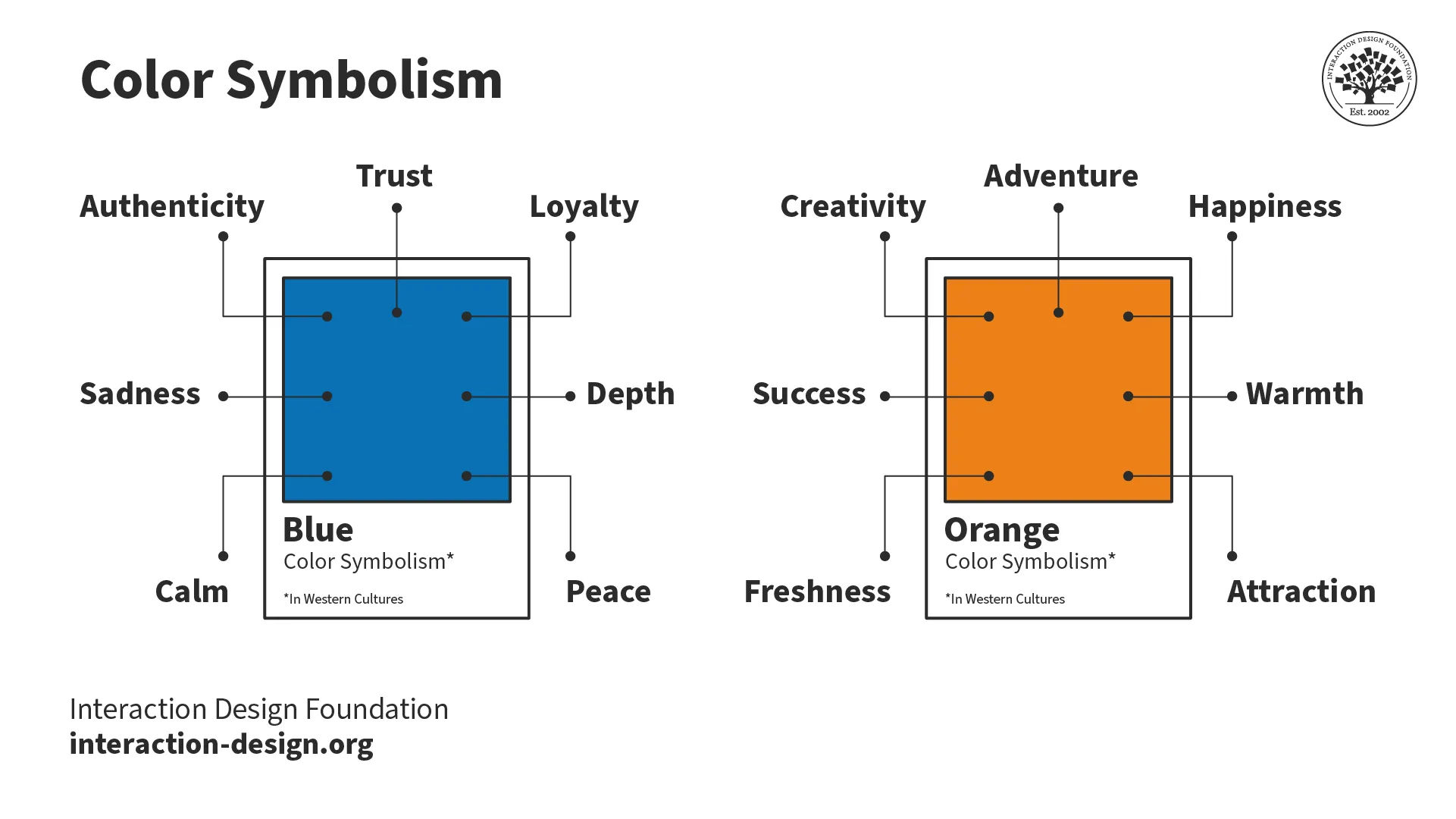
An illustration of two colored boxes, representing color symbolism.

Colors can symbolize a wide range of emotions, some of which will depend on the context and culture of the users.

© Interaction Design Foundation, CC BY-SA 4.0

Focus on Usability and Functionality

Designers must ensure that their designs are not only visually appealing but also usable and functional—and accessible. A seamless and intuitive user experience can evoke positive emotional responses.  

Professor Alan Dix explains the interplay between emotion and usability in this video: 

Transcript
 

Personalize the Experience

Bring the experience home to individual users. Provide personalized recommendations, content and interactions. This helps create a sense of connection and emotional engagement. For example, well-crafted microcopy—the small bits of text that guide users through an interface—can inject personality into a design. It can make it feel more human and relatable to users. This can evoke positive emotions. Users will tend to feel valued and understood—vital objectives of a UX design process.  

Use Microinteractions

Use small, delightful interactions throughout the user journey. These microinteractions can include animated buttons, subtle sounds and visual feedback that enhance the emotional experience.  

Tell a Compelling Story

Use storytelling techniques to engage users emotionally and create a memorable experience. Craft a narrative that aligns with the user's emotional journey and connects with their values and hopes.  

Evoke Empathy

Design with empathy: consider the user's emotions, needs and goals. It’s vital to show understanding and compassion through the design choices, content and interactions. Designers who weave empathy into their design work early on—through user personas, for example—can leverage empathy to great effect and have better results in user tests. 

This video explains how valuable empathy is in design: 

Transcript
  

Seek User Feedback

It’s important to continuously gather user feedback, to understand how the design resonates emotionally with users. Designers should use this feedback to iterate and improve the emotional experience.  

Test and Iterate

Conduct usability testing and gather feedback throughout the design process. That’s the way to identify any emotional pain points or areas for improvement. It’s important to iterate and refine the design based on user insights.  

Measure Emotional Impact

Designers should use qualitative and quantitative measures to assess their design’s emotional impact. It’s essential to conduct user interviews, surveys and emotional response assessments to gauge user satisfaction and emotional connection.  

Remember, emotions are a powerful tool in UX design and a central part of user-centered design. They’re also a vital gauge to estimate user behaviors and reactions. UX and UI designers should harness emotional design with insight and energy to ensure their brands excel at producing the most delightful experiences.  

When designers and other members of the design team, such as product managers, understand emotions, they can create user experiences that resonate and win in the marketplace. Also, when designers appreciate the nature and risk of negative emotions in various contexts, they can create products that wisely anticipate how users feel. User-friendly and delightful designs are the result of carefully informed decisions that come through in good visual design, specific features, information architecture and more.  

Questions About Emotional Response?
We've Got Answers!

Can designers measure emotional responses to their designs?

Designers can measure emotional responses to their designs. They use methods such as surveys, interviews, and physiological measures like heart rate or skin conductance to understand how people feel about a design. Eye tracking technology also offers insights into which elements capture attention and potentially evoke emotions. By combining these methods, designers gain valuable feedback that helps them create more engaging and effective designs. This approach ensures that designs not only look good but also connect with users on an emotional level, and enhance user experience and satisfaction. 

Take our Master Class Emotional Design: Evoke Emotional Responses Through Design with Susan Weinschenk, Chief Behavioral Scientist and CEO, The Team W, Inc., and Guthrie Weinschenk, COO, The Team W, Inc.

How can color psychology influence emotional response in design?

Color psychology significantly influences emotional responses in design. Different colors can evoke specific emotions and behaviors. For example, blue often creates a sense of calm and trust, making it a favorite for healthcare and finance industries. Red, known for its intensity, can trigger excitement or urgency, which is why sale signs often use it. 

 When designers understand color psychology, they can craft designs that not only attract attention but also resonate emotionally with the audience. This strategic use of color enhances user engagement, improves brand perception, and can even influence decision-making processes. When designers apply color psychology thoughtfully, they ensure their work not only stands out visually but also connects with viewers on an emotional level, and makes the design more effective and memorable. 

Take our Master Class How To Use Color Theory To Enhance Your Designs with Arielle Eckstut, Author and Co-Founder of The Book Doctors and LittleMissMatched, and Joann Eckstut, Color Consultant and Founder of The Roomworks. 

In what ways can typography impact a user's emotional response?

Typography can deeply affect a user's emotional response in several ways. First, the choice of font can convey a specific mood or feeling. For example, serif fonts often appear more traditional or formal, and evoke a sense of reliability. Meanwhile, sans-serif fonts might feel modern and approachable, and create a more relaxed atmosphere. Second, the size, spacing, and layout of text can impact readability and influence how comfortable users feel while reading. Comfortable reading experiences tend to foster positive emotions, whereas difficult or strained reading can lead to frustration. Third, the color of typography not only affects readability but can also carry emotional weight, similar to the broader impacts of color psychology in design. When designers consider these aspects, they can use typography to subtly guide users' emotional reactions, enhancing the overall effectiveness and user engagement of a design. 

Take our Master Class How To Communicate With Typography with Ellen Lupton, Writer, Designer, Curator and Educator.

How do A/B testing strategies incorporate emotional response analysis?

A/B testing strategies incorporate emotional response analysis by comparing two versions of a design to see which one elicits a more positive emotional reaction from users. Designers create two variants (A and B) with different emotional triggers, such as color schemes, imagery or messaging. They then measure users' reactions to each version using metrics like engagement rates, conversion rates and direct feedback through surveys or interviews. This process helps identify which elements contribute to a stronger emotional connection with the audience. By analyzing the emotional responses to each variant, designers gain insights into user preferences and behaviors. This allows them to refine their designs in a way that resonates more deeply with their target audience. This approach not only enhances user experience but also improves design effectiveness by aligning more closely with users' emotional needs and expectations. 

Take our Master Class Design with Data: A Guide to A/B Testing with Zoltan Kollin, Design Principal at IBM. 

What role does storytelling play in enhancing emotional response in design?

Storytelling plays a crucial role in enhancing emotional responses in design. It does so by creating a narrative that users can connect with on a personal level. When designers incorporate storytelling into their work, they invite users into a story, making the experience more memorable and engaging. This connection can evoke a wide range of emotions, from happiness and excitement to empathy and trust, depending on the story being told. Storytelling also helps in building a stronger relationship between the user and the brand, as it often conveys the brand's values and mission in a relatable way. By weaving storytelling into design, designers can transform a simple interaction into a compelling experience that resonates emotionally, and encourage deeper engagement and loyalty.

Take our Master Class The Power of Storytelling in UX with Fernando Marcelo Hereñu, Product and Design Manager at The Walt Disney Company. 

What techniques can increase emotional resonance through UX design?

To increase emotional resonance through UX design, designers employ several techniques. First, they use personalized content to make the user feel seen and understood. This includes tailored recommendations or greetings that use the user’s name. Second, designers create interactive elements that delight users, such as animations or micro-interactions, which make the experience feel alive and engaging. Third, storytelling elements are woven into the design to build a narrative that users can connect with emotionally. This could be through the use of visuals, text, or the overall layout that tells a story. Fourth, incorporating feedback loops, such as reactions or comments, allows users to share their feelings, making the experience more interactive and personal. Lastly, empathy mapping is a tool designers use to understand and address the emotional needs of their users better. By focusing on these techniques, designers can create more emotionally resonant UX designs that foster a deeper connection with users. 

Take our Master Class How To Design UX That Users Love To Convert Through with Talia Wolf, Founder, GetUplift. 

Are there specific metrics to track emotional engagement in digital products?

Yes, there are specific metrics to track emotional engagement in digital products. One key metric is user satisfaction, often measured through surveys like Net Promoter Score (NPS), which asks users how likely they are to recommend the product to others. Another metric is engagement rate, which looks at how actively users interact with the product, including time spent, clicks, and completion of key actions. Emotional engagement is also measurable through user feedback, collected via reviews, comments or direct feedback tools. Additionally, conversion rates can reflect emotional engagement by showing how effectively the product meets users’ needs and motivates them to take action. Finally, drop-off rates during the onboarding process or at specific features can indicate areas where the product fails to emotionally connect with users, guiding designers on where to make improvements. 

UX Strategist and Consultant, William Hudson explains why and when to use surveys, in this video: 

Transcript
 

Take our Master Class Emotional Design: Evoke Emotional Responses Through Design with Susan Weinschenk, Chief Behavioral Scientist and CEO, The Team W, Inc., and Guthrie Weinschenk, COO, The Team W, Inc. 

How can virtual reality (VR) enhance emotional engagement in design?

Virtual Reality (VR) enhances emotional engagement in design by creating immersive experiences that can evoke strong emotions. As it places users inside a simulated environment, VR allows them to interact with the design in a more personal and direct way. This immersion leads to a heightened sense of presence, and makes the experience feel more real and impactful. For example, VR can simulate environments or situations that trigger empathy, excitement or curiosity, and so deepens the emotional connection to the content. Additionally, VR's interactive nature encourages active participation, which further strengthens this emotional bond. If designers leverage VR, they can craft experiences that not only capture users' attention but also resonate with them on an emotional level, and so significantly enhance the overall impact of the design. 

Take our course UX Design for Virtual Reality

Are there cultural differences in how design evokes emotional responses?

Cultural differences play a significant role in how design evokes emotional responses. What resonates emotionally in one culture might not have the same effect in another. For instance, colors carry different meanings across cultures; red signifies good luck in China, but it can represent danger or love in Western cultures. Similarly, symbolism and imagery that evoke positive emotions in one cultural context might be neutral or even negative in another. This extends to typography, where the aesthetic appeal and legibility of certain fonts can vary significantly based on cultural familiarity and associations. Designers need to understand these cultural nuances to create designs that elicit the intended emotional responses from a diverse audience. When designers consider cultural differences, they can craft more inclusive and resonant experiences for users worldwide. 

Professor Alan Dix explains why it’s important to design with the users’ culture in mind: 

Copyright
Transcript

What are highly cited scientific articles on the subject of emotional response?

1. Hassenzahl, M., & Tractinsky, N. (2006). User experience - a research agenda. Behaviour & Information Technology, 25(2), 91-97.  

This seminal paper introduced the concept of user experience (UX) and its importance in human-computer interaction. It argued that UX goes beyond usability and encompasses the user's emotions, motivations, and overall experience with a product or system. The paper has been highly influential in shaping the UX research agenda and driving the field forward. 

2. Desmet, P. M. (2003). A multilayered model of product emotions. The Design Journal, 6(2), 4-13.  

This paper presents a comprehensive model for understanding the emotional responses users have towards products. It identifies different layers of emotional experience, including aesthetic, instrumental and symbolic emotions. The model has been highly influential in guiding research on emotional design and user experience. 

3. Mahlke, S., & Thüring, M. (2007). Studying antecedents of emotional experiences in interactive contexts. In Proceedings of the SIGCHI conference on Human factors in computing systems (pp. 915-918).   

This paper investigates the antecedents of emotional experiences in interactive contexts, focusing on the role of system qualities and user characteristics. It has been influential in advancing human understanding of the factors that shape emotional responses to interactive products and services.

What are highly regarded books on the subject of emotional response?

1. Norman, D. A. (2003). Emotional Design: Why We Love (or Hate) Everyday Things. Basic Books.  
Donald Norman's book on emotional design has been a landmark publication in the field. It explores how the emotional responses evoked by a product's design can significantly impact the user's experience and perception of the product. Widely cited for its insights into the role of emotion in user experience, Emotional Design: Why We Love (or Hate) Everyday Things has influenced researchers and practitioners. 

2. Csikszentmihalyi, M. (1990). Flow: The Psychology of Optimal Experience. Harper & Row.  
Csikszentmihalyi's book on the concept of "flow" has been highly influential in understanding the emotional and motivational aspects of user experience. It explores how the optimal balance between challenge and skill can lead to a state of deep engagement and enjoyment, which is a key consideration in designing engaging user experiences. 

Earn a Gift Earn a Gift, Answer a Short Quiz!

1
2
3
4
1
2
3
4
Question 1
Question 2
Question 3
Get Your Gift
Interaction Design Foundation logo

Question 1

Why are positive emotional responses important in UX design?

1 point towards your gift

  • They decrease the cost of production.
  • They increase user engagement and satisfaction.
  • They reduce the need for user research.
Interaction Design Foundation logo

Question 2

What are Don Norman's three levels of emotional design?

1 point towards your gift

  • Functional, practical and efficient
  • Visceral, behavioral and reflective
  • Visual, interactive and systemic
Interaction Design Foundation logo

Question 3

What is a significant challenge to design for emotional response?

1 point towards your gift

  • To guarantee that all users have the same emotional reaction
  • To predict user behavior based solely on functionality
  • To understand and predict a wide range of emotional responses

Learn More About Emotional Response

Make learning as easy as watching Netflix: Learn more about Emotional Response by taking the online IxDF Course Emotional Design — How to Make Products People Will Love.

Why? Because design skills make you valuable. In any job. Any industry.

In This Course, You'll

  • Get excited as you discover the secret to creating unforgettable products people love! Studies show that 95% of our purchasing decisions are emotional. Emotional design turns functionality into connection and products people want more of. Your favorite pen probably isn't the smoothest or fanciest, yet you chose it every time. Why? Because it's not just a pen. There's a connection, a feeling, and a story. That's what separates iconic products from mediocre ones. Emotional design uses timeless human-centered skills to create meaning, attachment, and trust, turning one-time users into lifelong advocates. These skills are paramount to turn AI from a tool into your new superpower, no matter how much the tech advances. You don't have to start from scratch. You'll build on your existing human skills like empathy, intuition, and storytelling.

  • Make yourself invaluable with design skills that tap directly into emotional decision-making. People naturally recommend and repeatedly use products that make them feel good. With your new emotional design skills, you'll effortlessly inspire action, build loyalty, and increase engagement, conversions, and retention. Whether you're a designer, marketer, or leader, this course gives you a timeless skill set to amplify your impact in any role.

  • Gain confidence and credibility as you master the hidden emotional triggers that make people fall in love with products. It's easier than you think, even if you're completely new to design. Use downloadable templates like the Hierarchy of User Experience (UX) Needs and the 5 Principles of Humanity-Centered Design to fast-track your learning. Directly apply Don Norman's three levels of emotional design—visceral, behavioral, and reflective—to create irresistible products. Leverage tools like Maslow's Hierarchy of Needs and the Triune Brain model to design experiences that win hearts and minds every time. 

It's Easy to Fast-Track Your Career with the World's Best Experts

Master complex skills effortlessly with proven best practices and toolkits directly from the world's top design experts. Meet your expert for this course:

  • Alan Dix: Author of the bestselling book “Human-Computer Interaction” and Director of the Computational Foundry at Swansea University.

Get an Industry-Recognized IxDF Course Certificate

Increase your credibility, salary potential and job opportunities by showing credible evidence of your skills.

IxDF Course Certificates set the industry gold standard. Add them to your LinkedIn profile, resumé, and job applications.

Course Certificate Example

Be in distinguished company, alongside industry leaders who train their teams with the IxDF and trust IxDF Course Certificates.

Our clients: IBM, HP, Adobe, GE, Accenture, Allianz, Phillips, Deezer, Capgemin, Mcafee, SAP, Telenor, Cigna, British Parliament, State of New York

All Free IxDF Articles on Emotional Response

Read full article
Emotion and Design - Article hero image
Interaction Design Foundation logo

Emotion and Design

Factors specific to the things we use in our everyday lives influence how we feel when we are using them. It is, therefore, the role of designers to both understand how we are affected by the products they design, and how they can be developed to (on a small scale) improve the associated user experi

Social shares
645
Published
Read Article
Read full article
Creating Emotional Connections - Article hero image
Interaction Design Foundation logo

Creating Emotional Connections

People form emotional connections and associations with the things they use and come across throughout their lives. These connections and associations help guide our behavior and determine how we perceive the world. Designers must grasp how to encourage emotional connections between users and their

Social shares
862
Published
Read Article

Creating Emotional Connections

Creating Emotional Connections

People form emotional connections and associations with the things they use and come across throughout their lives. These connections and associations help guide our behavior and determine how we perceive the world. Designers must grasp how to encourage emotional connections between users and their products. In order to influence emotions, you must have an understanding of general factors that impact all users, regardless of the product, and factors specific to your product.

Our experience of emotion is something we largely take for granted. For the most part, emotions are sensations, feelings, and physiological states that are not under our control. We experience emotion as a direct and immediate result of our involvement and interaction with the world. When someone walks through a door and lets it go in your face, you probably feel angry, and when you hold a door for others but they don’t say thank you, you likely feel the same emotion. Emotions are complicated, context-specific, and affected by our disposition, personality, and other personal factors (e.g., our relation to people), but we all know what is meant by 'Emotion'.

The Power of Emotion

When we talk to one another about how something made us feel, we don't have to explain what we mean by 'angry', 'sad', 'happy', 'anxious', 'excited', or any other word describing an emotional state. These words instantly arouse an understanding and, on occasion, similar physical and psychological sensations, which help us appreciate exactly how the other person feels or felt at some point in time. The human capacity for emotion informs, directs, and, to a large extent, determines our experience of the world, how we navigate it, and our relations with the things – both animate and inanimate – within it.

In the same way, we do not have to experience the exact same conditions as someone else in order to understand how he/she feels/felt, we can judge how our behavior or a particular scenario might make us feel, without actually having to engage in the act or being in that situation. This ability enables us to choose behaviors and make decisions, when interacting with our environment, which are advantageous or, at the very least, have minimal cost to us physically and/or mentally. At the most basic level of human behavior, we can say an action or event is most likely to be carried out or engaged in when there is a significant chance of experiencing a positive emotion, such as happiness, while it becomes increasingly less likely as the emotion becomes progressively more negative.

Emotional Associations and Connections

Emotions become associated with objects, things, places, time periods, and any other element in your life. Once we have formed an emotional association between an object/scenario/thing, etc. and a psychophysiological state, just by simply sensing (i.e. seeing, hearing, tasting, etc.) it again, the same emotion is often evoked. For example, you may have a toy or some other object from your childhood that has sentimental value; once you take it in hand, the same or similar emotions are evoked from your childhood. As a result, we become attached to and feel some emotional connection with the things that have featured in our lives. These emotional connections or associations can be powerful and enduring.

Creating Emotional Experiences

Designers are essentially striving to develop products that encourage the user to form these emotional connections and associations. From the materials, colors, textures, and other aesthetic qualities of a product to the adverts used to attract customers, attempts are being made to make people feel. Designers are not, on the whole, making their products a certain color because it is their own personal favorite or it matches the color of their eyes; it is a conscious decision based on human psychology. Likewise, advertisers are not using images of puppies, kittens, and attractive people for some arbitrary reason; they are trying to tap into the way you think and use things that induce an instant emotional response.

While many of our emotional connections and associations are specific to our world experience, products are designed to induce an emotional response in thousands, if not millions of people. In order to achieve such a feat, they must grasp a whole variety of factors – some general, some specific.

General factors include:

The way we think, learn, solve problems, make decisions, and simply consume information.

  • Human psychology

We are developing an ever-growing understanding of how things affect our emotions, including colors, sounds, music, shapes, people, faces, and a whole range of other elements. For the most part, human psychology is similar across most of the world's population, so designers can usually be pretty confident that their products will induce a similar emotional response from one person to another.

  • Culture

Users' cultural experiences influence cognition and psychology, so this is an extremely important factor to consider before developing a product or refining an existing product for a different culture. This could fall into the 'specific' consideration category, but releasing a product to a large potential user base involves generalization. Within each household, there are probably aspects that you might think represent a culture specific to that group of people, but designers would find it impossible to contend with all of these individual 'micro-cultures'. Therefore, designers must research and develop products according to the dominant culture, whilst remaining as sensitive to the specific 'micro-cultures' as possible in the final product.

Specific factors include:

  • Psychological and physical qualities specific to your particular user base

For example, someone developing products for arthritis sufferers must have an understanding of how this condition impedes mobility and flexibility. If the product demands that the user has to grip some part firmly or there is a specific shape requiring dexterity, this is likely to cause frustration, sadness and the product will probably sink without trace.

  • Dispositional factors

These refer to how the user is likely to feel at the time of using a particular product. For example, someone using a touchscreen train ticket machine will probably be in a hurry. The design of the machine and its interface needs to reflect the users' desire for speed, ease of use, and clear instructions to help them through the process. To further this example, the machine may also likely be used by tourists. The ability to switch the interface language easily from any state of the interface is crucial (some people simply abandon the process mid-way without returning to the main menu!). Think about the wording in the interface – the machine may be used by people from varied educational backgrounds, so you must avoid any text that includes jargon or complicated terminology. Your users may also span all age groups. You may consider the colors, include helpful animations and pleasant sounds that accompany visual feedback, and provide eye-catching and clear large fonts to ensure that everyone is encouraged to use the machine.

Where will the product be used? How will the product fit into the user's life? Does the product work in combination or next to other things found in the user's work set-up? If your product will be used in an area with restricted space, making it large, cumbersome or an odd shape will probably infuriate the users and impede their productivity (this also applies to screen space, not just physical space!). When the product is meant to mobilize the user (i.e. it can be used in various environments and places), as the designer you must ensure it is sensitive to the variety of conditions in which it will be used (e.g., different light conditions, public situations where discreetness is required, and the effects of motion on usability).

For each new product, there are usually other factors to consider, but the general and specific factors outlined above are usually certainties. A good example of the application of these factors to designing digital products can be found in the work of Katie Bessiere, a researcher at Carnegie Mellon University and her colleagues (2006). They found that situational and dispositional factors play a major role in the emergence of frustration during work carried out using computers.

The Take Away

People form emotional connections and associations with the things they use and come across throughout their lives. These connections and associations help guide our behavior and determine how we perceive the world. As designers, we must grasp how to encourage emotional connections between users and our products. In order to influence emotions, you must have an understanding of general factors which impact on all users, regardless of the product, and factors specific to your product. It’s the only way to make your designs relevant and catapult them soundly into the context of the users, wherever and whenever they may access them.

References & Where to Learn More

Hero Image: Copyright Holder: Coxblue.com Copyright terms and license: Fair Use.

Bessiere, K., Newhagen, J. E., Robinson, J. P., & Shneiderman, B. (2006). A model for computer frustration: The role of instrumental and dispositional factors on incident, session, and post-session frustration and mood. Computers in human behavior, 22(6), 941-961.

Feel Stuck?
Want Better Job Options?

AI is replacing jobs everywhere, yet design jobs are booming with a projected 45% job growth. With design skills, you can create products and services people love. More love means more impact and greater salary potential.

At IxDF, we help you from your first course to your next job, all in one place.

See How Design Skills Turn Into Job Options
Privacy Settings
By using this site, you accept our Cookie Policy and Terms of Use.
Customize
Accept all

Be the One Who Inspires

People remember who shares great ideas.

Share on:

Academic Credibility — On Autopilot

Don't waste time googling citation formats. Just copy, paste and look legit in seconds.