Plutchik’s Wheel of Emotions

Putting Some Emotion into Your Design – Plutchik’s Wheel of Emotions

• 7 min read

1,121 Shares

Emotional design is a big buzz word within the UX community. Designs which tap into the user’s emotions are considered to do more than just respond to their stated needs and provide a greater level of user experience. One way of understanding emotions is Plutchik’s Wheel of Emotions – this may help you deliver better experiences to your users when designing products.

Products that people love are products that people use over and over again. Products that they like, on the other hand, quickly slip from the user’s mind and are replaced in time with products that are liked better or even loved. The corner stone of emotional design is the idea that if you can elicit strong emotions in your users – you can use those emotions to either create loyalty or to drive a customer to take action.

Robert Plutchik, was a thought leader in the study of emotions. Before he passed away in 2006 he was responsible for 8 books (and editing another 7), nearly 300 articles, and 45 chapters in emotional research as a psychologist. He held a doctorate degree as well as positions at the professorial level at two respected universities.

Plutchik’s Psycho-evolutionary Theory of Emotion

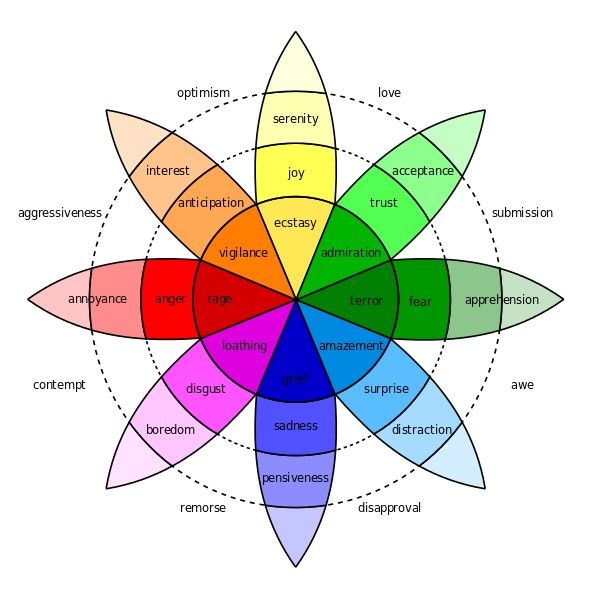
Robert Plutchik devised the psycho-evolutionary theory of emotion and this helps categorize emotions into primary emotions and the responses to them. He argued that the primary emotions are an evolutionary development and that the response to each such emotion is the one that is likely to deliver the highest level of survival possibility.

Author/Copyright holder: Machine Elf 1735. Copyright terms and licence: Public Domain.

He posited 10 points with regard to emotion:

  • Emotions are found at all evolutionary levels of species. They are equally applicable to all animals as they are to human beings.

  • Emotions evolved differently in different species and may be expressed differently between those species.

  • The purpose of emotions is an evolutionary survival response enabling the organism to survive when confronted by environmental challenges.

  • While emotions can be displayed and evoked through different mechanisms in different organisms there are common elements to emotions that can be identified across all emotional animals.

  • There are 8 basic, primary emotions.

  • Other emotions are simply a combination of these 8 basic emotions or are derived from one (or more) of these basic emotions.

  • Primary emotions are “idealized” and their properties must be inferred from evidence but cannot be accurately stated in full.

  • Each primary emotion is paired with another and is a polar opposite of that pair.

  • Emotions can and do vary in degrees of similarity to each other.

  • Emotions exist in varying degrees of intensity.

The 8 basic emotions that Plutchik devised were:

  • Anger

  • Disgust

  • Fear

  • Sadness

  • Anticipation

  • Joy

  • Surprise

  • Trust

The Wheel of Emotion

From this initial emotional theory Plutchik then developed a Wheel of Emotion. It was designed to help the user understand the nuances of emotion and how emotions contrast with each other. He developed both 2 and 3 dimensional models for this. The 3D model is the “cone-shaped model of emotion”. They were first described back in 1980.
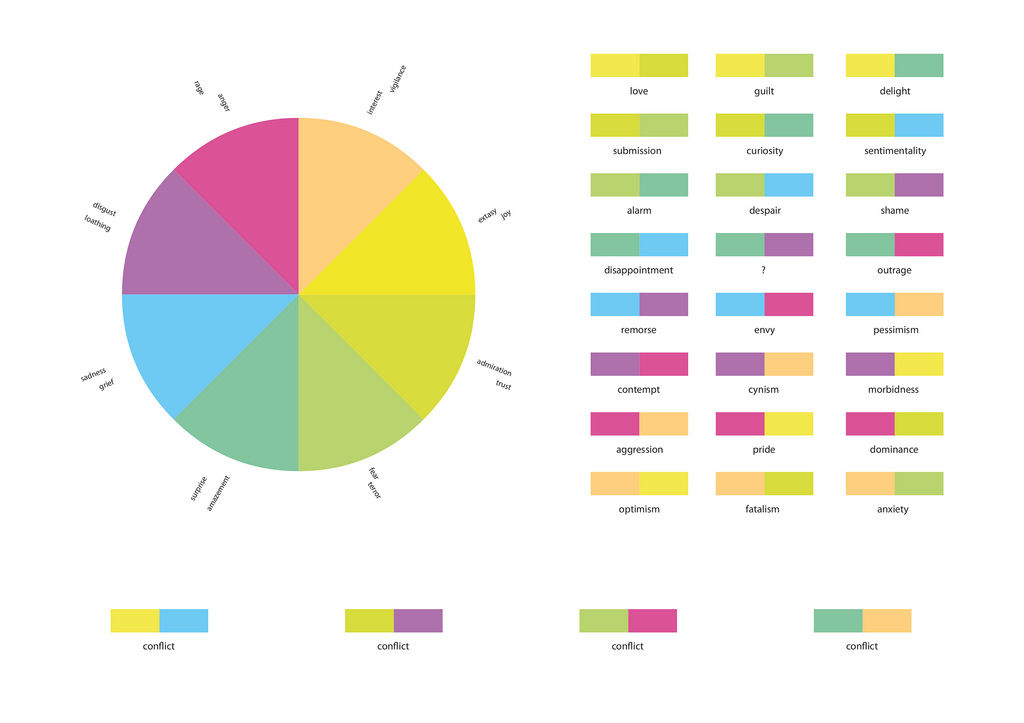
Author/Copyright holder: xdxd_vs_xdxd. Copyright terms and licence: CC BY-SA 2.0

The wheel can be used by designers to examine the complexities of emotion and to act as a “colour palette” for emotional design – with the idea being that blending different emotions will create different levels of emotional response and intensities of that response.

The wheel is a simple model and there are almost certainly additional emotional inferences that could be drawn from a more complex model – however, it focuses on the basic emotions that most designers are likely to want to elicit in their users and as such provides a useful starting point.

Basic Emotional Pairs on

The basic emotional pairs are as follows:

  • Joy and Sadness

  • Trust and Disgust

  • Fear and Anger

  • Surprise and Anticipation

Emotions on Plutchik’s wheel may be combined as follows:

  • Anticipation + Joy = Optimism (with its opposite being disapproval)

  • Joy + Trust = Love (with its opposite being remorse)

  • Trust + Fear = Submission (with its opposite being contempt)

  • Fear + Surprise = Awe (with its opposite being aggression)

  • Surprise + Sadness = Disapproval (with its opposite being optimism)

  • Sadness + Disgust = Remorse (with its opposite being love)

  • Disgust + Anger = Contempt (with its opposite being submission)

  • Anger + Anticipation = Aggressiveness (with its opposite being awe)

Criticisms of Plutchik’s Model

The biggest criticism of this model is its failure to take into account the pairing of Pride and Shame. These are emotions which designers often play to. For example, gamification efforts may attempt to tap into a user’s pride through leaderboards or badges. Conversely charitable and campaigning organizations may try to tap into shame to encourage action.

It is also often felt that the model is too simplistic and that there are greater emotional nuances not captured within it.

However, it is generally agreed that the Wheel of Emotion is a good starting point when considering what emotions a design may elicit. It does not prevent the UX designer from looking for additional tools to aid in emotional design.

The Take Away

The Wheel of Emotion is a useful tool to get UX designers thinking about how they may elicit certain emotions through their product design. It is not considered to be a complete emotional design toolkit and may be too simplistic for some situations and may neglect other strong emotions completely.

References

Course: “Emotional Design — How to Make Products People Will Love”

You can find several emotional models here on Wikipedia here.

You can find some great ideas for emotional metrics for emotional design at Smashing Magazine here.

UX Review looks at emotional mapping for design here.

Hero Image: Author/Copyright holder: shellgreenier. Copyright terms and licence: CC BY-NC-ND 2.0

Learn More in This Course:

Visual Design: The Ultimate Guide

1
3
53
56
91 % booked
View Course

What You Should Read Next

  • Read full article
    What is Interaction Design? - Article hero image
    Interaction Design Foundation logo

    What is Interaction Design?

    Interaction design is an important component within the giant umbrella of user experience (UX) design. In this article, we’ll explain what interaction design is, some useful models of interaction design, as well as briefly describe what an interaction designer usually does.A simple and useful unders

    Social shares
    1.5k
    Published
    Read Article
  • Read full article
    Apple’s Product Development Process – Inside the World’s Greatest Design Organization - Article hero image
    Interaction Design Foundation logo

    Apple’s Product Development Process – Inside the World’s Greatest Design Organization

    Apple’s Product Development Process may be one of the most successful design processes ever implemented. With a valuation that exceeds $2 trillion, there’s a lot that designers can learn from Apple and introduce into their own design environments.Apple is a notoriously secretive business. In Steve J

    Social shares
    1.4k
    Published
    Read Article
  • Read full article
    Shneiderman’s Eight Golden Rules Will Help You Design Better Interfaces - Article hero image
    Interaction Design Foundation logo

    Shneiderman’s Eight Golden Rules Will Help You Design Better Interfaces

    Follow Ben Shneiderman’s 'Eight Golden Rules of Interface Design' if you want to design great, productive and frustration-free user interfaces. Apple, Google and Microsoft are among some of the highly successful companies whose well-designed products reflect Shneiderman’s rules. The characteristics

    Social shares
    1.4k
    Published
    Read Article
  • Read full article
    How to Change Your Career from Graphic Design to UX Design - Article hero image
    Interaction Design Foundation logo

    How to Change Your Career from Graphic Design to UX Design

    If there’s an occupation that is 100% linked with the public’s idea of what design is all about, it’s graphic design. From the familiar golden arches of the McDonald’s brand to the typography and colors of movie posters, graphic designers create some of the most iconic and ubiquitous designs around

    Social shares
    1.4k
    Published
    Read Article
  • Read full article
    The Grid System: Building a Solid Design Layout - Article hero image
    Interaction Design Foundation logo

    The Grid System: Building a Solid Design Layout

    Now that we’ve seen some grids at work in the Rule of Thirds article, let’s examine them a little more deeply. As a concept that deals so fundamentally with the fabric and background of our work as designers, it’s easy to overlook the power of grids and think more about the elements we want to creat

    Social shares
    1.4k
    Published
    Read Article
  • Read full article
    The Principles of Service Design Thinking - Building Better Services - Article hero image
    Interaction Design Foundation logo

    The Principles of Service Design Thinking - Building Better Services

    Service design is all about taking a service and making it meet the user’s and customer’s needs for that service. It can be used to improve an existing service or to create a new service from scratch. In order to adapt to service design, a UX designer will need to understand the basic principles of

    Social shares
    1.4k
    Published
    Read Article
  • Read full article
    A Simple Introduction to Lean UX - Article hero image
    Interaction Design Foundation logo

    A Simple Introduction to Lean UX

    Lean UX is an incredibly useful technique when working on projects where the Agile development method is used. Traditional UX techniques often don’t work when development is conducted in rapid bursts – there’s not enough time to deliver UX in the same way. Fundamentally Lean UX and other forms of UX

    Social shares
    1.3k
    Published
    Read Article
  • Read full article
    Dieter Rams: 10 Timeless Commandments for Good Design - Article hero image
    Interaction Design Foundation logo

    Dieter Rams: 10 Timeless Commandments for Good Design

    Let’s pay a virtual visit to a famous industrial designer’s workshop. By examining the principles of his winning approach, we can incorporate vital elements into our designs in the “less is more” age.As user experience practitioners, most of us have worked with Nielsen and Molich’s 10 heuristics or

    Social shares
    1.3k
    Published
    Read Article
  • Read full article
    The 7 Factors that Influence User Experience - Article hero image
    Interaction Design Foundation logo

    The 7 Factors that Influence User Experience

    User Experience (UX) is critical to the success or failure of a product in the market but what do we mean by UX? All too often UX is confused with usability which describes to some extent how easy a product is to use and it is true that UX as a discipline began with usability – however, UX has grown

    Social shares
    1.3k
    Published
    Read Article
  • Read full article
    10 Free-to-Use Wireframing Tools for UX Designers in 2026 - Article hero image
    Interaction Design Foundation logo

    10 Free-to-Use Wireframing Tools for UX Designers in 2026

    Wireframes help you quickly ideate and test your ideas. While paper wireframes are the fastest to create, digital wireframes look more polished and presentable. If you are looking for a pocket-friendly wireframing tool, look no further.Whether you prefer browser-based apps or offline desktop tools,

    Social shares
    1.3k
    Published
    Read Article

Top Articles

Top Topic Definitions

Feel Stuck?
Want Better Job Options?

AI is replacing jobs everywhere, yet design jobs are booming with a projected 45% job growth. With design skills, you can create products and services people love. More love means more impact and greater salary potential.

At IxDF, we help you from your first course to your next job, all in one place.

See How Design Skills Turn Into Job Options
Privacy Settings
By using this site, you accept our Cookie Policy and Terms of Use.
Customize
Accept all

Be the One Who Inspires

People remember who shares great ideas.

Share on:

Academic Credibility — On Autopilot

Don't waste time googling citation formats. Just copy, paste and look legit in seconds.

Feel Stuck? Want Freedom?

Join 326,689+ designers who get one powerful email each week. Learn to design a life you love.

Next email in
0
days
15
hrs
53
mins
57
secs

Free forever. No spam. Unsubscribe anytime.