It’s a common mistake for businesses to seek brand new market places. After all, a lack of competition can only be a good thing, right? Unfortunately, there are two problems with this approach – a lack of an established market can be a strong indicator of a lack of demand for a product and secondly, an un-established market will often require huge financial resources to educate potential buyers as to why they need something from this new market.
In fact, competition is a healthy sign of established demand for a product or service and can, in many ways, be beneficial for a new product. However, competition also often delivers new barriers to entry to a market place and there are many other sources that may create barriers to market entry as well.
McAfee, Mialon and Williams in their paper; “What is a barrier to entry?” published in The American Economic Review quote George Stigler who says that a barrier to entry is; “A cost of producing which must be borne by a firm which seeks to enter an industry but is not borne by firms already in the industry.”
The same authors quote Franklin M Fisher in their paper, “Economic and Antitrust Barriers to Entry,” who says that a barrier to entry is; “anything that prevents entry when entry is socially beneficial.”
However you define a barrier to entry to a market place; it must be overcome before your products can be adopted by your users and customers.
Let’s take a look at some common barriers to market entry for products and firms to new markets:
Common Barriers to Market Entry
Advertising and Marketing
Established brands often have larger budgets for advertising than new arrivals in a market place; this can enable them to “crush” new entrants by spending heavily on marketing and thus drowning out the message from the new entrant. Potential customers will also be more exposed to these established brands and thus may regard the new brand with suspicion.
It is important for new entrants to a market to carefully consider how they will approach the market and what the cost may be; before they commit to entering that market.

Author/Copyright holder: Albert Bridge. Copyright terms and licence: CC BY 3.0
Capital Costs
One of the most common barriers to entry for new players is the cost of entering a market. The equipment they use to make their products, the buildings they make them in and work from, and the raw materials all incur costs. In some markets the capital costs prevents all but a handful of possible new players from entering. Consider the capital costs, for example, in establishing a new telecoms network – billions of dollars of investment dramatically reduces the opportunities to start up your own operator.
Monopolization of Resources
In some instances the very resources needed to produce the finished product are tied up with a single producer or producers. China has effectively dominated solar panel production this way by ensuring that Chinese firms are given priority access to the raw silicon; a product that China has a near (but not total) monopoly on producing.
Cost Advantages (excluding economies of scale)
Established players in a market may have competitive access to raw materials or strong geographic locations which enable cheaper production of goods. They may also have developed or licensed proprietary technologies that make it more expensive for a new entrant to produce similar goods. They are also likely to have the experience to reduce production costs that a new entrant may lack.
Customer Loyalty
Nearly every year a new type of Cola is introduced to the global market and nearly every year this Cola either fails or quickly becomes a niche product in its local market. Pepsi and Coca-Cola have a near monopoly on the cola market and this is mainly due to customer loyalty. Well-established, strong brands have a large advantage with strong customer loyalty.
Distribution
Both distributors and retailers in certain sectors may either be contractually prohibited from doing business with competing businesses by contracts with existing businesses or may be highly incentivized for doing so. This can make it difficult for a new market entrant to get their products in front of customers in order for them to adopt them.
Economies of Scale
Economies of scale benefit large, established players in a market because they buy large volumes of raw material and intermediary products – they get them at a preferential price. This may make it difficult for new entrants to a market to produce goods as cheaply as the established players. In some cases, technological advances can quickly eliminate economies of scale. Today, computing power, for example, is available to nearly all businesses - 50 years ago only industrial giants could afford access to such an advantage.
Regulatory Barriers
Governments take a strong interest in certain market sectors and new entrants may be required to jump through a lot of legal hoops before they can enter a market. Licenses, permissions, compliance, etc. all add additional financial and administrative burdens to new entrants to a market.
Inelastic Demand
Many new entrants to a market will try and adopt a cheaper pricing strategy to persuade customers to defect from existing competition. This can be a mistake if the demand for a product comes from price insensitive customers. Cigarette smokers are a good example of price insensitive consumers – increased taxes generally do not discourage smoking but increase revenues for governments. Cigarette smokers also tend to be “brand loyal” and a discount will not necessarily encourage a change of brand.
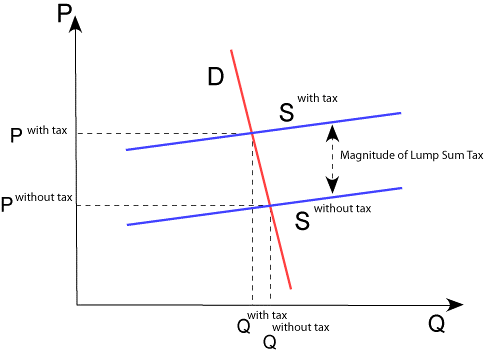
Author/Copyright holder: Mgunn. Copyright terms and licence: Public Domain.
Intellectual Property
You only have to witness Apple and Samsung slugging it out in the courts to realize that even big companies have issues with intellectual property when entering new markets. Patents, copyright, trademarks, etc. can be costly to obtain, market and protect. When the intellectual property required to succeed is owned by a competitor – it may be costly to appropriate driving up production prices.
Network Resistance
If a new product requires a network of customers to succeed; existing network may be hard/impossible to break into. Think Google + trying to break into social networking and having to tackle the established dominance of Facebook.
Predatory Pricing Effects
Larger companies may abuse their resources in order to significantly undercut new entrants to a market. This is sometimes referred to as “loss leading”. This makes it impossible for a new entrant, with shallower financial resources, to compete. Technically, this practice is illegal in most jurisdictions but in reality it can be very difficult and time consuming to prove and this can drive a new entrant out of business before the matter is resolved legally.
Restrictive Practices
Many airlines have agreements that allow them to dictate the allocation of landing slots at airports. This in turn makes it difficult for a new airline to establish themselves because of difficulty in obtaining landing slots. This is a restrictive practice and again may be illegal in some jurisdictions; once again – having the time and money to enforce this is a luxury not afforded to all new entrants.
Sunk Costs
If it costs a lot of money to enter a market and that money is not recoverable should the entrant try to leave the market (following failure to gain adoption from users/customers) – it is a barrier to entry as it dramatically increases the risks involved in market entry.
Switching Impedance
The harder it is to change from one supplier to another; the less likely they will change. For a long time banks were big beneficiaries of this practice; moving accounts required a painful manual process of visiting a branch, opening a new account, making written instructions for all existing instructions to be replaced, then visiting the branch of the old bank and repeating the process. Now that this process, in many places, is painless and electronic – more customers change banks.
Tariffs and Taxes
Some markets are protected by tariffs established on entrants from outside of that jurisdiction. Other jurisdictions offer tax regimes which are highly beneficial to large established players which cannot be exploited by newer, smaller market entrants.
 Author/Copyright holder: Images Money. Copyright terms and licence: CC BY 2.0
Overcoming Barriers to Market Entry
It is impossible to offer a single strategy or strategies to overcoming the barriers to market entry. However, barriers should be identified prior to product development taking place and strategies determined to overcome these barriers before any significant investment in development.
Failure to understand how to overcome the barriers to market entry may result in a failure for the market to adopt your products and ultimately may even cause the business to fail.
The Take Away
Barriers to market entry are challenges to be overcome if you want to enter a market and succeed. You need to decide what barriers lie in the way of your market entry very early in the product development/design process and understand how you intend to overcome such barriers.
As Charles Eames, the famous designer once said; “The details are not the details. They make the design.”
References & Where to Learn More
Course: Psychology of E-Commerce: How to Sell Online
What Is a Barrier to Entry? R. Preston McAfee, Hugo M. Mialon and Michael A. Williams The American Economic Review Vol. 94, No. 2, Papers and Proceedings of the One Hundred Sixteenth Annual Meeting of the American Economic Association San Diego, CA, January 3-5, 2004 (May, 2004), pp. 461-465
Economic and Antitrust Barriers to Entry, 2003, R. Preston McAfee, Hugo M. Mialon and Michael A. Williams
Hero Image: Author/Copyright holder: Pixabay. Copyright terms and licence: Free to Use.