Research can be compared to interacting with the ocean. On the surface, we may see calm beauty or turbulence; however, we can only fully understand the bigger picture once we submerge ourselves and go much deeper. In order to gain a holistic, empathic understanding of our users and the problem we are trying to solve, we need to question everything, even things that we think we know the answers to.
What Kind of Dive?
Working with the metaphor of diving and water, let's consider the following information-gathering techniques or missions. These may be based on the requirements of the occasion, or on the confidence of the actors.
Watch the surface for clues
Fish for something below the surface
Go for a little dip to see what's below
Snorkel to see what's going on down there
Deep sea dive to explore the deeper wonders
Dive into the unknown, submarines and all, to discover never before seen treasures
 Author/Copyright holder: kbossey. Copyright terms and licence: CC BY-ND 2.0
Take a deep breath and immerse yourself in your user’s environment and lives.
Design Thinking Has Its Own Systems and Subjects of Analysis
Idris Mootee, CEO of international strategic innovation firm Idea Couture, cautions in his book, Design Thinking for Strategic Innovation, that we should not consider Design Thinking’s and ethnographic research methods of gathering information as the antithesis of analytical data-driven thinking. He argues in his book, which focuses on the application of Design Thinking within a more strategic business setting, that Design Thinking has its own mode of analysis, with a focus more weighted towards relationships, behaviour, and human interaction.
Mootee lists seven areas in which Design Thinking aims to analyse, using its own unique methods of enquiry and data collection, so as to determine:
How a product, service, system, or business currently lives in an ecosystem.
How people interact with the above, and the nature, frequency, and attributes of that interaction.
How the different elements in the ecosystem relate to one another and if any systems-level impacts exist.
What other ecosystems exist adjacent to your ecosystem.
How new insight may be gained by looking broadly at communicative events within these ecosystems and how they fit together from a systems perspective.
What the key characteristics and patterns of behaviour of new relationships are when viewed from a systems level.
What the patterns of people's information behaviours are and how to map them visually to make sense of them.
Bestselling author and expert in design, creativity and innovation, Marty Neumeier, in his book MetaSkills, shares a similar set of areas for innovation. These areas for innovation, derived from a study by the global innovation firm Doblin, are:
The business model, or how the enterprise makes money.
Networking, including organizational structure, the value chain, and partnerships.
Enabling processes, or the capabilities the company buys from others.
Core processes, or the proprietary methods that add value.
Product performance, including features and functionality.
Product systems, meaning the extended system that supports the product.
Service, or how the company treats customers.
Channels, or how the company connects its offerings to its customers.
Branding, or how the company builds its reputation.
Customer experience, including the touch points where customers encounter the brand.
From the above lists of possible focus areas, it is clear that we need to dig deeper into the problems we are trying to solve in order to better understand where value may be needed, and from where we can extract the maximum value.
IDEO got its very aptly named Deep Dive method in this exploration which is now owned and implemented at Deloitte, the parent company of the Doblin Group.
Hunting for a Scent
Like our hunting ancient ancestors exploring the surrounding territory for clues of target prey, we too are hunters and gatherers, but of a different kind. As designers, we're constantly on the prowl, seeking to uncover new signs and signals that lead to making a catch.
We need to hone our skills at picking up strong signals, which may require urgent action, or weak signals that indicate an opportunity or threat in the near future. We need to immerse ourselves in the environment around us, and block out the background noise in order to pick up those key signals that will lead to a breakthrough.
The Purpose of Gathering Information
The purpose of gathering data is not merely to obtain a quantity of research data, but to study what comes out of the data, be it broad or deep. The purpose of gathering data is to extract insights that will inform us of the path ahead, and for us to gather the right amount and quality of information for our intended purpose. As a designer, you can gather two types of research data:
Quantitative – breadth of data: statistics, demographics, analytics, surveys, and customer feedback forms
Qualitative – depth of insight: exploratory, focus groups, interviews, observations, photo/video journals, photo/video user-based studies
At times, you may need to rely more on quantitative data and less on qualitative data. Each challenge will require a different research focus and will be based on the sought outcome type.
Quantitative research involves a scientific and statistical approach. As such, you should use quantitative research to understand an average of factors. It can provide insights in terms of the choices and behaviours that the majority of people take, but it is unable to verify the exact reasoning or human factors motivating these decisions. Qualitative research, however, attempts to understand the human and social phenomena much more deeply, on a case-by-case basis. However, it may not provide a wide enough view of things. You should use the two types of research in tandem, with varying degrees of emphasis, depending on the types of insight required.
The Importance of Primary Immersion
Some people refer to the initial data-gathering phase as immersion or primary immersion, a necessary kick-start process in which those embarking on the Design Thinking journey take a "deep dive" into the challenge space and everything associated with it.
Becoming deeply familiar with the information allows the serendipitous connections and insights to form more easily in the minds of the Design Thinking team. It's about familiarising the mind with the available stimuli and then setting the scene for disrupting the data in new and unconventional ways that may reveal new patterns.
The Five Whys Method
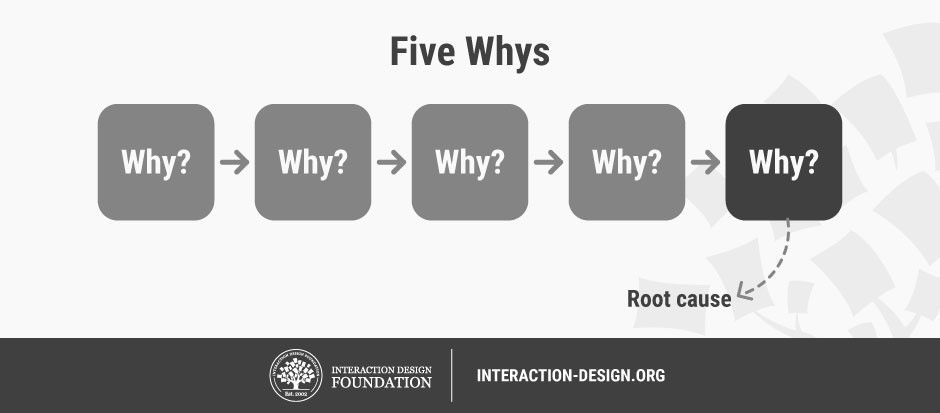 Author/Copyright holder: Teo Yu Siang and Interaction Design Foundation. Copyright terms and licence: CC BY-NC-SA 3.0
The Five Whys is an iterative interrogation technique used to uncover the root causes of problems. Getting past the superficial understanding of what needs to be solved and addressing problems at the root is a more holistic way of ensuring that the solution actually works at the appropriate level, and the Five Whys method can help you in achieving that. Quite simply, the Five Whys method necessitates you to ask your interviewee “Why?”—repeatedly—in order to dig deeper and arrive at the root causes of needs, emotions, and behaviours.
The Five Whys method is a technique developed by Sakichi Toyoda, the Japanese inventor and industrialist who founded Toyota Industries, and Taiichi Ohno, who is considered to be the father of the Toyota Production System. Toyota implemented this technique as part of its manufacturing methodologies in order to reveal root causes of problems within the manufacturing system.
The technique has since been adopted into a wide range of problem-solving methodologies because of its simplistic nature and adaptability.
An example often used by Taiichi Ohno goes as follows:
1. "Why did the robot stop?"
The circuit has overloaded, causing a fuse to blow.
2. "Why is the circuit overloaded?"
There was insufficient lubrication on the bearings, so they locked up.
3. "Why was there insufficient lubrication on the bearings?"
The oil pump on the robot is not circulating sufficient oil.
4. "Why is the pump not circulating sufficient oil?"
The pump intake is clogged with metal shavings.
5. "Why is the intake clogged with metal shavings?"
Because there is no filter on the pump.
Drilling down into your problems is a good way to prepare for the appropriate framing of the challenge at hand. Even if you won't directly be tackling the core issue, understanding what it is helps address the level you're working on with a much deeper understanding.
The Take Away
Most of what we can see at the first glance about a problem is only what’s on the surface. In order to create solutions that truly impact our users, however, we need to dig deep into the root of the problem, and the drivers, needs, and motivations of our users. In other words, we should question everything. We should gather information — both quantitative and qualitative — and use what we have learnt to inform our problem-solving process. Lastly, the Five Whys method is a simple but extremely useful way to get to the root of a problem or issue.
References & Where to Learn More
Idris Mootee, Design Thinking for Strategic Innovation: What They Can't Teach You at Business or Design School, 2013
Learn more about the difference between quantitative and qualitative research in this YouTube video by Android Developers: UXD: LeanUX Measurement - Qualitative and Quantitative here.
Hero Image: Author/Copyright holder: Jonathan Simcoe. Copyright terms and licence: CC0