Several girls sitting on the floor collaborating and building something together.

Stage 5 in the Design Thinking Process: Test

by Rikke Friis Dam and Yu Siang Teo • 9 min read

1,103 Shares

We employ a wide range of testing methods during the design thinking process, many of which are also used in human-computer interaction (HCI) and user-centered design (UCD) processes. At the heart of these methods is the need to test our solutions so that we can improve them. User feedback is priceless—without it, the iterative design process will fail. Therefore, you must seek feedback whenever possible, use real people in your tests and analyze results to determine what is right (and wrong) with your design. That’s how you can create a solution that is desirable to people, feasible to implement and viable for long-term success.

You should conduct tests throughout the design thinking process. Tests go hand in hand with prototypes, since you will most often test your prototypes with users. Given that, you should constantly create prototypes—start with low-fidelity ones and move to higher-fidelity ones as you progress—and test them with users. When you test your ideas and prototypes with users, you gain a deeper understanding of your users and also gain their feedback to improve your designs.

In fact, the Test stage of the design thinking process often feeds into other stages: your findings allow you to empathize and gain a better understanding of your users; it may lead to insights that change the way you define your problem statement; it may generate new ideas to solve the user problem; and, finally, it helps you improve your prototype.
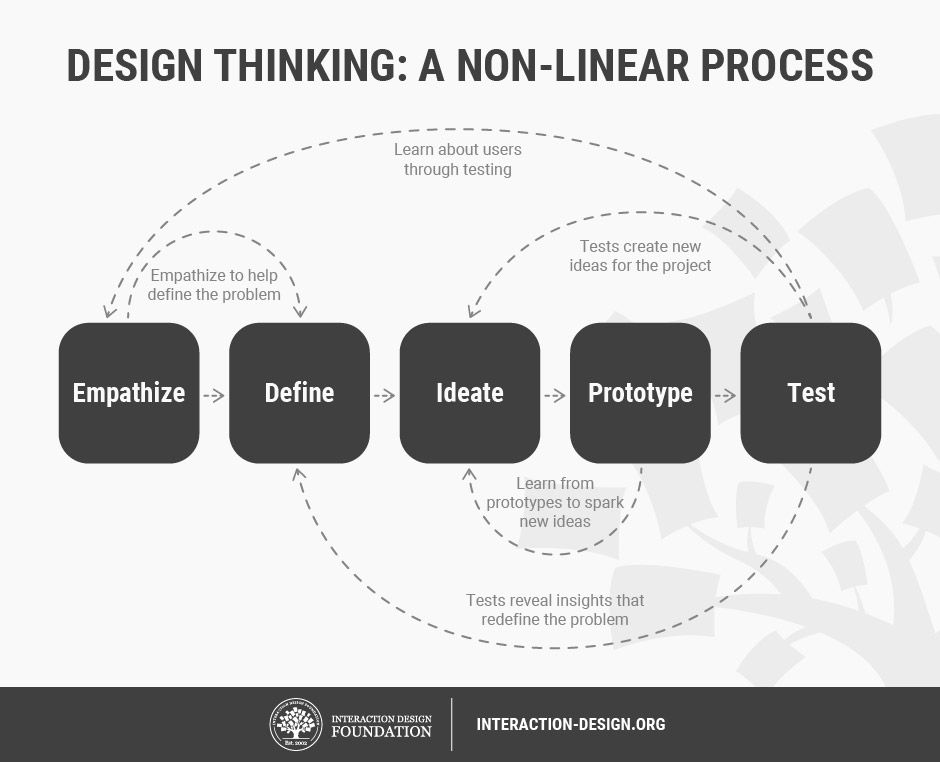
Illustration of the 5-Stage design process showing how it is not linear.

The five stages of Design Thinking—Empathize, Define, Ideate, Prototype and Test—are not sequential steps in a project. Instead, they are “modes” that you take on during each phase of your project (sometimes in parallel or in iterative loops), as and when they would give you the most learning and value. For instance, you can create prototypes early on in the project—ahead of ideation—to help your team empathize with users.

The test stage of the design thinking process often feeds into the other stages—that’s the beauty of the iterative design process.

© Teo Yu Siang and the Interaction Design Foundation, CC BY-NC-SA 3.0.

5 Guidelines for Conducting a Test

1. Show, don’t tell: let your users experience the prototype

Make sure to introduce yourself. Never, ever say you are the designer, even if you are. People will be less honest with feedback if they think you are the author and won’t want to hurt your feelings. Explain how long the session should take, what your expectations are for them and what they are going to be doing. Always ask if they have any questions before starting.

Avoid over-explaining how your prototype works, or how it is supposed to solve your user’s problems. Let the users’ experience in using the prototype speak for itself, and observe their reactions.

2. Ask Participants to Talk Through Their Experience

When participants are exploring the prototype, ask them to tell you what they’re thinking. Let them know that they should think out loud and speak what’s on their minds during the entire test session. This doesn’t come naturally to people, so you may have to prompt the participant during the test to remind them. In your intro to the test, make sure to let them know you are expecting this and give an example. You want them to let you know what they expect to happen when they select something or what they were expecting to see on the screen based on the title or location.

3. Observe Your Participants

Be a neutral observer. Observe how your participants use your prototype and resist the urge to correct them when they misinterpret how it’s supposed to be used. Mistakes are valuable learning opportunities. Remember that you are testing the prototype, not the participant.

4. Ask Follow-Up Questions

Always follow up with questions, even if you think you know what the participant means. Ask questions such as “What do you mean when you say ___?”, “How did that make you feel?”, “What did you expect would happen?” and, most importantly, “Why?”.

5. Negative Feedback is Your Way to Learn and Improve

When you test your ideas and prototypes, remember that negative feedback is an important way to learn and improve. You might feel a sting in the moment when you hear a person complain about how difficult your prototype is to use, but try to get used to the idea that such feedback will help you in the long run. You will uncover problems that you and your team might not have even considered. Always remember that:
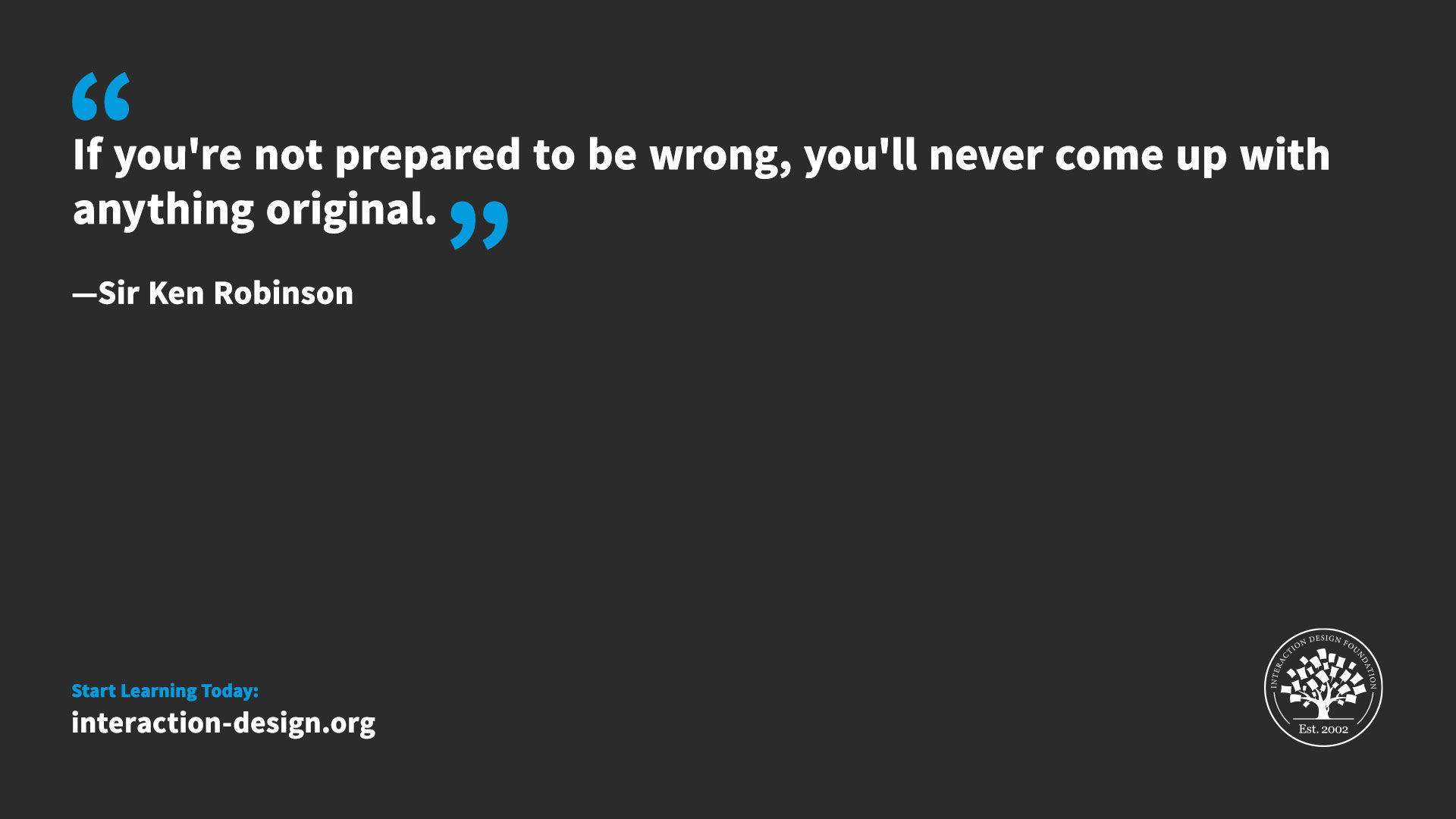
Quote by Sir Ken Robinson,

Quote from Sir Ken Robinson.

© Daniel Skrok and the Interaction Design Foundation, CC BY-NC-SA 3.0.

The End Goal: Desirable, Feasible and Viable Solutions
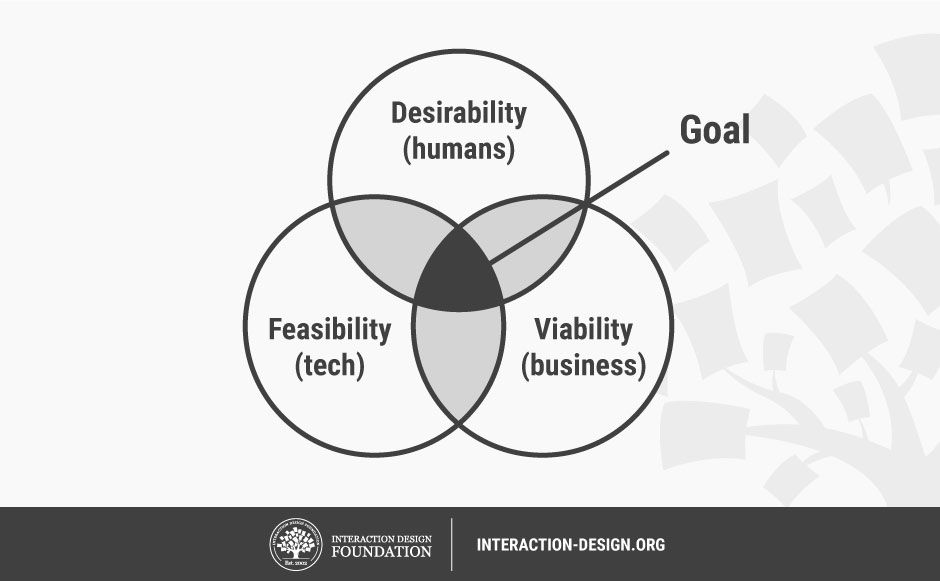
Venn diagram of Feasibility, Viability, and Desirability with the goal at the intersection of the three circles.

© Teo Yu Siang and the Interaction Design Foundation, CC BY-NC-SA 3.0.

The design thinking process doesn’t follow a fixed sequence of steps, but it has an ideal end point. The end goal of every design thinking project is a solution that is desirable, feasible and viable.

  • Desirability focuses on people. It’s what puts the “human” in human-centered design. Your solution is desirable if it appeals to the needs, emotions and behaviors of the people you target.

  • Feasibility is about technology. Is your design solution technically possible or does it depend on a technology that’s yet to be invented (or good enough for regular use)?

  • Viability is about whether your design solution works as a business. Is there an appropriate business model behind your solution, or would it collapse after a few years without investor or donor contributions? Design thinking is not about making a profit, but good design solutions should be self-sustaining. That way, you can continue to support and improve your solution way beyond the project deadline.

When you are able to create a prototype (or finished product or service) that satisfies the desirability, feasibility and viability tests, pat yourself on the back, congratulate your team, or even do a small dance if you like! You’ve designed a solution that will impact people around you for the better, and one that will continue to improve lives in the years to come.

The Take Away

Testing is the fifth stage in the five-stage design thinking process. You often perform tests together with the prototyping stage. Through testing, you can learn more about your users, improve your prototype and even refine your problem statement. To help you plan a test, there are a number of guidelines you can follow:

  1. Show, don’t tell: let your people experience the prototype.

  2. Ask test participants to talk through their experience.

  3. Observe your users.

  4. Ask follow-up questions.

  5. Negative feedback is your way to learn and improve.

And, last but not least, the design thinking process is fluid, iterative and flexible: the different stages often feed into one another and don’t necessarily follow any fixed sequence. That said, the ideal end point of design thinking (when you know you’ve done a great job) is when the product or service is desirable, feasible and viable.

References & Where to Learn More

Course: “Design Thinking - The Ultimate Guide”.

IDEO: Human-Centered Design Toolkit, 2009.

Images

Hero Image: © Loy9, CC BY 2.0.

Topics in This Article

Learn More in This Course:

Design Thinking: The Ultimate Guide

Course Closed
100 % booked
View Course

What You Should Read Next

  • Read full article
    The 5 Stages in the Design Thinking Process - Article hero image
    Interaction Design Foundation logo

    The 5 Stages in the Design Thinking Process

    Design thinking is a methodology that provides a solution-based approach to solving problems. It’s extremely useful when used to tackle complex problems that are ill-defined or unknown—because it serves to understand the human needs involved, reframe the problem in human-centric ways, create numerou

    Social shares
    2k
    Published
    Read Article
  • Read full article
    What is Design Thinking and Why Is It So Popular? - Article hero image
    Interaction Design Foundation logo

    What is Design Thinking and Why Is It So Popular?

    Design Thinking is not an exclusive property of designers—all great innovators in literature, art, music, science, engineering, and business have practiced it. So, why call it Design Thinking? What’s special about Design Thinking is that designers’ work processes can help us systematically extract,

    Social shares
    1.6k
    Published
    Read Article
  • Read full article
    Personas – A Simple Introduction - Article hero image
    Interaction Design Foundation logo

    Personas – A Simple Introduction

    Personas are fictional characters, which you create based upon your research to represent the different user types that might use your service, product, site, or brand in a similar way. Creating personas will help you understand your users’ needs, experiences, behaviors and goals. Creating personas

    Social shares
    1.6k
    Published
    Read Article
  • Read full article
    Stage 2 in the Design Thinking Process: Define the Problem and Interpret the Results - Article hero image
    Interaction Design Foundation logo

    Stage 2 in the Design Thinking Process: Define the Problem and Interpret the Results

    An integral part of the Design Thinking process is the definition of a meaningful and actionable problem statement, which the design thinker will focus on solving. This is perhaps the most challenging part of the Design Thinking process, as the definition of a problem (also called a design challenge

    Social shares
    1.4k
    Published
    Read Article
  • Read full article
    What is Ideation – and How to Prepare for Ideation Sessions - Article hero image
    Interaction Design Foundation logo

    What is Ideation – and How to Prepare for Ideation Sessions

    Ideation is the process where you generate ideas and solutions through sessions such as Sketching, Prototyping, Brainstorming, Cheatstorming, Brainwriting, Worst Possible Idea, and a wealth of other ideation techniques. Ideation is also the third stage in the Design Thinking process. Although many p

    Social shares
    1.4k
    Published
    Read Article
  • Read full article
    Empathy Map – Why and How to Use It - Article hero image
    Interaction Design Foundation logo

    Empathy Map – Why and How to Use It

    Here’s an interesting fact you may—or may not—know: users are more likely to choose, buy, and use products that meet their needs than products that just meet their wants. And an Empathy map will help you understand your user’s needs while you develop a deeper understanding of the persons you’re desi

    Social shares
    1.4k
    Published
    Read Article
  • Read full article
    Affinity Diagrams: How to Cluster Your Ideas and Reveal Insights - Article hero image
    Interaction Design Foundation logo

    Affinity Diagrams: How to Cluster Your Ideas and Reveal Insights

    Affinity diagrams are a great method to use when you want to make sense of a large volume of mixed information and data—facts, ethnographic research, ideas from brainstorms, user opinions, user needs, insights and design issues, just to name a few! Affinity diagrams require you to cluster informatio

    Social shares
    1.3k
    Published
    Read Article
  • Read full article
    Stage 4 in the Design Thinking Process: Prototype - Article hero image
    Interaction Design Foundation logo

    Stage 4 in the Design Thinking Process: Prototype

    One of the best ways to gain insights in a Design Thinking process is to carry out some form of prototyping. This method involves producing an early, inexpensive, and scaled down version of the product in order to reveal any problems with the current design. Prototyping offers designers the opportun

    Social shares
    1.3k
    Published
    Read Article
  • Read full article
    The History of Design Thinking - Article hero image
    Interaction Design Foundation logo

    The History of Design Thinking

    We need to appreciate the roots and origins of a concept to truly understand it—we need to know how it came to be. Let’s take a look at how design thinking emerged from an exploration of theory and practice to become one of the most effective ways to address the human, technological and strategic in

    Social shares
    1.3k
    Published
    Read Article
  • Read full article
    Stage 1 in the Design Thinking Process: Empathise with Your Users - Article hero image
    Interaction Design Foundation logo

    Stage 1 in the Design Thinking Process: Empathise with Your Users

    Design Thinking cannot begin without a deeper understanding of the people you are designing for. In order to gain those insights, it is important for you as a design thinker to empathize with the people you’re designing for so that you can understand their needs, thoughts, emotions and motivations.

    Social shares
    1.3k
    Published
    Read Article

Top Articles

Top Topic Definitions

Feel Stuck?
Want Better Job Options?

AI is replacing jobs everywhere, yet design jobs are booming with a projected 45% job growth. With design skills, you can create products and services people love. More love means more impact and greater salary potential.

At IxDF, we help you from your first course to your next job, all in one place.

See How Design Skills Turn Into Job Options
Privacy Settings
By using this site, you accept our Cookie Policy and Terms of Use.
Customize
Accept all

Be the One Who Inspires

People remember who shares great ideas.

Share on:

Academic Credibility — On Autopilot

Don't waste time googling citation formats. Just copy, paste and look legit in seconds.

Feel Stuck? Want Freedom?

Join 326,000+ designers who get one powerful email each week. Learn to design a life you love.

Next email in
1
day
18
hrs
29
mins
18
secs

Free forever. No spam. Unsubscribe anytime.