Empathy requires us to put aside our learning, culture, knowledge, opinions, and worldview purposefully in order to understand other peoples’ experiences of things deeply and meaningfully. It requires a strong sense of imagination for us to be able to see through another person’s eyes. It requires humility so we can seek to abandon our preconceived ideas and biases. It requires that we have a heightened awareness of other peoples’ needs, wants, motivations and goals. Let’s go through the traits an empathic observer should possess—and some methods you can use to gain a deep understanding of the people for whom you are designing.
Empathy is an innate quality in all people. Still, sometimes, being an empathic listener in a Design Thinking project is not as simple as it seems, because we are trained — whether consciously in our schools or workplaces, or subconsciously from our prior experiences — to form judgements and opinions about others rather than absorbing and understanding the raw data.
There are many interrelated qualities and characteristics that combine to develop a more empathic approach to engaging with others. Keeping these qualities and traits in mind, and learning to develop them, are key to forming a deep and genuine understanding of your users.
Empathy is especially important in the first stage of any Design Thinking process. The first stage in Design Thinking is often named the “empathise” stage – the following four stages are: Define, Ideate, Prototype and Test. In the Empathise stage, it’s your goal as a designer to gain an empathic understanding of the people you’re designing for and the problem you are trying to solve. This involves empathising with, engaging and observing the people—your target audience—you intend to help.
How to be an Empathic Observer
1. Abandon Your Ego
Most of us have a tendency to assert ourselves, which results in an imposition upon others, as well as having more concern about our own situation rather than the needs and concerns of others. Often in our education or workplace, we are taught to adopt an egocentric view of things and be firm in our opinions and thoughts. However, in order to empathise deeply, we need to tame and put aside our egos. We need to become aware of the primary goal of empathy in Design Thinking, which is to understand and experience the feelings of others.
2. Adopt Humility
When we adopt humility, we naturally improve our ability to empathise, because through humility we elevate the value of others above ourselves. This is underscored in Rise of the DEO, a book by Maria Giudice, innovator and VP of Experience Design in Autodesk, and Christopher Ireland, ethnographer and CEO of design research firm Cheskin. In Rise of the DEO, Giudice and Ireland discuss the emerging role of design leadership and point out that humility is a characteristic of design-focused leaders who are willing to admit their own shortcomings as well as to abandon preconceived ideas for the good of the overall vision and goals.
3. Be a Good Listener
So as to empathise, we need to listen and listen attentively. We need to choose actively to block out our inner conflicting voices, and allow the other's voice to resonate. We need to train ourselves to control our natural tendency to formulate our own opinions and voice them before the other person has finished talking. Doing so would enable us to have a deeper kind of listening, which uncovers deeper meaning and experience.
4. Hone Your Observation skills
In order to develop empathy towards our users, we need to do more than listen. We need to observe others, and have a close reading of their behaviours, subtle indications, their non-verbal expressions, body language, and environments. Only once we are able to experience the full range of sensations of others within context can we have a deeper and more meaningful empathic experience. Many times, what our users articulate is only a fraction of the full story. By honing our observation skills, we can fill many of the gaps, leading to a deeper understanding of someone else's experience.
5. Care
A genuine concern about the state of others, leading to the desire to act and assist, is required. This is one of the important drivers that allow us to overcome our own needs and wants and seek to understand others. We must build a sense of care, a deep concern and desire to want to help, nurture, and provide assistance. This requires a level of emotional insight.
"No one cares how much you know, until they know how much you care."
– Theodore Roosevelt
6. Be Curious
Being genuinely curious makes engaging in empathy research not only easier but also extremely rewarding as we learn to understand what motivates people. By being curious, we are naturally inclined to dig into unexpected areas, uncover new insights, and explore all aspects of people's lives. At a glance, these details might seem unimportant, but they will expose the most important information we need for problem solving.
7. Be Sincere
Nothing kills empathy more than a lack of sincerity. When we approach people with a superficial agenda, superiority complex, or any mindset that may undermine our sincere intention to understand their experience deeply, we are placing a barrier between us and those we seek to understand. Rather than approaching people with the mindset that they are in need of our help, we should realise that we stand to benefit more out of deeply understanding them. After all, the solution exists to serve their needs, and your work will not be complete unless you properly understand their needs.
Learn to Understand Body Language
We should have a keen awareness of how our body language sets the scene for trust and engagement between ourselves and the people we are observing or interviewing. On top of that, we need to read and interpret the signals that our users give off via their body language. This is a skill that comes with practice, and thus practice we must. At times, body language might be so subtle that the messages made by our very forms (eyebrows, shoulders, hands, and virtually any other part) as well as how we sound and behave are visible only to practiced readers of body language. If we want to connect with and engage our users on a deeper level, we need to study their body language, body signals, facial expressions, voice intonations, and the positive and negative signs that come from these. Here are some of the little things that you should pay attention to:
Learn to read the subtle nuances in communication, change of tone, pauses and skipping back over points.
Listen to what is not being said, to what's being avoided or covered up.
Subtly know when to encourage more expression or to lead the conversation or story in a beneficial direction.
Know what to ask and how to ask it—and when the person might be ready to be asked.
 Author/Copyright holder: crew.co. Copyright terms and licence: Free to use.
Our body language often says much more about ourselves than what we say verbally. It’s a great ‘lie detector’ in many respects.
How to Gain an Empathic Understanding of People
The most effective way you can gain empathy comes in the form of immersion: direct experience of the lives, contexts, environments, and activities of the people you would like to understand better. On top of immersing yourself in the environment to experience first-hand what it feels like to be your user, there are also a couple of methods you can engage in so as to gain a deeper understanding of people’s needs and emotions. Here, we will highlight three methods, and provide a template for each that you can download and use. Remember: the key to developing empathy is to go out there and practice with real people.
What-How-Why Method
 Author/Copyright holder: Teo Yu Siang and Interaction Design Foundation. Copyright terms and licence: CC BY-NC-SA 3.0
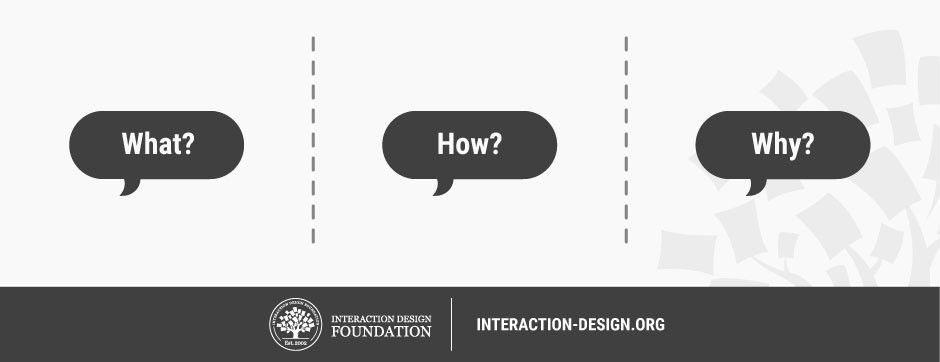
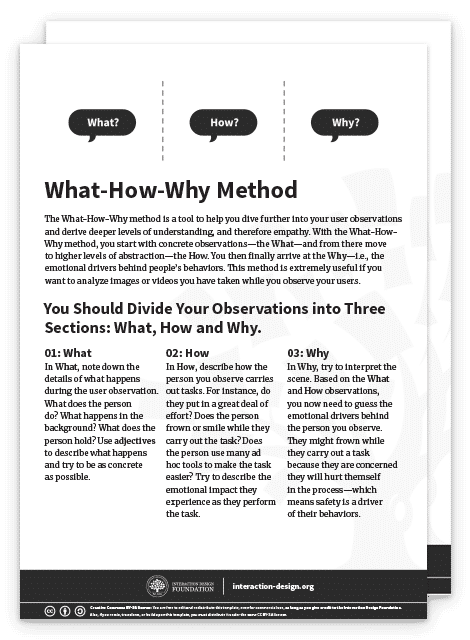
The What-How-Why method is a tool that you can use while observing people to help you dive into your observations and derive deeper levels of understanding. With the What-How-Why method, you start with concrete observations — the What — and from there move to higher levels of abstraction — asking How — and then finally you arrive at the Why—i.e., the emotional drivers behind people’s behaviours. This method is extremely useful for you to analyse images that you might have taken while observing your users.
You should divide your observations into three sections: What, How and Why.
In What, note down the details of what is happening. What is the person doing? What is happening in the background? What is the person holding? Describe using adjectives and try to be as concrete as possible.
In How, describe how the person is doing what he or she is doing. For instance, is the person putting in a great deal of effort? Is the person frowning or smiling while doing the task? Does the person use many ad-hoc tools to make the task easier? Try to describe the emotional impact of performing the task.
Finally, in Why, try to interpret the scene. Based on the What and How observations, guess the emotional drivers behind the person you are observing. The person might be frowning while doing a task because she is concerned about hurting herself in the process — which means safety is a driver of her behaviours.
You can download and print the What-How-Why template here:
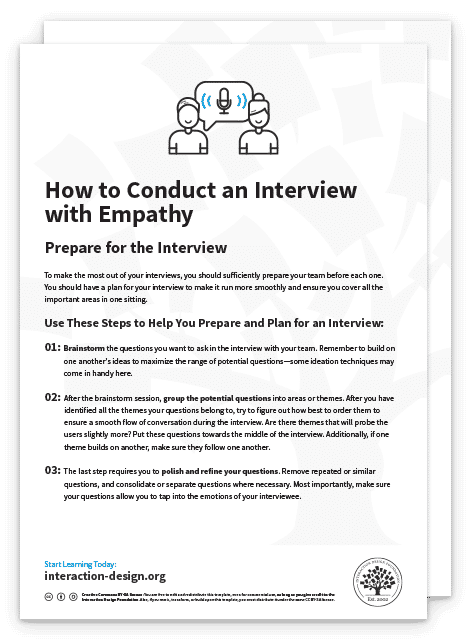
Conducting an Interview with Empathy
 Author/Copyright holder: Teo Yu Siang and Interaction Design Foundation. Copyright terms and licence: CC BY-NC-SA 3.0
At many points in your Design Thinking project, you will be interviewing your users. During the initial stages as you build your understanding of users, and after testing prototypes with them, you are likely to ask them questions so as to probe deeper into their emotions and behaviours. To make the most out of your interviews, you should sufficiently prepare your team before each one. Make a list of questions you want to ask your users. Then, group the questions into themes or topics, and try to create a smooth flow between the topics so that your interview would flow naturally.
During the interview, you’ll need to ask the question “Why?” on a constant basis— even though you might think you already know the answer. Chances are, your users are going to have their own answers that challenge your assumptions about them. Keep in mind that people tend to have gaps in what they say they do and what they actually do; it happens to all of us, and observing where these gaps form can help you gain insights about users.
You can download and print the template for conducting interviews with empathy here:
Building Empathy with Analogies
 Author/Copyright holder: Teo Yu Siang and Interaction Design Foundation. Copyright terms and licence: CC BY-NC-SA 3.0
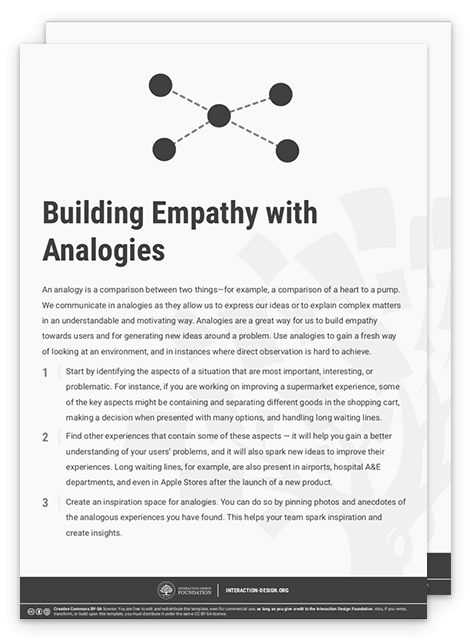
An analogy is a comparison between two things—for example, a comparison of a heart to a pump. We communicate in analogies as they allow us to express our ideas or to explain complex matters in an understandable and motivating way. Analogies are a great way for us to build empathy towards users and for generating new ideas around a problem. Use analogies to gain a fresh way of looking at an environment, and in instances where direct observation is hard to achieve.
When using analogies, you should start by identifying the aspects of a situation that are most important, interesting, or problematic. For instance, if you are working on improving a supermarket experience, some of the key aspects might be containing and separating different goods in the shopping cart, making a decision when presented with many options, and handling long waiting lines. Then, find other experiences that contain some of these aspects — it will help you gain a better understanding of your users’ problems, and it will also spark new ideas to improve their experiences.
You can download and print the template for building empathy with analogies here:
The Take Away
Empathy is innate in everyone, and focusing on some key traits of an empathic observer can help you unlock and augment your empathic skills so you can gain a greater understanding of the latent needs of users. At the same time, learning about what people’s body language tells us (above and beyond what they say verbally) is a skill that we can hone with practice. Immersing yourself in your users’ shoes is the best way to learn about them, and, on top of that, there are a couple of useful methods you can employ — the What-How-Why method, interviewing, and using analogies to build empathy — so as to gain a deep and holistic understanding of your users.
References & Where to Learn More
Maria Giudice and Christopher Ireland, Rise of the DEO - Leadership by Design, 2013
James Borg, Body Language: 7 Easy Lessons to Master the Silent Language, 2009.
d.school Bootcamp Bootleg, 2013.
Hero Image: Author/Copyright holder: : Teo Yu Siang and Interaction Design Foundation. Copyright licence: CC BY-NC-SA 3.0