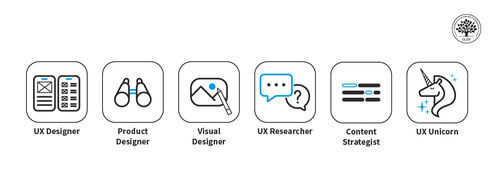
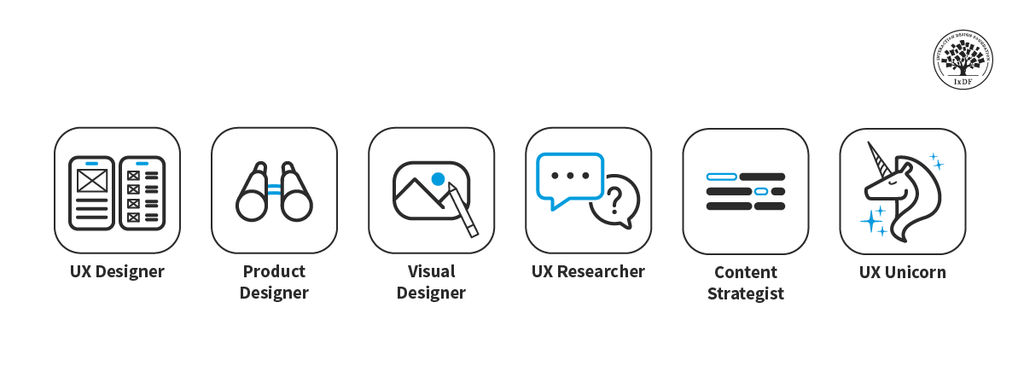
UX roles describe the various parts designers play in the design process. They range from generalist roles—e.g., UX designers and product designers—to specialist ones such as visual designers and UX researchers. UX roles might overlap in scope, and they keep evolving with our understanding of the ideal design process.
“Successful design projects require effective collaboration and healthy conflict.”
—Dan M. Brown, Author, co-founder and principal of EightShapes
One major part of what a design team does is to follow a user centered design process and work through it to produce the best possible designs for the target users. Team-mates perform many tasks throughout projects—from user research[TTV3] , to prototyping, to conducting usability testing—to iterate towards optimal solutions. Design thinking showcases the key UX tasks corresponding to these roles. It also reflects how each role contributes slightly differently regarding tasks. Main roles are:
1. UX designers(akaInteraction/UI/Experience designers) – Generalists working on all design thinking phases.
Design pattern libraries, style guides or design systems
2. Product designers – Like UX designers, but focusing especially on product designand the UX. They help create product designs, goals and roadmaps (high-level summaries/6–12-month forecasts of product offerings and features).
Tasks:
(Same as UX designers’)
Inform and plan roadmaps
Collaborate closely with development and marketing teams to ensure designs can be implemented properly
Typical Deliverables:
(Same as UX designers’)
Product roadmaps (probably co-developing these alongside other stakeholders)
3. Visual designers – Specialists with graphic design/visual design backgrounds focusing on making pixel-perfect prototypes later in the design process.
Tasks:
Convert UX goals into attractive design sets (e.g., app screens) with high usability and accessibility
Create and/or maintain libraries of product icons, colors and fonts
Develop live frontend prototypes for realistic usability testing
Implement frontend code
Typical Deliverables:
(Same as UX designers’)
Frontend prototypes
Ready-for-launch frontend code
Author/Copyright holder: Yuval Yeret. Copyright terms and licence: CC BY-NC-SA 3.0
UX Roles at Work
Organizations’ definitions of UX roles vary. While these shouldn’t deviate drastically from those listed above, you should research a brand’s culture to understand its expectations. For instance, recruiters scanning UX portfolios may want a “UX designer” to handle all UX-related tasks. Applicants would then address that in their UX cover letters and UX resumes. Also, with the industry’s dynamic nature, expect to constantly find new job titles, job descriptions and UX tools. Nonetheless, your knowledge remains timeless – you just must adapt to whatever hat your company wants you to wear.
Questions About UX Roles? We've Got Answers!
What are the main roles in UX design?
UX (user experience) design involves a range of roles that focus on creating useful, usable, and delightful digital experiences. The main roles in UX design include:
UX Designers shape the overall user experience by researching user needs and crafting intuitive interfaces. They create wireframes and prototypes, ensuring smooth and logical user interactions. They also organize content and navigation so users can find what they need easily.
UI Designers focus on the look and feel, choosing colors, typography, and visual layout.
UX Researchers gather data about user behaviors and needs through interviews, surveys, and usability tests.
UX Writers craft microcopy and interface text that guides and supports users.
Product Designers often blend UX, UI, and strategy to align user needs with business goals.
These roles frequently overlap in practice, especially in small teams or small organizations. Each plays a vital part in shaping engaging, user-centered digital products.
Watch this revealing video about important points to bear in mind when deciding on which UX role to go for:
Explore an immense landscape of career possibilities in the Build a Standout UX/UI Portfolio: Land Your Dream Job course with Morgane Peng: Designer, speaker, mentor, and writer who serves as Director and Head of Design at Societe Generale CIB.
How do interaction designers fit into UX teams?
Interaction designers fit into UX teams by focusing on the behavior of digital products—how users move through a system and how interfaces respond. They ensure interactions are intuitive, efficient, and aligned with user goals. While UX designers often handle a broader scope (including user research and overall experience), interaction designers dive deep into the details of usability and flow.
In many UX teams, especially smaller or cross-functional ones,a UX designer may perform interaction design tasks. In larger teams, interaction designers often work alongside visual designers, UX researchers, and developers, turning insights and wireframes into interactive prototypes or behavior specs.
Their role bridges design and development: they help translate user needs and design intentions into interactions that feel natural. Interaction designers improve how users engage with digital products, often shaping whether those experiences feel seamless or frustrating.
Watch to learn some important points about what an interaction designer does:
Can I switch from graphic design to UX design easily?
Yes; switching from graphic design to UX design is not only possible—it’s common, too. Graphic designers already have a solid foundation in visual communication, layout, and branding, all of which carry over directly into UI and UX work. What you'll need to add are skills in user research, interaction design, usability principles, and prototyping.
Many graphic designers start by learning UX fundamentals through courses or hands-on projects. They often pivot into UI design roles first and then expand into broader UX responsibilities. Your eye for detail, creative problem-solving, and ability to design visually appealing interfaces already give you a head start.
To ease the transition, build a UX-focused portfolio with case studies that highlight your design thinking, not just aesthetics. Focus on user flows, problem statements, and testing outcomes.
Explore the rich tapestry of elements that make up UX design in this video:
Transcript
Transcript loading ...
Autoscroll
Is there a difference between a service designer and a UX designer?
Yes; there is a difference between a service designer and a UX designer—but they often collaborate and their work overlaps.
A UX designer typically focuses on digital experiences: how users interact with a website, app, or system. They optimize usability, flow, and interaction within that digital context.
A service designer, on the other hand, maps and improves the entire service journey—across digital and physical touchpoints. This could include call centers, in-store experiences, logistics, and backend operations. Service designers look at the full ecosystem, not just the screen.
The key difference lies in scope. UX design usually focuses on digital product interactions. Service design zooms out to orchestrate how all components—tech, people, spaces, and policies—work together to deliver a seamless service.
In practice, many UX designers apply service design principles, especially in complex or omnichannel environments. After all, “users” and “experience” feature as vital focal points in both UX design and service design.
Watch as CEO of Experience Dynamics, Frank Spillers discusses service design:
No; you don’t need a degree to work in a UX role. Most UX hiring managers focus more on your portfolio, skills, and thinking than on formal education. Many successful UX professionals come from non-traditional backgrounds—graphic design, psychology, coding, writing, even architecture.
What matters most is that you understand user-centered design principles, can conduct or interpret research, and know how to design and test usable interfaces. You’ll also need to communicate design decisions clearly and collaborate well with developers and stakeholders.
You can build these skills through online UX courses, bootcamps, or self-study—and then apply them in personal projects, freelance work, or internships. A strong, well-documented portfolio often carries more weight than a degree, especially if it shows your process and problem-solving.
How do UX roles collaborate with developers and product managers?
UX roles collaborate closely with developers and product managers to ensure products are both user-friendly and feasible to build. UX designers bring user insights and prototypes to the table. Product managers define business goals and priorities. Developers evaluate what’s technically possible and help bring designs to life.
Together, they form a cross-functional team that balances usability, business needs, and engineering constraints. UX designers often join product discovery early, shaping feature ideas based on user research. Throughout development, they refine designs with developer input and test usability. Testing is essential from early prototypes to final design solutions.
Effective collaboration hinges on clear communication. UX designers must explain design decisions with user evidence, while adapting to tech realities. Shared tools like design systems, user stories, and agile rituals (like sprint planning and retros) keep everyone aligned.
Is UX a good long-term career?
Yes; UX is a strong, future-resilient career. Demand for UX professionals remains high because businesses now understand that thoughtful design drives user satisfaction, loyalty, and growth. UX roles consistently rank well for job satisfaction, pay, and career opportunities.
However, with AI reshaping how professionals work, the nature of UX work will evolve. AI may handle routine tasks like layout generation, A/B test analysis, or user data clustering. What it won’t replace is the human side—empathy, storytelling, ethics, and strategic thinking. UX designers who focus on those skills will stay essential.
As technology grows more complex, companies need designers who can make it feel seamless and human. That is why UX careers span every industry, from fintech and health tech to education and government. UX also offers room to grow into roles in leadership, research, content, or service design.
A UX strategist defines the long-term user experience vision and aligns it with business goals. While UX designers focus on the “how”—creating screens, flows, and interactions—UX strategists focus on the “why” behind product decisions. They connect user needs, brand values, and market trends to guide design efforts at a strategic level.
Their work involves user research, competitive analysis, stakeholder interviews, and aligning cross-functional teams around a shared UX roadmap. They help prioritize features that add value, shape KPIs for user experience, and influence the overall product direction.
In short, UX strategists ensure the product delivers real value, not just a polished interface. Their role is critical in large-scale projects, design transformations, or early-stage startups looking to build the right thing from the start.
Watch CEO of Experience Dynamics, Frank Spillers discuss UX strategy:
Transcript
Transcript loading ...
Autoscroll
What skills do I need to become a UX lead or UX manager?
To become a UX lead or UX manager, you need more than design skills; you need leadership, strategy, and collaboration skills. Strong UX leads excel in communication, stakeholder management, and guiding design teams. They set the vision, mentor designers, and ensure projects align with both user needs and business goals.
Key skills include:
UX design expertise: Wireframing, prototyping, usability, and research must be second nature.
Team leadership: Delegating, giving feedback, and nurturing talent are core to the role.
Strategic thinking: You must align UX outcomes with product strategy and KPIs.
Cross-functional collaboration: You’ll bridge product, dev, and business teams.
Communication: Leading design critiques and presenting to execs requires confidence and clarity.
Most UX leads evolve into the role after years of hands-on design work and by consistently driving impact at a team level.
Discover a wealth of valuable insights in UX Management: Strategy and Tactics, and watch as Frank Spillers explains key points about the course:
Transcript
Transcript loading ...
Autoscroll
Who’s responsible for user testing in a UX team?
In a UX team, UX researchers or UX designers typically lead user testing, depending on the team’s size and structure. In larger teams, UX researchers plan and run usability tests—choosing methods, recruiting users, and analyzing results. In smaller teams, UX designers often take the lead, using lightweight tools like moderated interviews or remote testing platforms.
Still, everyone shares a stake in user testing, and effective user testing is non-negotiable. Product managers help define what needs validating. Developers join sessions to observe pain points. Stakeholders use findings to guide decisions. It’s a collaborative effort with UX roles driving the process.
Effective teams don’t treat user testing as a phase; they embed it throughout the design cycle. This helps them catch issues early, validate ideas quickly, and build products users enjoy using.
The UX Careers Handbook by Cory Lebson serves as a comprehensive guide for individuals pursuing or advancing a career in user experience (UX). The second edition updates the original content with insights into critical soft skills, expanded discussions on UX leadership, and introduces a 17th UX career pathway. Lebson offers practical advice on personal branding, networking, resume and portfolio development, and strategies for securing UX positions. The book includes real-world stories from industry professionals, activities, and worksheets to aid career planning. It's an essential resource for students, career changers, hiring managers, and recruiters aiming to understand and navigate the diverse landscape of UX professions.
Leah Buley’s The User Experience Team of One is an essential resource for UX professionals working solo or in small teams. The second edition expands on the original’s practical tools and methodologies for conducting user research, ideation, and design without extensive resources. Buley emphasizes lean and adaptable processes, making UX work feasible even in organizations with limited support. The book offers step-by-step guidance on integrating UX into product development, advocating for user needs, and driving UX maturity. Its relevance has only grown as UX becomes a broader discipline embraced by startups and cross-functional teams alike, making it a must-read for independent and embedded UX practitioners.
Earn a Gift! Answer a Short Quiz at the End of This Page
Earn a Gift, Answer a Short Quiz!
1
2
3
4
1
2
3
4
Question 1
Question 2
Question 3
Get Your Gift
2
3
4
2
3
4
Question 1
Question 2
Question 3
Get Your Gift
3
4
3
4
Question 1
Question 2
Question 3
Get Your Gift
4
4
Question 1
Question 2
Question 3
Get Your Gift
Try Again! IxDF Cheers for You!
0 out of 3 questions answered correctly
Remember, the more you learn about design, the more you make yourself valuable.
UX Roles: The Ultimate Guide – Who Does What and Which One You Should Go For?
Do you have the ambition and enthusiasm for a career in UX design but don’t know where to start? You’ll be pleased to know there are many paths you can take. Even as a relatively new field, user experience (UX) design has both general and specialist job roles. This variety means there is a role wait
UI & UX Designer Salaries: How Much Can I Earn in 2026?
How much can you earn as a UI or UX designer in 2026? The truth is that there's no single answer. Your earning potential depends less on averages and more on factors you can actually control. Designers using AI to accelerate execution while bringing strategic thinking, user empathy, and measurable b
Product Design and UX Design Roles: Unveiling the Differences
Product and user experience (UX) design are both prominent fields—and make rewarding career choices. People often use the two terms interchangeably in conversation, but they’re not the same. Product designer vs. UX designer isn’t a simple “either-or” scenario—and each role has got unique responsibil
Question time: Have you gained substantial experience in UX (user experience) design—as in, to the point where you’re considering a career change?If your answer is YES and conducting in-depth research makes you feel more content—along with helping brands “nail” it in the marketplace with their produ
Level Up Your LinkedIn: Craft a UX Design Profile That Attracts Clients and Top Recruiters
In a competitive job market, if you’re a UX (user experience) designer who’s seeking career advancement, you need to build a strong online presence. LinkedIn—the world’s largest professional networking platform—stands out as one of the most powerful tools you can use to attract new clients or top re
This One Skill Gets You Hired, And It's Not What You Think
Simply matching a job description isn’t enough anymore. The right qualifications will get you considered for a position. But to actually get hired, you must make an impression. Successful candidates communicate their value with clarity and confidence. When you master how you present yourself, interv
Social shares
292
Published
Read Article
UX Roles: The Ultimate Guide – Who Does What and Which One You Should Go For?
Do you have the ambition and enthusiasm for a career in UX design but don’t know where to start? You’ll be pleased to know there are many paths you can take. Even as a relatively new field, user experience (UX) design has both general and specialist job roles. This variety means there is a role waiting for you that fits you perfectly based on your passions and experience. However, UX roles can sometimes be confusing—you may find the same position at different companies but with different names. Here, we’ll look at eight common UX roles and how they contribute to the design process. Soon, you’ll clearly understand which job role is the right fit for you.
A common misconception is that UX is just what you see in the final product. However, the tangible elements of a product are just the tip of the UX iceberg, as explained in this video:
Transcript
Transcript loading ...
Autoscroll
UX design is still a relatively new industry. The first job to include the term “user experience” was Don Norman’s role as User Experience Architect at Apple in 1993. New UX roles and specializations are appearing constantly, and the field continues to evolve as technology and user needs change. For this reason, user experience is an incredibly exciting industry to be a part of—a fact that has likely brought you here.
Unravel UX Roles and Find Your Perfect Fit
Kate Conrick, a designer working for the Australian government, aptly sums up the sometimes-confusing state of UX roles:
“I built on my background in tech and design, picked up some solid research skills, added some business process and a sprinkle of marketing, and voila! A user experience designer. Or a Service Designer? A UX Researcher? A digital strategist? An experience analyst? Design thinker? Stuff tinkerer? Unicorn? Power ranger? You tell me. Because I’m not sure I know the answer.”
—Kate Conrick
If you’re confused about UX roles, you’re not alone. But don’t worry; you’ll soon have a strong grasp of the different UX roles available and which one you’d like to pursue. With your destination in hand (i.e., the role you aspire to), you can plot your course to becoming a UX extraordinaire. Eight of the most common UX roles are:
UX Designer.
UI Designer.
Product Designer.
UX Researcher.
UX Engineer.
UX Writer.
Service Designer.
UX Unicorn (yes, this is a real job title!)
Once you’ve chosen your role, one of the primary stepping stones on your journey is to build your UX/UI design portfolio—an essential asset for your UX career. In this video, Morgane Peng, Design Director at Societe Generale CIB, explains what a portfolio is and its purpose:
Transcript
Transcript loading ...
Autoscroll
For each UX role, you’ll learn the expected tasks and deliverables and get a rough idea of whether you’ll like the role. Ready to make sense of UX roles?
Forget The Semantics and Focus on the Design Process
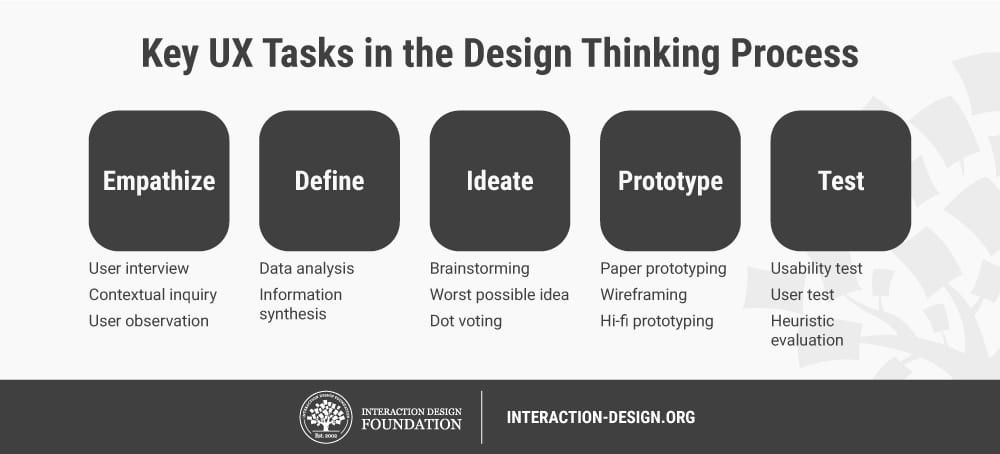
With all these job titles, it’s essential to contextualize their collective purpose—allUX roles exist to serve the design process. A great way to understand UX roles is to examine how they contribute to the design process. UX professionals perform a whole slew of UX tasks as they go through a design process to create a final design.
For instance, designers usually start by understanding users before they create designs and test them. Different UX roles simply take charge of various subsets of these UX tasks.
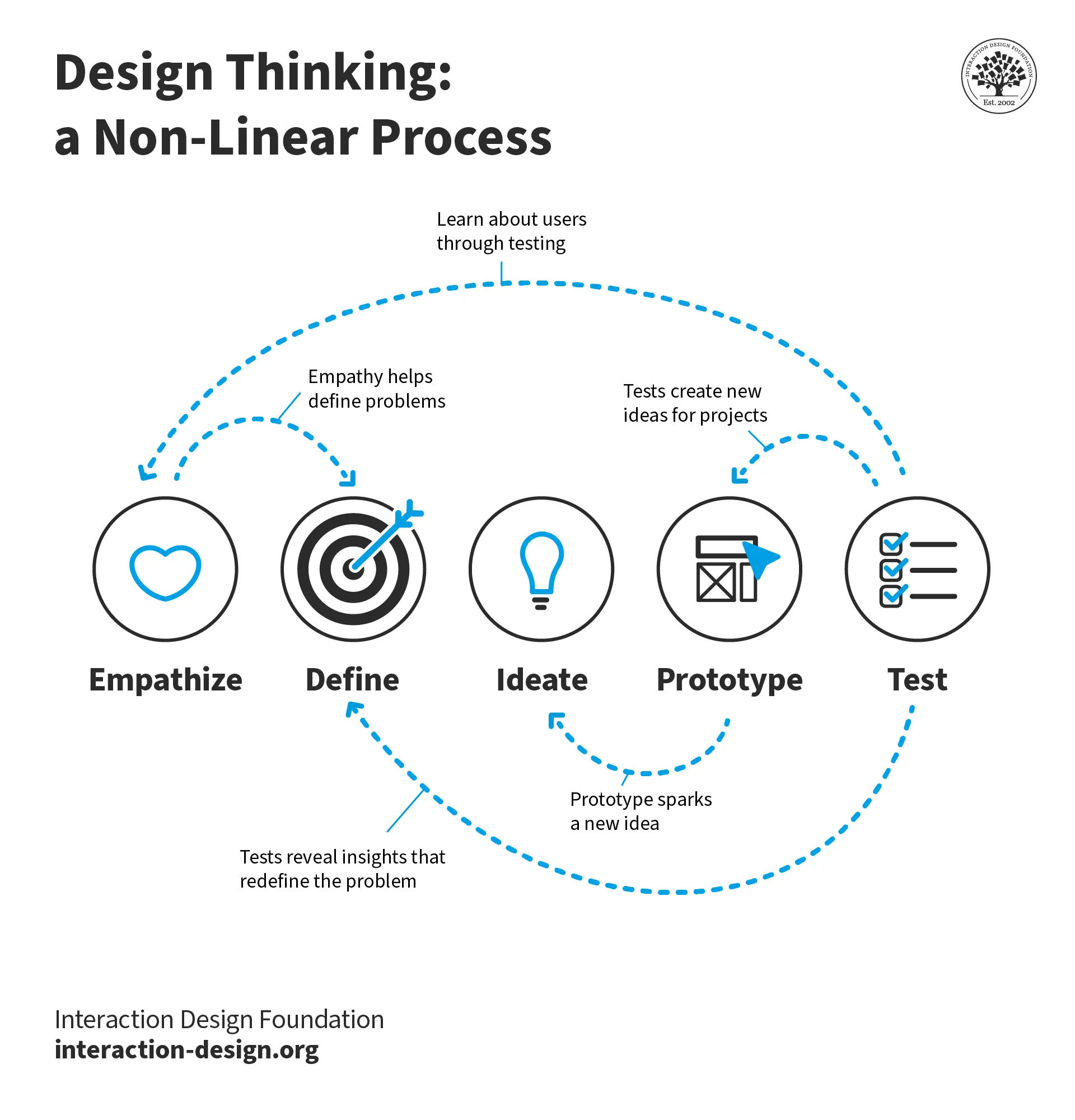
Design thinking is one of the most common design methodologies and helps illustrate where each UX role fits. As you can see, the stages are closely connected; they overlap and are iterative by nature. This overlap is partly why job roles are often so difficult to define and separate completely.
Each UX role explained below performs a slightly different range of these key UX tasks. For instance, a UX Designer is a generalist who takes charge of all the UX tasks, while a UX Researcher focuses on the empathize and test phases.
If you frame each role within the design process, it will help you see the big picture. That way, when a new job title pops up, you’ll be able to understand it in the context of the design process.
On top of that, companies might define UX roles differently. However, once you understand UX roles as “how they contribute to the design process,” you’ll be less confused when you go job hunting and portfolio building. In other words, you’ll focus less on the job title and more on what you’ll be doing.
The design process will also aid in your portfolio, as you’ll be able to target specific roles based on the stages you include in your UX case studies. For example, if you want to become a UX Researcher, you will want to focus on the empathize, define, and test stages in your case studies.
Enough talk; let’s look at the eight most common UX roles!
UX Designer: The All-Rounder
The role of a UX Designer is an exciting one!UX Designerscoverthe entire design process. This means you’ll get the satisfaction of seeing products or features go from a user problem to a final solution. As a UX Designer, you’ll:
Deeply understand your users, their needs, and what they want to achieve.
Generate and ideate ideas to solve your users’ problems.
Prototype designs and test them with users.
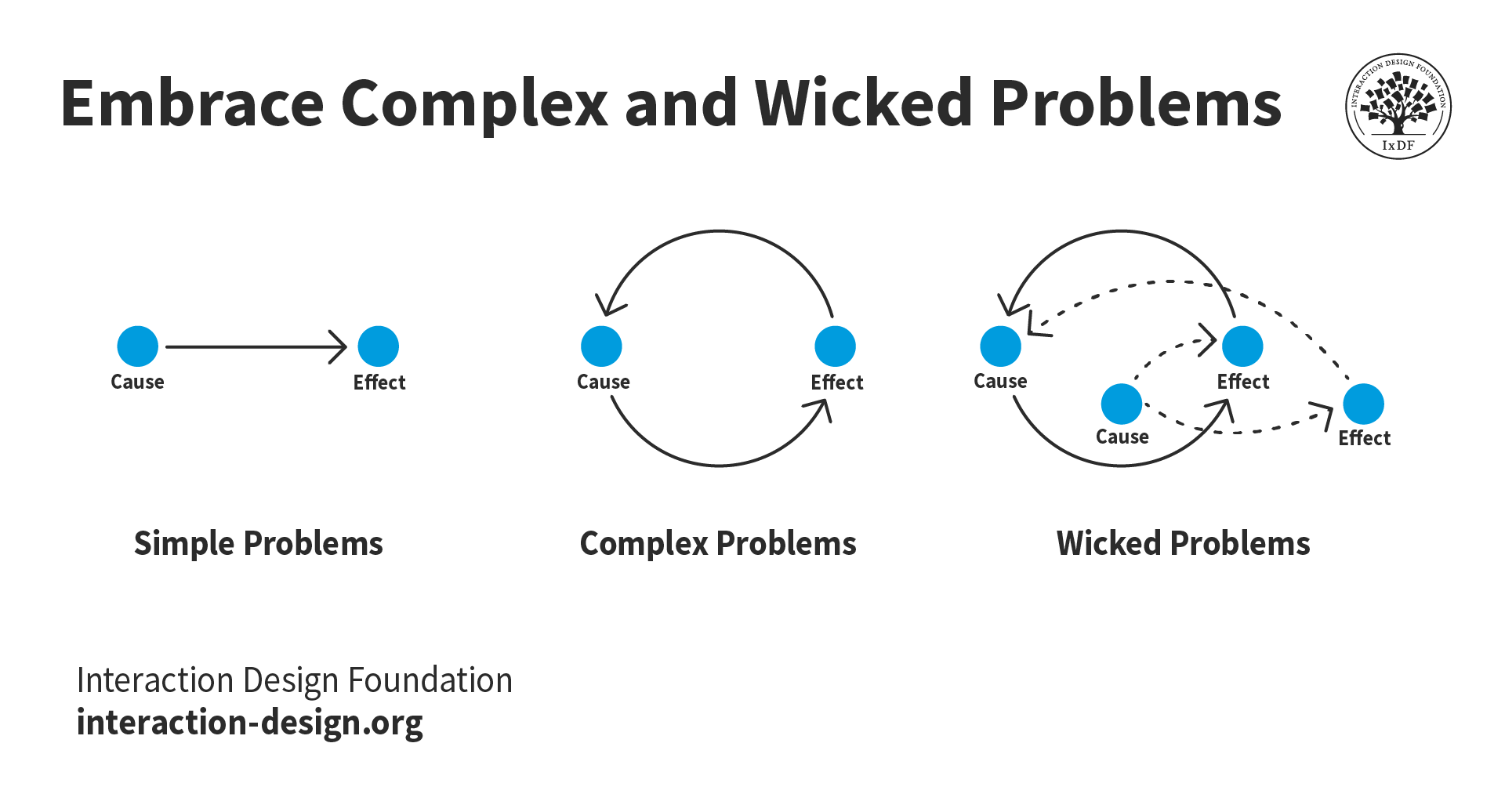
Do you have excellent problem-solving abilities? Then you’re in the right place! UX design is all about problem solving, from simple problems that have a single cause and effect to wicked problems that require a little more thought and ingenuity to solve.
The role of a UX Designer can look different depending on the size of the company. In large companies, a UX Designer typically works in a dynamic team with other UX professionals, including UX Researchers and UI Designers. In smaller companies like start-ups, UX Designers tend to handle all the design work. This means there’s a UX Designer role out there for you, whether you love to collaborate with specialists or own the whole design process.
UX Designers Are Also Known as...
UI/UX or UX/UI Designers (a User Interface (UI) Designer with some UX skills or vice-versa).
Experience Designers.
What Tasks Will You Perform as a UX Designer?
A UX Designer conducts all kinds of UX activities as part of their role. As a UX Designer, you will:
Conduct user research through interviews, observations, and other research methods.
Based on your user research, analyze and identify pain points from the users’ perspective.
Generate ideas through ideation techniques, such as brainstorming and worst possible idea. These techniques help to solve the users’ needs in a way that provides value to the company.
Select the most promising idea(s) based on their feasibility, desirability, and viability.
Prototype designs, which can range from simple paper sketches to high-fidelity digital mockups.
Provide and solicit feedback on your designs as well as the designs of your teammates.
Conduct usability and user tests to determine if you can improve your design(s) further.
Push a design solution out into the world that will benefit both your company and your users.
What UX Deliverables Will You Produce as a UX Designer?
While each company—and indeed, each team within a company—expects different deliverables from a UX Designer, the most common ones are:
“How might we” statements that capture a problem that your design aims to solve.
Paper prototypes.
Wireframes.
High-fidelity, pixel-perfect mockups.
Usability reports.
Heuristic evaluation reports.
User testing reports.
Design pattern libraries, style guides or design systems.
You’ll Love Being a UX Designer if you...
Want to be involved in the entire design process, from the initial stage of understanding users to the final stage of producing a high-fidelity prototype.
Love to learn and master a wide range of topics and skills, including:
Are fulfilled by analyzing complex data to produce design goals that you then work towards.
Thrive on creating intuitive and useful solutions that solve the problems users face in their lives.
UI Designer: Where Aesthetics and Usability Meet
UI Designers combine usability with visual design to build intuitive user interfaces. This role is an excellent fit if you’re a creative person who wants to incorporate psychology, user behavior analysis, and visual storytelling into your work.
Since a UI is a significant component of a product, it requires research, ideation, prototyping, and testing. Therefore, as a UI Designer, you have the chance to get involved in all five stages of the design thinking process.
Many UX Designers also take on UI design responsibilities, but it's important to remember that UI design is a component of UX design—they are not synonymous. Discover more about UI vs UX in this video:
Transcript
Transcript loading ...
Autoscroll
UI Designers Are Also Known as...
Interface Designer.
UX/UI or UI/UX Designer.
What Tasks Will You Perform as a UI Designer?
As a UI Designer, you will:
Use your visual design skills to create attractive interfaces that align with brand guidelines and meet user needs. Color, typography, graphics, and Gestalt principles all play a role in UI design.
Design layouts with well-organized, consistent, and accessible content across all devices.
Develop and maintain product design systems. Design systems include components like buttons, icons, and typography styles.
Apply accessibility standards and cultural considerations to produce inclusive designs.
Collaborate with UX Designers to turn wireframes and prototypes into refined, high-fidelity designs.
Provide detailed design specifications and assets to front-end developers.
What UX Deliverables Will You Produce as a UI Designer?
As with UX design, UI design deliverables vary from company to company. However, the most common deliverables include:
High-fidelity UI designs.
Interactive prototypes that showcase animations and transitions.
Design systems, including components like buttons, icons, and other reusable elements.
Visual style guides that include typography, color palettes, spacing rules, and more.
Responsive design layouts for various screen sizes and devices (such as mobile and tablet devices).
Documentation and design files for developers.
You’ll Love Being a UI Designer if you...
Relish the challenge of perfecting the balance between aesthetics and usability.
Are passionate about visual design and its principles, such as typography, color theory, and layout.
Thrive in the structure that comes from design systems and clear rules for branding, but know when to break the rules.
Are ready for the challenge of making complex information easy to navigate through thoughtful design.
Aspire to collaborate with UX Designers and developers to bring high-fidelity designs to life.
Have excellent attention to detail and get obsessed with the minutia of a design.
Product Designer: Upgrade to Business Class
Are you excited about becoming a UX Designer, but wish you could incorporate your business acumen into the role? Well, you’re in luck! Product Designers pay special attention to the product as a whole on top of the user’s experience.
As a Product Designer, you will contribute to the creation and management of the product’s designs, goals, and roadmap. A product roadmap is a high-level strategic summary of the direction of the product’s offerings and features.
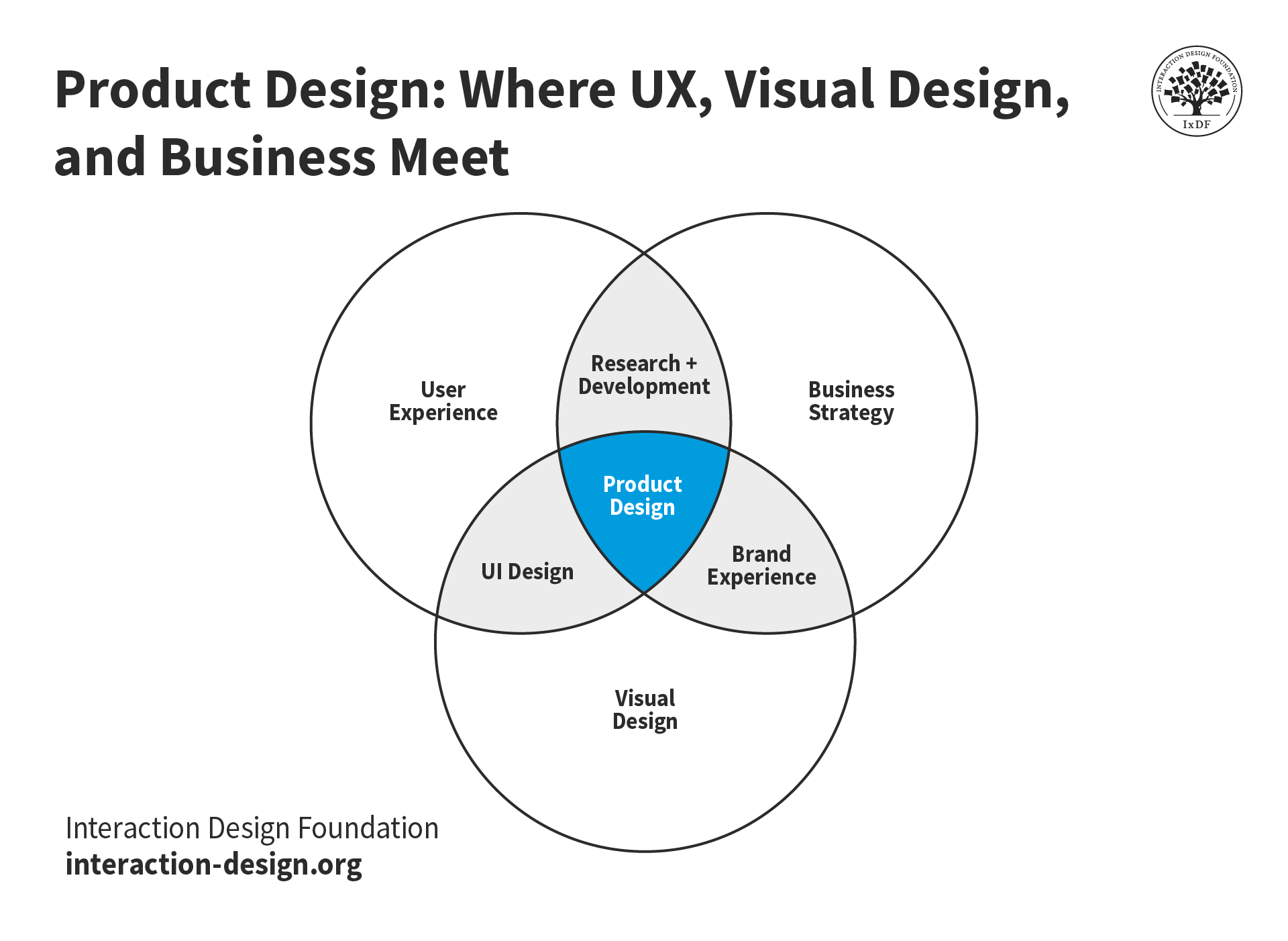
Product design lies at the intersection of UX, visual design, and business strategy. While all UX designers consider business goals when designing user experiences, product designers must consider not only today’s business goals but also those of the long term.
There aren’t any synonyms for Product Designers. Some companies define Product Designers as identical to UX Designers. Other companies view Product Designers as senior UX Designers who have the added responsibility of charting a product’s goals and roadmap.
What Tasks Will You Perform as a Product Designer?
All the tasks listed under “UX Designer” above, plus:
Inform and plan the product’s roadmap 6–12 months into the future.
Collaborate closely with development to ensure they can successfully implement designs.
Work with marketing teams to communicate and plan product launches.
What UX Deliverables Will You Produce as a Product Designer?
Product Designers produce all the deliverables listed under “UX Designer” above, in addition to product roadmaps. You will likely co-develop roadmaps with stakeholders such as team leaders, the product manager and the CEO.
You’ll Love Being a Product Designer If You…
Are passionate about design and business.
Are excited by developing and integrating business goals into design and product decisions.
Want to participate in the entire design process.
Are ready to develop a deep knowledge of design and a good understanding of business.
Have a knack for analyzing data and reaching conclusions that balance business goals with user needs.
UX Researcher: The User’s Champion
UX Researchers bring the voice of the user into every part of the design process. They spend their days talking with users, analyzing data, and using their findings to influence design decisions. As a UX Researcher, you’ll participate in the empathize, define, and testing phases:
You’ll empathize with users to really get to know them and their needs.
You’ll define the problems that the product should solve.
Once the design team has created a prototype, you will test it with users and help validate and improve designs.
Gain a rich and complete understanding of users through qualitative user research methods. Methods include user interviews, user observations, and field studies.
Conduct quantitative user research using methods like surveys and card sorting. This research will confirm your qualitative research outcomes and inform design decisions.
Analyze the data you’ve gathered on users to synthesize key findings and make design proposals.
Advocate for users’ needs and perspectives within the design team.
Help inform product goals by presenting your research findings to stakeholders.
Test and improve designs by conducting evaluative research, such as usability and user testing.
What UX Deliverables Will You Produce as a UX Researcher?
These are the main deliverables you’ll create as a UX Researcher:
Have a strong passion for human psychology and the study of people.
Enjoy stepping into users' shoes to empathize with them and build a rich and deep picture of their perspectives and problems.
Are well-versed in psychology or interested in learning deeply about it.
Get excited about generating and analyzing complex data.
UX Engineer: A Bridge Between Design and Development
UX Engineers exist in the gap between design and development teams. If you’re a developer who understands and advocates for user experience, then you might have just found your perfect role. You can find UX Engineer positions at large companies with strong UX maturity. Given their coding and UX abilities, a typical responsibility of UX Engineers is to build high-fidelity prototypes that closely resemble the final product.
In this video, Syzmon Adamiak, Co-Founder of Hype4, explains the importance of good communication when designers hand off designs to developers:
Transcript
Transcript loading ...
Autoscroll
UX Engineers Are Also Known as...
Creative Technologists.
Product Design Engineers.
Design Technologists.
What Tasks Will You Perform as a UX Engineer?
Build high-fidelity, functioning prototypes using your UX and coding skills.
Package designs and communicate them in a developer-friendly format.
Work across research, design, development, and product management teams.
Front-end development tasks such as implementing UIs and new features.
What UX Deliverables Will You Produce as a UX Engineer?
Many of the same deliverables as a UX Designer, plus:
Polished and final prototypes.
Component libraries.
Code documentation.
You’ll Love Being a UX Engineer if you...
Perform best with a varied and multidisciplinary workload.
Have the desire to utilize both coding and UX skills.
Enjoy a fast-paced work environment where you will build rapid but functioning prototypes.
UX Writer: The Master Communicator
If you’re passionate about words and user-centered design, then you will make an excellent UX Writer. Copy is one of the most essential parts of a design, and it requires a specialist touch to optimize it for the best results.
As a UX Writer, you’ll write instructional text, onboarding content, and microcopy for buttons, error messages, and tooltips. You’ll contribute to the prototype phase of the design process, and you are crucial in finalizing the product before launch.
Torrey Podmajersky, UX Writer, explains how to get into UX writing:
Transcript
Transcript loading ...
Autoscroll
UX Writers Are Also Known as...
Copywriters.
Content Strategists.
Content Designers.
What Tasks Will You Perform as a UX Writer?
As a UX Writer, you will:
Write copy for user interfaces so people can easily navigate, use, and troubleshoot the product.
Create compelling page titles and navigation menu item names for optimal usability.
Write error messages that are simple, effective, and blame-free. In the unfortunate event of an error, users should feel assured rather than annoyed.
Craft effective emails and newsletters to achieve product goals (such as account signups).
Weave a cohesive narrative throughout the product. Users should experience a consistent tone of voice and direction no matter which screen or page they access.
Define and maintain a vision for the product’s language that other stakeholders will use.
Test your copy for performance and improvements.
What UX Deliverables Will You Produce as a UX Writer?
As a UX Writer, most of your work will be directly incorporated into the product itself, so it often won’t appear as a standalone deliverable. As a result, your most common deliverables are:
Copy, which you will incorporate into the product itself.
Editorial guidelines or product language guidelines that set the tone and content style for the product.
You’ll Love Being a UX Writer if you...
Have a strong desire to help users achieve their goals with the least cognitive load.
Can strongly empathize with your users and understand their goals.
Are passionate about achieving product and business goals.
Possess deep knowledge in writing and a solid understanding of UX design.
Enjoy using empathy, data, business goals, and logic to inform your writing.
Service Designer: People, Processes, and Places
Service Designers create cohesive, end-to-end solutions for services. This role is for you if you’re passionate about UX but want to take a wider view and design a service holistically. Service Designers focus on every touchpoint a customer or user interacts with and the internal processes that support the service. For example, a UX Designer may focus on the design of an ordering screen at a fast-food restaurant. However, a Service Designer will consider the entire customer journey, from how they find the restaurant to when they pick up their order.
Service Designers are involved in every stage of the design process, from research to testing. They cover multiple disciplines, including UX, customer experience (CX), and operations. In this video, Frank Spillers, CEO of Experience Dynamics, explains what service design is and isn’t:
Transcript
Transcript loading ...
Autoscroll
Service Designers Are Also Known as...
Experience Designers.
Customer Experience Designers.
What Tasks Will You Perform as a Service Designer?
Service Designers have a broad remit and carry out many tasks. They:
Map the entire service journey, including both customer-facing and behind-the-scenes processes.
Visit competitors, analyze their services, and discover what works and what doesn’t.
Conduct research with customers and employees to understand pain points and moments of delight.
Design service blueprints to outline how all parts of the service interact.
Collaborate with UX Designers, CX professionals, and operations teams to optimize service delivery.
Prototype and test solutions with customers and employees.
Align digital and physical service touchpoints for a consistent and immersive experience.
What UX Deliverables Will You Produce as a Service Designer?
Many of the same deliverables as a UX Designer, plus:
Service blueprints.
Customer journey maps.
Business model canvases.
Value proposition canvases.
Ecosystem maps.
Experience prototypes.
Employee experience maps.
You’ll Love Being a Service Designer if you...
Enjoy solving complex, system-wide challenges that cover multiple touchpoints and interactions.
Thrive on designing holistic, end-to-end experiences that benefit customers and service providers.
Are passionate about improving not only the user experience but the operational efficiency of services.
Love working at the intersection of UX, CX, and business strategy.
Enjoy collaborating with various stakeholders, from customers to frontline employees and business leaders.
Have a keen interest in research with both customers and employees to gain actionable insights.
UX Unicorn: The Mythical Start-up Beast
You will typically find UX Unicorns in the world of tech start-ups. If you’re someone who possesses the usual set of skills required for a role and additional skills in another domain, then you might just be one of them. These additional skills multiply the value a unicorn contributes to a business—hence the legendary name.
A UX Unicorn is similar to a UX Engineer and typically refers to a UX Designer proficient in design and front-end or even full-stack development. Where UX Engineers and unicorns differ, however, is that the engineer is part of a team, whereas the unicorn often is the team. However, UX Unicorns that can achieve results comparable to those of a designer and developer team are extremely rare.
What Tasks Will You Perform as a UX Unicorn?
All the tasks listed under “UX Designer” above, plus:
Develop live front-end prototypes to test with users for more realistic results than a static prototype.
Implement the front-end code of a design. In exceptional circumstances, the unicorn may also implement the back-end code.
What UX Deliverables Will You Produce as a UX Unicorn?
All the deliverables listed under “UX Designer” above, plus:
Front-end prototypes.
Front-end code that is ready for launch.
You’ll Love Being a UX Unicorn if you...
Excel at both UX design and development, and have a desire to take on both roles. A UX Unicorn is the sort of phenomenon that happens if, for instance, you have been an active hobbyist for years. If you’ve got a strong passion for and deep knowledge of front-end development, this might just be the role for you.
Take Your Pick: Which UX Role Should You Go For?
Which of these eight UX roles speaks to you the most? If you cannot decide, Stephen Gay’s advice might help you. Stephen Gay is the UX Lead of Google One, and he recommends that you choose your design role based on your passion and skills:
If you’re still unsure, know that many people start their UX journey with the UX Designer role. This allows you to experience the different specializations, and if you find you especially like one of them, you can dive deeper into it.
UX Roles Are Ever-Changing
UX roles are in flux—and likely always will be. After all, designers seem to have a limitless amount of creativity that makes them reinvent and redefine roles every few years. For example, artificial intelligence and voice interaction are two areas where the demand for new UX practices is rapidly growing.
When you go job-hunting, remember that different companies might define roles differently. Large companies, for instance, tend to hire specialist designers, so they often have specific roles such as “User Researcher” and “UI Designer.” Small and medium-sized companies, on the other hand, tend to prefer generalists and will have roles such as “UX Designer” or even “UI/UX Designer.” Always carefully read the job description of an opening before you apply, and check the requirements to see where they fit within the design process.
Next Steps: Build a Standout Portfolio
Once you’ve chosen your role, your next course of action is to build your UX portfolio. And you can get started right away! You can use student projects, hobby projects, hypothetical projects, and more to create case studies that will get you hired.
Remember that each case study is a story, and you’re in complete control of how it is told. For example, if you start as a UX Designer and realize you are most engaged with UI design, you can translate any project into a focused UI design case study.
You can even reframe your past non-design experiences into the UX role you’re aiming for, as Morgane Peng explains in this video:
Transcript
Transcript loading ...
Autoscroll
The Take Away
UX roles can be confusing and overlap in some ways, but all exist to serve different parts of the design process. A great way to understand UX roles is to identify which phases of the design process they contribute towards.
“The only way to be truly satisfied is to do what you believe is great work, and the only way to do great work is to love what you do. If you haven't found it yet, keep looking, and don't settle. As with all matters of the heart, you'll know when you find it.”
—Steve Jobs
Here’s a quick summary of the eight common UX roles:
UX Designers take charge of the whole design process and work on all five phases of the design thinking process.
UI Designers focus specifically on a product’s UI and combine visual design with usability.
Product Designers are like UX Designers but also help chart a vision of the product’s mid-to-long-term roadmap.
UX Researchers focus on understanding and advocating for users. They participate in the empathize, define, and test phases.
UX Engineers fill the gap between designers and developers and use both UX and developer skills.
UX Writers are all about crafting persuasive, clear, consistent copy that contributes to the prototype phase.
Service Designers take a holistic approach when they design services and cover the disciplines of UX, CX, and operations.
UX Unicorns are rare people who handle both UX design and front-end development, typically by themselves.
Aim for a role that matches your passion and skills. If you’re still working out what excites you about UX, get started as a UX Designer to allow you to experience different areas of the field. You can then narrow your focus as you discover what you truly enjoy doing.
Finally, once you’ve chosen a role, you can get started on your portfolio, and you’ll be preparing for interviews in no time!
References and Where to Learn More
Want to create a portfolio that gets you hired? Take our course, Build a Standout UX/UI Portfolio: Land Your Dream Job, and learn how to showcase your skills, tell compelling project stories, and impress employers.
 Author/Copyright holder: Yuval Yeret. Copyright terms and licence: CC BY-NC-SA 3.0