Artificial Intelligence (AI)

Your constantly-updated definition of Artificial Intelligence (AI) and collection of videos and articles.
Be a conversation starter: Share this page and inspire others!

1,283 Shares

What is Artificial Intelligence (AI)?

Artificial Intelligence (AI) refers to computer systems that can perform tasks that typically require human intelligence. These tasks include learning, reasoning, problem-solving, understanding natural language, and adapting to new information.

AI applications range from virtual assistants and image recognition to complex tasks such as autonomous vehicles and medical diagnosis. They contribute to sustainable design by optimizing resource use and reducing waste.

In this video, Ioana Teleanu, Founder of UX Goodies, former Lead Product Designer (AI) at Miro, and former Senior Product Designer at UiPath, talks about how AI is changing the world.

Transcript

AI systems use algorithms and computational models to analyze vast datasets, identify patterns, and make decisions. Machine learning, a subset of AI, enables systems to improve performance over time by learning from experience without explicit programming, which can support a circular economy by enhancing resource efficiency and recycling processes. Deep learning, a specialized subset of machine learning, centers around deep neural networks with multiple layers, which mimics the human brain's complexity. These networks autonomously extract intricate patterns from extensive datasets, enabling advanced capabilities like image recognition and natural language processing, and can be applied in incremental modular design to iteratively improve products and systems.
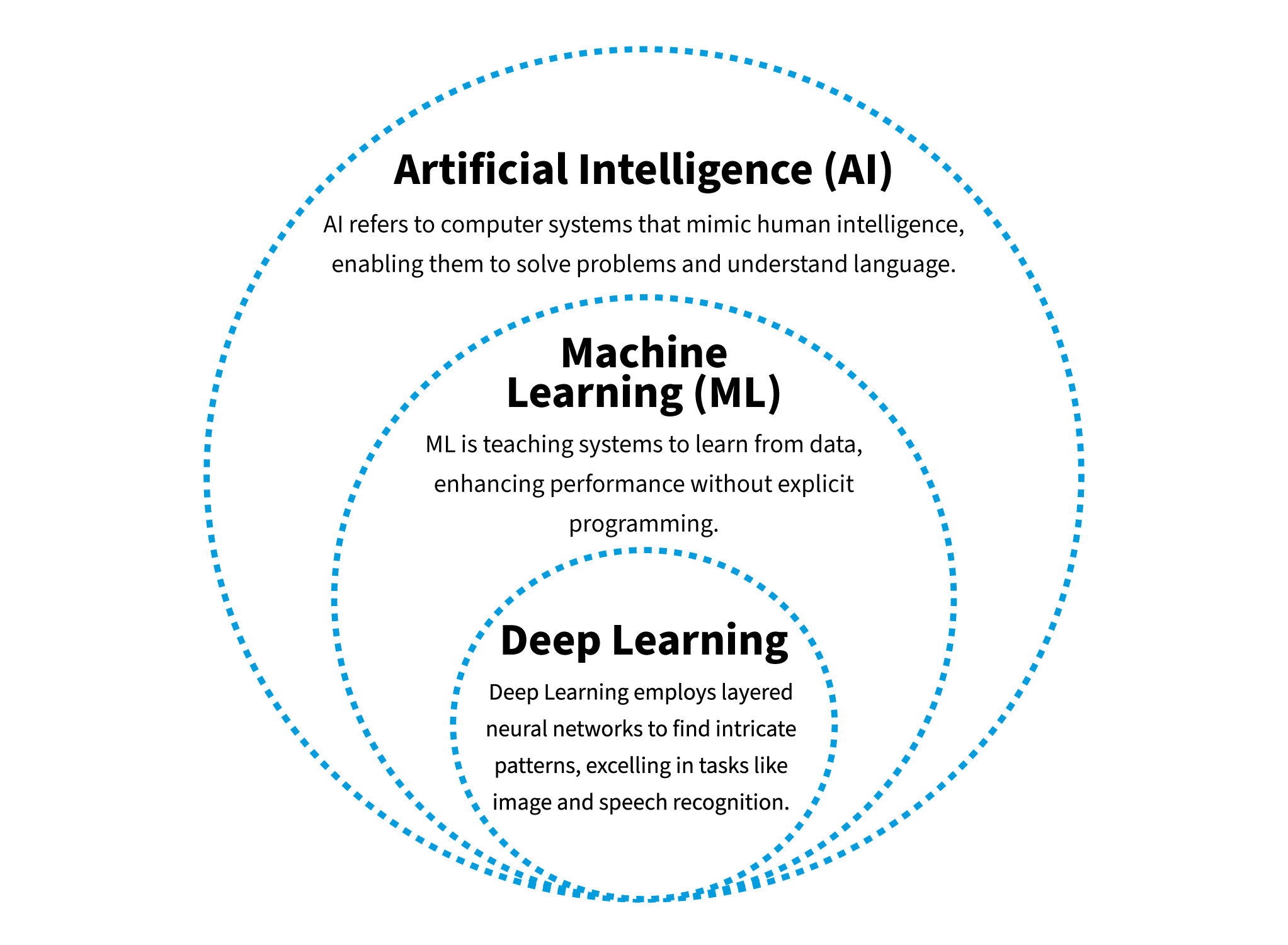
An illustrated infographic that demonstrates how machine learning and deep learning fits in with artificial intelligence.

© Interaction Design Foundation, CC BY-SA 4.0

The AI Landscape: Different Types of Artificial Intelligence

Artificial Intelligence encompasses a spectrum of capabilities, from specialized task-oriented systems to intelligence that mirrors human cognitive functions. At the core of this distinction lies the difference between Narrow AI, also known as Weak AI, and General AI, also known as Strong AI or Artificial General Intelligence (AGI).

Narrow AI

Narrow AI refers to systems tailored for specific, well-defined tasks within a limited scope. Examples of narrow AI models are common in our daily lives, from voice recognition tools like Siri or Alexa to recommendation algorithms powering platforms like Netflix and Spotify. Chatbots assisting with customer service on websites and specialized image recognition software in facial recognition or medical imaging analysis are also instances of narrow AI. Its defining characteristic is its lack of capacity to generalize knowledge beyond its designated domain.

General AI

On the other end of the spectrum is General AI, an advanced form capable of comprehending, learning, and applying knowledge across various tasks—mimicking the breadth of human intelligence. Unlike narrow AI, AGI can reason, problem-solve, adapt, and exhibit self-awareness. The ultimate goal of AGI is to perform any intellectual task that humans can, seamlessly transfer knowledge between domains, and autonomously improve over time.

While narrow AI excels in specific functions, AGI is the pinnacle of AI development. Currently, however, most AI systems are narrow, designed for specialized tasks and lacking the broad adaptability of AGI. Achieving AGI remains the significant and ambitious objective of AI research and development.
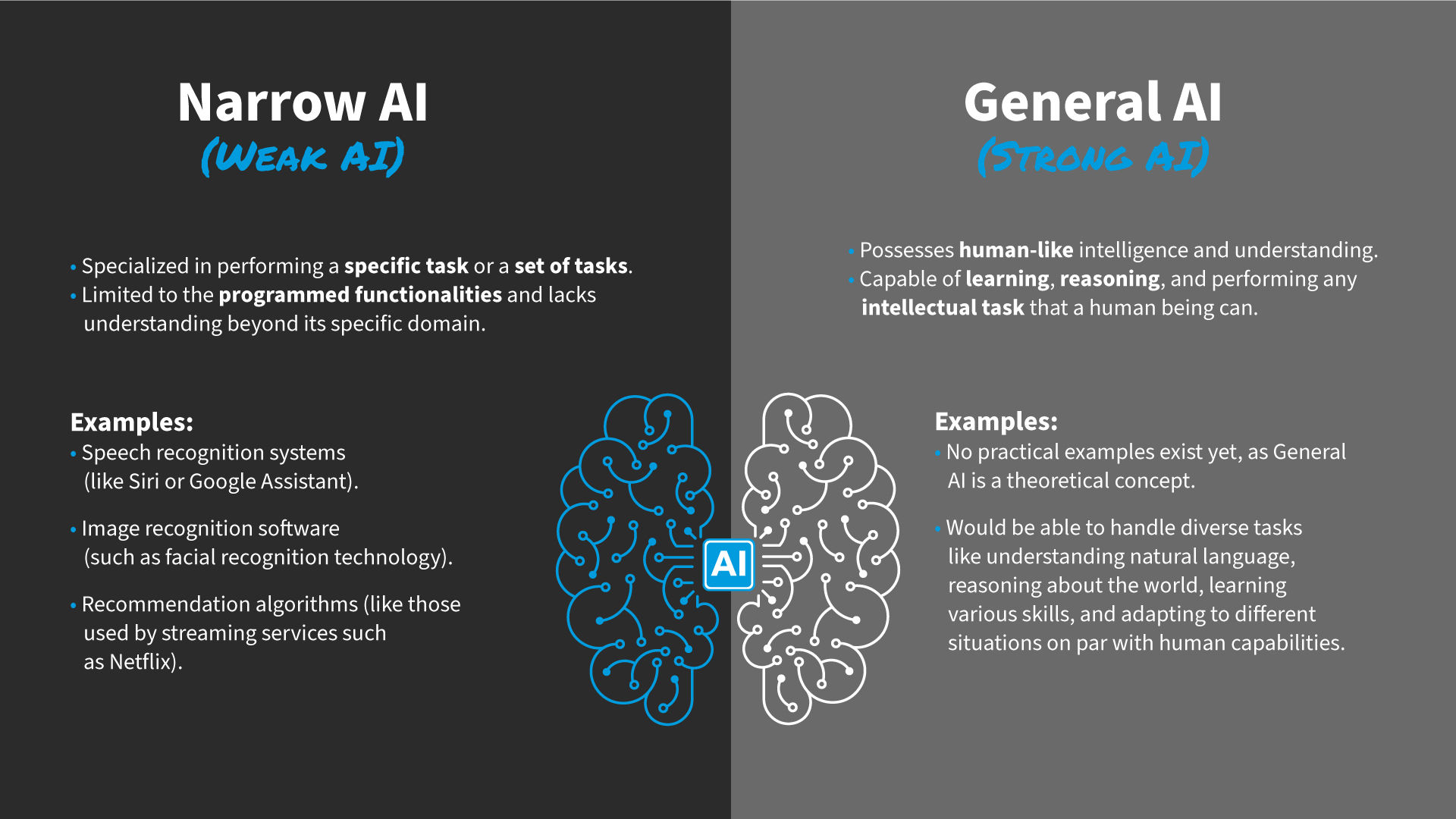
An illustration that represents Narrow AI also known as Weak AI vs General AI or Strong AI. The image includes text descriptions, examples and an illustration of a brain.

© Interaction Design Foundation, CC BY-SA 4.0

The AI Revolution: Generative AI

On the spectrum of AI, generative AI is positioned between narrow and general AI. It’s a category of artificial intelligence that focuses on creating new content, data, or artifacts rather than performing specific predefined tasks, embodying the principles of humanity-centered design to ensure ethical and societal benefits. It involves machines that can produce outputs, such as images, text, or other forms of content, that weren't explicitly programmed into them. Generative AI often employs deep learning and neural networks to learn patterns from large datasets to generate novel outputs. Outputs are created in response to AI prompts. Effective prompts, or prompt engineering, are an essential part of human-AI interaction.

ChatGPT, a generative language model by OpenAI, was released in 2022. Within five days, over a million people had signed up for it. Unlike traditional programs with fixed responses, ChatGPT can dynamically generate answers based on the patterns it learned from vast amounts of text data. This ability makes it versatile—you can ask it questions, request information, or even use it for creative writing. This type of AI is valuable for various tasks, from aiding in research to helping with creative projects.

ChatGPT is also capable of generating unique images from text inputs or prompts. For instance, you can ask ChatGPT to generate an image of a "giant rubber duck" or a "surreal cityscape with floating buildings," and it will produce an original image matching that description. This kind of AI is part of the broader category of generative models designed to create new content. ChatGPT's image generation showcases how AI can be used for artistic and creative endeavors, offering users a new way to generate visual content.

AI-Generated Art

AI-generated art refers to artworks that are created with the assistance or direct involvement of artificial intelligence. In this process, artists or individuals collaborate with AI systems, which can include machine learning models and generative algorithms. These AI tools analyze vast datasets and learn patterns to generate new artistic outputs. AI-generated art spans various forms, including visual arts, music, literature, and more. The unique aspect of AI-generated art lies in the fusion of human creativity with the computational capabilities of AI, challenging traditional ideas of the arts and opening up new possibilities for artistic expression.

Unsupervised from Refik Anadol's Machine Hallucinations project is a fascinating example of AI-generated art. It exemplifies the intersection of technology and creativity. Unsupervised, a product of deep learning algorithms processing vast datasets from the Museum of Modern Art (MoMA), generates abstract images guided by intricate patterns and associations within the museum's collection. This artwork is a testament to the capabilities of generative AI and its potential to produce unique and unexpected outputs that extend beyond explicit programming.

Learn more about AI-generated art, its challenges and opportunities in this video.

Transcript

Ethical Questions Behind Generative AI

In this video, Niwal Sheikh explains how ethical AI applies transparency, fairness, accountability, and privacy to help you judge whether an AI system’s decisions are legitimate and aligned with human values.

Transcript

Transparency becomes a crucial concern as the origin of information and the decision-making process of these AI systems can be obscured. The potential for bias, privacy implications, and the need for explainability in AI-generated content underscore the intricate landscape that artists and technologists navigate.

In this video, Don Norman: Father of User Experience design, author of the legendary book The Design of Everyday Things, co-founder of the Nielsen Norman Group, and former VP of the Advanced Technology Group at Apple, discusses how we can collaborate with AI.

Transcript

Don Norman warns that these programs are not truly intelligent yet. They don't have wants, needs or a sense of self as humans do. Instead, they make decisions based on patterns in data too large for humans to process.

AI follows a complex set of logical rules called algorithms. Multiple algorithms connect in a way that mimics the human brain, called a neural network. This network can learn and improve its process over time. We call this "machine learning."

Artificial intelligence has already improved technologies like voice recognition and language translation. Even still, AI has shown even more potential and some surprising new applications.

For example, AI can create art and literature in the style of human authors and artists. Yet, they don't express emotions or create their own artistic style without human help.

This emerging technology has a variety of exciting and frightening uses. AI programs make it easy to pretend to be someone else or pass off AI content as your own. On top of that, the ethics of sentient AI will be a hot topic in various fields as the technology advances.

What Programs Use AI?

As developments in AI continue to evolve, new AI products are released daily, and existing products incorporate AI features. Here are just a few popular choices.

Text Generators

  • OpenAI ChatGPT: A general-purpose conversational AI known for flexible reasoning and helpful tool-style workflows (e.g., drafting, coding, explaining, iterating) inside a chat interface.

  • Google Gemini: A multimodal AI assistant tightly integrated with Google’s ecosystem, designed to combine strong reasoning with live-search and Google app connections.

Image Generators

  • Midjourney: An art-forward image generator famous for highly stylized, aesthetic results and a community-driven Discord workflow.

  • OpenAI ChatGPT: A chat-based image generator that emphasizes easy prompt-to-image creation and iterative editing/refinement through conversation.

Video and Speech

  • OpenAI Sora: An AI model that generates short videos from text or image prompts, producing realistic or stylized moving scenes.

  • ElevenLabs: An AI voice platform that turns text into natural-sounding speech and supports creating or customizing synthetic voices.

UX Design

  • Google Stitch: An AI UI design tool that turns prompts or rough inputs into interface mockups and usable design/code starting points.

  • Figma AI: A set of AI features inside Figma that helps designers generate ideas, content, and layouts faster while working on designs.

Artificial Intelligence in Design

Interaction designers use AI technologies in a variety of ways. Artificial intelligence improves search algorithms for web searches, streaming services and other platforms. They can analyze terabytes of data to find patterns a human brain couldn't.

There is no doubt that AI will change how users interact with products and services. AI voice assistants and chatbots are examples of interfaces that adapt to user inputs in real-time. UX designers design the voice and the functions of voice assistants to appeal to users. Even though chatbots are text, they still need to make sense in the product's context of use. Like any interface, designers want to make a user experience that users trust and enjoy using.

“There’s a very simple formula, perceived trustworthiness plus perceived expertise will lead to perceived credibility. Since AI is in service to human beings, I can't imagine a case where UX isn’t relevant…If you blow the UX design, it doesn't matter how good the AI is.”

— Dan Rosenberg, UX Professor at San Jose University.

The goal of artificial intelligence today is to be credible. They should be reliable tools and assistants for humans performing specific tasks. This credibility comes partly from a well-designed user experience and intuitive user interface.

Will AI Replace Designers?

Transcript

The potential for AI to replace human workers is possible. But, it is more likely to be used to assist humans in making decisions. For example, AI could assist in usability tests or find patterns in user feedback or other user research tasks. AI has the potential to transform the essential tasks of a UX researcher.

“When it comes to [user] research, it is such a strategic discipline I can't think that we will ever automate it. If we are talking about general usability testing, that is going to be something where AI is going to play a big role. AI does something extremely well and that’s pattern recognition.”

— Greg Nudelman, Head of Design at LogicMonitor and Author on UX for AI

The Future of Artificial Intelligence

Many experts see the potential for AI to change human-computer interaction but also have doubts. AI systems can improve data analysis, assist translation, and help creatives bring ideas to life.

Yet, all this brings up deep ethical questions. Creatives of all types are forced to compete with AI, which can plagiarize their work in minutes. The question of who owns that AI content is also unclear.

Some communities have banned AI art entirely, even as the ability to tell them apart from human work diminishes. Even if AI does not fully replace humans, what will our economy or workplace look like if AI replaces daily tasks or even jobs?

In the future, “Strong AI” would learn, think, and generally function on the same level as humans. As fully sentient beings, there are moral questions of ownership and legal definitions of autonomy to grapple with.

Despite these challenges, tech companies are investing heavily in AI to explore the possibilities.

Questions About Artificial Intelligence (AI)?
We've Got Answers!

How does machine learning differ from AI and deep learning?

Artificial Intelligence (AI) is the broad field of making machines perform tasks that normally require human intelligence. Machine learning (ML) is a subset of AI that allows systems to improve through data and experience without explicit programming. For example, a recommendation engine learns your preferences as you stream shows.

Deep learning is a subset of ML that uses multi-layered neural networks to analyze vast, complex datasets. This permits advanced capabilities such as speech recognition, image classification, and natural language processing (NLP). AI is the umbrella, ML is the approach to learn patterns, and deep learning is the advanced method that powers the most powerful tools today.

Explore what machine learning can do.

What are neural networks, and how do they relate to design?

Neural networks are computational models which the human brain has inspired. They process information through interconnected nodes (“neurons”) that detect patterns across massive datasets. Each layer of the network extracts features: the first might detect edges in images, later layers recognize shapes, and deeper layers identify objects.

In design, neural networks fuel AI systems that perform image recognition, natural language understanding, and personalization. They enable tools like auto-tagging photos, suggesting layouts, or interpreting voice commands. For designers, neural networks open opportunities to create interfaces that feel intuitive, adaptive, and human-like. However, they also raise challenges around transparency, bias, and control. When designers understand how networks make predictions, they can ensure systems remain explainable, trustworthy, and aligned with user needs.

Get right into neural networks to understand how to leverage AI “brains” for the better.

What is the difference between narrow AI and general AI?

The purpose of narrow AI, or “weak AI,” is to perform a specific task exceptionally well—for example, a chatbot answering customer queries. These tools do not “understand” context beyond their domain.

General AI, or “strong AI,” is hypothetical and aims to replicate human-level intelligence. It would reason, adapt, and apply knowledge across any domain, just as people can switch from solving math to writing poetry.

All AI in use is narrow for the moment, effective within constraints but unable to generalize. General AI remains a distant goal of research. The key is to recognize limits; current AI can supercharge experiences in targeted ways but still needs human guidance, creativity, and ethical judgment to stay relevant and safe.

Grab a greater grasp of general AI to explore fascinating points about where AI and design may head in the future.

What is generative AI, and how is it used in creative work?

Generative AI creates new content, such as text, images, video, or code, based on patterns learned from massive datasets. Unlike traditional programs with fixed outputs, generative models like ChatGPT or Gemini produce dynamic, original results in response to prompts.

You can use generative AI to brainstorm ideas, prototype interfaces, generate imagery, or explore variations quickly. For example, ChatGPT can produce unique illustrations for a concept and draft microcopy for a user interface. Artists also collaborate with generative AI to explore new forms of creative expression.

The power of generative AI lies in its ability to augment creativity, speeding exploration and iteration, while humans provide direction, context, and ethical oversight to ensure outcomes serve human goals.

Get right into generative AI for a wealth of insights into its applications and more.

Can AI create full user interfaces or design systems?

Yes, AI can generate user interfaces and whole design systems, but quality depends on context and human input. Some tools can produce layouts or design components from text prompts. These systems speed up repetitive tasks and help non-designers prototype ideas.

However, AI still lacks a deep understanding of user psychology, accessibility, and brand nuance. It can assemble components and mimic existing design languages, but it cannot fully replace human judgment in creating meaningful, usable, and differentiated experiences. So, designers must refine AI outputs to ensure alignment with user needs, brand voice, and accessibility standards. Overall, AI acts as a co-pilot, automating production and exploration, while humans drive the strategy, empathy, and creativity side.

Discover insightful points about how to harness artificial intelligence in design in our article Why Is AI so Important and How Is It Changing the World?.

Will AI replace UX or UI designers in the near future?

No, AI will not replace designers anytime soon, but it will change their work. For example, experts argue that UX research is too strategic and contextual to automate fully. What AI excels at is pattern recognition, data processing, and generating options, which complement human creativity, empathy, and critical thinking. Designers will rely on AI to handle repetitive tasks like generating prototypes, analyzing usability data, or drafting copy.

However, rest assured that designers remain essential in defining problems, ensuring accessibility, shaping ethics, and crafting meaningful experiences. AI cannot grasp human emotions, cultural nuances, or values as people can. Soon, designers who embrace AI as a partner will thrive, while those ignoring it risk losing relevance.

Get a greater grasp of what AI means for UX designers in our article How Can Designers Adapt to New Technologies? The Future of Technology in Design.

How can I stay relevant as a designer in an AI-powered world?

Stay relevant by combining human strengths with AI capabilities. Build up your expertise in strategy, ethics, storytelling, and psychology, areas AI cannot replicate. Learn how AI works, from machine learning basics to prompt engineering, so that you can direct tools effectively.

Develop skills in facilitating workshops, interpreting qualitative insights, and shaping brand identity. Master accessibility and inclusive design to help ensure AI-driven products serve diverse users.

Experiment with AI-powered design tools to accelerate workflows, but maintain a critical eye; AI suggestions need refinement. Lastly, position yourself as a bridge that translates between AI systems, stakeholders, and users. AI cannot “take over” as long as designers embrace adaptability, continuous learning, and ethical leadership in shaping the future of digital experiences.

How do I make AI-driven experiences more ethical and transparent?

We must make sure AI systems are trustworthy. So, begin with explainability; communicate how AI decisions are made in language that users understand. For example, show why a recommendation appears or how personalization works. Address bias by testing datasets for fairness and diversity. AI trained on skewed data can exclude or misrepresent groups.

Respect privacy, minimize data collection, anonymize records, and provide clear consent. Offer control, giving users ways to opt in, adjust, or override AI recommendations. Build accountability into interfaces by signaling when users interact with AI rather than humans.

Overall, AI interactions should be designed to respect autonomy, dignity, and trust. Ethical design ensures users see AI as a partner, not a hidden manipulator.

Find out vital points about respecting users in design and more in our article AI Challenges and How You Can Overcome Them: How to Design for Trust.

How do I use prompt engineering effectively as a designer?

Prompt engineering means crafting inputs that guide generative AI toward useful outputs. Treat prompts like design briefs as a designer, be specific, contextual, and outcome focused. Instead of writing “make a button,” specify “generate a mobile-friendly call-to-action button, with accessible contrast, in a playful brand style.” Iterate; adjust prompts, compare results, and refine wording until you get there.

Use examples, constraints, and role assignment (“act as a UX researcher”) to shape responses. Document effective prompts for reuse in design systems. Test AI outputs against user needs and accessibility guidelinesnever take them at face value.

Designers who master prompt engineering can transform AI from a gimmick into a powerful collaborator, accelerating exploration while keeping control over quality and direction.

Explore prompt engineering for a treasure trove of helpful insights into how to make the best use of it.

How does AI enhance personalization in digital products?

AI enables personalization by analyzing massive user datasets, such as user behavior, preferences, location, history, and tailoring experiences accordingly. Recommendation engines on Netflix or Spotify exemplify this; they predict content you will enjoy by recognizing patterns.

E-commerce platforms use AI to personalize product suggestions, while news apps surface stories that align with interests. In design, AI enhances personalization by adapting interfaces: changing layout, language, or tone based on user context. For example, a fitness app can adjust difficulty levels dynamically.

Done well, personalization increases engagement and loyalty, but designers must balance relevance with privacy: users want helpful customization, not intrusive surveillance. Ethical personalization means transparency, consent, and user control over data-driven adjustments.

Learn how to personalize via AI and more in our article How to Design with AI: 5 Insights to Supercharge Your Work.

How do UX and UI designers use AI in their workflow?

Designers increasingly integrate AI into daily practice. For example, UX researchers use AI to analyze transcripts, detect sentiment, or cluster patterns in feedback. User interface (UI) designers employ tools to generate layouts or icons from text prompts.

UX writers use AI to draft microcopy, error messages, or multilingual variants. Design teams leverage AI chatbots for brainstorming, exploring edge cases, or generating user scenarios. And designers also use AI-powered testing to simulate user interactions and predict usability issues.

However, professionals always refine AI output, checking for accessibility, tone, and alignment with goals. The key is not to replace designers but to empower them with AI as a creative assistant that speeds iteration and broadens exploration.

Discover more about the essential skill of user research and understand why it is vital to help set the foundation for any UX design project or product.

Earn a Gift Earn a Gift, Answer a Short Quiz!

1
2
3
4
1
2
3
4
Question 1
Question 2
Question 3
Get Your Gift
Interaction Design Foundation logo

Question 1

Why do designers need high-quality training data for artificial intelligence (AI) algorithms?

1 point towards your gift

  • To make sure algorithms recognize complex patterns and make accurate predictions
  • To minimize user input during data processing
  • To reduce the computing power required to generate life-like responses.
Interaction Design Foundation logo

Question 2

How can AI improve user interfaces?

1 point towards your gift

  • It can adapt interfaces dynamically based on individual behavior.
  • It can offer generic templates for users.
  • It can reduce the frequency of user interactions.
Interaction Design Foundation logo

Question 3

What is a main ethical concern in AI applications?

1 point towards your gift

  • To design AI algorithms that are energy-efficient
  • To guarantee AI is capable of handling high volumes of data
  • To prevent biases that can lead to discrimination

Learn More About Artificial Intelligence (AI)

Make learning as easy as watching Netflix: Learn more about Artificial Intelligence (AI) by taking the online IxDF Course AI for Designers.

Why? Because design skills make you valuable. In any job. Any industry.

In This Course, You'll

  • Get excited about how quickly you can create meaningful results when you turn AI into your new superpower and combine it with timeless human-centered design skills. As an AI-powered designer, you’ll increase your efficiency and salary potential, and as a human-centered leader, you'll create ethical AI-powered products people love. When these abilities come together, you’ll solve real-world problems faster and make the world a better place. Studies show that AI-driven productivity accelerates growth and helps busy professionals like you achieve in months what once took decades. Now's the time to master the powerful combination that keeps you in demand.

  • Make yourself invaluable when you use AI to accelerate repetitive tasks while applying your irreplaceable human strengths like empathy, critical thinking, and ethical decision-making to guide every solution toward what users truly need. Leaders seek professionals with AI fluency because the people who thrive combine AI efficiency with deep human insight that machines can't replicate. You'll learn to automate and streamline repetitive tasks, make data-driven decisions, and optimize your workflow for innovation and cost savings. No matter your background, you'll easily master AI for Designers. With clear guidance and real-world examples, you'll apply your skills immediately.

  • Gain confidence and credibility as you master the art of text prompts for design. You'll learn how to deal with bias in AI and how to use AI tools to create intuitive user experiences that drive business success. You can fast-track your portfolio of AI-enhanced case studies with step-by-step guidance, practical tips for real-life projects, and downloadable templates. This course gives you the hands-on knowledge to guide AI with timeless human-centered design skills, and that's how you stay in demand in any industry!

It's Easy to Fast-Track Your Career with the World's Best Experts

Master complex skills effortlessly with proven best practices and toolkits directly from the world's top design experts. Meet your experts for this course:

  • Ioana Teleanu: Founder of UX Goodies and former Lead Product Designer (AI) at Miro.

  • Rafael Hernandez: Lead Product Designer at T. Rowe Price.

  • Jarvis Moore: Senior Design Lead, Design Systems at Microsoft.

  • Niwal Sheikh: Product Design Lead at Netflix.

  • Vitaly Friedman: Senior UX Consultant for the European Parliament, and Creative Lead, Smashing Magazine.

  • Pablo Stanley: Designer and CEO of Musho and Lummi.

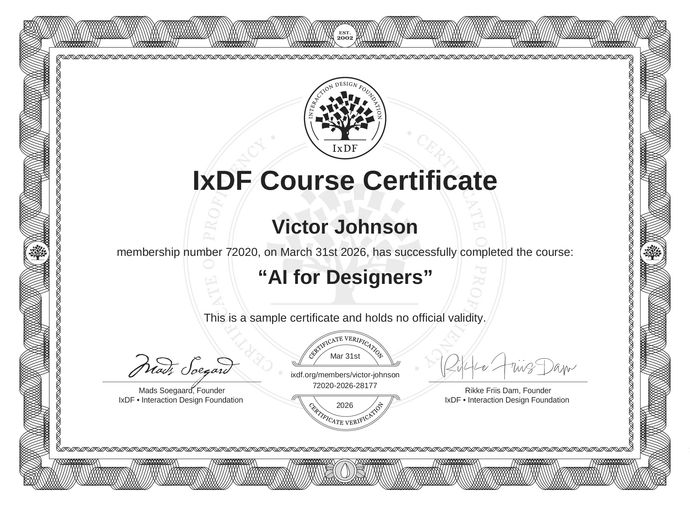
Get an Industry-Recognized IxDF Course Certificate

Increase your credibility, salary potential and job opportunities by showing credible evidence of your skills.

IxDF Course Certificates set the industry gold standard. Add them to your LinkedIn profile, resumé, and job applications.

Course Certificate Example

Be in distinguished company, alongside industry leaders who train their teams with the IxDF and trust IxDF Course Certificates.

Our clients: IBM, HP, Adobe, GE, Accenture, Allianz, Phillips, Deezer, Capgemin, Mcafee, SAP, Telenor, Cigna, British Parliament, State of New York

All Free IxDF Articles on Artificial Intelligence (AI)

Read full article
No-UI: How to Build Transparent Interaction - Article hero image
Interaction Design Foundation logo

No-UI: How to Build Transparent Interaction

Here, we will explore and teach you about the incredible user experience opportunities which you can take advantage of when designing for interaction beyond the classical Graphical User Interface (GUI). Non-visual User Interaction (no-UI) is pioneered by the ground-breaking work of researchers who h

Social shares
874
Published
Read Article
Read full article
Healthcare UX: Design that Saves Lives - Article hero image
Interaction Design Foundation logo

Healthcare UX: Design that Saves Lives

UX (user experience) design has the potential to improve people’s everyday lives. The stakes are even higher if you work as a UX designer in the healthcare industry. The health-tech sector is among the fastest-growing in the world, with expected revenue of USD 1,305.1 billion in 2030, according to G

Social shares
824
Published
Read Article
Read full article
How Can Designers Adapt to New Technologies? The Future of Technology in Design - Article hero image
Interaction Design Foundation logo

How Can Designers Adapt to New Technologies? The Future of Technology in Design

The design industry is rapidly evolving with the integration of technologies such as artificial intelligence (AI) and 3D printing. While there may be concerns about job displacement, history has demonstrated that new technologies typically create more job opportunities. Don Norman, author of The Des

Social shares
667
Published
Read Article
Read full article
Why Is AI so Important and How Is It Changing the World? - Article hero image
Interaction Design Foundation logo

Why Is AI so Important and How Is It Changing the World?

You've heard about AI and all the wonderful (and sometimes scary) possibilities. But unlike sci-fi apocalyptic movies, AI isn't out to destroy humanity. Let's take a look at the challenges and opportunities we face as AI meets design.In this video, Ioana Teleanu, Founder of UX Goodies and former Lea

Social shares
444
Published
Read Article
Read full article
Your Practical Prompt Playbook: Get Better Results from AI Right Now - Article hero image
Interaction Design Foundation logo

Your Practical Prompt Playbook: Get Better Results from AI Right Now

If you’re going to collaborate seamlessly with Artificial Intelligence (AI), then you’ve got to master the art of effective communication and, with that, craft prompts that precisely guide the AI to the outcomes you want. Let's look at the complexities of prompt engineering and p

Social shares
616
Published
Read Article
Read full article
How to Supercharge Your Design Workflow with AI - Article hero image
Interaction Design Foundation logo

How to Supercharge Your Design Workflow with AI

AI won't replace you. But a designer who uses AI will. That's the reality we face today. AI amplifies your natural ability to solve people's problems, improve their lives, and do fulfilling, career-accelerating work. But it can't replace your human-centered skills like empathy, creativity, and syste

Social shares
601
Published
Read Article

Why Is AI so Important and How Is It Changing the World?

Why Is AI so Important and How Is It Changing the World?

You've heard about AI and all the wonderful (and sometimes scary) possibilities. But unlike sci-fi apocalyptic movies, AI isn't out to destroy humanity. Let's take a look at the challenges and opportunities we face as AI meets design.

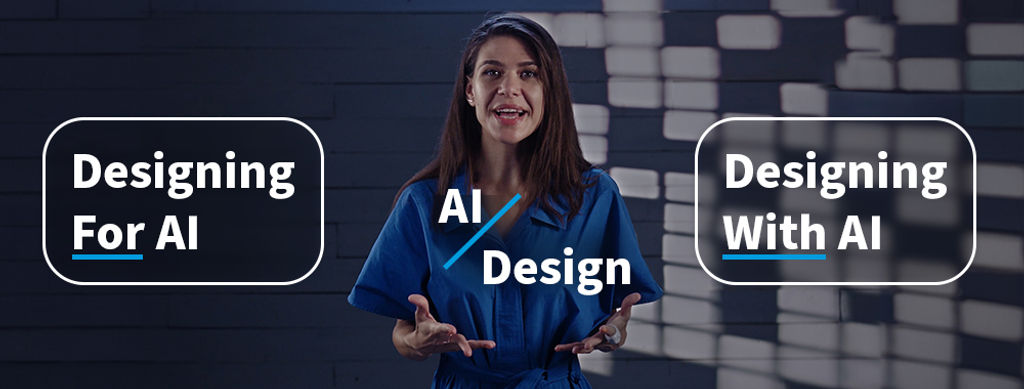
In this video, Ioana Teleanu, Founder of UX Goodies and former Lead Product Designer (AI) at Miro, talks about the impact of AI on design from two perspectives: “Designing for AI” products and “Designing with AI”.

Transcript

How AI is Changing the World

AI is already reshaping our world, from its profound influence on healthcare and education to its transformative impact on transportation and agriculture:

  • Chatbots are commonplace, AI-generated art is everywhere, and prompt engineering is now an essential skill.

  • Stanford's AI Index Report shows AI adoption jumped from 55% of organizations in 2024 to 78% in 2025.

  • A report by PwC says that people with advanced AI skills earned a 56% wage premium compared to those without (based on nearly 1 billion job ads).

In this video, we'll navigate the intricate terrain of AI's far-reaching effects, and explore the concerns it raises and its remarkable potential across diverse domains.

Transcript

The Take Away

In AI and design, we have two core aspects: "Designing for AI" and "Designing with AI".

  • "Designing for AI" means that we incorporate AI into the solutions that we design. Don’t think of products based on detailed commands; rather, express goals and let AI work out the steps. This changes the way we think about products and solutions.

  • "Designing with AI" means that we can incorporate AI into our design process. We can think of it as a partner and collaborator.  We can use AI as an exoskeleton and augment our capabilities.

AI brings both concerns and undeniable benefits. While some express worries about its rapid development, AI also holds immense potential. It can revolutionize healthcare, education, environmental sustainability, transportation, and productivity. Historically, such technological shifts have raised concerns, but they've ultimately led to new opportunities and societal changes. Thus, it's crucial to approach AI with a balanced perspective and recognize its dual nature.

References and Where to Learn More

Watch our 1-hour Master Class with Rafael Hernandez, Lead Product Designer at T. Rowe Price, and discover how to Get Ahead in Product Design with AI.

Explore our comprehensive article on Artificial Intelligence for a complete overview of AI in design, along with additional resources.

Find out how to get an AI efficiency boost as you build your design portfolio in our article, Create a Winning UX/UI Portfolio: Optimize with AI.

Hero image: © Interaction Design Foundation, CC BY-SA 4.0

Feel Stuck?
Want Better Job Options?

AI is replacing jobs everywhere, yet design jobs are booming with a projected 45% job growth. With design skills, you can create products and services people love. More love means more impact and greater salary potential.

At IxDF, we help you from your first course to your next job, all in one place.

See How Design Skills Turn Into Job Options
Privacy Settings
By using this site, you accept our Cookie Policy and Terms of Use.
Customize
Accept all

Be the One Who Inspires

People remember who shares great ideas.

Share on:

Academic Credibility — On Autopilot

Don't waste time googling citation formats. Just copy, paste and look legit in seconds.