Artificial General Intelligence (AGI) or General AI represents a theoretical form of artificial intelligence (AI) that can solve any task using human-like cognitive abilities. Unlike its specialized counterpart, Narrow AI, which is designed for specific tasks, General AI should emulate the breadth and depth of human intelligence across many domains.
In this video, AI Product Designer Ioana Teleanu explains the differences between General AI and Narrow AI.
Narrow AI vs General AI: What’s the Difference?
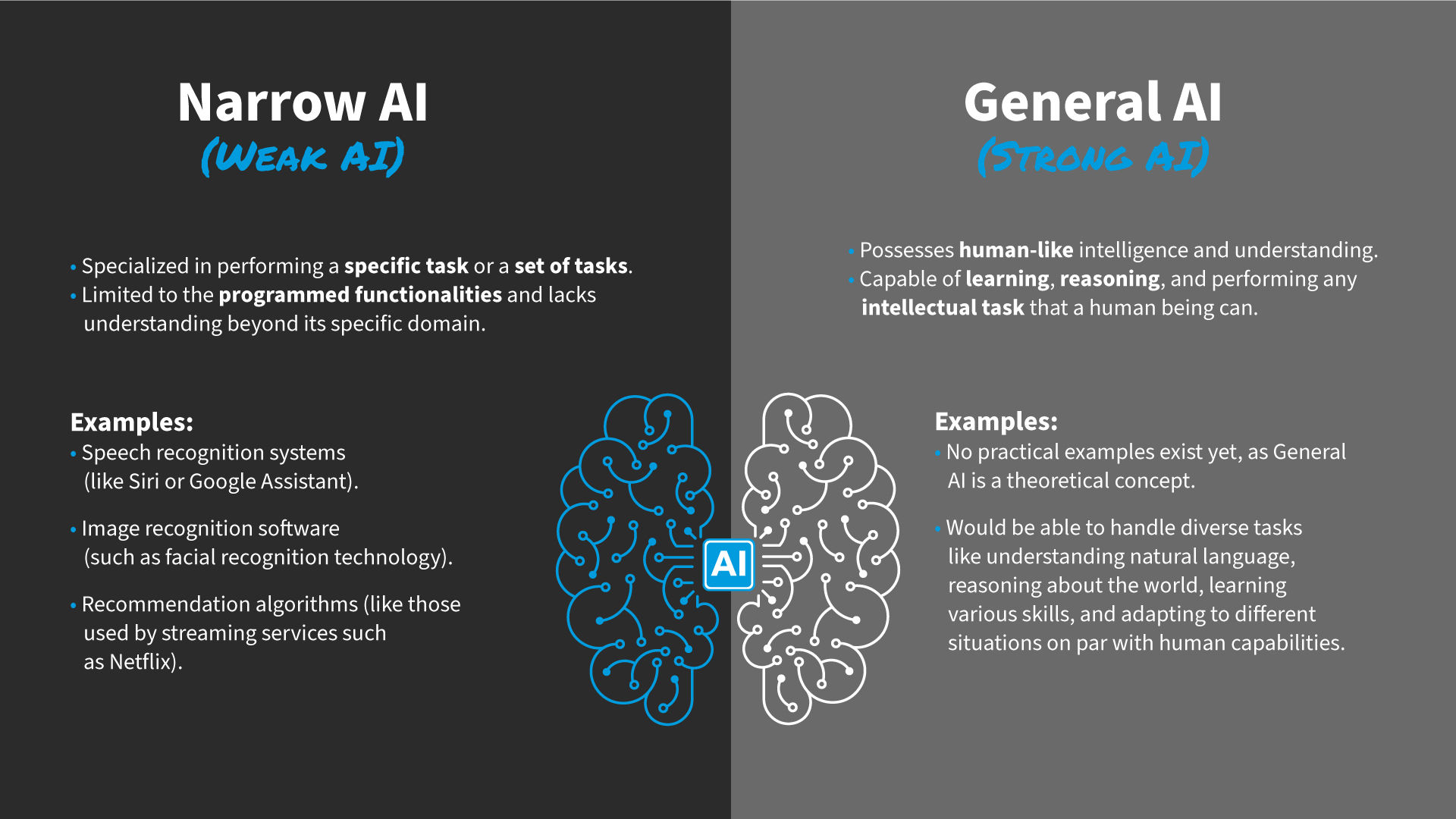
General AI, or Strong AI, represents a significant step forward in artificial intelligence. General AI systems will have the ability to understand, learn, and apply knowledge across various tasks akin to human adaptability. As of now, no truly Strong AI exists. While General AI is a promising concept, current AI systems, including those labeled as Strong AI, are more accurately described as advanced Narrow AI. In contrast, Narrow AI is finely tuned for specific jobs, showcasing expertise in defined areas but lacking the broad adaptability that defines the envisioned future of General AI.
© Interaction Design Foundation, CC BY-SA 4.0
Key Distinctions:
Scope of Tasks:
General AI: Capable of performing any intellectual task that a human being can.
Narrow AI: Specialized in a specific task or set of tasks.
Learning and Adaptation:
General AI: Possesses the capacity to learn from experience and apply knowledge to unfamiliar scenarios.
Narrow AI: Limited to predefined tasks and cannot generalize knowledge.
Flexibility:
General AI: Exhibits adaptability across diverse domains akin to human intelligence.
Narrow AI: Highly specialized and lacks versatility.
General AI: Beyond Specialization
General AI represents the pinnacle of artificial intelligence. It encapsulates the vision of creating machines with cognitive abilities mirroring those of humans. General AI systems would not only comprehend and execute specific tasks but would possess the capacity to understand, learn, and apply knowledge across a diverse spectrum of tasks, much like the versatility inherent in human intelligence.
The defining characteristic of General AI lies in its departure from specialization. While Narrow AI excels within the confines of specific domains, General AI transcends these boundaries and demonstrates adaptability, reasoning, and problem-solving skills across various contexts. Imagine an artificial entity that can seamlessly switch from recognizing speech to playing chess, translating languages, and even understanding abstract concepts.
What Could General AI Mean for Designers?
New Design Frontiers
For designers, the prospect of General AI introduces a paradigm shift in the creative process. While Narrow AI has proven invaluable for specific applications, the versatility of General AI opens doors to entirely new design possibilities. Imagine a design tool that not only understands user preferences but anticipates needs, learns from design iterations and adapts to evolving trends.
Groundbreaking User-Centric Experiences
General AI has the potential to revolutionize user experiences by offering personalized, adaptive interfaces that go beyond predefined patterns. Designers can create interfaces that respond to user input and proactively tailor themselves based on user behavior, preferences, and contextual understanding.
Collaborative Design Partners
As General AI evolves, designers may work alongside AI collaborators capable of contributing creative insights, suggesting design elements, and even participating in ideation sessions. This General AI-designer collaboration can accelerate the design process, introduce innovative perspectives, and transform how designers approach problem-solving.
How Could General AI Impact Design?
While we have yet to witness the full realization of General AI-powered products, exploring the potential impact on product design opens many possibilities. The adaptability and broad comprehension inherent in General AI could revolutionize the way we conceive, create, and interact with products.
Personalized Product Experiences
In contrast to Narrow AI-driven personalization, which often relies on predefined algorithms, General AI could offer a deeper level of personalization. Products might dynamically adapt to individual preferences, learning and evolving with user interactions in a more nuanced and responsive manner.
Intuitive User Interfaces
While Narrow AI has improved user interfaces by responding to explicit commands, General AI's contextual understanding could elevate interfaces to new heights of intuitiveness. The ability to comprehend natural language and anticipate user intentions might lead to more seamless and anticipatory interfaces.
Enhanced Problem-Solving Capabilities
While Narrow AI excels in specific problem-solving tasks, General AI could bring a more holistic approach. Products might possess advanced troubleshooting capabilities, offering dynamic solutions to various challenges in electronic devices or professional tools.
Context-Aware Design
Compared to Narrow AI's context awareness, which is often confined to specific domains, General AI's contextual understanding could transcend boundaries. Products might adapt to the environment and user behavior in a more nuanced and comprehensive manner, creating truly context-aware and personalized experiences.
Collaborative Design Partnerships
While Narrow AI assists in specific design tasks, General AI could redefine collaboration itself. Acting as collaborative design partners, General AI might contribute to ideation, suggest creative solutions, and predict user preferences in a manner that goes beyond the task-specific assistance provided by Narrow AI.
Integration with Emerging Technologies
The convergence of General AI with emerging technologies such as augmented reality (AR), virtual reality (VR), and the Internet of Things (IoT) would present new opportunities for designers. Immersive experiences, intelligent environments, and context-aware interfaces become tangible possibilities.
Design for Cognitive Augmentation
Designers could explore how General AI can augment human cognitive abilities. From assisting in complex problem-solving to enhancing creativity, AI systems could become invaluable tools that amplify the capabilities of users.
User Education and Empowerment
If and when General AI enters the mainstream, designers will have to educate users about the capabilities and limitations of these systems. Transparent and user-friendly interfaces will be essential to foster trust and understanding.
General AI has the potential to reshape the landscape of product design. It offers new dimensions of personalization, intuitiveness, and problem-solving that could redefine user experiences in the future.
Ethical Considerations in General AI Design
Designers can embrace the potential of General AI if they’re able to master the technical aspects and navigate the ethical and societal implications. Designers must ensure that AI-driven designs align with ethical standards, promote inclusivity, and avoid biases.
In this video, Ioana Teleanu talks about how to design for trust with AI.
Designers will influence frameworks that prioritize ethical principles, transparency, and user well-being as General AI evolves.
1. Bias and Fairness: General AI systems can inadvertently perpetuate biases present in their training data. Designers must ensure these systems are trained on diverse and representative datasets so that they don’t reinforce societal biases.
2. Privacy Concerns: General AI’s extensive capabilities in understanding and interpreting data bring forth privacy issues. Designers have to strike a balance between innovation and the protection of individual privacy.
3. Accountability and Transparency: It will be challenging to determine the accountability of General AI as General AI systems will be able to make decisions autonomously. It’s essential to ensure transparency of how these systems reach conclusions tor establish trust and to understand their impact.
4. Unintended Consequences: The adaptability of General AI introduces the possibility of unintended consequences. Designers must anticipate and mitigate potential risks, to ensure that AI systems operate within ethical boundaries.
5. Social Impact: General AI can influence societal structures, and potentially impact employment, accessibility, and power dynamics. Ethical considerations of General AI should encompass a broad understanding of the societal implications and strive for inclusivity and positive transformation.
What Are the Challenges for General AI?
Technological Challenges
The vision of General AI is beguiling, but the technological challenges are formidable. There should be significant advancements in machine learning, natural language processing, and a deeper understanding of human consciousness to achieve human-level cognition.
Ethical Dilemmas
The potential impact of General AI on employment, privacy, and societal structures raises ethical dilemmas. Designers must grapple with questions surrounding the responsible deployment of AI and its implications for individuals and communities.
Design for Human AI Interaction
If and when General AI becomes a reality, designers will need to explore ways to facilitate seamless collaboration between humans and AI entities. This involves how to design intuitive interfaces, establish clear communication channels, and ensure that AI systems augment human capabilities rather than replace them.
The Current Landscape of General AI Development
General AI remains an aspirational goal rather than a fully realized reality. Notable advancements in specific AI domains characterize the landscape of General AI development:
1. Specialized AI Applications: Current efforts in AI development primarily focus on specialized applications (Narrow AI). These systems demonstrate proficiency in specific tasks but need broader adaptability and understanding associated with General AI.
2. Research and Exploration: Research in General AI is ongoing, many projects explore various aspects of how to replicate human-like intelligence. However, the intricate nature of cognition, consciousness, and adaptability poses significant challenges, and breakthroughs in these areas are yet to materialize fully.
3. Task-Specific Achievements: AI systems have achieved remarkable feats in specific tasks, such as image recognition, natural language processing, and game playing. These achievements showcase the potential of AI but underscore the task-specific nature of current developments.
4. Ethical and Regulatory Considerations: The development of General AI is accompanied by increased attention to ethical and regulatory considerations. As the field advances, there is a growing recognition of the need for responsible AI practices to address issues like bias, transparency, and accountability.
5. Collaboration Across Industries: General AI development involves collaborative efforts across academic, corporate, and research institutions. A multidisciplinary approach, with expertise from computer science, neuroscience, ethics, and other fields, is essential to try to general intelligence.
6. Awareness of Limitations: Stakeholders in the AI community are increasingly aware of the limitations associated with current AI systems. It’s important to acknowledge these limitations to steer development in a direction that aligns with realistic expectations and responsible AI practices.
While the current status of General AI development showcases significant advances in specialized AI applications, achieving a comprehensive understanding and replication of human intelligence remains a long-term and evolving endeavor.
Theoretical Framework: How Could General AI Work?
The realization of General AI would involve the replication of the versatility and adaptability of human intelligence. Researchers have suggested several theoretical approaches:
1. Cognitive Architectures: One approach envisions General AI through the implementation of cognitive architectures inspired by human cognition. These architectures emulate the hierarchical and interconnected nature of the human brain, which allows learning, reasoning, and adapting to a broad range of tasks.
2. Transfer Learning and Meta-Learning: General AI may leverage transfer learning and meta-learning paradigms. Transfer learning involves applying knowledge gained in one task to improve performance in a new, related task. Meta-learning takes this a step further by enabling the AI system to learn how to learn, which facilitates adaptation to novel tasks more efficiently.
3. Reinforcement Learning and Autonomy: Reinforcement learning, a prominent paradigm in AI, involves the system learning through trial and error, receiving feedback on actions taken in an environment. General AI could rely on reinforcement learning mechanisms, coupled with a high degree of autonomy, which enables the system to navigate and learn from various scenarios.
4. Hybrid Models and Integrative Approaches: Hybrid models which combine symbolic reasoning with statistical methods, present another avenue for General AI. Integrative approaches aim to merge the strengths of different AI techniques to create a more robust and adaptable system capable of tackling a broad spectrum of tasks.
5. Neural Network Architectures: Deep neural networks, inspired by the structure of the human brain, are pivotal in AI advancements. General AI might incorporate highly sophisticated neural network architectures that foster complex learning, abstraction, and pattern recognition, which contributes to its adaptability.
6. Neurosymbolic Systems: A promising direction involves neurosymbolic systems—this integrates symbolic reasoning with neural networks. This approach combines the logical and abstract reasoning capabilities of symbolic AI with the pattern recognition and learning capabilities of neural networks, which potentially leads to a more comprehensive form of AI.
Breakthroughs in understanding human cognition, advancements in hardware capabilities, and innovative algorithmic developments are needed to achieve General AI. Theoretical explorations pave the way for interdisciplinary research, which encourages collaboration between experts in computer science, neuroscience, psychology, and related fields to unravel the complexities of replicating generalized human cognitive abilities in AI systems.