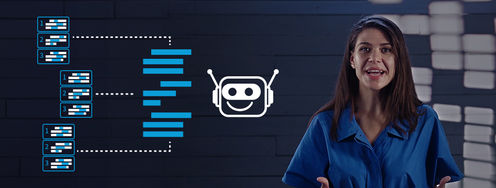
Screenshot of Ioana Teleanu stating that designers should push for transparency.

AI Challenges and How You Can Overcome Them: How to Design for Trust

by Laia Tremosa, Molly Fitz-Patrick and Kasturika Kasturika • 27 min read

613 Shares

As a designer, designing for trust in Artificial Intelligence (AI) products is paramount. AI presents unique challenges that require transparent interfaces, clear feedback, and ethical considerations to build user confidence. If you prioritize trust, you can ensure user adoption and satisfaction, which enhances the overall user experience in AI-powered products.

In this video, Ioana Teleanu, Founder of UX Goodies and former Lead Product Designer (AI) at Miro, discusses AI hallucination and how to ensure that your AI-enabled solutions are reliable and trustworthy.

Transcript

“We all fear what we do not understand.”

― Dan Brown, The Lost Symbol

The best way to build trust with our users is to be as transparent as possible (without overwhelming the user with too much technical information).

  1. Clearly communicate:

    1. Where does your system get its data? Indicate sources where possible.

    2. What user-generated information does the system use? For example, does the system rely on other users to provide data? 

    3. How does your system learn from user data?

    4. What are the chances of errors?

  2. If your system relies on personal data (such as location data, demographic information, or web usage metrics):

    1. Always collect this information with full consent.

    2. Ask users to explicitly opt in to share information instead of asking them to turn off the setting.

    3. Allow the user to use your solution without providing any personal data.

Characteristics of a Trustworthy AI System

The National Institute of Standards and Technology (NIST) defines seven characteristics of a trustworthy AI system:  

  1. Valid and reliable: Validity refers to the system’s ability to meet user needs. Reliability refers to the system’s ability to keep performing without fail. To ensure your AI products are valid and reliable, define success criteria and metrics to measure the performance of the system. Constantly assess the system to confirm it's performing as intended.

  2. Safe: AI systems must never cause harm to their users. Rigorously test and simulate real-world usage to detect possible use cases where the system may cause harm and address them through design. Designers, data scientists, and developers must work together to safeguard user safety. For example, you may prohibit a user from performing certain actions based on their age or location, or display warnings prominently. 

  3. Secure and resilient: A system is resilient if it can continue to perform under adverse or unexpected conditions and degrade safely and gracefully when this is necessary. For example, you might design a non-AI-based solution to allow the user to continue using the solution in case the AI system breaks down. 

  4. Accountable and transparent: Transparency refers to the extent to which users can get information about an AI system throughout its lifecycle. The more transparent a system is, the more likely people are to trust it. For example, the system can provide status updates on its functioning or information on its process so that people using the system can understand it better.

  5. Explainable and interpretable: An explainable system is one that reveals how it works. The system can offer descriptions tailored to users’ roles, knowledge, and skill levels. Explainable systems are easier to debug and monitor.

  6. Privacy-enhanced: Privacy refers to safeguarding users’ freedoms, identities and dignity. There is a tradeoff between enhanced privacy and bias. Allowing people to remain anonymous can limit the inclusive data needed for AI to function with minimal bias.

  7. Fair with harmful bias managed: Fairness relates to equality and eliminating discrimination. Bias isn’t always negative. Fairness is a subjective term that differs across cultures and even specific applications.

Use this checklist to check the reliability of your AI tool.
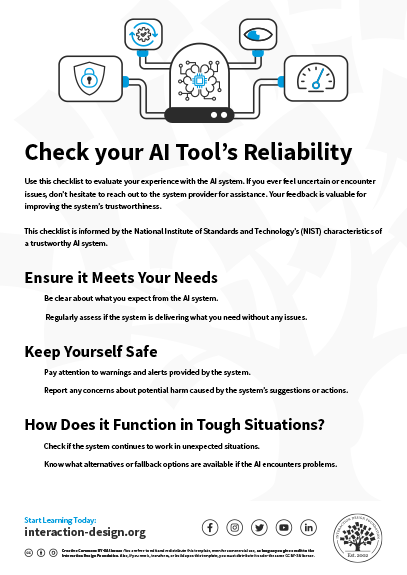
Advance Your Career With This Free Template for “Check Your AI Tool's Reliability”
Check Your AI Tool's Reliability
We respect your privacy
Get 1 powerful email each week: Design a life you love!

Unsupervised: AI Art that Sidesteps the Copyright Debate

Generative AI can create stunning works of art. Unsupervised, part of artist Refik Anadol’s project, called Machine Hallucinations, is a generative artwork. The abstract images are driven by the Museum of Modern Art’s (MoMA) data, guided by machine learning and intricate algorithms, showcasing the intersection of art and cutting-edge AI research.

Anadol trained a unique AI model to capture the machine's "hallucinations" of modern art in a multi-dimensional space. Data was collected from MoMA’s extensive collection and processed with machine learning models.

This project tackles the challenges of AI-generated art: It has huge potential for creative expression, but it raises concerns with transparency and ethics. Anadol's work invites a conversation about the interplay between art, AI research, and technology's far-reaching impact. 

The art copyright debate centers on attributing creative rights in AI-generated artworks. Traditionally, copyright law is based on human authorship. Unsupervised addresses this issue by openly acknowledging the collaborative role of its AI model, StyleGAN2 ADA, in creating the art. This approach avoids copyright complexities by recognizing both the AI and the human artist, Refik Anadol, as co-creators. In doing so, Unsupervised fosters a shared authorship model, providing transparency and clarity in navigating the evolving landscape of art copyright for AI-generated works. 

Transcript

The Take Away

In design, building trust with users is paramount, especially with AI, and transparency plays a pivotal role. As designers, it's essential to clearly communicate various aspects, such as the data sources, how the system learns from user data, and the probability of errors. 

A trustworthy AI system possesses several vital attributes. Firstly, it must be valid and reliable, meeting user needs and performing consistently. Safety is non-negotiable; rigorous testing is crucial to detect potential harm, and collaboration between designers, data scientists, and developers is vital to ensure user safety. 

Accountability and transparency are achieved through regular status updates and clear insights into the system's processes. Explainability and interpretability make the system understandable, aiding in debugging and monitoring. 

Privacy-enhanced AI respects users' privacy while managing biases, acknowledging the delicate balance between privacy and data inclusivity. Lastly, fairness, a nuanced concept varying across cultures, should be strived for, with careful management of biases to eliminate discrimination.

As a designer, it is fundamental that you understand and implement these principles in order to craft ethical and trustworthy AI systems.

References and Where to Learn More

Watch our Master Class with Niwal Sheikh, Product Design Lead, Netflix, Human-Centered Design for AI.

Learn More in This Course:

AI for Designers

12 days
13 % booked
View Course

What You Should Read Next

  • Read full article
    ChatGPT for UX Design: 7 of Our Favorite Prompts - Article hero image
    Interaction Design Foundation logo

    ChatGPT for UX Design: 7 of Our Favorite Prompts

    Your creative process is a precious part of how you design—as in, it’s the engine behind it all. And in the era of ChatGPT—a real game-changer in design—there’s one question in particular that might be top of mind: How can the worlds of artificial intelligence (AI) and user experience (UX) design co

    Social shares
    1k
    Published
    Read Article
  • Read full article
    UI & UX Designer Salaries: How Much Can I Earn in 2026? - Article hero image
    Interaction Design Foundation logo

    UI & UX Designer Salaries: How Much Can I Earn in 2026?

    How much can you earn as a UI or UX designer in 2026? The truth is that there's no single answer. Your earning potential depends less on averages and more on factors you can actually control. Designers using AI to accelerate execution while bringing strategic thinking, user empathy, and measurable b

    Social shares
    942
    Published
    Read Article
  • Read full article
    No-UI: How to Build Transparent Interaction - Article hero image
    Interaction Design Foundation logo

    No-UI: How to Build Transparent Interaction

    Here, we will explore and teach you about the incredible user experience opportunities which you can take advantage of when designing for interaction beyond the classical Graphical User Interface (GUI). Non-visual User Interaction (no-UI) is pioneered by the ground-breaking work of researchers who h

    Social shares
    874
    Published
    Read Article
  • Read full article
    Healthcare UX: Design that Saves Lives - Article hero image
    Interaction Design Foundation logo

    Healthcare UX: Design that Saves Lives

    UX (user experience) design has the potential to improve people’s everyday lives. The stakes are even higher if you work as a UX designer in the healthcare industry. The health-tech sector is among the fastest-growing in the world, with expected revenue of USD 1,305.1 billion in 2030, according to G

    Social shares
    824
    Published
    Read Article
  • Read full article
    How Can Designers Adapt to New Technologies? The Future of Technology in Design - Article hero image
    Interaction Design Foundation logo

    How Can Designers Adapt to New Technologies? The Future of Technology in Design

    The design industry is rapidly evolving with the integration of technologies such as artificial intelligence (AI) and 3D printing. While there may be concerns about job displacement, history has demonstrated that new technologies typically create more job opportunities. Don Norman, author of The Des

    Social shares
    667
    Published
    Read Article
  • Read full article
    Create a Winning UX/UI Portfolio: Optimize with AI - Article hero image
    Interaction Design Foundation logo

    Create a Winning UX/UI Portfolio: Optimize with AI

    You’re a designer. You’ve got talent, vision, and a lot of potential—and know that, somewhere ahead, you’ve got an open road on a great employment “highway” to fulfill that potential. But what about putting that portfolio together? You know you need it, but it can feel like an endless traffic jam of

    Social shares
    622
    Published
    Read Article
  • Read full article
    How to Design with AI: 5 Insights to Supercharge Your Work - Article hero image
    Interaction Design Foundation logo

    How to Design with AI: 5 Insights to Supercharge Your Work

    With AI, you’ve got a faster track to creating ideas and prototypes. Master the art of intelligent design in our AI for Designers course. Find out how to get artificial intelligence working for you to elevate your design process to new levels and really captivate users from the outset. Read on and g

    Social shares
    617
    Published
    Read Article
  • Read full article
    Your Practical Prompt Playbook: Get Better Results from AI Right Now - Article hero image
    Interaction Design Foundation logo

    Your Practical Prompt Playbook: Get Better Results from AI Right Now

    If you’re going to collaborate seamlessly with Artificial Intelligence (AI), then you’ve got to master the art of effective communication and, with that, craft prompts that precisely guide the AI to the outcomes you want. Let's look at the complexities of prompt engineering and p

    Social shares
    616
    Published
    Read Article
  • Read full article
    How to Supercharge Your Design Workflow with AI - Article hero image
    Interaction Design Foundation logo

    How to Supercharge Your Design Workflow with AI

    AI won't replace you. But a designer who uses AI will. That's the reality we face today. AI amplifies your natural ability to solve people's problems, improve their lives, and do fulfilling, career-accelerating work. But it can't replace your human-centered skills like empathy, creativity, and syste

    Social shares
    601
    Published
    Read Article
  • Read full article
    Design Freedom: Automate Repetitive Tasks in the Design Process - Article hero image
    Interaction Design Foundation logo

    Design Freedom: Automate Repetitive Tasks in the Design Process

    Ever found your workday disappearing into tasks that don't require your expertise? Scheduling meetings, reformatting decks, and tracking action items can keep you from the strategic design work you were hired to do. AI won't fix bad processes, but it can reclaim hours lost to repetitive work. Hours

    Social shares
    536
    Published
    Read Article

Top Articles

Top Topic Definitions

Feel Stuck?
Want Better Job Options?

AI is replacing jobs everywhere, yet design jobs are booming with a projected 45% job growth. With design skills, you can create products and services people love. More love means more impact and greater salary potential.

At IxDF, we help you from your first course to your next job, all in one place.

See How Design Skills Turn Into Job Options
Privacy Settings
By using this site, you accept our Cookie Policy and Terms of Use.
Customize
Accept all

Be the One Who Inspires

People remember who shares great ideas.

Share on:

Academic Credibility — On Autopilot

Don't waste time googling citation formats. Just copy, paste and look legit in seconds.

Feel Stuck? Want Freedom?

Join 326,029+ designers who get one powerful email each week. Learn to design a life you love.

Next email in
1
day
13
hrs
52
mins
58
secs

Free forever. No spam. Unsubscribe anytime.