AI-generated art is artwork created with the assistance of artificial intelligence (AI). This process typically involves algorithms that can learn from data inputs and generate new, original art pieces. AI art can take various forms, including digital images, paintings, sculptures, music, and poetry.
AI-generated art has evolved into a dynamic force in the creative landscape. It challenges the traditional idea of art as a solely human endeavor. AI-generated art has introduced a collaborative process between humans and machines, where the artist defines the parameters, and the AI fills in the details, which results in artworks that might not have been possible otherwise.
Projects like Unsupervised by artist Refik Anadol showcase the impressive capabilities of AI art. Unsupervised uses a unique AI model trained on data from the Museum of Modern Art (MoMA) to produce abstract artworks that illustrate the intersection of art and advanced AI research.
This video explains the project in greater detail.
Evolution of AI in Art: From Tools to Creators
The relationship between AI and art has evolved over time—first, AI was primarily a tool for artists to aid in their creative process. Over time, generative models, generative AI like ChatGPT, have now taken on a more autonomous role in the creation of artworks.
The move from tool to creator marks a paradigm shift in how we perceive the boundaries of human creativity and machine intelligence.
How Does Artificial Intelligence Create Art?
AI art is the result of algorithms, data, and the boundless potential of machine learning. The process often begins with a set of input data, like photographs, paintings, or drawings, which the AI uses to learn about styles, textures, and compositions. Once trained, the AI can generate new images autonomously or based on specific AI prompts or parameters set by a human artist.
Here are the essential elements that AI uses to create art:
1. Data as the Catalyst: Data is at the heart of AI's artistic prowess. AI models, whether Generative Adversarial Networks (GANs) or Variational Autoencoders (VAEs), are trained on extensive datasets which comprises many artistic styles, genres, and influences. This training equips the AI with the ability to recognize patterns, styles, and nuances embedded in the data.
Generative Adversarial Networks (GANs): These play a central role for projects like Unsupervised at MoMA., The adversarial interplay between the generator and discriminator within GANs fuels the creative process. The generator conjures new content—images, paintings, or sculptures—by deciphering the patterns it has discerned during training. Simultaneously, the discriminator acts as a critic that pushes the generator to refine and enhance its creations.
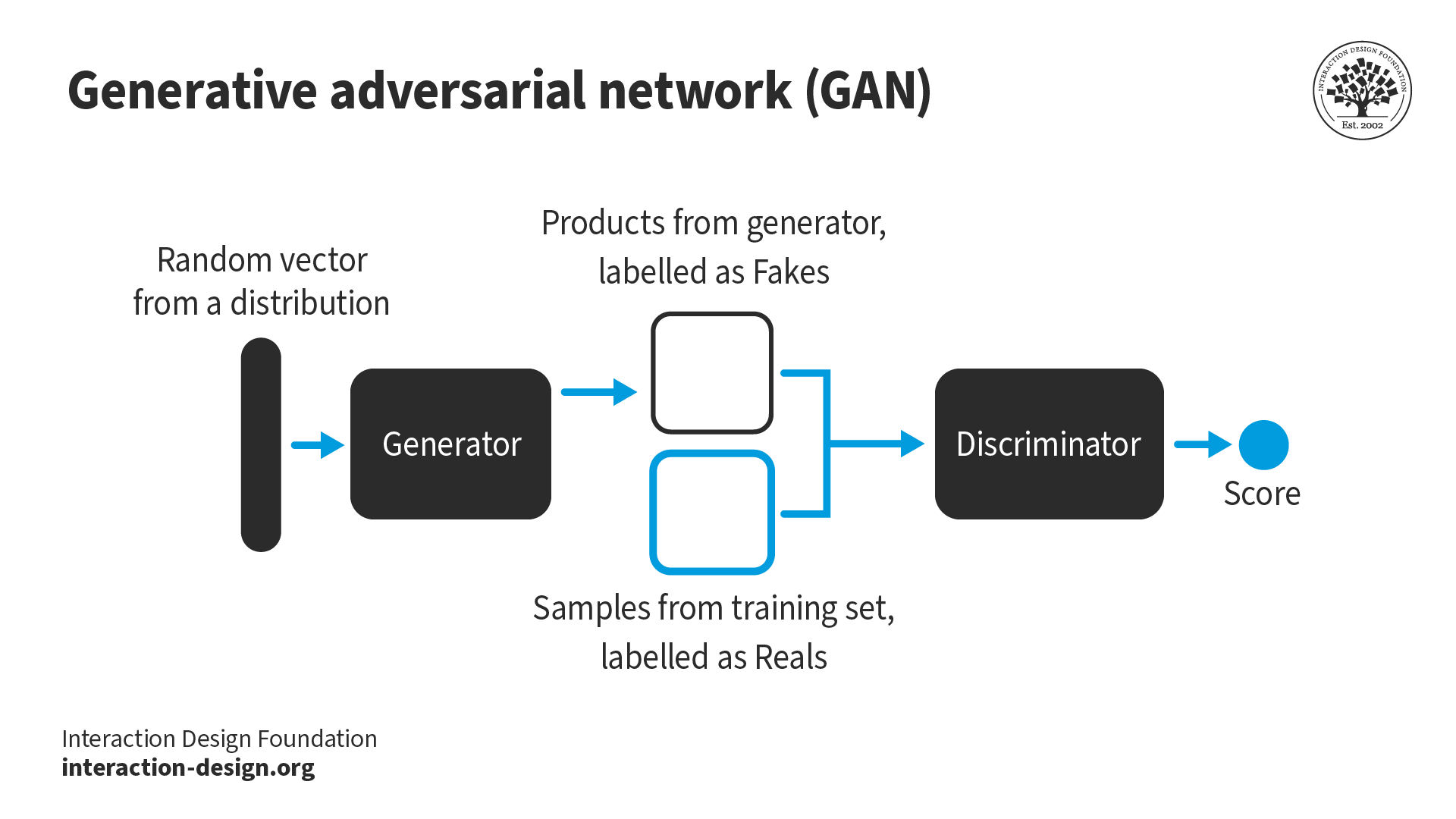
© Interaction Design Foundation, CC BY-SA 4.0
Variational Autoencoders (VAEs): In parallel, VAEs introduce a probabilistic dimension to the creative journey. The encoder, latent space, and decoder orchestrate a symphony of probabilities. The encoder maps input data into a distribution within the latent space, which fosters variability and enables diverse outputs during decoding. Sampling from this distribution infuses an element of chance, allowing for the generation of unique and unpredictable artistic expressions.
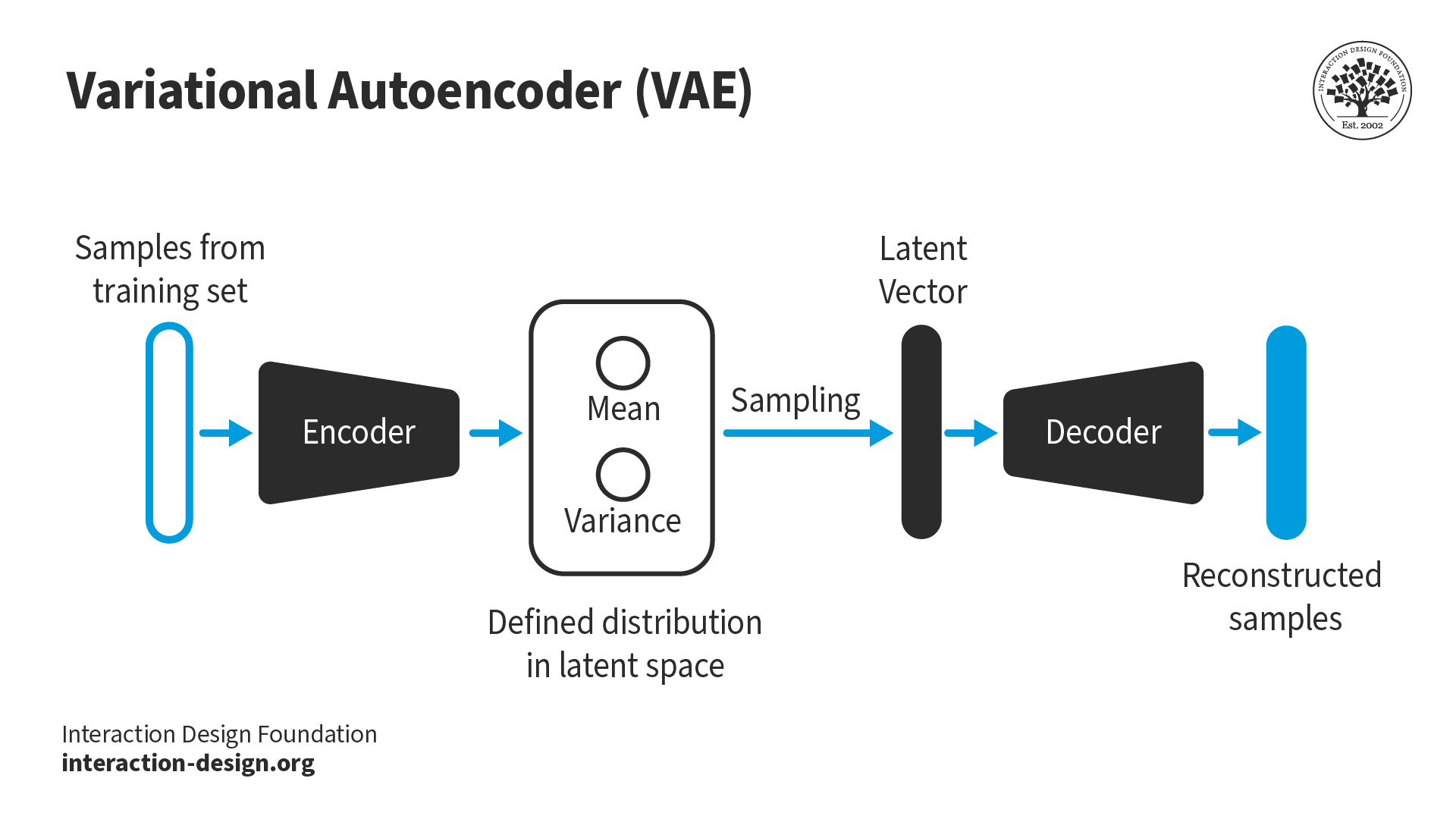
© Interaction Design Foundation, CC BY-SA 4.0
2. Artist-AI Collaboration: In projects like Unsupervised, human artists actively engage with the algorithms and influence the generative process to shape the final artwork. This collaborative process challenges traditional notions of authorship and creates a shared canvas where human creativity and AI algorithms harmonize.
3. Feedback Loop: The training process initiates a perpetual feedback loop. As the AI generates content, the discriminator evaluates its authenticity, guiding the generator to refine its approach. This iterative cycle continues until an equilibrium is reached—a point where the generated content seamlessly aligns with the intricacies of the training data.
4. Contextual Understanding: AI lacks the nuanced understanding of context and subjective interpretation that human artists bring to their work. While AI can replicate styles and generate visually appealing pieces, it can’t grasp art's profound emotional or cultural significance.
5. Ethical Considerations: Artists must ensure that AI respects inclusivity, avoids biases, and engage in transparent collaborations.
6. Dynamic Adaptation: Art is a living, breathing entity shaped by cultural shifts and artistic movements. AI's ability to adapt to evolving artistic landscapes remains an ongoing exploration. The challenge lies in how well AI can capture and respond to the ever-changing zeitgeist of art.
In essence, the creative process of AI in art is an intricate interplay between algorithms, data, and human input.
The Artistic Collaboration: Human-AI Synergy
The collaboration between AI and human artists introduces a dynamic interplay between predetermined algorithms and spontaneous human creativity.
Installation view of the AI artwork Unsupervised by Refik Anadol, The Museum of Modern Art.
© Refik Anadol. Unsupervised—Machine Hallucinations—MoMA. 2022, Fair UseAI art, like Unsupervised, showcases the collaboration between human artists and AI. This collaborative approach yields visually striking artworks and emphasizes AI's potential to augment and complement human artistic endeavors.
Can AI Replace Human Creativity in Art?
AI demonstrates algorithmic ingenuity, endless iterations, and predictive creativity, but lacks the depth of emotional understanding, intuitive insight, and nuanced interpretation that characterize human artistry. The dialogue between AI and human creativity suggests a future where collaboration, rather than replacement, defines the artistic landscape.
In this video, UX Product Designer Ioana Teleanu explains why human creativity is irreplaceable.
The coexistence of AI and human artists thus opens new possibilities where both contribute their unique strengths to the creative process.
Originality in AI-Generated Art
Originality of AI-generated art is a crucial to preserve the essence of creativity and uniqueness. Diverse training data, human input through collaboration, constraints, and continuous monitoring and adjustment mechanisms are vital to ensure that AI-generated art maintains authenticity and avoids unintended replication.
Artists must design frameworks that allow for human intervention, creative input, and unique perspectives to ensure that AI-generated art remains a collaborative venture rather than replicating existing patterns.
What Are the Limitations of AI to Create Art?
While AI has undoubtedly made remarkable strides in art generation, it is essential to acknowledge its inherent limitations. These constraints, shaped by the current state of AI technology, provide insights into the challenges artists and developers grapple with.
1. Lack of Genuine Creativity: One of the primary limitations lies in the AI's inability to possess true creativity. While AI models can analyze vast datasets and produce outputs that mimic artistic styles, they lack the profound understanding, emotional depth, and innate creativity that defines human artistry. AI-generated art reflects patterns learned from existing works rather than originating from a genuine creative spark.
2. Overreliance on Training Data: The quality and diversity of the training data significantly influence the results of AI-generated art. The AI model may struggle to produce unique or culturally diverse artworks if the training dataset is biased or limited. Artists must address this limitation and carefully curate datasets to ensure a broad representation of artistic styles and cultural influences.
3. Interpretation and Context: AI lacks the subjective interpretation and nuanced understanding of contextual elements that human artists bring to their work. Art often carries cultural, historical, or personal significance that eludes the comprehension of AI models. This limitation challenges the creation of art that resonates on a profound emotional or cultural level.
4. Ethical and Bias Concerns: AI-generated art can inadvertently perpetuate biases present in training data. If the data used to train the model contains biases, these biases may manifest in the generated artworks. The challenge for artists and developers is to navigate ethical considerations and ensure AI-generated art is inclusive, unbiased, and respectful of diverse perspectives.
5. Replication vs. Innovation: AI excels at replicating existing styles but encounters difficulties to produce truly innovative and groundbreaking artworks. The reliance on learned patterns may result in outputs that closely resemble known artistic genres but fall short of pushing the boundaries of artistic expression.
6. Lack of Intuition and Intention: Unlike human artists who imbue their work with intention, intuition, and a sense of purpose, AI lacks a true understanding of the meaning behind the art it generates. AI-generated pieces may lack the depth, symbolism, or personal narratives that often characterize human-created artworks.
7. Dynamic and Evolving Nature of Art: Art is a dynamic form of expression that reflects the zeitgeist and cultural shifts. Constrained by their training data, AI models may struggle to capture and adapt to the ever-evolving landscape of artistic trends and movements.
It’s crucial for both artists and AI developers to understand these limitations is crucial. It serves as a compass to navigate the delicate balance between leveraging AI's capabilities and preserving the irreplaceable aspects of human creativity in art.
What tools are used to create AI-generated art?
Powerful tools sculpt the world of AI-generated art. Here's a look at key instruments that drive the evolution of AI artistry:
Artbreeder
Artbreeder's platform allows users to blend and morph images to create new and enchanting artworks. Users can experiment with various parameters to create visually stunning compositions, showcasing the potential of GAN to generate diverse and appealing visual content.
RunwayML:
RunwayML's utilization of VAEs results in a variety of visually striking outputs. Artists can leverage this tool to produce artwork with unpredictable and dynamic elements, demonstrating the artistic possibilities introduced by VAEs in the generative art landscape.
DALL-E by OpenAI:
DALL-E shows how text prompts can be transformed into vivid visual creations. From fantastical creatures to inanimate objects, DALL-E exemplifies the ability of AI to translate linguistic input into diverse and imaginative artworks.
NVIDIA GauGAN:
NVIDIA GauGAN turns rough sketches into stunningly realistic landscapes. Artists can experiment with creating entire scenes, complete with mountains, rivers, and skies, showcasing the ability of GAN-based models to synthesize intricate and lifelike visual narratives.
5. Midjourney:
Midjourney offers artists a platform to create unique and personalized artworks. Artists can explore generative techniques, creating a bridge between traditional artistic expression and cutting-edge technology.
Midjourney showcase.
© Midjourney, Fair UseThese examples highlight the diverse artistic outputs achievable with each tool and illustrate AI’s ability to generate unique and captivating artworks.
AI-Generated Art: What’s Next?
Based on current trends and ongoing research, several directions for AI art are possible:
Increased Realism and Detail: AI algorithms will continue improving and generate highly realistic and detailed artworks, blurring the lines between AI-generated and human-created art.
Integration of Multiple Modalities: Future AI systems may combine text, images, and potentially other modalities to create multimodal art.
Interactive and Dynamic Art: AI-generated art may become even more interactive and dynamic, able to respond to user input or environmental factors and create personalized and evolving visual experiences.
Generative Design in Various Industries: AI-generated art may extend beyond traditional artistic domains into areas like architecture, fashion, and product design, contributing to generative design processes.
Exploration of Unconventional Aesthetics: AI-generated art may explore unconventional and abstract aesthetics that challenge traditional notions of art, pushing the boundaries of what is considered visually appealing.