Chatbots

Your constantly-updated definition of Chatbots and collection of videos and articles.
Be a conversation starter: Share this page and inspire others!

197 Shares

What are Chatbots?

Chatbots present a conversational interface to an application that attempts to mimic human interaction. Early chatbots used basic pattern matching to understand and respond to textual input. Machine learning has given way to Artificial Intelligence (AI), which uses deep learning and large language models. This is the basis of popular AI chatbots like OpenAI's ChatGPT and Google's Gemini.

History

While the history of chatbots starts in the 1960s, the original idea of "chatting" with a computer is the basis of the Turing Test. The test was published in 1950 by Alan Turing as part of his paper "Computing Machinery and Intelligence". It had the simple premise that if a text-based conversation with a computer is indistinguishable from that of a human, the computer has passed the test.

A chatbot called Eliza was one of the earliest examples. It was written by Joseph Weizenbaum in 1964. Eliza mimicked a psychotherapist and gave the appearance of understanding. Parry was another early example, designed by Kenneth Colby in 1972. It crudely modelled a paranoid schizophrenic and used a rule-based system to simulate human emotions.
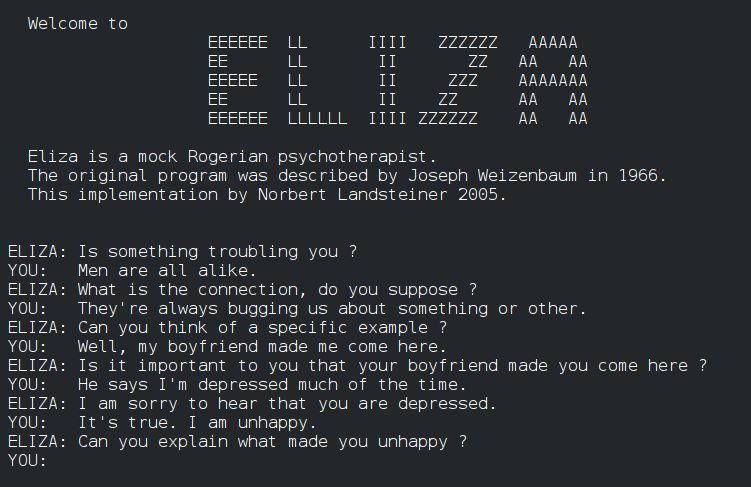
Eliza Chatbot by Joseph Weizenbaum in 1966

Public Domain

Learn more about Eliza in this clip of Elaine Anzaldo, a Conversation Designer at Meta.

Transcript

In 1972, the chatbots Eliza (simulating a psychiatrist) and Parry (simulating a schizophrenic) were connected at an international computer conference. A nonsensical conversation ensued, the opening of which is shown below. (It was recorded by Vint Cerf, one of the "fathers" of the Internet.)
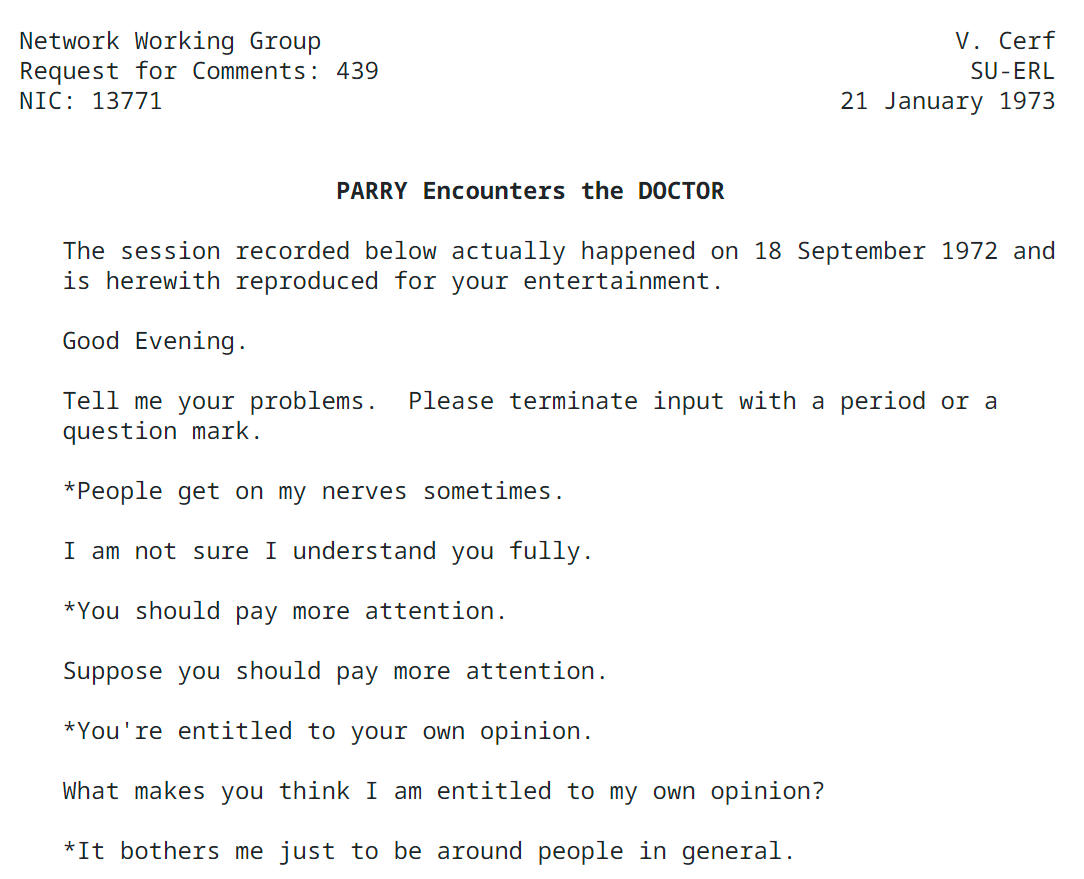
The chatbots Parry and Eliza talking together in 1972. (Eliza is the doctor.)

Public Domain

In 1988, Jabberwacky was the first chatbot to use artificial intelligence, learning from previous conversations. Alice followed in 1995. She was inspired by Eliza and used pattern matching but made no attempt to understand the conversation as a whole. However, Alice was latter improved using a language created for AI called Aiml (AI Markup Language). This allowed the production of more human-like responses and resulted in her creator, Richard Wallace, winning the Loebner Prize Competition in 2000 and 2001.

The early 2000s saw a profusion of chatbots using AI. Chatbots from 2010 onwards tended to use the AI technique, natural language processing:

  • 2001 Smarter Child (Active Buddy): A web-based chatbot on AOL and Windows Live Messenger, based on Microsoft technology. It could provide answers to practical questions by accessing sports, entertainment, news and weather databases.

  • 2005 Mitsuku/Kuki (Steve Worswick): Mitsuku was designed as a general chatbot, using natural language processing. She has won the Leobner Prize (for seeming human) five times: in 2013 and each year from 2016 to 2019. Since 2019 she has been known as Kuki. Both Mitsuku and Kuki take on the persona of an 18-year-old Japanese student who speaks in English. They are implemented using Aiml and borrowed code from an earlier chatbot, Alice.

  • 2010 Siri (Apple): The birth of the now ubiquitous personal assistant. At the time, Apple patented the idea of conversing with a chatbot through messages.

  • 2012 Google Now/Google Assistant (Google): Originally conceived to provide location and time-specific on smartphones, Google Now was expanded to Google Assistant around 2017. Both could respond to voice requests.

  • 2014 Alexa (Amazon): Alexa is the voice assistant built into Amazon Echo smart speakers. It is supported as a voice service on several platforms including Android, iOS, Linux, Windows and Wear. It is supported by a variety of entertainment devices and can also be used in cars through Amazon Echo Auto. Alexa uses natural language processing (NLP) but has limited ability compared with modern chatbots. In 2023 Amazon announced the incorporation of a large language model, similar to that used by ChatGPT, for example.

  • 2014 Cortana (Microsoft): Cortana was a voice-based assistant that Microsoft saw as a key ingredient of future operating systems on Windows Phone and PC. It was named after an AI character in Microsoft's later Halo video games. It was withdrawn from phone platforms starting in 2020. It was officially deprecated in the Windows OS in 2023. Much of the vision that Microsoft had for integrating AI into operating systems was shifted to Microsoft Copilot chatbot.

  • 2022 ChatGPT (OpenAI): GPT stands for generative pre-trained transformer. It uses a large language model (LLM) to build an "understanding" of human speech and knowledge, primarily from Internet sources. It uses the model to generate responses to questions. In more recent implementations, ChatGPT is also used to process and generate audio, video and still images. ChatGPT-4 was released in March 2023. The trained model has grown substantially in each release, as reflected by the number of parameters used in the underlying neural network:

    • GPT-1: 0.1 billion

    • GPT-2: 1.5 billion

    • GPT-3: 175 billion

    • GPT-4: 1,760 billion (1.76 trillion)

  • 2023 Bard/Gemini (Google): Bard was launched in early 2023 in response to Microsoft's planned announcement to incorporate ChatGPT technology in its Bing search engine. (Microsoft is one of OpenAI's largest shareholders.) However, Bard met a lackluster response from industry, partly due to errors revealed during an early public demonstration of the technology. Google's response was to upgrade Bard to use a larger language model. Bard was relaunched as Gemini later in 2023.

  • 2023 Bing Chat/Copilot (Micrososft): Bing Chat was introduced as a feature of the Bing search engine and Edge web browser. Microsoft's goal was to replace the Cortana chatbot feature built into its Windows operating system with a more powerful AI built on a Large Language Model. This was made possible by Microsoft's investment in, and collaboration with, OpenAI. Consequently, Bing Chat was based on ChatGPT-4. At the same time, Microsoft decided to rename Bing Chat as Copilot. It was built into Windows 11 during 2023 but was also available through the Edge browser. In 2024, Microsoft announced the integration of ChatGPT-4o into Copilot.

Types of Chatbots

Chatbots come in a variety of shapes and sizes, depending on their purpose, abilities and interface:
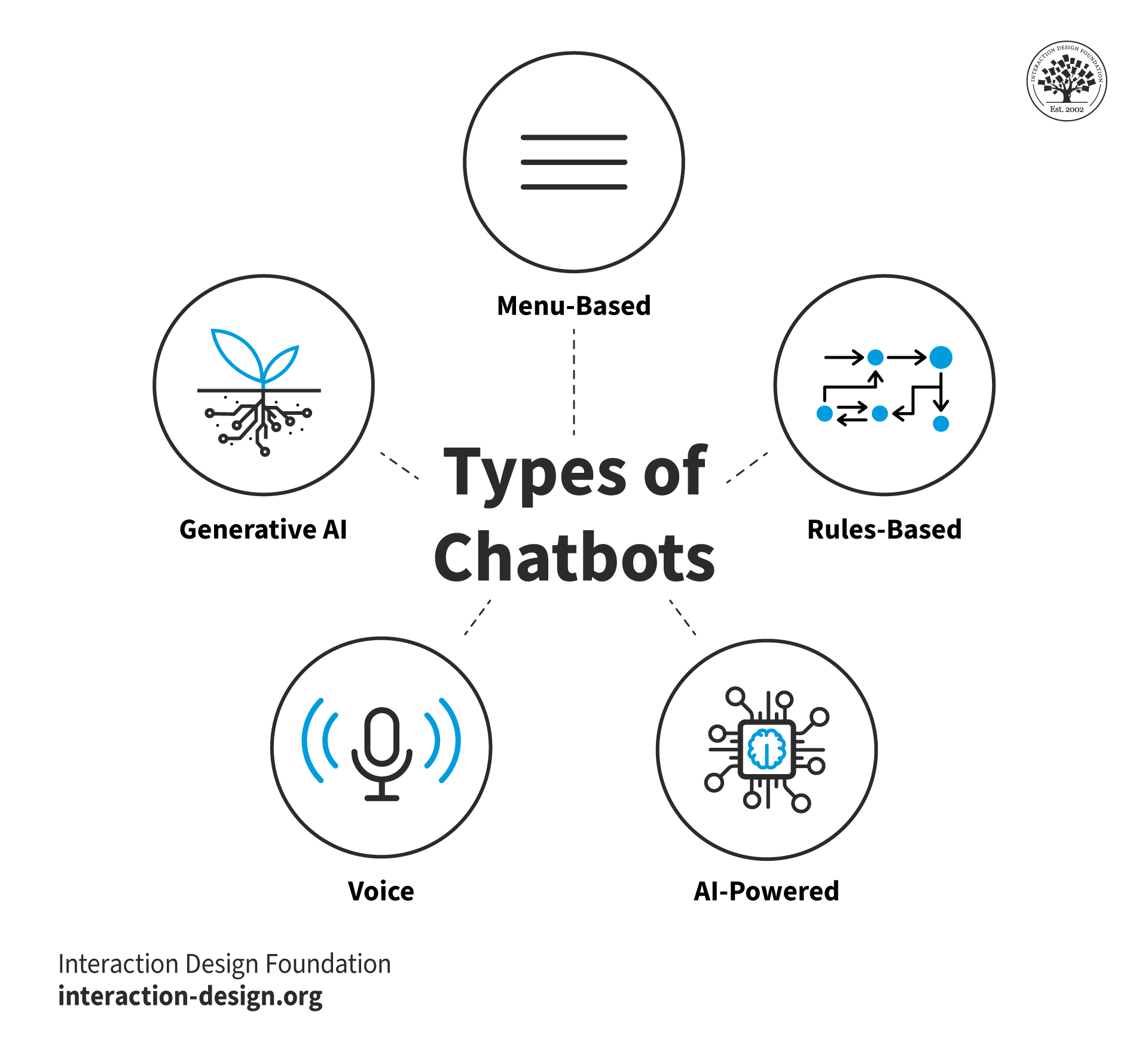
Types of Chatbots (described below)

© Interaction Design Foundation, CC BY-SA 4.0

Menu-Based Chatbots

Before graphical user interfaces (GUIs) became the most common mode of interaction with computer systems, tree-like menu structures were often used. They provided a limited set of options at a point on a tree. A user's response would determine which branch of the tree was visited next. Menu systems were much easier to use than command-line systems and like GUIs, relied on recognition rather than recall.

Early menu-based chatbots could be implemented using purely text. The chatbot would display a list of numbered menu items. The user would type a number to choose the next action. (Alphabetic labels were also sometimes used.)

The screenshots below show a simple menu-based chatbot that might be used in a text-based environment like WhatsApp.
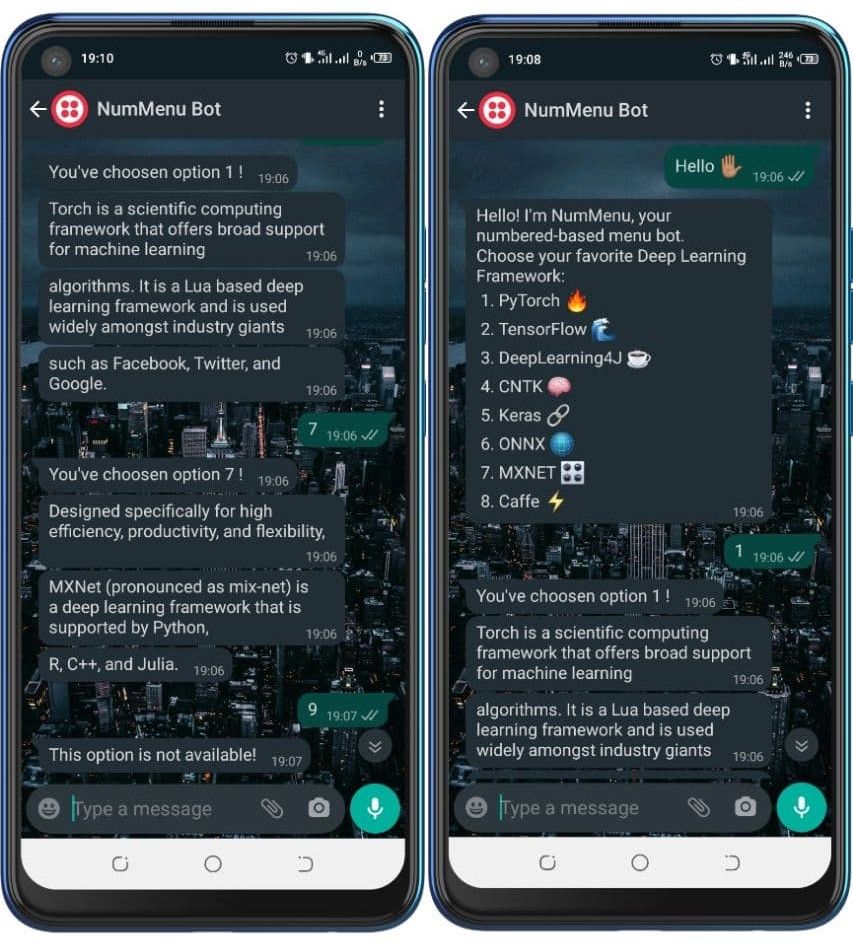
NumMenu Bot, an example of a menu-based chatbot.

https://github.com/DerXter/NumMenu-Bot

Menu-based chatbots are also possible within a GUI. Users click or tap on the questions themselves or buttons placed alongside.

Rules-Based Chatbots

Rules-based chatbots share some of the limitations of menu-based systems. A set of rules are typically written by developers for a narrow problem domain. Interaction is based on keyword detection, typically following a question and answer dialogue. Rules-based chatbots are very quick and require few resources, but they are unable to address topics outside of their defined domain. They do not learn from interactions and depend largely on provided content.

AI-Powered Chatbots

AI-powered chatbots use machine learning and natural language processing (NLP) to understand a wide range of conversational constructs and content. As a result, AI-based chatbots learn from interactions and can be trained on a broad range of subject areas. AI chatbots generally make use of deep neural networks but do not necessarily use the large language models found in general-purpose chatbots like OpenAI's ChatGPT. Nevertheless, AI chatbots can engage in very convincing, naturalistic, conversations.

Voice Chatbots

Voice chatbots allow speech to be used for interaction. Interactive voice response (IVR) is a basic form of voice chatbot, but like rules-based and menu systems, they are usually limited to specific problem domains and a small set of keywords. With advances in AI, voice chatbots can engage in less structured conversations and are not as limited in terms of the breadth of subject matter that can be addressed.

Generative AI Chatbots

Generative AI chatbots extend the deep learning enabled by neural networks to a range of media beyond simple text: images, audio and video. They are trained on large bodies of material. This enables them to create or modify media in response to requests from users. Generative AIs are the subject of much attention and improvement. They can create realistic output, including high-resolution video containing human and animal forms.
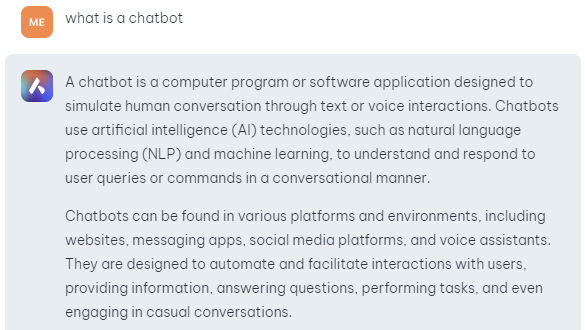
Opera's Aria AI-based chatbot describing what a chatbot is.

Public Domain
Questions About Chatbots?
We've Got Answers!

What is a chatbot?

A chatbot is a computer program that can simulate human conversations using text or voice. Chatbots can interact with users through various platforms, such as websites, mobile apps, social media, messaging apps, and voice assistants. Chatbots can provide information, answer questions, perform tasks, or entertain users.

What are the types of chatbots?

There are two main types of chatbots: rule-based and AI-based. Rule-based chatbots use predefined rules and decision trees to generate responses based on keywords and patterns. AI-based chatbots use machine learning and natural language processing to learn from user input and generate more personalized and context-aware responses.

How do chatbots work?

Chatbots work by following a basic process:

  • First, the chatbot receives the user’s input, which can be text or speech.

  • Second, the chatbot analyzes the user’s input and extracts the intent and entities. The intent is the goal or purpose of the user’s input, such as booking a flight, ordering a pizza, or asking for the weather. The entities are the specific details or parameters related to the intent, such as the destination, the toppings, or the date.

  • Third, the chatbot generates a response based on the intent and entities. The response can be a simple text or speech output or a complex action that involves accessing other services or applications through APIs. The response can include follow-up questions or suggestions to keep the conversation going.

  • Fourth, the chatbot sends the response to the user and waits for the next input.

What are the benefits of chatbots?

Chatbots have many benefits for both businesses and users, such as:

  • Chatbots can improve customer service and satisfaction by providing 24/7 support, instant answers, and personalized solutions.

  • Chatbots can increase sales and conversions by engaging customers, recommending products, and facilitating transactions.

  • Chatbots can reduce costs and save time by automating repetitive tasks, streamlining workflows, and optimizing resources.

  • Chatbots can enhance user experience and loyalty by creating interactive and immersive interactions, offering feedback and rewards, and learning from user preferences.

What are some examples of chatbots?

There are many examples of chatbots in various industries and domains, such as:

  • Customer service chatbots: These chatbots help customers with common queries, issues, or complaints. For example, Sephora uses a chatbot on Facebook Messenger to provide beauty tips, product recommendations, and booking services.

  • E-commerce chatbots: These chatbots help customers with shopping online. For example, H&M uses a chatbot on Kik to offer style advice, outfit suggestions, and purchase options.

  • Healthcare chatbots: These chatbots help patients with health-related questions or concerns. For example, Ada is a chatbot app that helps users diagnose their symptoms, find possible causes, and get appropriate guidance.

  • Education chatbots: These chatbots help students with learning or studying. For example, Duolingo is a chatbot app that helps users learn new languages through interactive conversations.

  • Entertainment chatbots: These chatbots help users with fun or leisure activities. For example, [Replika] is a chatbot app that helps users create their own personal AI companion to talk to anytime.

What is an AI chatbot?

An AI chatbot is a chatbot that uses artificial intelligence (AI) technologies, such as machine learning and natural language processing, to understand the user’s questions and generate responses. AI chatbots can provide more accurate, relevant, and personalized answers than traditional chatbots that rely on predefined scripts or keywords.

Some examples of AI chatbots are:

  • IBM watsonx Assistant: A chatbot platform that allows businesses to create and deploy conversational AI solutions across various channels, such as websites, mobile apps, voice assistants, and messaging platforms. IBM watsonx Assistant uses natural language understanding (NLU) to discern the meaning and intent of user input and natural language generation (NLG) to produce natural and engaging responses.

  • Drift: A chatbot software that helps businesses generate and qualify leads, book meetings, and provide customer support. Drift uses conversational AI to create personalized and human-like conversations with website visitors, and integrates with various tools such as email, CRM, and calendar

  • Airdroid: A chatbot development platform that enables developers to build and deploy AI chatbots for various use cases, such as e-commerce, education, healthcare, and entertainment. Airdroid uses NLP and machine learning to create chatbots that can understand natural language, handle multiple intents, and provide contextual responses

Earn a Gift Earn a Gift, Answer a Short Quiz!

1
2
3
4
1
2
3
4
Question 1
Question 2
Question 3
Get Your Gift
Interaction Design Foundation logo

Question 1

What is the main function of a chatbot?

1 point towards your gift

  • To generate images and videos
  • To perform complex mathematical calculations
  • To simulate human conversation using text or voice
Interaction Design Foundation logo

Question 2

Who came up with the term "chatbot"?

1 point towards your gift

  • Alan Turing
  • Joseph Weizenbaum
  • Michael Mauldin
Interaction Design Foundation logo

Question 3

Which type of chatbot performs specific tasks like booking flights or checking the weather?

1 point towards your gift

  • Chat-oriented chatbots
  • Rule-based chatbots
  • Task-oriented chatbots

Learn More About Chatbots

Make learning as easy as watching Netflix: Learn more about Chatbots by taking the online IxDF Course AI for Designers.

Why? Because design skills make you valuable. In any job. Any industry.

In This Course, You'll

  • Get excited about how quickly you can create meaningful results when you turn AI into your new superpower and combine it with timeless human-centered design skills. As an AI-powered designer, you’ll increase your efficiency and salary potential, and as a human-centered leader, you'll create ethical AI-powered products people love. When these abilities come together, you’ll solve real-world problems faster and make the world a better place. Studies show that AI-driven productivity accelerates growth and helps busy professionals like you achieve in months what once took decades. Now's the time to master the powerful combination that keeps you in demand.

  • Make yourself invaluable when you use AI to accelerate repetitive tasks while applying your irreplaceable human strengths like empathy, critical thinking, and ethical decision-making to guide every solution toward what users truly need. Leaders seek professionals with AI fluency because the people who thrive combine AI efficiency with deep human insight that machines can't replicate. You'll learn to automate and streamline repetitive tasks, make data-driven decisions, and optimize your workflow for innovation and cost savings. No matter your background, you'll easily master AI for Designers. With clear guidance and real-world examples, you'll apply your skills immediately.

  • Gain confidence and credibility as you master the art of text prompts for design. You'll learn how to deal with bias in AI and how to use AI tools to create intuitive user experiences that drive business success. You can fast-track your portfolio of AI-enhanced case studies with step-by-step guidance, practical tips for real-life projects, and downloadable templates. This course gives you the hands-on knowledge to guide AI with timeless human-centered design skills, and that's how you stay in demand in any industry!

It's Easy to Fast-Track Your Career with the World's Best Experts

Master complex skills effortlessly with proven best practices and toolkits directly from the world's top design experts. Meet your experts for this course:

  • Ioana Teleanu: Founder of UX Goodies and former Lead Product Designer (AI) at Miro.

  • Rafael Hernandez: Lead Product Designer at T. Rowe Price.

  • Jarvis Moore: Senior Design Lead, Design Systems at Microsoft.

  • Niwal Sheikh: Product Design Lead at Netflix.

  • Vitaly Friedman: Senior UX Consultant for the European Parliament, and Creative Lead, Smashing Magazine.

  • Pablo Stanley: Designer and CEO of Musho and Lummi.

Get an Industry-Recognized IxDF Course Certificate

Increase your credibility, salary potential and job opportunities by showing credible evidence of your skills.

IxDF Course Certificates set the industry gold standard. Add them to your LinkedIn profile, resumé, and job applications.

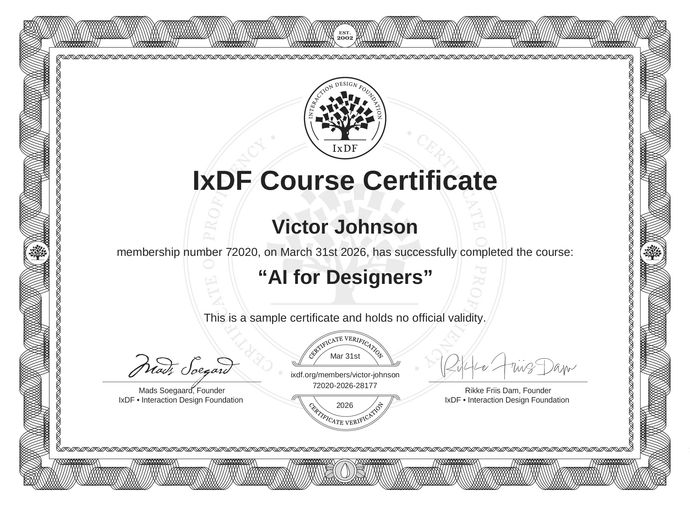
Course Certificate Example

Be in distinguished company, alongside industry leaders who train their teams with the IxDF and trust IxDF Course Certificates.

Our clients: IBM, HP, Adobe, GE, Accenture, Allianz, Phillips, Deezer, Capgemin, Mcafee, SAP, Telenor, Cigna, British Parliament, State of New York

All Free IxDF Articles on Chatbots

Read full article
No-UI: How to Build Transparent Interaction - Article hero image
Interaction Design Foundation logo

No-UI: How to Build Transparent Interaction

Here, we will explore and teach you about the incredible user experience opportunities which you can take advantage of when designing for interaction beyond the classical Graphical User Interface (GUI). Non-visual User Interaction (no-UI) is pioneered by the ground-breaking work of researchers who h

Social shares
874
Published
Read Article
Read full article
Why Is AI so Important and How Is It Changing the World? - Article hero image
Interaction Design Foundation logo

Why Is AI so Important and How Is It Changing the World?

You've heard about AI and all the wonderful (and sometimes scary) possibilities. But unlike sci-fi apocalyptic movies, AI isn't out to destroy humanity. Let's take a look at the challenges and opportunities we face as AI meets design.In this video, Ioana Teleanu, Founder of UX Goodies and former Lea

Social shares
444
Published
Read Article

Why Is AI so Important and How Is It Changing the World?

Why Is AI so Important and How Is It Changing the World?

You've heard about AI and all the wonderful (and sometimes scary) possibilities. But unlike sci-fi apocalyptic movies, AI isn't out to destroy humanity. Let's take a look at the challenges and opportunities we face as AI meets design.

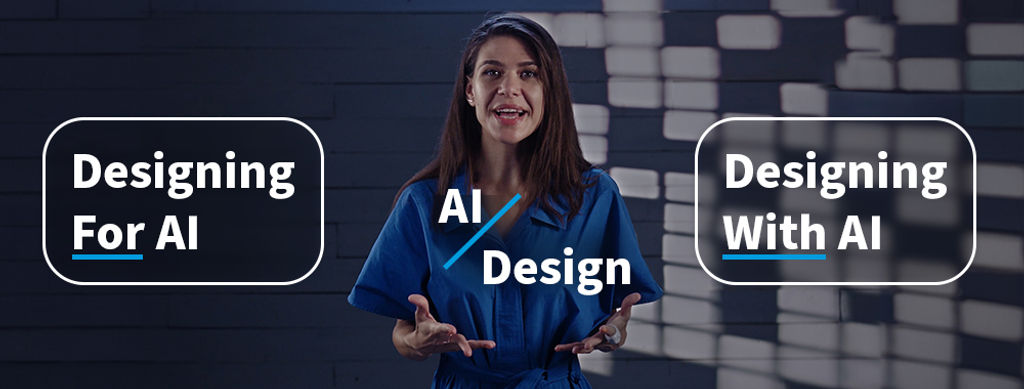
In this video, Ioana Teleanu, Founder of UX Goodies and former Lead Product Designer (AI) at Miro, talks about the impact of AI on design from two perspectives: “Designing for AI” products and “Designing with AI”.

Transcript

How AI is Changing the World

AI is already reshaping our world, from its profound influence on healthcare and education to its transformative impact on transportation and agriculture:

  • Chatbots are commonplace, AI-generated art is everywhere, and prompt engineering is now an essential skill.

  • Stanford's AI Index Report shows AI adoption jumped from 55% of organizations in 2024 to 78% in 2025.

  • A report by PwC says that people with advanced AI skills earned a 56% wage premium compared to those without (based on nearly 1 billion job ads).

In this video, we'll navigate the intricate terrain of AI's far-reaching effects, and explore the concerns it raises and its remarkable potential across diverse domains.

Transcript

The Take Away

In AI and design, we have two core aspects: "Designing for AI" and "Designing with AI".

  • "Designing for AI" means that we incorporate AI into the solutions that we design. Don’t think of products based on detailed commands; rather, express goals and let AI work out the steps. This changes the way we think about products and solutions.

  • "Designing with AI" means that we can incorporate AI into our design process. We can think of it as a partner and collaborator.  We can use AI as an exoskeleton and augment our capabilities.

AI brings both concerns and undeniable benefits. While some express worries about its rapid development, AI also holds immense potential. It can revolutionize healthcare, education, environmental sustainability, transportation, and productivity. Historically, such technological shifts have raised concerns, but they've ultimately led to new opportunities and societal changes. Thus, it's crucial to approach AI with a balanced perspective and recognize its dual nature.

References and Where to Learn More

Watch our 1-hour Master Class with Rafael Hernandez, Lead Product Designer at T. Rowe Price, and discover how to Get Ahead in Product Design with AI.

Explore our comprehensive article on Artificial Intelligence for a complete overview of AI in design, along with additional resources.

Find out how to get an AI efficiency boost as you build your design portfolio in our article, Create a Winning UX/UI Portfolio: Optimize with AI.

Hero image: © Interaction Design Foundation, CC BY-SA 4.0

Feel Stuck?
Want Better Job Options?

AI is replacing jobs everywhere, yet design jobs are booming with a projected 45% job growth. With design skills, you can create products and services people love. More love means more impact and greater salary potential.

At IxDF, we help you from your first course to your next job, all in one place.

See How Design Skills Turn Into Job Options
Privacy Settings
By using this site, you accept our Cookie Policy and Terms of Use.
Customize
Accept all

Be the One Who Inspires

People remember who shares great ideas.

Share on:

Academic Credibility — On Autopilot

Don't waste time googling citation formats. Just copy, paste and look legit in seconds.