A UX case study is a detailed analysis and narrative of a user experience (UX) design project. It illustrates a designer's process and solution to a specific UX challenge. A UX case study encompasses an explanation of the challenge, the designer’s research, design decisions and the impact of their work. UX designers include these case studies in their portfolios to demonstrate their experience, skills, approach and value to potential employers and clients.
“Every great design begins with an even better story.”
— Lorinda Mamo, Designer and creative director
Why UX Case Studies are Essential for a Successful Design Career
© Interaction Design Foundation, CC BY-SA 4.0
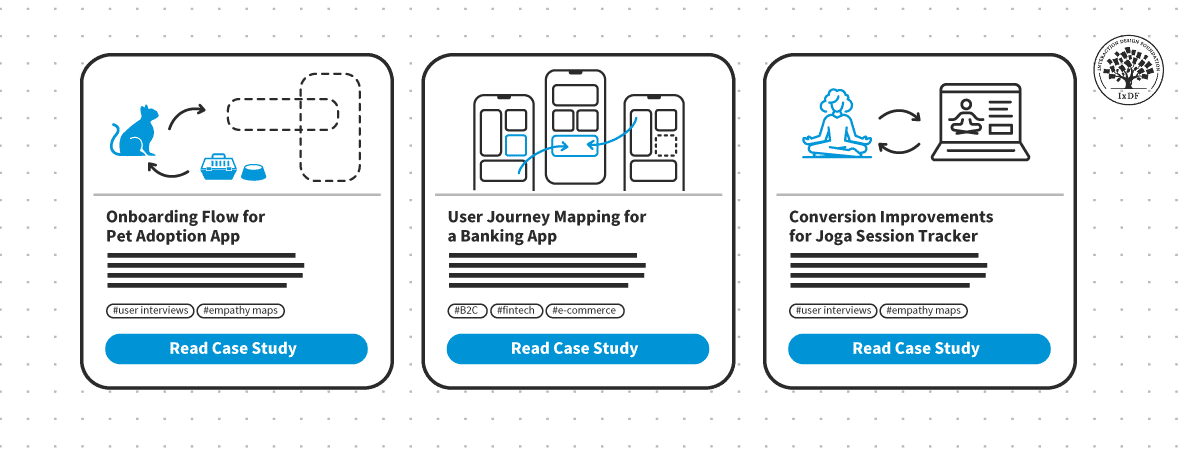
UX case studies are more than just documentation—they are powerful tools that advance a designer’s career and are integral to their success. They provide concrete evidence of a designer’s ability to tackle complex challenges from the initial user research to the final implementation of their solution. This transparency—a clear explanation and examination of the approach, thinking and methods—builds trust and credibility with potential clients and employers.
Beyond showcasing expertise, case studies encourage personal and professional growth. Through reflection and analysis, designers identify areas for improvement that hone their skills and deepen their understanding of user-centered design principles. What’s more, when designers compile and refine their case studies, they strengthen communication skills which allows them to articulate, rationalize and present data effectively.
For potential employers and clients, case studies give insight into a designer’s thought process and problem-solving approach. They reveal how designers gather and analyze user data, iterate on designs, and ultimately deliver solutions. This level of insight goes beyond resumes and qualifications as they provide tangible evidence of a designer's ability to research, reason and create user-centered products that meet business objectives. Ultimately, UX case studies empower designers to tell their unique story, stand out in a competitive market and forge a successful career in the evolving field of UX design.
How to Approach UX Case Studies
Recruiters want candidates who can communicate through designs and explain themselves clearly and appealingly. Recruiters will typically decide within five minutes of skimming UX portfolios whether a candidate is a good fit. Quantity over quality is the best approach to selecting case studies for a portfolio. The case studies should represent the designer accurately and positively. So, they should illustrate a designer’s entire process and contain clear, engaging, error-free copywriting and compelling visual aids. Designers can convince recruiters they’re the right candidate when they portray their skills, thought processes, choices and actions in context through engaging, image-supported stories.
UX Design Leader at Google discusses why narrative is an important element in case studies
Content strategy, too, is a fundamental aspect of UX design case studies and portfolios. In the next video, Morgane Peng talks about content strategy in the context of case studies and design portfolios.
How to Build Successful UX Case Studies
Case studies should have an active story with a beginning, middle and end—never a flat report. So, a designer would write, e.g., “We found…”, not “It was found…”. Designers must always get their employer’s/client’s permission when they select case studies for their portfolios. Important information should be anonymized to protect your employer’s/client’s confidential data (by changing figures to percentages, removing unnecessary details, etc.). What is anonymized or omitted depends on whether a non-disclosure agreement (NDA) is involved.
Step-by-Step Guide: How to Create a UX Case Study
1. Choose the right project: Whether this is for a web-based portfolio or one created for a specific job, choose a project that showcases the best, most relevant work and skills. Make sure permission is granted to share the project, especially if it involves client work.
But remember, you can still use your non-design experience as a valuable resource for your design case studies, as Morgane explains in this video.
2. Define the problem: Clearly articulate the problem addressed in the project. Explain its significance and why it was worth solving. Provide context and background information about the project, including the target audience and stakeholders.
3. Establish your role and contribution: Detail specific responsibilities and contributions to the project. Highlight collaboration with team members to showcase teamwork and communication too.
4. Describe the process: Include research methods used (e.g., user interviews, surveys) and the insights gained. Use quotes, anecdotes and even photographs and artifacts from user research to bring the story to life. Introduce user personas developed from the research to add depth to the narrative. Insert user journey maps to visualize the user experience and identify pain points.
5. Illustrate the design and development journey: Show the initial wireframes and prototypes. Explain the iteration process and how feedback was incorporated. Explain the reasons behind design choices, supported by visuals like sketches, wireframes, and prototypes. Mention the tools and techniques used during the design process.
6. Highlight the testing and iteration phase: Detail the usability tests conducted and key findings. Use real user feedback to add authenticity to the story. Describe how feedback was used to make iterations to demonstrate a commitment to continuous improvement.
7. Showcase the final solution: Present high-fidelity mockups of the final design. Highlight key features and functionalities. Discuss final product’s visual and functional aspects with the use of visuals to enhance the narrative.
8. Conclude with results and impact: Describe the results, including metrics and data that demonstrate the impact (e.g., increased user engagement, improved usability). Reflect on the lessons learned during the project—mention any challenges faced and how they were overcome.
9. Present the story: Make sure the case study tells a compelling story with a clear beginning, middle, and end. Check to see where images, charts, and other visuals can be added to further support the story. Ensure visuals are well-integrated and enhance the narrative. Keep the narrative concise and focused—always avoid unnecessary details and jargon.
10. Final review and polishing: Reread, edit and proofread—the case study should be clear, well-written, free of errors, and professional. It’s always advisable to get feedback from peers or mentors to refine the case study.
Storytelling for Case Studies: How to Hook Hiring Managers and Clients
Consider Greek philosopher Aristotle’s storytelling elements and work with these in mind when getting started on a case study:
Plot: The career- or job-related aspect the designer wants to highlight. This should be consistent across case studies for the specific role for which they’re applying. So, if they want to land a job as a UX researcher, they must focus on the relevant skills—user research methods—in their case studies.
Character: A designer’s expertise in applying industry standards and working in teams.
Theme: Goals, motivations and obstacles of their project.
Diction: A friendly, professional tone in jargon-free language.
Melody: Your passion—for instance, where a designer proves that design is a lifelong interest as opposed to just a job.
Décor: A balance of engaging text and images.
Spectacle: The plot twist/wow factor—e.g., a surprise discovery. Naturally this can only be included if there was a surprise discovery in the case study.
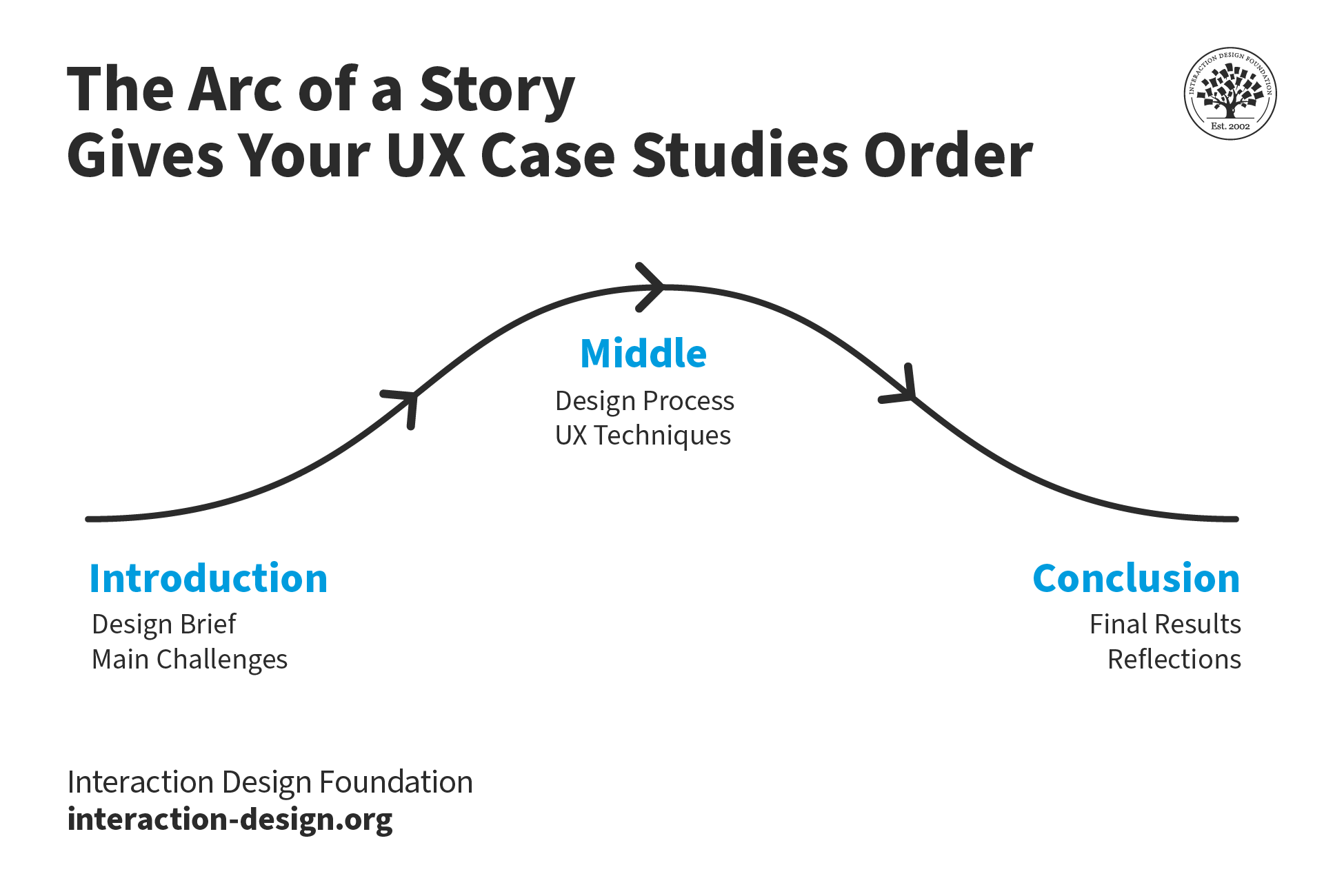
All good stories have a beginning, a middle and an end.
© Interaction Design Foundation. CC BY-NC-SA 3.0.
Designers can also take inspiration from German novelist-playwright Gustav Freytag’s 5-part pyramid to structure their case studies and add a narrative flow:
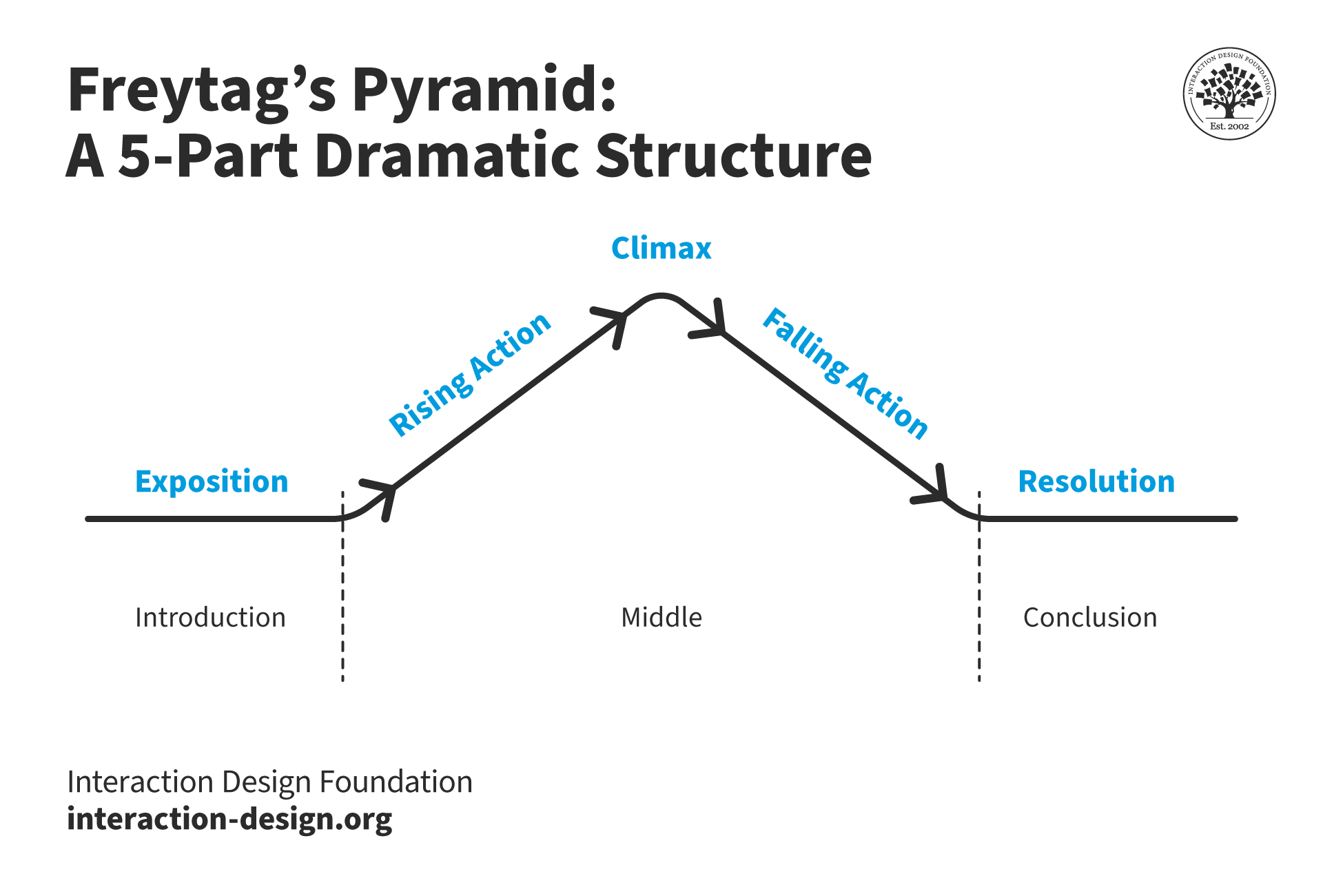
Typical dramatic structure consists of an exposition and resolution with rising action, climax and falling action in between.
© Interaction Design Foundation. CC BY-NC-SA 3.0.
Exposition—the introduction or hook (4–5 sentences). This should describe the:
Problem statement: Include the motivations and thoughts/feelings about the problem.
The solution: Outline the approach. Hint at the outcome by describing the deliverables/final output.
The role: What role was played, what contribution was made.
Stages 2-4 form the middle (more than 5 sentences). Summarize the process and highlight the decisions:
Rising action: Outline some obstacles/constraints (e.g., budget) to build conflict and explain the design process (e.g., design thinking). Describe how certain methods were used, e.g., qualitative research to progress to one or two key moments of climax.
Climax: Highlight this, the story’s apex, with an intriguing factor (e.g., unexpected challenges). Choose only the most important information and insights to tighten the narrative and build intrigue.
Falling action: Show how the combination of user insights, ideas and decisions guided the project’s final iterations. Explain how, e.g., usability testing helped shape the final product.
Stage 5 is the conclusion:
Resolution (4–5 sentences): Showcase the end results as how the work achieved its business-oriented goal and what was learned. Refer to the motivations and problems described earlier to bring the story to an impressive close.
Overall, the case study should:
Tell a design story that progresses meaningfully and smoothly.
Tighten/rearrange the account into a linear, straightforward narrative.
Reinforce each “what” that’s introduced with a “how” and “why”.
Support text with the most appropriate visuals (e.g., screenshots of the final product, wireframing, user personas, flowcharts, customer journey maps, Post-it notes from brainstorming). Use software (e.g., Canva, Illustrator) to customize visually appealing graphics that help tell a story.
Balance “I” with “we” to acknowledge team members’ contributions and shared victories/setbacks.
Make the case study scannable, e.g., Use headings, subheadings etc.
Remove anything that doesn’t help explain the thought process or advance the story.