Content strategy is a framework for planning, developing and managing content—written or in other media—to achieve specific goals. Content refers to useful information a user or target audience will consume. Content strategy encompasses the entire lifecycle of content, from conception to publishing, distribution and maintenance. In UX design, content strategy improves the experience of a product or service and supports its goals.
In this video, Design Director at Societe Generale CIB, Morgane Peng, explains why content strategy is central to a successful design portfolio.
Why Content Strategy is Important in UX Design
Content strategy is a necessity for successful UX design—it ensures that content is aligned to both user needs and business goals. This improves the overall user experience. Content strategy helps users find what they need quickly and efficiently because all content is designed to be relevant and valuable.
A content strategy should be developed and integrated from the very beginning and throughout the UX design process. Well-planned and clear content reduces confusion, frustration and costs as time and resources are saved from unnecessary mistakes and multiple revisions. A defined content strategy results in clearer, more optimized content and thus the entire user experience is more enjoyable.
Here are the ways in which content strategy is essential in UX design:
Improves User Experience
A well-planned and executed content strategy ensures that the right content is delivered to the right user at the right time. This means that users can achieve their goals efficiently, better understand the product and ultimately have a more positive user experience.
Clear Communication
A successful digital product requires clear, consistent communication. A content strategy defines the communication approach and thus enhances clarity, minimizes confusion and reduces errors—this allows users to easily navigate the user experience.
Establishes a Brand Voice and Tone
A content strategy helps to develop and maintain a consistent voice and tone across a brand or product’s touchpoints, channels and communications. This strengthens the brand’s identity, builds trust and forges a deeper connection with users.
Better Usability, Findability and Discoverability
Content strategy improves the usability and findability of content—it structures content in a way that makes it easy to navigate. It uses techniques like clear labeling, Search Engine Optimization (SEO) and optimized navigation so that users are able to quickly locate what they need and complete tasks efficiently. This improves the overall user experience—this enhances the overall user experience, which makes interactions with the content more efficient and satisfying.
Drives Conversions and Business Goals
A well-developed content strategy makes sure that all content is aligned to both user needs and business goals. It drives conversions and achieves business objectives through the delivery of targeted valuable information that resonates with users and guides them through their journey. When user needs are met and their pain points are effectively addressed, a content strategy builds trust, increases engagement and encourages desired actions—such as making purchases and subscribing to services. The alignment between content, user intent and business objectives enhances the overall user experience of a product which leads to higher conversion rates and business growth.
Accessibility and Inclusivity
Content strategy ensures that content is designed to be accessible to all users, including those with disabilities. This involves following guidelines like the Web Content Accessibility Guidelines (WCAG), using appropriate formatting, alt text for images, and clear language that is easily understood by a diverse audience.
Learn more about accessibility in this video:
Content Strategy vs Content Marketing vs Content Design: What's the Difference?
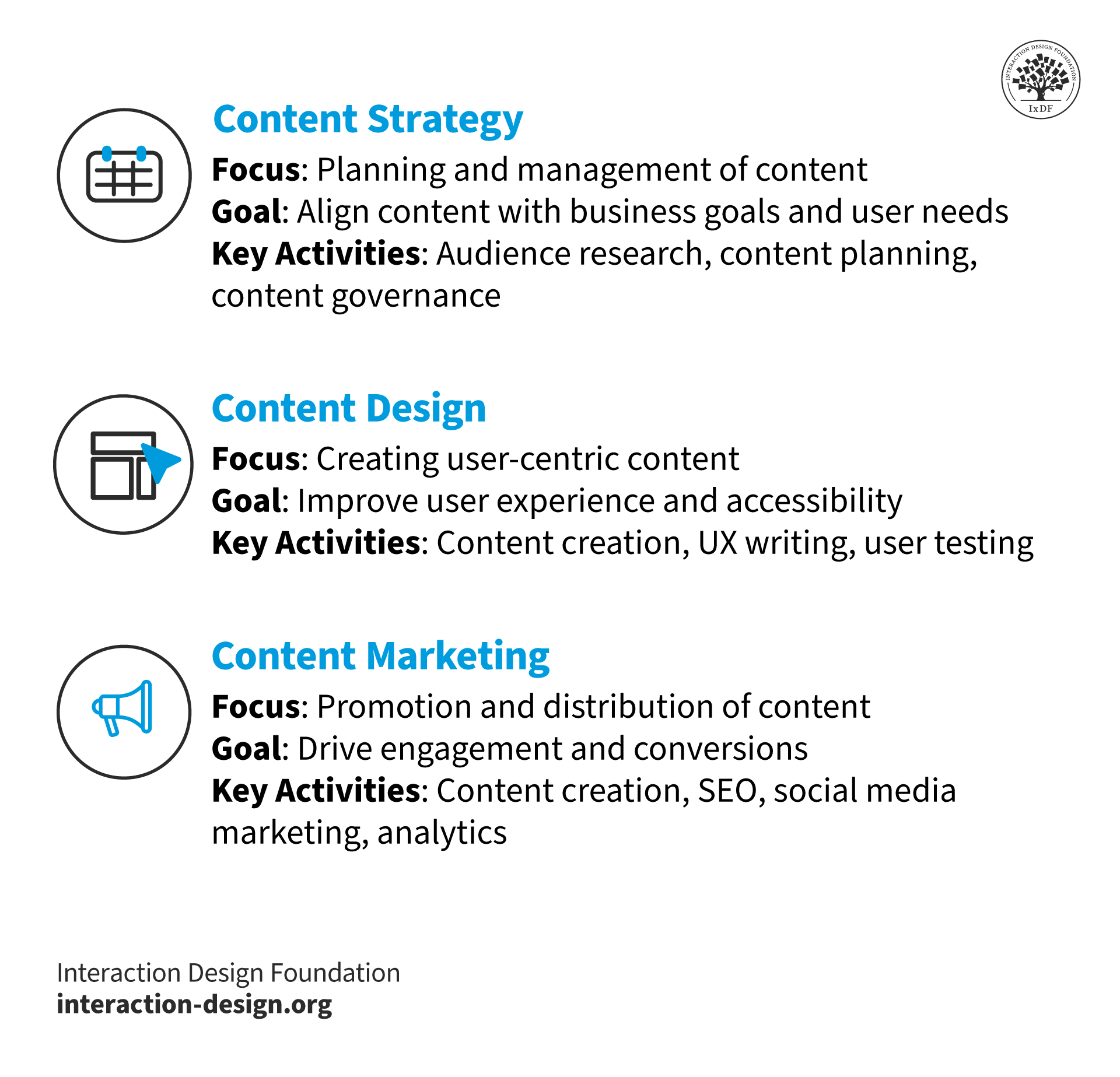
Content strategy, content marketing, and content design are interrelated yet distinct aspects of content management.
© Interaction Design Foundation, CC BY-SA 4.0
Content strategy involves the planning, creation, delivery, and management of content—it sets the overarching direction for content initiatives to make sure it aligns with business goals and user needs. Content strategy focuses on the "why" and "how" of content creation to address the purpose, target audience, and distribution channels of the content. This creates a cohesive and effective content experience.
On the other hand, content marketing is a tactical approach within the broader content strategy. It focuses on content—creating, publishing, and distributing—that attracts, engages, and retains a target audience. Its purpose is to achieve marketing goals and profitable customer actions like conversions and relationship building.
Finally, content design focuses on the "how" and "what" of content creation. It’s the practice of structuring content to be clear, concise, and user-friendly. Content design applies the principles of UX design to make sure that content is accessible, understandable, and usable.
Content Strategy: A Cornerstone of Successful Storytelling
Content strategy is the backbone of effective storytelling in the digital age. It ensures that every story aligns with the overall goals of a project, resonates with a target audience, and contributes to a consistent brand narrative. By strategically planning, creating, and distributing content, designers, marketers, strategists and others can build lasting relationships with their audience, enhance their brand reputation, and drive meaningful results.
Content strategy provides a framework for a product or project’s storytelling endeavors, from user research and channel optimization to measurement and evaluation. It helps to craft compelling stories that are not just entertaining but also serve a strategic purpose. When storytelling is integrated into a content strategy, a brand narrative can be transformed into a powerful tool for engagement, growth, and success.
In the context of a design portfolio, a solid content strategy and storytelling is equally important. It ensures that the work is presented clearly, effectively, and persuasively. When a portfolio is organized with intention—wherein strengths and achievements are highlighted, a unique story is told and there’s alignment with career goals and a specific audience—content strategy takes the portfolio from a simple collection of work to a strategic asset for career advancement. This approach helps demonstrate skills, experience, and value in a way that resonates with potential employers or clients, which enhances the overall impact of the portfolio.
© Interaction Design Foundation, CC BY-SA 4.0
How Content Strategy Works
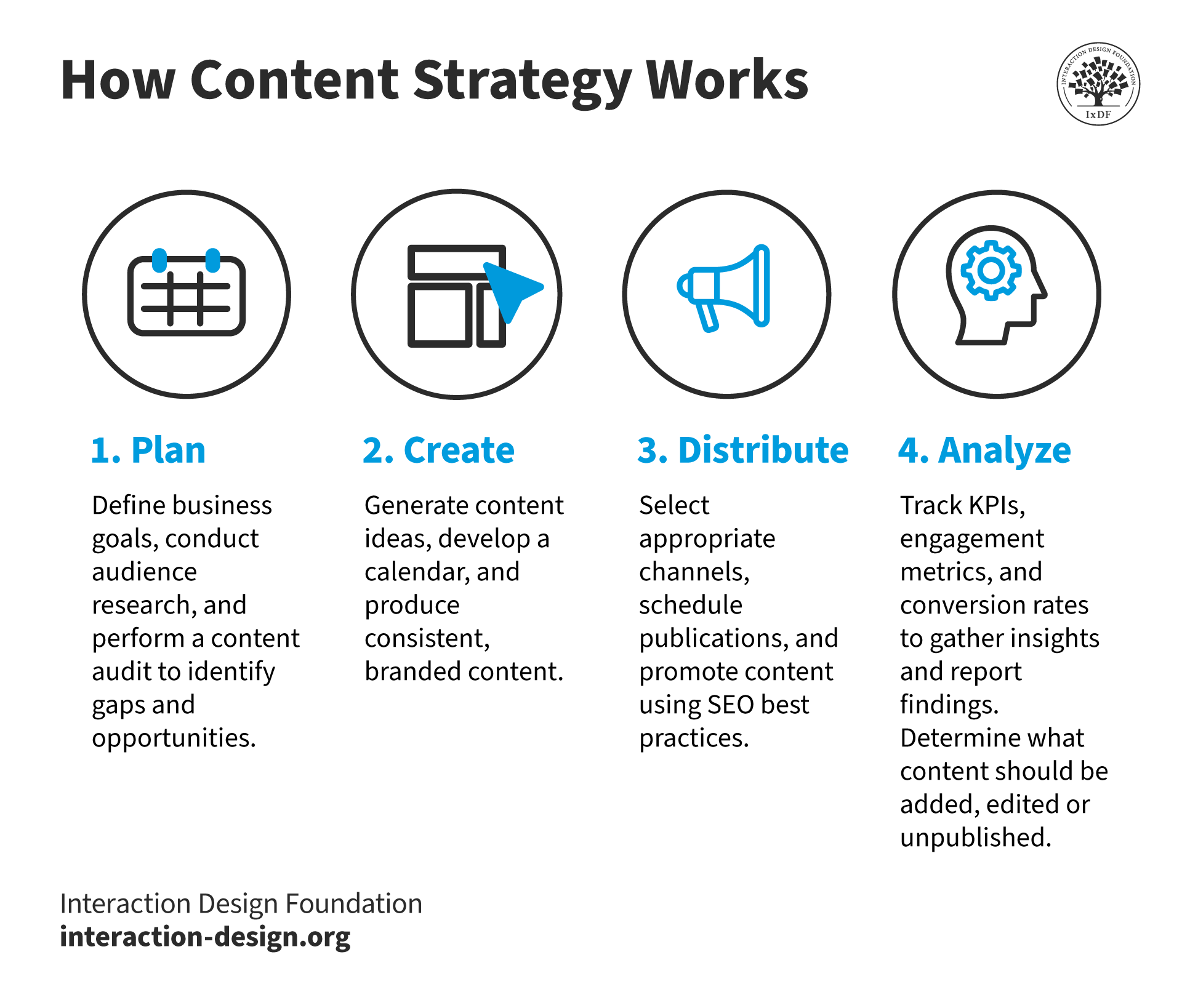
The content strategy framework is a structured, step-by-step process that ensures that every piece of content created aligns with business goals, meets audience needs, and drives measurable results. This framework is very important because it brings order and purpose to content creation—it transforms it from an ad-hoc activity to a strategic process. The process typically involves planning, creating, distributing, and analyzing content, each step building on the previous one to create a cohesive and effective strategy.
© Interaction Design Foundation, CC BY-SA 4.0
1. Plan
Planning is the first step—set goals, conduct research and audit existing content. This stage lays a solid foundation and makes sure that the content strategy aligns with the overarching business objectives and the specific needs of the target audience.
2. Create
Creating comes next—designers should focus on producing high-quality, relevant content that speaks directly to the audience’s needs and interests. This step requires careful attention to detail, as the content must not only be engaging but also consistent in tone and style.
3. Distribute
This stage involves strategically sharing the content across various channels to maximize reach and engagement. This step requires a deep understanding of where the target audience spends their time and how they prefer to consume content. Proper distribution ensures that the right people see the right content at the right time, which amplifies its impact.
4. Analyze
Analyzing is the final step, where the performance of the content is measured against the set goals. This involves tracking key performance indicators (KPIs) such as engagement rates, conversion rates, and other metrics that provide insights into how well the content is performing. Analysis allows for continuous improvement and informs future content planning and creation efforts.
When each step is followed and integrated into the UX design process, or any process for that matter, the resulting content will not only support the experience, but enhance it too. A well-planned, well-executed content strategy helps create a seamless, engaging and effective user journey—better business outcomes and increased user satisfaction follows suit.
How to Develop a Content Strategy
Follow these steps to create a content strategy from scratch, or to modify an existing one.
Set clear goals and objectives:
Define what the purpose of the content is and what it must achieve (e.g., increase brand awareness, drive traffic, boost engagement).
Goals must be specific, measurable, achievable, relevant, and time-bound (SMART).
Conduct research:
Identify the target audience/user group with personas, surveys, and market research.
Understand their needs, preferences, behaviors, and pain points to tailor the content effectively.
In this video, CEO of Experience Dynamics, Frank Spillers, explains why user research is so important for a content strategy:
Perform a content audit:
Review any existing content to identify strengths, gaps, and opportunities for improvement.
Evaluate which content pieces to keep, update, repurpose, or remove.
Develop a content plan and calendar:
Outline key themes, topics, formats, and publication schedules.
Use a content calendar to organize and plan content creation efforts to ensure consistency and strategic alignment.
Create high-quality content:
Produce engaging, relevant, and valuable content that aligns with your brand and audience needs.
Focus on quality writing, compelling visuals, and useful information to capture and retain your audience's attention.
Choose distribution channels:
Identify the best platforms to reach your target audience (e.g., websites, social media, email newsletters).
Tailor your content distribution strategy to each platform for maximum impact.
Optimize for SEO:
Implement SEO best practices by using relevant keywords, meta descriptions, and tags.
Ensure your content is discoverable and ranks well in search engine results to increase visibility.
Measure and analyze performance:
Track key performance indicators (KPIs) such as engagement, conversions, and traffic.
Use analytics tools to assess the effectiveness of your content strategy and make data-driven decisions.
Establish governance and workflow:
Define clear processes, roles, and responsibilities for content creation, approval, and maintenance.
Implement a streamlined workflow to ensure consistency, quality, and timely delivery of content.
Iterate and optimize:
Continuously refine and update your content strategy based on performance data, audience feedback, and market trends.
Regularly assess, iterate and optimize your approach to keep your content fresh, relevant, and aligned with evolving audience preferences.