Ideation

Your constantly-updated definition of Ideation and collection of videos and articles.
Be a conversation starter: Share this page and inspire others!

789 Shares

What is Ideation?

Ideation is the creative process UX (user experience) designers use to generate a wide range of ideas that solve user problems. You use it with your team to move beyond the obvious and explore potential solutions in depth. Then you choose which ideas to develop further through prototyping and testing. With structure and collaboration, ideation helps you identify the most effective solutions to correctly defined problems.

Explore the five phases of the design thinking process here, and how this flexible, iterative design process drives innovation you can count on.

Copyright
Transcript

How to Run an Ideation Session Effectively

Ideation may sound self-explanatory, almost too obvious and “organic” a stage in the UX design process to approach with an analytical mindset. However, it’s virtually impossible to overstate its importance. One reason is the misconception that great ideas “just happen.” Although wonderful notions can sometimes come from “out of the blue,” a deliberate approach is best.

Use this step-by-step approach to get the most out of your ideation sessions.

Step 1: Frame the Right Problem

Before you start ideating, you need to know the design challenge and what’s involved. Make sure you’ve got:

  • A clear problem statement or “How might we…” question that you have rooted in user insight and design constraints: for example, “How might we help remote workers feel connected through our collaboration tool?”

  • A shared understanding of user needs, pain points, and context. For this, it’s wise to create some personas (research-based representations of real user groups) you can empathize with and plug into your design process.

In this video, William Hudson: User Experience Strategist and Founder of Syntagm Ltd., explains how personas help you keep real users at the center of your design process.

Transcript

  • Established constraints, such as technology, business goals, brand, and budget, so your team can push creativity within realistic boundaries to rein in the more extravagant ideas you might generate at first.

In this video, William Hudson explains how clearly identifying constraints early, including requirements like accessibility compliance and data encryption, helps you frame the right problem and avoid costly rework later in development.

Transcript

  • A prepared space, facilitator, materials (whiteboard, sticky notes, markers), and a mindset that fosters open generation of ideas.

Step 2: Set the Stage and Rules

In terms of “venue,” you might run in-person workshops (with sticky notes, whiteboards); remote sessions (using digital whiteboards); individual sketching or silent idea generation followed by group sharing; or contextual ideation (in the field, or using roleplay, bodystorming, or scenario creation).

You’ll want structure and rules to serve a key part in ideation, though not to stifle creativity. So:

  • The facilitator should explain rules like: “No idea is too wild,” “Go for quantity over quality,” “Build on each other’s ideas,” “Avoid off-topic tangents,” and “Suspend judgment.” You need a judgment-free environment, so encourage wild ideas first, and then let them evolve into more realistic solutions.

  • Decide on a length for the ideation session, such as 30–60 minutes.

  • Orient the group with a warm-up exercise if they need to break the ice, and remind everyone to keep an open mindset.

  • Provide materials for in-person sessions, like sticky notes, markers, and sketch pads.

Step 3: Use Generative Techniques

Select one or more ideation techniques that fit your team and challenge, including:

  • Brainstorming: This classic verbal idea sharing approach can work wonders in a group.

In this video, William Hudson explains how to run an effective brainstorming session that sparks creativity and collaboration.

Transcript

  • Brainwriting / Brainwalking: In these brainstorming variants, participants write down ideas, pass them on, or rotate between stations.

  • Crazy eights: Each participant folds a sheet into eight panels and quickly sketches eight ideas in eight minutes.

  • Mind-mapping: Write a keyword in the center and draw branches of associated ideas, then connections between them. It’s useful for exploring a large idea space.

  • Bad ideas: Encourage everyone to come up with bad ideas deliberately, to discover what makes them “bad” and find useful insights. You’ve also got the worst possible idea approach, where you invite the group to propose hilariously bad solutions and then flip them into useful ones. The weirdest, wildest, and worst ideas can help break inhibitions and reveal hidden directions to optimal design destinations.

In this video, Alan Dix: Author of the bestselling book “Human-Computer Interaction” and Director of the Computational Foundry at Swansea University, shows you how deliberately creating bad ideas can spark unexpected creativity and lead to innovative solutions.

Transcript

  • Bodystorming / Roleplay: Physically act out the scenario or simulate the environment to spark ideas. It’s a famously useful technique as it helps team members get closer to empathize with users as they can feel more what it’s like to be them.

In this video Frank Spillers: Service Designer, Founder and CEO of Experience Dynamics, shows you how bodystorming and role play can help you experience user interactions firsthand.

Transcript

You can combine techniques in one session, such as mind-mapping and then crazy eights, for example.

Step 4: Capture and Record Everything

Even ideas that feel silly or irrelevant might spark a later insight, so don’t let them get away. Capture all ideas on sticky notes, digital boards, or whiteboards. Document who said what, if needed, and keep a photo or export of the board so the resource is there to tap. You might have some “diamonds in the rough”; don’t overlook them.

Step 5: Sort, Cluster, and Refine Ideas

Once idea generation slows, you’ll likely have explored most, if not all, of what you can. The strength of divergent thinking means you should have a wide variety of ideas, so now it’s time to switch to convergent thinking and look at what you have and sift and sort it all to find useful ideas.

So, move into a clustering or affinity-mapping activity: group similar ideas, identify themes, merge duplicates, and highlight interesting directions. Begin narrowing toward feasibility and alignment with constraints so you can filter ideas that are creative and feasible.

Find valuable insights as this video explains how affinity diagramming helps you organize and cluster ideas to uncover key patterns and insights.

Transcript

Pick one or more ideas to develop further, in the prototyping and then testing stage. Use criteria such as user value, business viability, technical feasibility, and uniqueness. Store other ideas for future use; not all ideas will be viable right now.

Step 6: Transition to Prototyping

Once you’ve selected promising ideas, hand them over to the team for prototyping, storyboarding, sketching or wireframing. Early prototyping empowers you to quickly find answers about your idea for a possible design solution. From testing it with users, you’ll come away with essential insights as to what works and what doesn’t. Note that ideation doesn’t stop here; you may repeat the process as you test and learn.

Explore how prototyping and iteration help you refine designs through user testing and continuous improvement in this video with Alan Dix.

Transcript

The Benefits of Ideation

Ideation represents a crucial transition: a bridge from user research and problem definition into solution exploration. Here are some key reasons why good ideation matters.

Expands Possibilities and Supports Innovation

When you deliberately widen your thinking and approach it as a dedicated activity, you create space for unexpected, creative responses to user needs. First, concentrate on idea generation itself and mentally “go wide” in terms of concepts and outcomes. When you adopt effective ideation techniques, you can challenge assumptions you might not realize you have. From there, you can access new angles to examine the problem and surface valuable insights on where to go for a solution.

Anchors Ideas in a User-Centered Context

Because ideation follows design thinking’s empathize phase (where you research your target audience to understand their user needs and more) and define phase (where you isolate and define the right problem these users face), the ideas you generate remain grounded in real user needs rather than personal preferences or technology hype. With that alignment, target users will more likely find your solution meaningful and usable. For even the most complex problems, ideation often can help crack the “code” you need to determine what users really want, not what you (or they) think they might want.

Avoids Premature Commitment to One Solution

Ideation helps you keep the door open so you can explore many paths without committing resources to detailed designs. One of the dangers of design work is that design teams can jump to conclusions based on assumptions or go along with the first promising-looking idea. However, when you ideate you can think ahead without making commitments and avoid wasted time or effort on ideas you end up not using.

Encourages Collaboration and Shared Ownership

Running ideation workshops makes great sense. It fosters cross-disciplinary collaboration, engages people from different backgrounds and skill sets, brings in diverse perspectives, and helps team members align around possibilities rather than just technical or business constraints. Ideating with other teams, such as marketing, development, and business stakeholders, can stoke the “fires” of creativity tremendously. You can light your way to examine the true problem more fruitfully, and from more angles, and find the best viewpoint on what’s needed in a solution.

Sets the Stage for Prototyping and Testing

The output from ideation becomes the input for you and your design team to advance to prototyping and experimentation in the best direction. From the many ideas you’ll likely generate in divergent thinking, where you push the limits to explore a vast array of possibilities, you then narrow your focus on the most promising options in convergent thinking. And through further refining at this stage, you can find great ideas to prototype and test if they’re valid.

In this video, Alan Dix explains how divergent and convergent thinking work together to turn creative ideas into practical design solutions.

Transcript

Overall, treat ideation not as an exercise in “we generated ideas” but “we selected ideas to explore.” Like myths about creative individuals, misconceptions about ideation may lead some people in the organization, especially business stakeholders, to misread it as an excuse to waste time under the guise of “creativity.” Nothing could be further from the truth. Blue-sky ideation can cover almost innumerable angles before you zero in on promising contenders. Plus, the team-building in ideation sessions enables groups to gel together around a common goal of participation and team-ownership of a golden opportunity.

Perhaps best of all, because ideation is not a “one-and-done” activity but circular, you and your team can re-explore new avenues as you move back and forth in your design process. The right solution is out there, waiting for you. You may unwittingly find the doorway to it and won’t realize it at first. Or it might just take a fresh ideation effort to push into that section of the vast idea space and lock onto the “coordinates” of an exceptionally powerful solution. From there, you can bring it down to “street level” and fine-tune your way to serving up a truly innovative and successful digital solution, one which users will love your brand for delighting them with.


Questions About Ideation?
We've Got Answers!

When should I start ideation in a UX project?

Start ideation once you’ve clearly defined the problem based on user research. This typically follows the discovery and synthesis phases or empathize and define phases in design thinking. By then, you’ll understand your users’ needs, behaviors, and pain points, which empowers you to engage in meaningful idea generation. Ideating too early risks solving the wrong problem.

Once you’ve crafted problem statements or “How Might We” questions, you’re ready. This timing aligns with the double diamond model, where ideation happens in the second diamond, after discovery and definition. Solid research enables designers to generate targeted, innovative solutions. UX (user experience) design teams who ideate with a strong research foundation often create more relevant, user-centered products; so, before sketching or brainstorming, ensure the insights are in place to guide your creative process.

Explore how to empathize to kickstart your creative process with solid insights you can build upon.

What are the most common ideation techniques in UX design?

UX designers use a variety of ideation techniques, each suited to different goals. The most common include brainstorming, where teams rapidly generate ideas without judgment; mind mapping, which helps visually organize thoughts and relationships; and Crazy 8s, which pushes participants to sketch eight ideas in eight minutes on the eight “panels” of a folded sheet of paper. SCAMPER is another favorite, which prompts designers to think differently by asking how to Substitute, Combine, Adapt, Modify, Put to another use, Eliminate, or Reverse elements of a solution.

Storyboarding visualizes user experiences step-by-step, while sketching helps express rough concepts quickly. These methods encourage diverse thinking, collaboration, and speed. UX teams often mix multiple techniques during a single session to keep creativity flowing and cover more ground. Each method helps break away from conventional ideas and promotes user-centered innovation that can produce highly creative wins for users and brands.

Tap the immense power of brainstorming to unlock otherwise-hidden avenues that can bring powerful insights about users and what they want from design solutions.

How do I run a successful ideation session with a team?

To run a successful ideation session, start with a clear goal and set of “How Might We” questions. Invite a diverse group of participants to encourage varied perspectives. Create a safe, judgment-free space so that everyone feels comfortable sharing ideas.

Use time-boxed ideation activities like brainstorming or Crazy 8s to keep energy high and ideas flowing. Capture all ideas visually using sticky notes or digital whiteboards. Keep discussions focused, and if energy dips, introduce a creative exercise or short break.

After ideating, cluster similar ideas and vote on favorites using methods like dot voting. Above all, facilitate, don’t dominate; your role is to guide, not control. A well-structured session fuels innovation and ensures every voice contributes to truly user-focused solutions.

Get right into the role of facilitator and come away with valuable insights in our article What is Ideation – and How to Prepare for Ideation Sessions.

What’s the best way to ideate when working alone as a UX designer?

When ideating solo, structure your time like a team session. Don’t worry; you don’t have to pretend others are there. Instead, begin with a clear problem statement or “How Might We” question. Use methods like mind mapping, sketching, or journaling to explore ideas.

Try the Crazy 8s technique (sketching 8 ideas in 8 minutes on a sheet of paper folded 3 times to make 8 sections); it still works solo and forces quick thinking. Approaches like SCAMPER help shift your perspective and generate unique solutions. Talk aloud or record voice notes to simulate dialogue and spark new thoughts.

When ideas stall, take a walk or switch environments to reset. Reflect on past projects or competitors’ designs for inspiration (but don’t copy). Most importantly, externalize your thinking; don’t just brainstorm in your head. The act of writing or sketching makes ideas real and helps refine them. Solo ideation offers deep focus and freedom from groupthink, powerful plusses that can lead to creative, user-centered outcomes.

Dig deeper and come away with golden insights from our article Define and Frame Your Design Challenge by Creating Your Point Of View and Ask “How Might We.”

How can I use Crazy 8s in my UX ideation process?

Crazy 8s boosts ideation speed and variety by challenging you to sketch eight ideas in eight minutes. Start with a well-defined problem or “How Might We” question. Fold a sheet of paper into eight sections (so fold the sheet three times). Set a one-minute timer for each sketch; keep it fast and rough. Don’t aim for perfection; focus on quantity and creativity.

Crazy 8s breaks mental blocks by forcing rapid thinking and pushing past obvious solutions. It’s something teams often use early in design sprints to spark diverse ideas. After sketching, share and discuss the concepts if working with a team, or review them yourself to identify patterns. You can mix it with dot voting to prioritize ideas. Crazy 8s keeps ideation fresh, visual, and energizing, and it’s perfect for UX challenges that need a creative jumpstart.

How does the SCAMPER method help with ideation in UX?

SCAMPER helps UX designers innovate by applying seven thinking techniques: Substitute, Combine, Adapt, Modify, Put to another use, Eliminate, and Reverse. Each prompts you to look at existing ideas or features differently. For example, you might ask: “What can we eliminate to simplify the user flow?” or “Can we adapt a feature from another product?”

SCAMPER encourages out-of-the-box thinking and reveals unexpected solutions. It works best once you’ve defined the user problem and want to explore enhancements or alternatives. You can apply it individually or as a team, on paper or with digital tools. Many UX professionals use SCAMPER during redesigns or when refining prototypes. Its structured prompts drive ideation beyond surface-level ideas, helping create user experiences that feel both novel and useful.

Discover the power of the SCAMPER technique to access new angles and precious design and user insights.

How do I choose the right ideation method for my project?

Choose your ideation method based on the project’s stage, your goals, and your team dynamics. For early-stage, divergent thinking, use brainstorming or Crazy 8s (sketching 8 ideas on 8 panels of a folded sheet of paper in 8 minutes) to generate lots of ideas quickly. If you’re refining concepts, SCAMPER or mind mapping can push your thinking deeper. When working with a team, collaborative methods like storyboarding, role-playing, or brainwriting ensure everyone contributes. For solo work, sketching and journaling work well.

Consider constraints, too: short timelines favor quick methods like rapid sketching, while complex problems might benefit from scenario-based ideation. Match the method to the type of insight you want: emotional, functional, or behavioral. Test different techniques over time to find what consistently delivers strong, user-centered solutions. Picking intentionally helps maximize creativity and align ideas with your design goals.

Explore mind maps to find how to use this powerful ideation tool to access vital insights towards the best designs.

How do I overcome creative blocks during ideation sessions?

To overcome creative blocks, shift your perspective and reduce pressure. To start, revisit your user research: it often sparks fresh ideas. Change your environment or switch mediums; for example, move from typing to sketching. Use prompts like “What would a child do?” or “How would this work in a different industry?”

SCAMPER or role-playing can also unlock new angles. Take a short break or walk: stepping away often clears mental clutter. If you’re working in a group, introduce timed exercises like Crazy 8s to reignite momentum. Most importantly, let go of perfection and judgment, as creative flow thrives in safe, playful spaces. Encourage quantity over quality at first. Once the ideas flow again, refine and cluster them. Creative blocks happen to everyone; it’s normal and natural, so use them as a signal to try a new approach.

Explore the nature of creative blocks to understand how to handle them best, for yourself and the benefit of the design solutions you can unlock.

How do I evaluate and choose the best ideas from a session?

After ideation, evaluate ideas based on criteria like user value, feasibility, and alignment with business goals. Group similar ideas and look for themes. Use tools like an impact-effort matrix to map ideas; prioritize those with high impact and low effort. Dot voting works well in teams to highlight popular concepts.

Consider user research insights, too: Which ideas solve real pain points? Prototyping a few top concepts can help validate them through quick user feedback. Avoid favoring flashy ideas without substance. Instead, focus on solutions that balance creativity with practicality. Document why certain ideas were chosen to keep decision-making transparent. This structured evaluation process ensures your final concept serves users and stakeholders while it stays well-grounded in the project’s objectives.

Understand more about user research to unlock a treasure trove of insights you can apply to help find the best design ideas for your user problems.

Can I combine different ideas into one UX solution?

Yes, combining ideas often leads to stronger, more innovative UX solutions. During ideation, you’ll likely generate ideas that tackle different angles of the same problem. So, look for ways to merge complementary concepts: for instance, pairing a simplified navigation with a personalized dashboard.

Use clustering or affinity mapping to group ideas, then explore how they might integrate. Combining ideas helps create well-rounded solutions that address multiple user needs. Just make sure the final concept stays cohesive and user-centered. Avoid feature bloat; prioritize simplicity and usability. Prototyping helps test if the combination works in practice. Many successful products evolved from blended concepts. Merging ideas unlocks richer experiences, so don’t be afraid to mix, match, and iterate until the solution truly resonates with users.

Explore another ideation technique, embrace opposites, to learn another helpful way you might combine with a method you’ve already tried.

How do I know when to stop ideating and move forward?

Stop ideating when you’ve met your goals: generated diverse options, identified high-potential ideas, and aligned on a clear direction. If your top ideas consistently solve the user problem and meet project constraints, it’s time to prototype. Use decision-making tools like dot voting or impact-effort grids to confirm team alignment.

Revisit your problem statement; have your ideas addressed it well? If new ideas start repeating or feel forced, it’s a sign the session has run its course. Consider deadlines, too; ideation is vital, but it’s one phase in the UX process. Move forward to test and refine your top concepts. UX design thrives on iteration, so you’ll revisit ideas as you need to. Progress matters more than perfection, and transitioning from ideation to action keeps your design process user-focused and efficient.

Peer into the practice of prototyping to explore the many powerful avenues it opens for the right design ideas.

What are some common problems with ideating in UX design?

Common ideation problems include unclear goals, lack of user insights, and fear of judgment.

Without a clear problem statement, teams generate irrelevant ideas. Skipping user research leads to solutions that miss real needs. In group settings, dominant voices can overshadow quieter participants, reducing diversity of thought.

Creative blocks and groupthink limit innovation, too. Plus, poor facilitation or unstructured sessions often waste time.

To avoid these pitfalls, start with solid research, craft clear “How Might We” questions, and foster an inclusive, playful atmosphere. Use time-boxed methods to stay focused and energize the team. Document everything to track progress. The best UX ideation combines structure with creativity, grounding bold ideas in real user problems.

Explore how to get away from groupthink so you can help steer a better course for your design projects and the solutions that emerge for users to enjoy.

What are some highly cited or recent articles about ideation in UX design?

Hay, L., Duffy, A. H. B., Gilbert, S. J., Lyall, L., Campbell, G., Coyle, D., & Grealy, M. A. (2019). The neural correlates of ideation in product design engineering practitioners. Design Science, 5, e29.

This study is one of the first to explore the neural basis of ideation in practicing professional product design engineers using fMRI. It compared brain activity during ideation versus control tasks and found greater activation in the left cingulate gyrus and potential involvement of the right superior temporal gyrus. Notably, no significant differences were found between open-ended and constrained ideation tasks. This research is important because it shifts the understanding of creative design thinking from abstract theory into cognitive neuroscience, providing empirical insight into how ideation unfolds in the professional design mind: relevant for improving UX and design workflows.

Hu, W. L., & Reid, T. (2018). The effects of designers’ contextual experience on the ideation process and design outcomes. Journal of Mechanical Design, 140(10), 101101.

This experimental study examined how contextual experience influences creative ideation in design. Using EEG measurements and evaluation of ideation outcomes (novelty, quality, quantity) from 33 participants, the authors found that greater familiarity with the design context negatively affected creativity, particularly novelty. This counterintuitive finding suggests that prior experience may constrain ideation by reinforcing habitual thinking patterns. For UX design practitioners and teams, the implications are clear: incorporating fresh perspectives and non-experts into the ideation process may lead to more innovative outcomes by offsetting the potential cognitive rigidity of experts.

Campbell, G., Hay, L., Gilbert, S. J., McTeague, C., Coyle, D., & Grealy, M. A. (2024).
Functional activity and connectivity during ideation in professional product design engineers. Design Studies, 91–92, 101247.

This recent fMRI study extends prior research by focusing on brain network connectivity during ideation in professional designers. Unlike studies that isolate brain regions, this research explores how multiple networks, including executive control, salience, default mode, and visual systems, interact dynamically during creative thinking. The findings emphasize that ideation is a distributed, multimodal process involving switching between cognitive control and imagination. For UX and product designers, this underscores the value of supporting diverse modes of thinking during ideation, from visualization and sketching to reflective assessment. It strengthens the cognitive foundation of design thinking by detailing how the brain organizes idea generation.

Kelley, T., & Kelley, D. (2013). Creative Confidence: Unleashing the Creative Potential Within Us All. Crown Business.

This book, from two leading voices in design and innovation (of IDEO and the Stanford d.school), argues that creativity and ideation are not reserved for “creative types” alone but can be nurtured and embedded in everyday work. The authors draw on rich stories and case‑studies to show how teams can generate and build on ideas, overcome fear of failure, and create a culture of ideation. Because ideation underpins innovation in UX design (the “how might we…” stage of design thinking), this book is influential in shifting mindset and practice toward more generative, idea‑rich workflows.

Buxton, B. (2007). Sketching User Experiences: Getting the Design Right and The Right Design. Morgan Kaufmann (Elsevier).

Bill Buxton’s book importantly foregrounds ideation via sketching: that is, not only generating ideas, but making them visible early, exploring many design alternatives, and choosing the “right design” (not just “designing right”). The book links ideation, sketching, prototyping and iteration, thereby helping UX designers transition from vague ideas to concrete concepts. It’s highly respected for placing ideation at the center of the UX process and for giving practical and philosophical justification for early divergence in design work.

Earn a Gift Earn a Gift, Answer a Short Quiz!

1
2
3
4
1
2
3
4
Question 1
Question 2
Question 3
Get Your Gift
Interaction Design Foundation logo

Question 1

What is the primary role of ideation in the design process?

1 point towards your gift

  • To finalize the visual aesthetics of a product
  • To create and explore a wide range of ideas before narrowing down to potential solutions
  • To write documentation and technical specifications for developers
Interaction Design Foundation logo

Question 2

Why do designers aim to generate as many ideas as possible during ideation?

1 point towards your gift

  • Because more ideas increase the chance of finding a truly innovative solution
  • Because the final product needs to include every idea
  • Because it speeds up the final implementation phase
Interaction Design Foundation logo

Question 3

Which of the following is commonly used in ideation to spark new ideas?

1 point towards your gift

  • Brainstorming
  • Quality assurance testing
  • Wireframing

Learn More About Ideation

Make learning as easy as watching Netflix: Learn more about Ideation by taking the online IxDF Course Design Thinking: The Ultimate Guide.

Why? Because design skills make you valuable. In any job. Any industry.

In This Course, You'll

  • Get excited when you discover that you don't need to start from scratch to use the secret recipes that empower companies like Apple and Google to shape the future. You just need a structure and proven methods to optimize what you already do. As AI becomes part of your day-to-day workflows, your ability to guide it with timeless human-centered skills such as strategic thinking, creativity, and empathy for real users is what turns AI into your superpower and delivers meaningful results.

  • Build on your existing creativity, problem-solving, and people skills to learn the powerful 5-stage method called Design Thinking. It's one of the key drivers behind Apple and Google's continuous innovation and provides a clear, structured way to solve real-world problems. You've already got the instincts, so it's easy to learn the method. 

  • Make yourself invaluable with hands-on skills in Design Thinking. Design Thinking can help you break into User Experience Design, product design, and tech. It's widely applicable, impactful, and fun! Use your skills to improve customer support processes, create new products, and even tackle big challenges like climate change. This human-centered approach is a key driver of business success because it guides you to systematically understand and address what your users really need and want. That's why Design Thinking skills can help you increase sales, keep customers loyal, and turn them into powerful advocates for your company.

  • Gain confidence and credibility as you effortlessly apply methods from all five stages of the Design Thinking process. You'll be guided to build empathy and gather insights into people's habits through user interviews. 

  • Use our downloadable templates to create affinity diagrams, empathy maps, and actionable "How Might We" questions. Develop solutions as you apply ideation and innovation methods. Create a paper prototype early and fast, then test and optimize your prototype to ensure that your users love it. More love, more impact, greater salary potential. 

  • Apply your new skills in an optional project where you'll design and test a user-centered experience that's perfect for your portfolio and career growth. Master Design Thinking to amplify your uniquely human strengths like empathy, intuition, and creativity, and confidently stay in demand as AI reshapes how teams work.

It's Easy to Fast-Track Your Career with the World's Best Experts

Master complex skills effortlessly with proven best practices and toolkits directly from the world's top design experts. Meet your experts for this course:

  • Don Norman: Father of User Experience (UX) Design, author of the legendary book “The Design of Everyday Things,” and co-founder of the Nielsen Norman Group.

  • Alan Dix: Author of the bestselling book “Human-Computer Interaction” and Director of the Computational Foundry at Swansea University.

  • Mike Rohde: Experience and Interface Designer, author of the bestselling “The Sketchnote Handbook.”

Get an Industry-Recognized IxDF Course Certificate

Increase your credibility, salary potential and job opportunities by showing credible evidence of your skills.

IxDF Course Certificates set the industry gold standard. Add them to your LinkedIn profile, resumé, and job applications.

Course Certificate Example

Be in distinguished company, alongside industry leaders who train their teams with the IxDF and trust IxDF Course Certificates.

Our clients: IBM, HP, Adobe, GE, Accenture, Allianz, Phillips, Deezer, Capgemin, Mcafee, SAP, Telenor, Cigna, British Parliament, State of New York

All Free IxDF Articles on Ideation

Read full article
Ideation for Design  - Preparing for the Design Race - Article hero image
Interaction Design Foundation logo

Ideation for Design - Preparing for the Design Race

Ideation is easy to define. It’s the process by which you generate, develop and then communicate new ideas. Ideas can take many forms such as verbal, visual, concrete or abstract. The principle is simple to create a process by which you can innovate, develop and actualize new products. Ideation is c

Social shares
870
Published
Read Article
Read full article
What is Design Thinking and Why Is It So Popular? - Article hero image
Interaction Design Foundation logo

What is Design Thinking and Why Is It So Popular?

Design Thinking is not an exclusive property of designers—all great innovators in literature, art, music, science, engineering, and business have practiced it. So, why call it Design Thinking? What’s special about Design Thinking is that designers’ work processes can help us systematically extract,

Social shares
1.6k
Published
Read Article
Read full article
The 5 Stages in the Design Thinking Process - Article hero image
Interaction Design Foundation logo

The 5 Stages in the Design Thinking Process

Design thinking is a methodology that provides a solution-based approach to solving problems. It’s extremely useful when used to tackle complex problems that are ill-defined or unknown—because it serves to understand the human needs involved, reframe the problem in human-centric ways, create numerou

Social shares
2k
Published
Read Article
Read full article
What is Ideation – and How to Prepare for Ideation Sessions - Article hero image
Interaction Design Foundation logo

What is Ideation – and How to Prepare for Ideation Sessions

Ideation is the process where you generate ideas and solutions through sessions such as Sketching, Prototyping, Brainstorming, Cheatstorming, Brainwriting, Worst Possible Idea, and a wealth of other ideation techniques. Ideation is also the third stage in the Design Thinking process. Although many p

Social shares
1.4k
Published
Read Article
Read full article
Create Some Space – for Ideation Sessions and Design Thinking - Article hero image
Interaction Design Foundation logo

Create Some Space – for Ideation Sessions and Design Thinking

The spaces we occupy deeply influence our experiences, our feelings, and our behaviors. Our state of health, psychology, productivity, mood, and creativity spaces influence us on many levels and also influence our interactions with each other. The spaces in which we journey through Design Thinking a

Social shares
703
Published
Read Article
Read full article
Learn How to Use the Analogies Method - Article hero image
Interaction Design Foundation logo

Learn How to Use the Analogies Method

Hospital emergency rooms have been inspired by F1 pit stop crews. Henry Ford's assembly line was inspired by observing systems within slaughterhouses and grain warehouses. Executives, artists, writers and all kinds of other creative professionals have relied on creating analogies as a powerful tool

Social shares
877
Published
Read Article

What is Ideation – and How to Prepare for Ideation Sessions

What is Ideation – and How to Prepare for Ideation Sessions

Ideation is the process where you generate ideas and solutions through sessions such as Sketching, Prototyping, Brainstorming, Cheatstorming, Brainwriting, Worst Possible Idea, and a wealth of other ideation techniques. Ideation is also the third stage in the Design Thinking process. Although many people might have experienced a “brainstorming” session before, it is not easy to facilitate a truly fruitful ideation session. In this article, we’ll teach you some processes and guidelines which will help you facilitate and prepare for productive, effective, innovative and fun ideation sessions.

Ideation is often the most exciting stage in a Design Thinking project, because during Ideation, the aim is to generate a large quantity of ideas that the team can then filter and cut down into the best, most practical or most innovative ones in order to inspire new and better design solutions and products.

“Ideation is the mode of the design process in which you concentrate on idea generation. Mentally it represents a process of ‘going wide’ in terms of concepts and outcomes. Ideation provides both the fuel and also the source material for building prototypes and getting innovative solutions into the hands of your users.”
– d.school, An Introduction to Design Thinking PROCESS GUIDE

Ideation Will Help You:

  • Ask the right questions and innovate with a strong focus on your users, their needs, and your insights about them.

  • Step beyond the obvious solutions and therefore increase the innovation potential of your solution.

  • Bring together perspectives and strengths of your team members.

  • Uncover unexpected areas of innovation.

  • Create volume and variety in your innovation options.

  • Get obvious solutions out of your heads, and drive your team beyond them.

Why do We Need Ideation in Design Thinking?

We’ll let Grand Old Man of User Experience, Don Norman, answer this important question in a down-to-earth and very relevant way. Don Norman helps us take one step back and reflect upon why we need to challenge assumptions, ask stupid questions and provoke our current understanding, which is—in fact—what Ideation methods such as Challenge Assumptions, SCAMPER, and Provocations help us do:

“One of my concerns has been design education, where the focus has been centered too much upon craft skills and too little on gaining a deeper understanding of design principles, of human psychology, technology and society. As a result, designers often attempt to solve problems about which they know nothing. I have also come to believe that in such ignorance lies great power: The ability to ask stupid questions. What is a stupid question? It is one which questions the obvious. ‘Duh,’ thinks the audience, ‘this person is clueless.’ Well, guess what, the obvious is often not so obvious. Usually it refers to some common belief or practice that has been around for so long that it has not been questioned. Once questioned, people stammer to explain: sometimes they fail. It is by questioning the obvious that we make great progress. This is where breakthroughs come from. We need to question the obvious, to reformulate our beliefs, and to redefine existing solutions, approaches, and beliefs. That is design thinking. Ask the stupid question. People who know a lot about a field seldom think to question the fundamentals of their knowledge. People from outside the discipline do question it. Many times their questions simply reveal a lack of knowledge, but that is OK, that is how to acquire the knowledge. And every so often, the question sparks a basic and important reconsideration. Hurrah for Design Thinking.”
– Don Norman, in Rethinking Design Thinking

According to Don Norman, asking stupid questions is not stupid at all. However, Ideation and Design Thinking is not only about challenging assumptions and asking so-called stupid questions. It’s also about going from researching and defining your users and their needs in the Empathise and Define phases and moving on into starting to come up with the right solutions for the users via Ideation methods:

“You ideate in order to transition from identifying problems to creating solutions for your users. Ideation is your chance to combine the understanding you have of the problem space and people you are designing for with your imagination to generate solution concepts. Particularly early in a design project, ideation is about pushing for a widest possible range of ideas from which you can select, not simply finding a single, best solution.”
– d.school, An Introduction to Design Thinking PROCESS GUIDE

The d.school celebrates Design Thinking, and d.school provides one of the most – if not the most – celebrated and recognised resources on Design Thinking and ideation techniques. D-school is a design school based at Stanford University in cooperation with the German Hasso Plattner Institute of the University of Potsdam. Here, we’ll introduce you to how you can prepare for Ideation Sessions based on d.school and the international design and consulting firm IDEO’s best practices.

Get Started in Applying Ideation Methods

Ideation facilitation is a challenging and complex task. It requires experience in understanding and managing teams, people dynamics, adaptability and flexibility and a range of other soft skills, which in reality are really hard to master. Having said that, there's nothing like experience to help you learn the ropes of any field. The best way to learn is to take the theory and techniques you learn from the experts, and then apply and test them in your own context and adapt them to your own needs.

Preparation before the Storm

When we're about to venture into stormy territory, we know we need to prepare for a bumpy ride and take extra provisions so that we come out on the other side and arrive at our destination unscathed. An ideation process such as Brainstorming or Challenging Assumptions is no different. Wandering into a Brainstorm without preparation is asking for trouble. You may inadvertently damage your team's perception of ideation and scar them for future creative activities. You could also damage team cohesion by going into a situation like this and causing team members to fall out with each other due to a brainstorming session gone wrong.

How to Prepare Before You Start Ideating

Author/Copyright holder: Teo Yu Siang and Interaction Design Foundation. Copyright terms and licence: CC BY-NC-SA 3.0
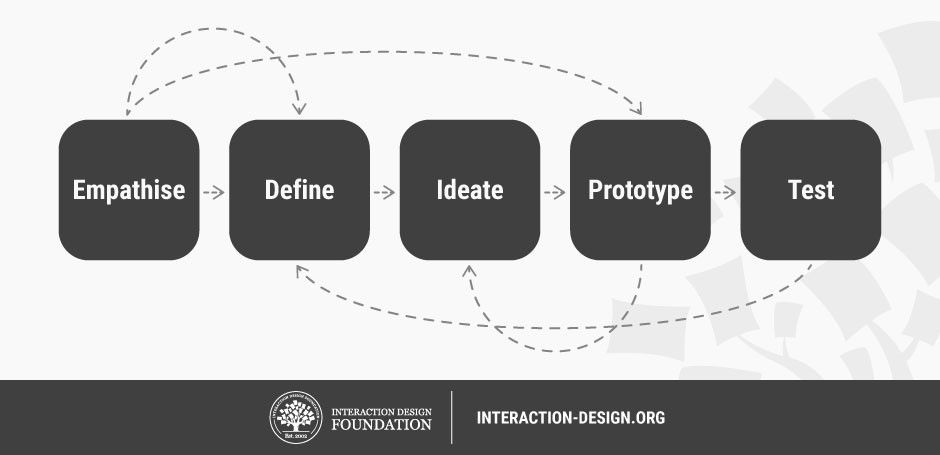
Even though Design Thinking is not a linear process, it is crucial to take into account the first two stages or modes in Design Thinking before you start ideating. If you neglect to take these two modes and their guidelines into account before an Ideation session, you risk becoming lost. The Empathise and Define guidelines will help you develop the sufficient background knowledge and set a clear goal for your ideation sessions.

1st Mode: Empathise

Design Thinking’s first two modes or stages – as presented by the d-school and us here at the Interaction Design Foundation – can help us prepare for the Ideation session. The first part of the preparation is the Empathise mode, which is all about researching and observing in field studies – and watching, engaging with and listening to your users:

Empathy is the centerpiece of a human-centered design process. The Empathize mode is the work you do to understand people, within the context of your design challenge. It is your effort to understand the way they do things and why, their physical and emotional needs, how they think about the world, and what is meaningful to them.”
– d-school, An Introduction to Design Thinking PROCESS GUIDE

The Empathy mode will help you conduct relevant research and become an instant-expert on the subject and gain invaluable empathy for the person you are designing for.

2nd Mode: Define

The next stage, which you should to take into account when preparing an ideation session, is the Define mode, which is all about making sense of the widespread information you have gathered in the first mode:

“The Define mode of the design process is all about bringing clarity and focus to the design space. It is your chance, and responsibility, as a design thinker to define the challenge you are taking on, based on what you have learned about your user and about the context.”
– d-school, An Introduction to Design Thinking PROCESS GUIDE

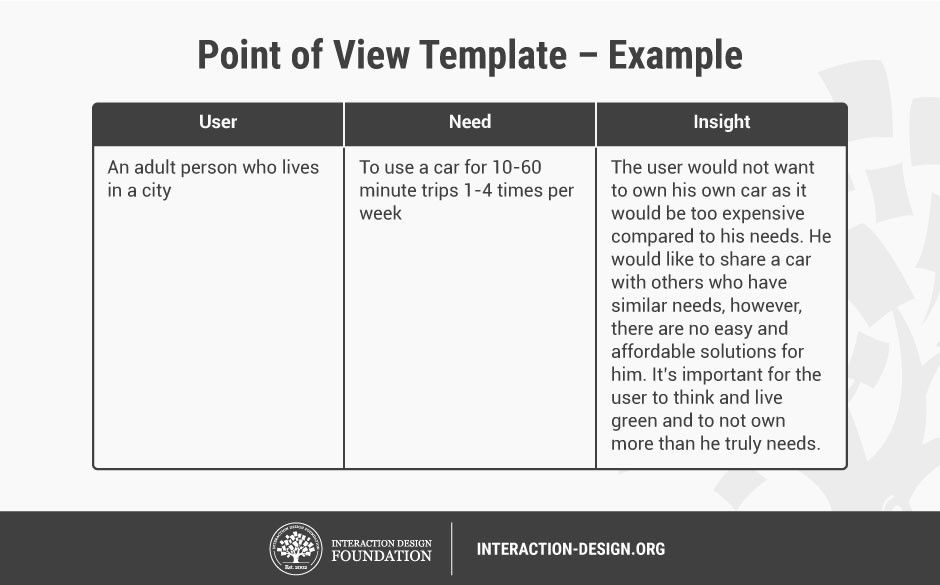
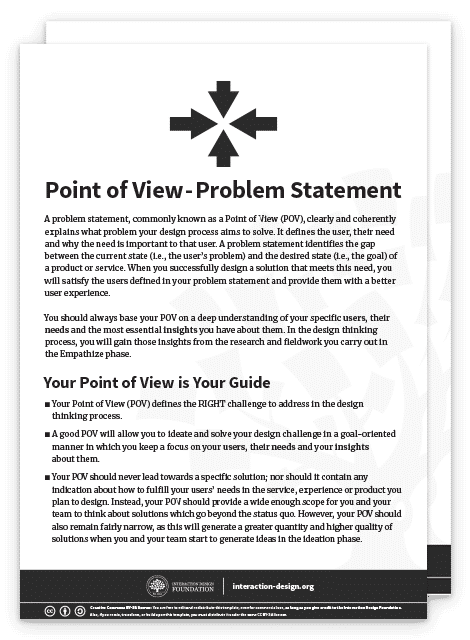
Defining involves synthesising and making sense of all the available information you gathered during the Empathise mode, by discovering connections and patterns. You will often want to use methods such as Affinity Diagrams, and Sharing Inspiring User Stories and Personas. By the end of the Define mode, your goal is to construct a meaningful and actionable problem statement, also known as a Point Of View (POV).

A good problem statement or POV will allow you to ideate in a goal-oriented manner. Your POV defines the RIGHT challenge to address in the ideation sessions. It may seem counterintuitive, but d-school recommends that you construct a more narrowly-focussed problem statement as this will result in both a greater quantity and higher quality solutions when you and your team start generating ideas. In the ideation process, POV should be your guiding statement that focusses on your insights about your users and their needs.

How do you define your Point Of View?

Step 1

  • You define the type of person you are designing for – your user. For instance, you can develop one or more personas, use affinity diagrams, empathy maps and other methods, which help you understand and crystallise your research results – observations, interviews, fieldwork, etc.

  • You extract and synthesise your users’ most essential needs, which are the most important to fulfill. Remember that needs should be verbs.

  • You work to express insights you developed through the synthesis of information that you gathered during your initial Empathise mode. The insight should typically not simply be a reason for the need, but rather a synthesised statement that you can leverage in your design solution.

Step 2

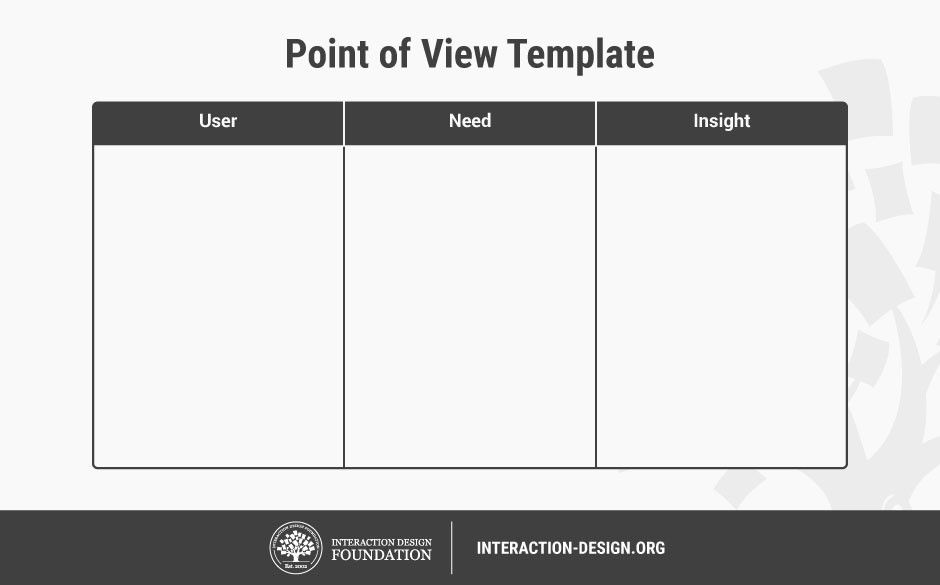
Write your definitions into a Point Of View template like this one:

Author/Copyright holder: Teo Yu Siang and Interaction Design Foundation. Copyright terms and licence: CC BY-NC-SA 3.0
Your Point Of View template:

Author/Copyright holder: Teo Yu Siang and Interaction Design Foundation. Copyright terms and licence: CC BY-NC-SA 3.0
Step 3 – POV Madlib

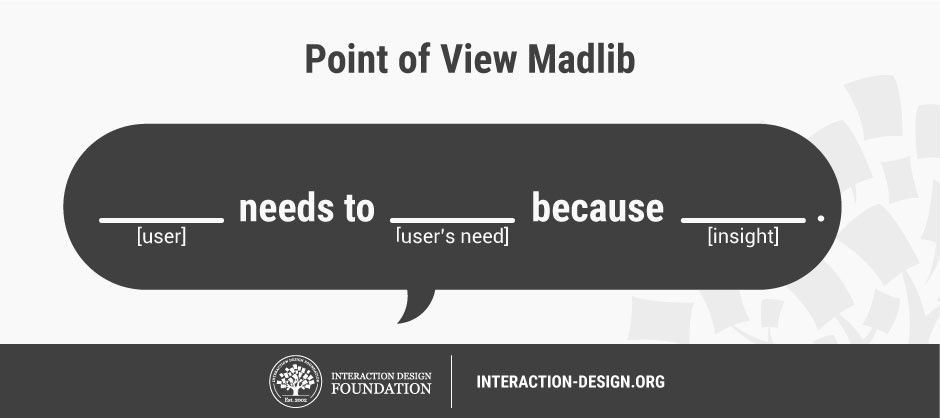
You can articulate a POV by combining these three elements – user, need, and insight – as an actionable problem statement that will drive the rest of your design work. It’s surprisingly easy when you insert your findings in the POV Madlib below. You can articulate your POV by inserting your information about your user, the needs and your insights in the following sentence:

[User . . . (descriptive)] needs [Need . . . (verb)] because [Insight . . . (compelling)]

Author/Copyright holder: Teo Yu Siang and Interaction Design Foundation. Copyright terms and licence: CC BY-NC-SA 3.0
Condense your Point Of View by using this POV Madlib.

Example: An adult person who lives in the city… needs access to a shared car 1-4 times for 10-60 minutes per week … because he would rather share a car with more people as this is cheaper, more environmentally friendly, however it should still be easy for more people to share.

Step 4 – Make Sure That Your Point Of View is One That:

  • Provides a narrow focus.

  • Frames the problem as a problem statement.

  • Inspires your team.

  • Guides your innovation efforts.

  • Informs criteria for evaluating competing ideas.

  • Is sexy and captures people’s attention.

  • Is valid, insightful, actionable, unique, narrow, meaningful, and exciting.

Yay! You’re now well-equipped to create a POV and it’s time to understand how to start using your POV in a way which crystallises all of your previous work from the Empathise and Define modes.

Do you want to learn how you can get started creating your own Point Of View/problem statement for your next design project and ideation session? Then you can download our Point Of View template:

Advance Your Career With This Free Template for “Point of View - Problem Statement”
Point of View - Problem Statement
We respect your privacy
Get 1 powerful email each week: Design a life you love!

3rd mode: Ideate

When you’ve developed your POV it’s time to start ideating. Begin with your Point Of View or problem statement. Break that larger challenge up into smaller actionable pieces. Look for aspects of the statement to complete the sentence, “How might we…?”

“How Might We?” Questions Frame and Open Up Your Design Challenge

You start using your POV by reframing the POV into a question: Instead of saying, we need to design X or Y, Design Thinking explores new ideas and solutions to a specific design challenge. It’s time to start using the Ideation method that involves asking, “How Might We…?”

Author/Copyright holder: Teo Yu Siang and Interaction Design Foundation. Copyright terms and licence: CC BY-NC-SA 3.0

Examples of How to Generate HMW Questions Which Fuel your Ideation Sessions

When you’ve defined your design challenge in a POV, you can start opening up for ideas to solve your design challenge. You can start using your POV by asking a specific question starting with, “How Might We?” or “in-what-ways-might-we?”. For example: How might we… design a driverless car, which is environmental friendly, cheap and easy for more people to share?

You then break the POV into smaller and actionable pieces as follows:

  1. You might start coming up with too narrow questions, such as: “HMW create a taxi which does not need a chauffeur”.

  2. Or you questions might become too broad: “HMW redesign transportation”.

  3. You should strive to ask an inspiring and specific question which can be the main question which you use as your guide in your ideation sessions: “HMW design a driverless car, which is environmental friendly, cheap and easy to share for more people.”

  4. After you’ve asked the foundational question you start breaking the POV into several smaller and actionable sub-questions which you can center your different ideation sessions around: “HMW design an electric car?” and “HMW design a car which has a digital code as a key which is safe to share among a lot of varying users.”

These are simple examples, all with their own subtle nuances that may influence slightly different approaches in the ideation phases. Your HMW questions will ensure that your upcoming creative ideation and design activities are informed with one or more HMW questions, which spark your imagination and aligns well with the core insights and user needs that you’ve uncovered.

“We use the How Might We format because it suggests that a solution is possible and because they offer you the chance to answer them in a variety of ways. A properly framed How Might We doesn’t suggest a particular solution, but gives you the perfect frame for innovative thinking.”
– Ideo.org

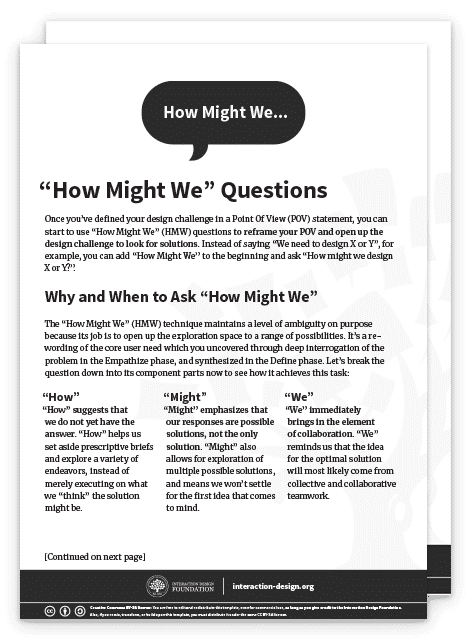
How Might We (HMW) questions are the best way to open up Brainstorm and other Ideation sessions. HMW opens up to Ideation sessions where you explore ideas that can help you solve your design challenge. By framing your challenge as a How Might We question, you’ll prepare yourself for an innovative solution in the third Design Thinking phase, the Ideation phase. The How Might We method is constructed in such a way that it opens up the field for new ideas, admits that we do not currently know the answer, and encourages a collaborative approach to solving it.

Best Practice Guide to Asking How Might We

  1. Begin with your Point of View (POV) or problem statement. Start by rephrasing and framing your Point Of View as several questions by adding “How might we?” at the beginning.

  2. Break that larger POV challenge up into smaller actionable and meaningful questions. Five to ten How Might We questions for one POV is a good starting point.

  3. It is often helpful to brainstorm the HMW questions before the solutions brainstorm.

  4. Look at your How Might We questions and ask yourself if they allow for a variety of solutions. If they don’t, broaden them. Your How Might We questions should generate a number of possible answers and will become a launch pad for your Ideation Sessions, such as Brainstorms.

  5. If your How Might We questions are too broad, narrow them down. You should aim for a narrow enough frame to let you know where to start your Brainstorm, but at the same time you should also aim for enough breadth to give you room to explore wild ideas.

You can download and print out our How Might We template which you and your team can use as a guide:

Advance Your Career With This Free Template for “How Might We Questions”
How Might We Questions
We respect your privacy
Get 1 powerful email each week: Design a life you love!

Characteristics Required for Successful Ideation

Ideation requires purposefully adopting certain characteristics, whether they are natural or whether they need to be encouraged and learnt. Regardless of one's personality or way of thinking, we all fall into the trap of sticking to patterns and familiar ground, and tend to use the same recipes for solving problems, as this reduces the cognitive load required. Experts and novices alike need to be constantly self-aware and purposely intend to adopt some of the following characteristics, which create an open mind and fertile ground for sparking unconventional ideas.

  • Adapting: Be able to switch how you see, understand, and extend thinking as new input gets generated.

  • Connecting: Be able to connect seemingly unrelated concepts, attributes or themes in order to create new possibilities.

  • Disrupting: Be able to overturn commonly held beliefs, assumptions or norms in order to re-think conventional approaches.

  • Flipping: Turn dead-ends or deadlocks into opportunities by flipping them over or rapidly changing direction towards greater viability.

  • Dreaming and Imagining: Be able to visualise a new picture of reality by turning abstract needs into tangible pictures or stories, thereby allowing the space required for inventing bridges to that reality.

  • Experimental: Be open and curious enough to explore possibilities and take risks; be willing and eager to test out ideas and eager to venture into the unknown.

  • Recognise Patterns: Seek to spot common threads of meaning, and ways of seeing, doing and behaving; be able to recognise attributes or shared values across a spectrum of influence and input; and finally be able to utilize these commonalities to build solutions.

  • Curiosity: Be willing to ask uncomfortable, silly or even crazy questions. Be willing to explore and experience, in order to understand and learn something new and different.

Please always remember that:

“It’s not about coming up with the ‘right’ idea, it’s about generating the broadest range of possibilities.”
– d.school, An Introduction to Design Thinking PROCESS GUIDE

The Take Away – Design Thinking's Ideation Compass

Unlike the all too familiar designer's nightmare of staring at a blank page unable to conjure up ideas from the creative ether, Design Thinking’s first two modes, Empathise and Define, gives you a solid base to launch relevant and well-informed ideas, which hit the mark in surprising and delightful ways, no voodoo required. Sometimes it will make sense to visibly display personas, stories, scenarios and other maps from which you have derived insights and the Point Of View to keep the ship steering in the appropriate direction during your ideation session. Most of all, your Point Of View should be centre stage.

When you've got your Point Of View, you'll start asking “How Might We?” questions and you might feel as if you've already walked a long hard road to get there. Keep calm and ideate! Everything you've been doing up until this point is really about to come to life. Shake up the ranks and make some space for unleashing your ideas, all of them, however weird and wonderful they may be. Be prepared to throw it all out there.

Wait, did I hear you say you're shy? Are you worried others may poke fun at your ideas? Are you concerned your manager may shoot down your ideas? Have no fear; you can learn to create that happy place where you and your team members can really unleash that inner, clever child. The first point of comfort should be that the steps you have completed leads up to your Point Of View and “How Might We?” questions, have already sufficiently set the boundaries within which you can freely explore. True creativity really thrives within constraints, not on absolutely limitless possibilities. Your “How Might We?” questions provide a clear guide to keep the exploration in the ideation sessions meaningful and relevant.

References & Where to Learn More

d-school, Bootcamp Bootleg, 2010.

Tim Brown, CEO of IDEO, Change by Design, 2009

Don Norman. Rethinking Design Thinking, 2013.

Feel Stuck?
Want Better Job Options?

AI is replacing jobs everywhere, yet design jobs are booming with a projected 45% job growth. With design skills, you can create products and services people love. More love means more impact and greater salary potential.

At IxDF, we help you from your first course to your next job, all in one place.

See How Design Skills Turn Into Job Options
Privacy Settings
By using this site, you accept our Cookie Policy and Terms of Use.
Customize
Accept all

Be the One Who Inspires

People remember who shares great ideas.

Share on:

Academic Credibility — On Autopilot

Don't waste time googling citation formats. Just copy, paste and look legit in seconds.