Create Some Space – for Ideation Sessions and Design Thinking

by Rikke Friis Dam and Yu Siang Teo • 7 min read

703 Shares

The spaces we occupy deeply influence our experiences, our feelings, and our behaviors. Our state of health, psychology, productivity, mood, and creativity spaces influence us on many levels and also influence our interactions with each other. The spaces in which we journey through Design Thinking and Ideation sessions must be set up in such a way that they facilitate the purpose behind each phase or step appropriately. This involves creating an environment in which the team is free to embrace the mindsets required at each point in their process without the intervention of others who may not understand what they are doing and why.

Freedom to Think and Express

With all their thoughts out in the open, Design Thinking teams may feel slightly vulnerable to outside eyes, but with a protected free space they will feel more at home throwing forward everything they have to offer.

The right kind of environment helps to create a creative work culture and influences the way people see and do things, as well as how they interact with each other. Instead of boardrooms with the CEO at the head of the table, Design Thinking and ideation sessions requires a space that levels the playing field and puts everyone on an equal footing.

Fluid Spaces

The Design Thinking team may require the configuration of the space to change throughout the process. With their vision clearly pinned to the walls, Design Thinking teams and ideation participants are more easily able to keep their eye on the purpose of the challenge at hand, while allowing the influences of their exploration to tug constantly at their understanding.

Creating such a space means having room to move, wall space to stick up charts and ideas, white boards or paper charts for gathering data into meaningful collections and to make visual connections using drawn lines and other visual methods. Later on in a Design Thinking process, the room should provide enough space for building prototypes and testing models.
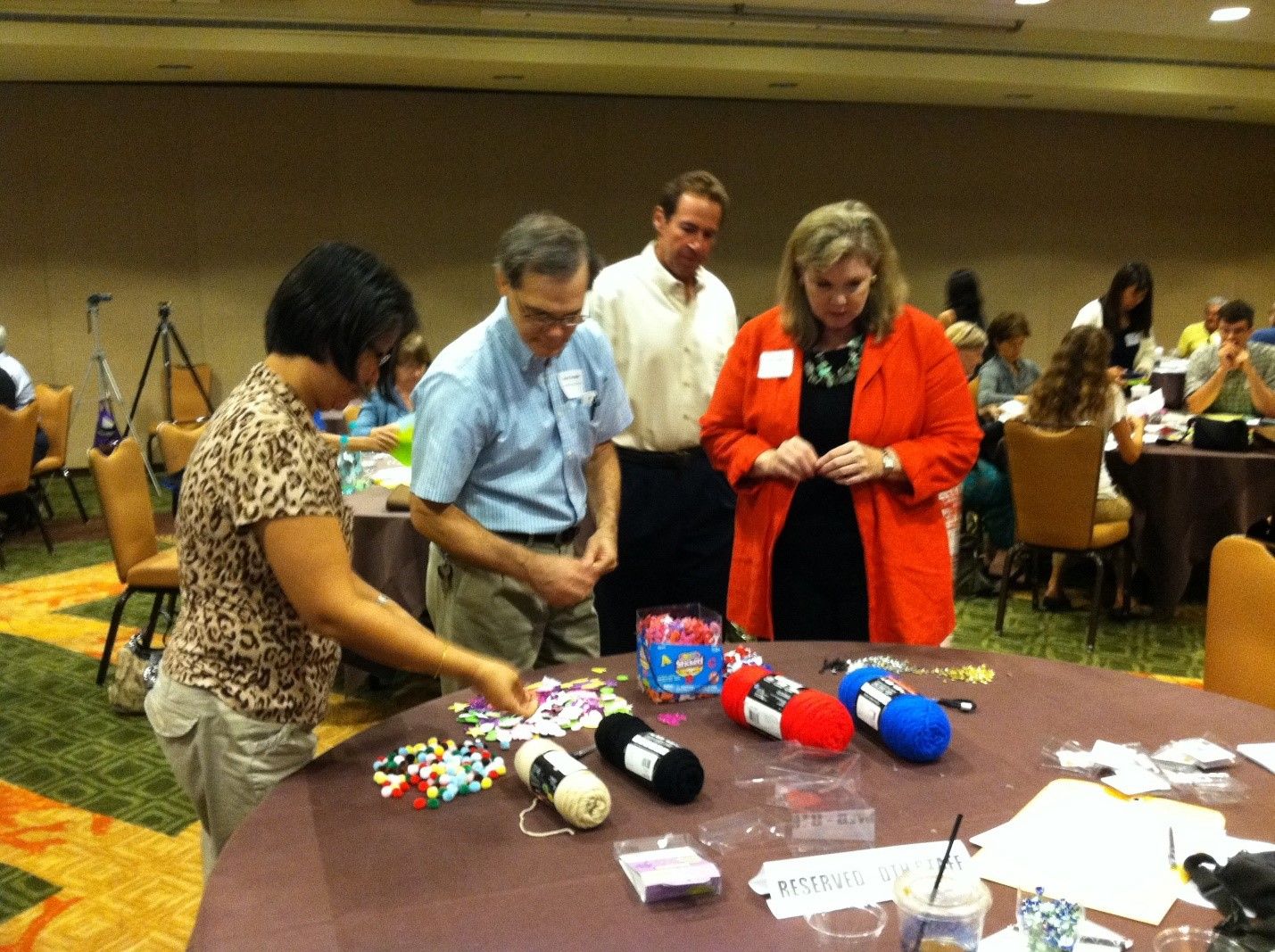
Author/Copyright holder: Bytemarks. Copyright terms and licence: CC BY 2.0

Round tables work well when you want people to collaborate during ideation and prototyping sessions – and so does standing up. Ideally, the Design Thinking and Ideation space should be located away from work environments, which stifle creativity or remind participants of stressful activities and time pressures. This picture is taken at a Design Thinking Workshop for educators held at the Sheraton.

Tips and resources for creating an innovation space

Scott Doorley and Scott Witthoft, directors of Environments Collaborative, co-authored a book with support from the design school known as Make Space. The book outlines tools, templates, building methods, and situational plans for creating collaborative spaces that foster a culture of innovation. The following checklist provides an idea of elements that may assist in creating the ideal Design Thinking space.

Checklist for the Ideal Ideation and Design Thinking Room and Requisites

The following checklist provides an idea of elements that will assist you in creating the ideal ideation session and design thinking space:

  • Space: Make sure you have enough space for all participants. Ideally, the Design Thinking and Ideation space should be located away from work environments, which stifle creativity or remind participants of stressful activities and time pressures.

  • Whiteboards and Flipcharts: These are generally portable and lightweight as they are the centre of attention at many design thinking sessions. You’ll see that they’ll soon be covered with sticky notes featuring handwritten ideas.

  • Room: A light and natural environment to encourage creativity.

  • Illumination: Make sure to choose a room with plenty of daylight. If possible, you should choose a room with large windows to post sticky notes on—or even draw or write directly on them if you have the right kind of markers, of course! Warm natural colours and materials are more supportive than sterile cold surfaces.

  • Air: Good ventilation and fresh air if the weather allows for it.

  • Temperature can support creativity. Research has identified that the correct temperature for sitting and working at a desk is between 22°C – 25°C. However ideation sessions and design thinking sessions will include a lot of standing and moving around so you should probably consider setting the thermostat a little lower.

  • Acoustics: It often gets quite loud when people explain their ideas to each other. Make sure that the acoustics are great and that there’s no echo.

  • Elevated tables and chairs: will encourage participation in the ideation processes. Elevated furniture allows people to come as close together as possible. The upright position keeps participants engaged. If possible, find a room where there’s a couch to use during the breaks or to sit back and relax in while the other teams present their findings and results.

With your perceptions, plans, people and places in order, your preparations for ideation and Design Thinking sessions should be perfect.
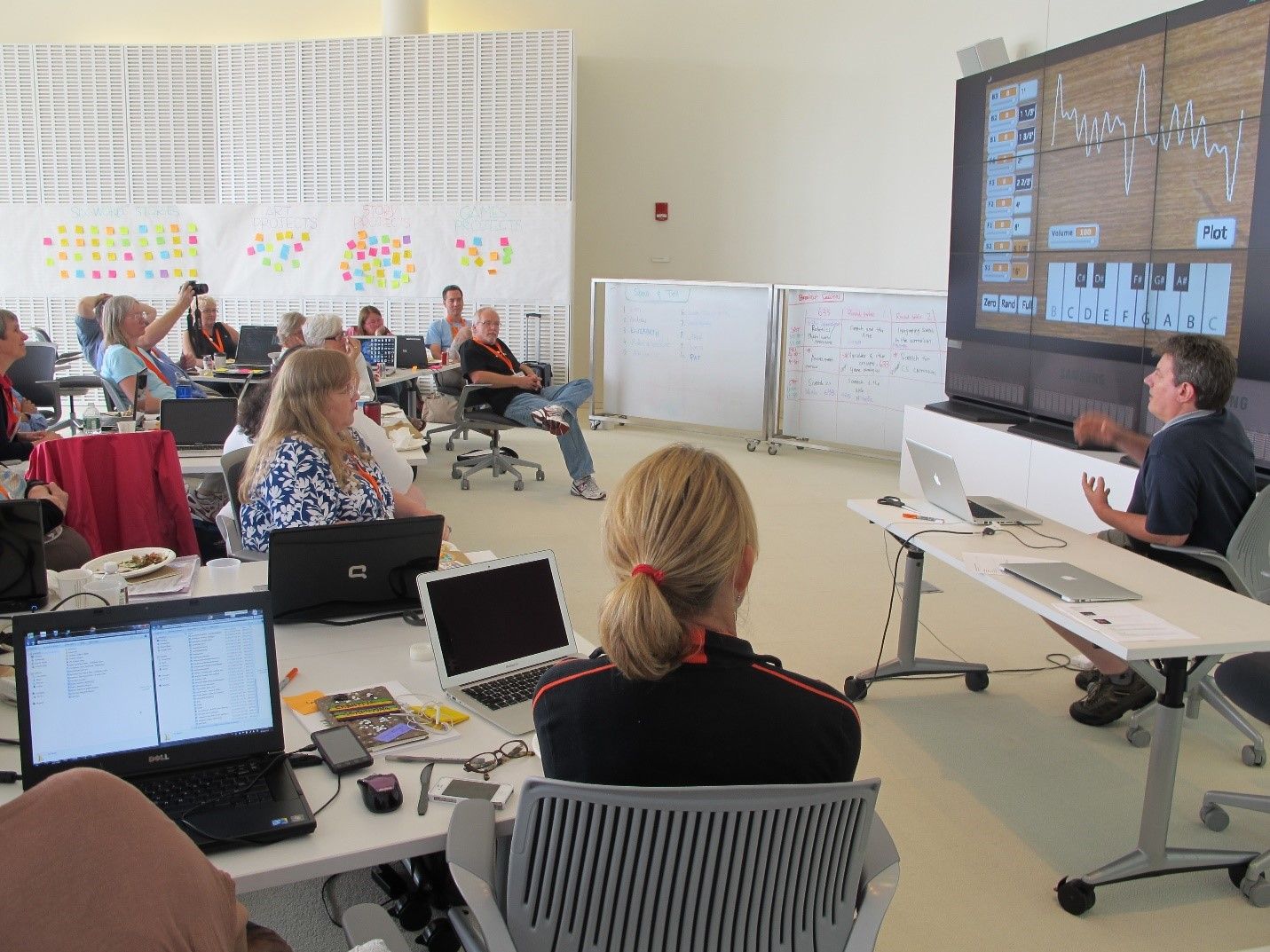
Author/Copyright holder: ScratchEd Team. Copyright terms and licence: CC BY 2.0

Creative office space at the MIT Creative Computing 2012 workshop which was held at the MIT Media Lab.

Ideation Material

  • Paper

  • Sticky notes (as large as possible, a range of colours, five different types)

  • Markers (whiteboard markers, permanent markers, many different colours and not too thick)

Prototyping Materials

  • Magazines (for collages)

  • Cardboard

  • Tape (duct tape)

  • Glue

  • LEGO or Duplo

  • Blue tack

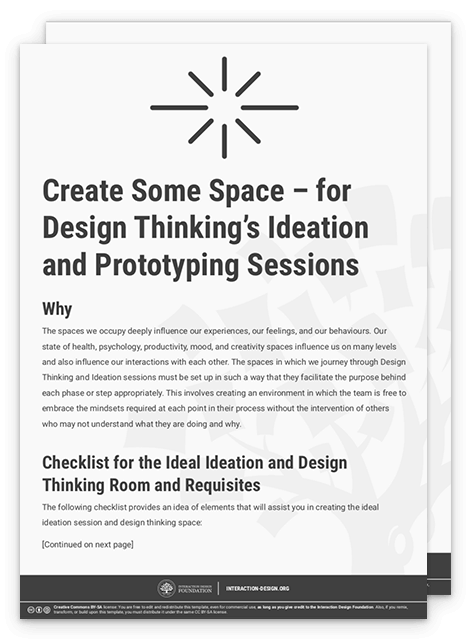
Do you want to learn how you can get started creating a suitable space for your team’s next ideation sessions – and for your whole Design Thinking process? Then you can download and print our “Create Some Space” template:
Advance Your Career With This Free Template for “Create Some Space”
Create Some Space
We respect your privacy
Get 1 powerful email each week: Design a life you love!

References & Where to Learn More

SAP User Experience Community. The Ideal Design Space. 2014.

Ella Miron-Spektor, Miriam Erez, and Eitan Naveh. To Drive Creativity, Add Some Conformity. Harvard Business Review, March 2012.

Scott Doorley and Scott Witthoft, Make Space: How to Set the Stage for Creative Collaboration, 2012.

Topics in This Article

Learn More in This Course:

AI for Designers

12 days
13 % booked
View Course

What You Should Read Next

  • Read full article
    The 5 Stages in the Design Thinking Process - Article hero image
    Interaction Design Foundation logo

    The 5 Stages in the Design Thinking Process

    Design thinking is a methodology that provides a solution-based approach to solving problems. It’s extremely useful when used to tackle complex problems that are ill-defined or unknown—because it serves to understand the human needs involved, reframe the problem in human-centric ways, create numerou

    Social shares
    2k
    Published
    Read Article
  • Read full article
    What is Design Thinking and Why Is It So Popular? - Article hero image
    Interaction Design Foundation logo

    What is Design Thinking and Why Is It So Popular?

    Design Thinking is not an exclusive property of designers—all great innovators in literature, art, music, science, engineering, and business have practiced it. So, why call it Design Thinking? What’s special about Design Thinking is that designers’ work processes can help us systematically extract,

    Social shares
    1.6k
    Published
    Read Article
  • Read full article
    Personas – A Simple Introduction - Article hero image
    Interaction Design Foundation logo

    Personas – A Simple Introduction

    Personas are fictional characters, which you create based upon your research to represent the different user types that might use your service, product, site, or brand in a similar way. Creating personas will help you understand your users’ needs, experiences, behaviors and goals. Creating personas

    Social shares
    1.6k
    Published
    Read Article
  • Read full article
    Stage 2 in the Design Thinking Process: Define the Problem and Interpret the Results - Article hero image
    Interaction Design Foundation logo

    Stage 2 in the Design Thinking Process: Define the Problem and Interpret the Results

    An integral part of the Design Thinking process is the definition of a meaningful and actionable problem statement, which the design thinker will focus on solving. This is perhaps the most challenging part of the Design Thinking process, as the definition of a problem (also called a design challenge

    Social shares
    1.4k
    Published
    Read Article
  • Read full article
    What is Ideation – and How to Prepare for Ideation Sessions - Article hero image
    Interaction Design Foundation logo

    What is Ideation – and How to Prepare for Ideation Sessions

    Ideation is the process where you generate ideas and solutions through sessions such as Sketching, Prototyping, Brainstorming, Cheatstorming, Brainwriting, Worst Possible Idea, and a wealth of other ideation techniques. Ideation is also the third stage in the Design Thinking process. Although many p

    Social shares
    1.4k
    Published
    Read Article
  • Read full article
    Empathy Map – Why and How to Use It - Article hero image
    Interaction Design Foundation logo

    Empathy Map – Why and How to Use It

    Here’s an interesting fact you may—or may not—know: users are more likely to choose, buy, and use products that meet their needs than products that just meet their wants. And an Empathy map will help you understand your user’s needs while you develop a deeper understanding of the persons you’re desi

    Social shares
    1.4k
    Published
    Read Article
  • Read full article
    Affinity Diagrams: How to Cluster Your Ideas and Reveal Insights - Article hero image
    Interaction Design Foundation logo

    Affinity Diagrams: How to Cluster Your Ideas and Reveal Insights

    Affinity diagrams are a great method to use when you want to make sense of a large volume of mixed information and data—facts, ethnographic research, ideas from brainstorms, user opinions, user needs, insights and design issues, just to name a few! Affinity diagrams require you to cluster informatio

    Social shares
    1.3k
    Published
    Read Article
  • Read full article
    Stage 4 in the Design Thinking Process: Prototype - Article hero image
    Interaction Design Foundation logo

    Stage 4 in the Design Thinking Process: Prototype

    One of the best ways to gain insights in a Design Thinking process is to carry out some form of prototyping. This method involves producing an early, inexpensive, and scaled down version of the product in order to reveal any problems with the current design. Prototyping offers designers the opportun

    Social shares
    1.3k
    Published
    Read Article
  • Read full article
    The History of Design Thinking - Article hero image
    Interaction Design Foundation logo

    The History of Design Thinking

    We need to appreciate the roots and origins of a concept to truly understand it—we need to know how it came to be. Let’s take a look at how design thinking emerged from an exploration of theory and practice to become one of the most effective ways to address the human, technological and strategic in

    Social shares
    1.3k
    Published
    Read Article
  • Read full article
    Stage 1 in the Design Thinking Process: Empathise with Your Users - Article hero image
    Interaction Design Foundation logo

    Stage 1 in the Design Thinking Process: Empathise with Your Users

    Design Thinking cannot begin without a deeper understanding of the people you are designing for. In order to gain those insights, it is important for you as a design thinker to empathize with the people you’re designing for so that you can understand their needs, thoughts, emotions and motivations.

    Social shares
    1.3k
    Published
    Read Article

Top Articles

Top Topic Definitions

Feel Stuck?
Want Better Job Options?

AI is replacing jobs everywhere, yet design jobs are booming with a projected 45% job growth. With design skills, you can create products and services people love. More love means more impact and greater salary potential.

At IxDF, we help you from your first course to your next job, all in one place.

See How Design Skills Turn Into Job Options
Privacy Settings
By using this site, you accept our Cookie Policy and Terms of Use.
Customize
Accept all

Be the One Who Inspires

People remember who shares great ideas.

Share on:

Academic Credibility — On Autopilot

Don't waste time googling citation formats. Just copy, paste and look legit in seconds.

Feel Stuck? Want Freedom?

Join 326,013+ designers who get one powerful email each week. Learn to design a life you love.

Next email in
1
day
17
hrs
24
mins
13
secs

Free forever. No spam. Unsubscribe anytime.