UX (user experience) research is the systematic study of target users and their requirements, to add realistic contexts and insights to design processes. UX researchers adopt various methods to uncover problems and design opportunities. Doing so, they reveal valuable information which can be fed into the design process.
See why UX research is a critical part of the UX design process.
UX Research is about Finding Insights to Guide Successful Designs
When you do UX research, you’ll be better able to give users the best solutions—because you can discover exactly what they need. You can apply UX research at any stage of the design process. UX researchers often begin with qualitative measures, to determine users’ motivations and needs. Later, they might use quantitative measures to test their results. To do UX research well, you must take a structured approach when you gather data from your users. It’s vital to use methods that 1) are right for the purpose of your research and 2) will give you the clearest information. Then, you can interpret your findings so you can build valuable insights into your design.
“I get very uncomfortable when someone makes a design decision without customer contact.”
– Dan Ritzenthaler, Senior Product Designer at HubSpot
We can divide UX research into two subsets:
Qualitative research – Using methods such as interviews and ethnographic field studies, you work to get an in-depth understanding of why users do what they do (e.g., why they missed a call to action, why they feel how they do about a website). For example, you can do user interviews with a small number of users and ask open-ended questions to get personal insights into their exercise habits. Another aspect of qualitative research is usability testing, to monitor (e.g.) users’ stress responses. You should do qualitative research carefully. As it involves collecting non-numerical data (e.g., opinions, motivations), there’s a risk that your personal opinions will influence findings.
Quantitative research – Using more-structured methods (e.g., surveys, analytics), you gather measurable data about what users do and test assumptions you drew from qualitative research. For example, you can give users an online survey to answer questions about their exercise habits (e.g., “How many hours do you work out per week?”). With this data, you can discover patterns among a large user group. If you have a large enough sample of representative test users, you’ll have a more statistically reliable way of assessing the population of target users. Whatever the method, with careful research design you can gather objective data that’s unbiased by your presence, personality or assumptions. However, quantitative data alone can’t reveal deeper human insights.
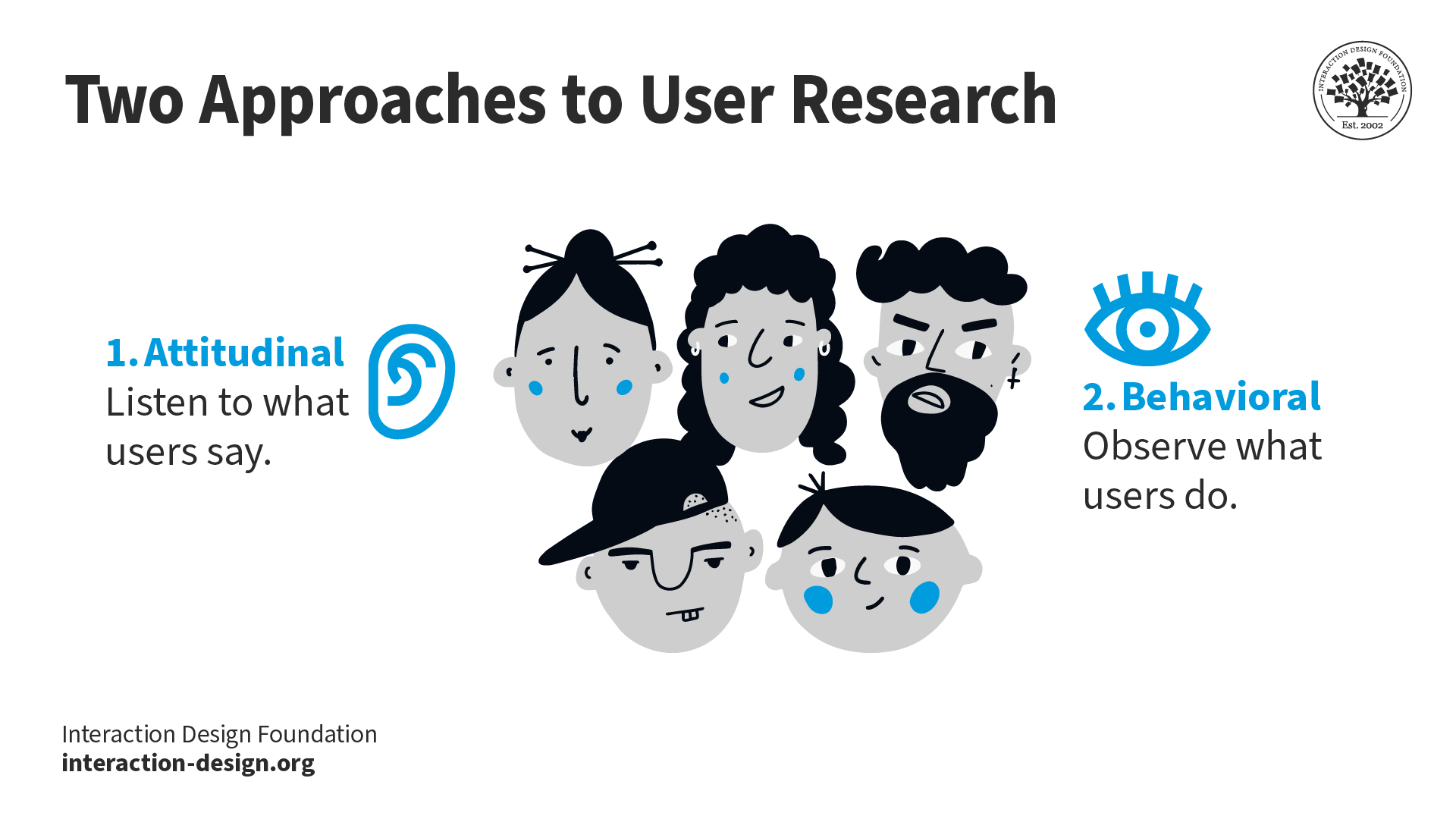
We can additionally divide UX research into two approaches:
Attitudinal – you listen to what users say—e.g., in interviews.
Behavioral – you see what users do through observational studies.
When you use a mix of both quantitative and qualitative research as well as a mix of attitudinal and behavioral approaches, you can usually get the clearest view of a design problem.
© Interaction Design Foundation, CC BY-SA 4.0
Use UX Research Methods throughout Development
The Nielsen Norman Group—an industry-leading UX consulting organization—identifies appropriate UX research methods which you can use during a project’s four stages. Key methods are:
Discover – Determine what is relevant for users.
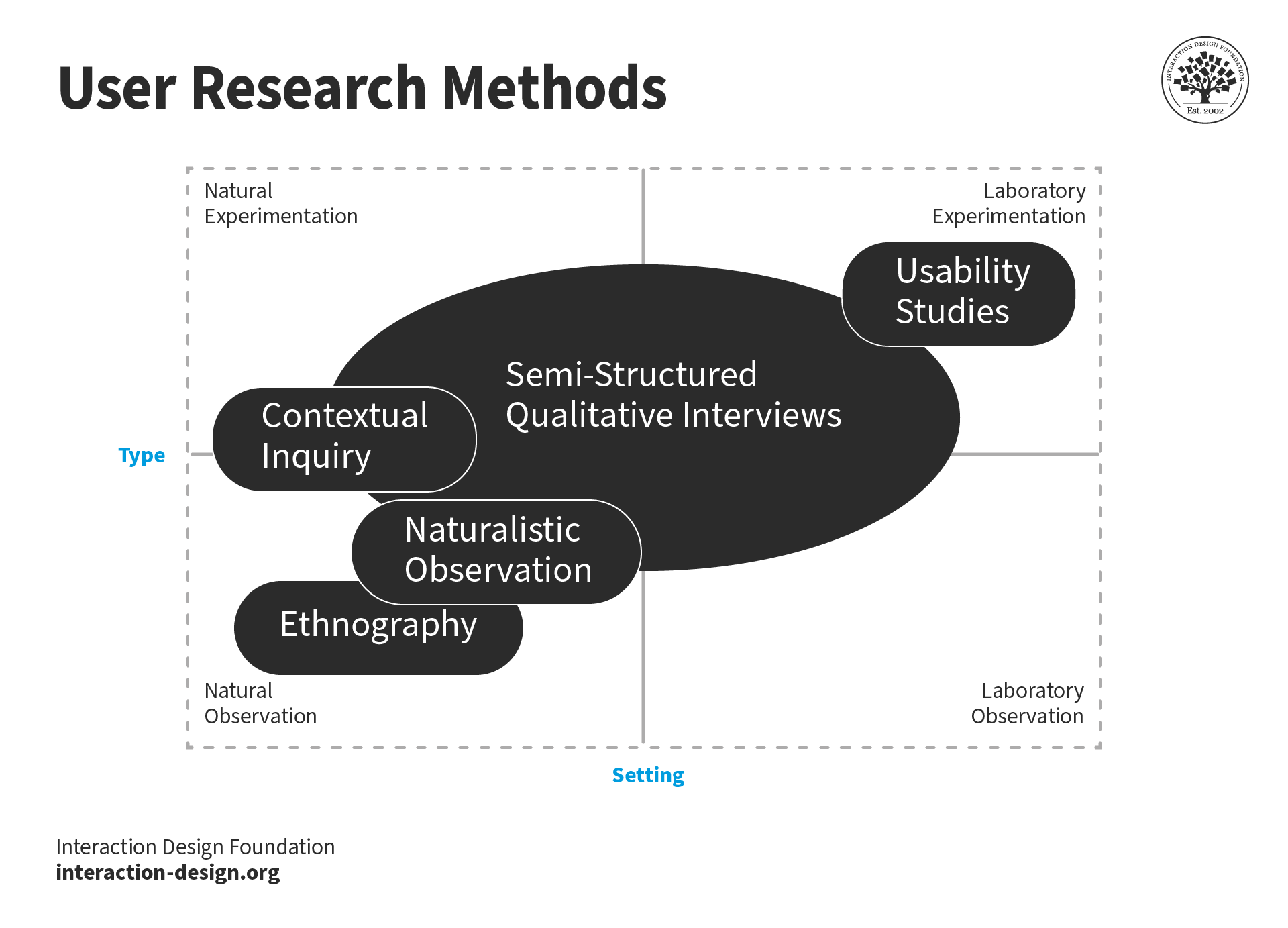
Contextual inquiries – Interview suitable users in their own environment to see how they perform the task/s in question.
Diary studies – Have users record their daily interactions with a design or log their performance of activities.
Explore – Examine how to address all users’ needs.
Card sorting – Write words and phrases on cards; then let participants organize them in the most meaningful way and label categories to ensure that your design is structured in a logical way.
Customer journey maps – Create user journeys to expose potential pitfalls and crucial moments.
Test – Evaluate your designs.
Usability testing – Ensure your design is easy to use.
Accessibility evaluations – Test your design to ensure it’s accessible to everyone.
Listen – Put issues in perspective, find any new problems and notice trends.
Surveys/Questionnaires – Use these to track how users’ feel about your product.
Analytics – Collect analytics/metrics to chart (e.g.) website traffic and build reports.
Whichever UX research method you choose, you need to consider the pros and cons of the different techniques. For instance, card sorting is cheap and easy, but you may find it time-consuming when it comes to analysis. Also, it might not give you in-depth contextual meaning. Another constraint is your available resources, which will dictate when, how much and which type of UX research you can do. So, decide carefully on the most relevant method/s for your research. Moreover, involve stakeholders from your organization early on. They can reveal valuable UX insights and help keep your research in line with business goals. Remember, a design team values UX research as a way to validate its assumptions about users in the field, slash the cost of the best deliverables and keep products in high demand—ahead of competitors’.
© Interaction Design Foundation, CC BY-SA 4.0
User research methods have different pros and cons,and vary from observations of users in context to controlled experiments in lab settings.