Your constantly-updated definition of Complex Socio-Technical Systems and collection of videos and articles. Be a conversation starter: Share this page and inspire others!
Complex socio-technical systems are intricate societal and global problems, challenges that designers strive to define human issues, understand their far-reaching implications, and address carefully. Designers try incremental steps toward sustainable solutions, as they are difficult to approach and understand.
“The designer simply cannot predict the problems people will have, the misinterpretations that will arise, and the errors that will get made.”
— Don Norman: Father of User Experience design, author of the legendary book The Design of Everyday Things, co-founder of the Nielsen Norman Group, and former VP of the Advanced Technology Group at Apple.
See why complex socio-technical systems can be wickedly intricate but not hopelessly impossible.
Transcript
Transcript loading ...
Autoscroll
The World Is Complex, the Human World Even More So
Cognitive science and user experience expert Don Norman differentiates complex socio-technical systems from wicked problems. Although the two are essentially the same, Norman states the latter term is overused and has too many different meanings. Nevertheless, wicked problems are:
Difficult to define.
Complex systems.
Difficult to know how to approach.
Difficult to know whether a solution has worked.
Many global problems have these qualities. They’re too massive and intricate to “solve” — take world peace as an example. But more solvable-looking problems (e.g., global warming) also have hordes of complex, intertwined issues within them. Often, these smaller issues are entangled with political agendas and various factors that make them hard to understand, let alone solve. What appears to be a simple approach is often an insignificant part of a very large problem. For example a socio-technical system could be (e.g.) healthcare-related, and some fantastically straightforward “good idea” might spring to mind. But then, it’s almost certain that many others (including experts) have already tried and discovered how that “good idea” can’t work.
Much of the trouble with considering such systems is because of the human brain. It’s used to seeing direct results in causal or cause-effect chains; “If I do X, Y happens.” Evolutionarily, we humans are designed to understand simple causes and immediate results: We throw a rock, and we see it fall to the ground. On the other hand, complex socio-technical systems such as climate change are hard to understand because the human mind is not designed to understand something that complex. In design, we’re used to having the convenience of getting feedback through, for example, usability testing. But the human brain can’t understand the complexities of world systems. Take recycling, for example; many people have grown used to considering it more in terms of collective responsibility. However, we’re not used to thinking on a grander scale in terms of the many — often invisible — ways our environment reacts to the effects of our actions, purchasing choices and habits. Complex socio-technical systems are difficult to analyze because:
Many systems have several feedback loops. When you do something, result A might not appear but instead impact something else you can’t perceive (result B) and then affect other things. Only when a threshold is crossed might the first result you notice appear (e.g., result J).
There could be a long delay between triggering actions and the first noticeable results. Sometimes, so much time might pass that causes are only traceable through deep investigation and systems analysis.
This complexity is why Norman points the way to 21st century design and humanity-centered design. When we’re facing highly involved, massively-scaled human problems enmeshed in complex systems, we can’t use the same approach we might take for, say, an app (e.g., using design thinking alone).
How to Handle Complex Socio-Technical Systems
We’ll never be able to solve some problems plaguing our world. How could we even tell if world peace occurred, for example? Still, we can do something to at least improve matters from one situation/project to the next and improve the world in little sections. Namely, we can leverage humanity-centered design to:
Big problems demand big solutions, but big solutions are too expensive, disruptive and prone to failure. Be pragmatic and “go small."
Once you understand the people you want to help, their situation’s realities and what their environment lets them do, wait for an opportunity to do something small but helpful. Then, see if it works well enough to either repeat/duplicate or improve. If it fails, it’s still small enough that it won’t spell disaster. Learn from it and use that knowledge to shape something that will work.
Small steps will also be more likely to win the community’s support. They happen quickly enough for people to see these aren’t hollow promises, and can even provide life-saving results. Success breeds success. If a small step leads to more victories, you’ll win even more community support.
Small steps taken at the right time can lead to the “best solution possible” at any future point — in contrast to a “big fix” taking (e.g.) 10 years, when the whole situation, including the nature of the problem will have changed.
Overall, be sure to work with the community leaders every step of the way.
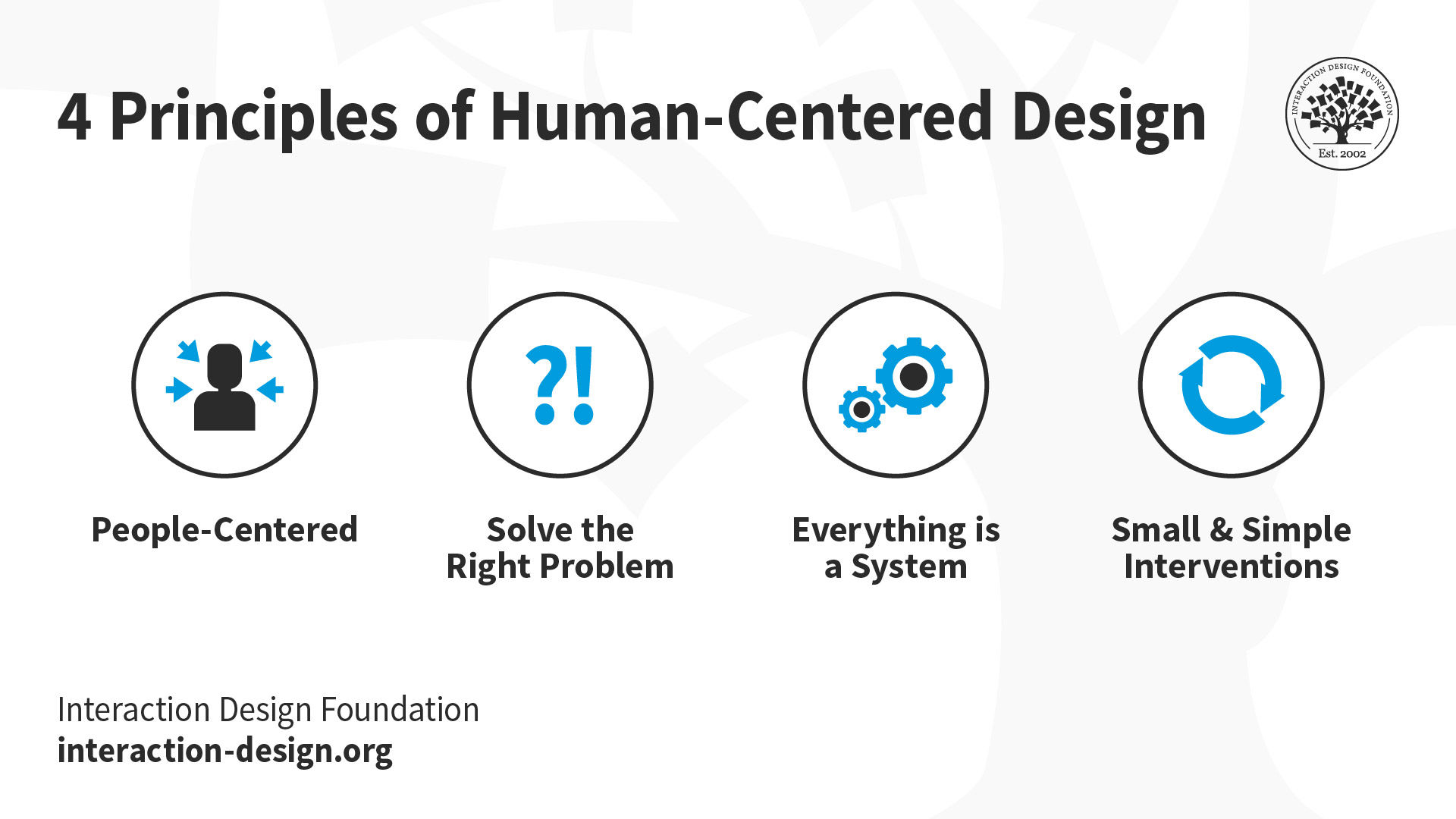
The four principles of Human-Centered Design are People-Centered, Solve the Right Problem, Everything is a System, and Small & Simple Interventions.
Questions About Complex Socio-Technical Systems? We've Got Answers!
How do complex socio-technical systems differ from simple systems?
Complex socio-technical systems involve many interconnected parts—people, technology, rules, and environments—that all influence each other. Unlike simple systems, where one action leads to one predictable result, complex systems behave unpredictably. In UX (user experience) design, this means a change to one element—like a user interface—can ripple through the whole system in unexpected ways.
These systems adapt, evolve, and depend heavily on human behavior and context. Think of a healthcare platform or a public transport app: designers must account for technical reliability and human workflows, regulations, and diverse user needs. You can't treat these systems like linear tools. Instead, UX designers need to observe real-world use, test iteratively, and design for flexibility. Understanding complexity helps designers build systems that are resilient, user-centered, and ready for real-life unpredictability.
What makes a system “complex” in the context of UX and product design?
A system becomes “complex” in UX and product design when it has many interconnected parts—users, technologies, rules, and environments—that constantly interact and affect each other. These systems don’t behave in a straight line; small changes can trigger significant, unexpected outcomes. For designers, complexity means they can’t rely on one-size-fits-all solutions or assume users will follow predictable paths. Think of a smart home system or enterprise software with multiple user roles—designers must support varied goals, workflows, and contexts.
Complex systems often evolve over time, so good UX design must adapt, scale, and stay intuitive under changing conditions. What makes them truly complex is that no single person fully controls them. Designers must understand how people use these systems in real life—and design for flexibility, learning, and ongoing feedback.
Explore the wider realm of “complex” systems and what they mean for design in our Master Class Design for the 21st Century with Don Norman, Founding Director - Design Lab, University of California, San Diego. Co-Founder, Nielsen Norman Group.
Why should UX designers care about the social side of technical systems?
UX designers should care about the social side of technical systems because technology doesn’t exist in a vacuum—people use it within social, cultural, and organizational contexts. A design that works perfectly in isolation might fail when real people, power dynamics, or team workflows come into play. For example, a project management tool might look user-friendly, but people won't use it effectively if it doesn’t support team norms or leadership styles.
The social side shapes trust, communication, and adoption. Designers who ignore it risk building systems that frustrate or exclude users. UX designers can create tools that truly support human goals by understanding the social context—how people collaborate, make decisions, or share information. This leads to more inclusive, effective, and sustainable products that people will want to use and keep using.
Discover vital points about how to design with culture in mind, in this video with Alan Dix: Author of the bestselling book “Human-Computer Interaction” and Director of the Computational Foundry at Swansea University.
Copyright
Copyright holder: Tommi Vainikainen _ Appearance time: 2:56 - 3:03 Copyright license and terms: Public domain, via Wikimedia Commons
Copyright holder: Maik Meid _ Appearance time: 2:56 - 3:03 Copyright license and terms: CC BY 2.0, via Wikimedia Commons _ Link: https://commons.wikimedia.org/wiki/File:Norge_93.jpg
Copyright holder: Paju _ Appearance time: 2:56 - 3:03 Copyright license and terms: CC BY-SA 3.0, via Wikimedia Commons _ Link: https://commons.wikimedia.org/wiki/File:Kaivokselan_kaivokset_kyltti.jpg
Copyright holder: Tiia Monto _ Appearance time: 2:56 - 3:03 Copyright license and terms: CC BY-SA 3.0, via Wikimedia Commons _ Link: https://commons.wikimedia.org/wiki/File:Turku_-_harbour_sign.jpg
Transcript
Transcript loading ...
Autoscroll
What are examples of socio-technical systems in everyday life?
Socio-technical systems show up everywhere in daily life—anywhere people and technology work together. Think of public transportation apps like Citymapper or Google Maps. They don’t just deliver data; they coordinate real-time traffic, city infrastructure, and user decisions.
Online banking is another example; it blends secure software, government regulations, financial institutions, and user trust. Even a food delivery platform like Uber Eats relies on complex interactions between customers, drivers, restaurants, GPS systems, and payment networks.
These systems can’t succeed on technology alone; they need to support how people communicate, make choices, and solve problems. For UX designers, recognizing these everyday socio-technical systems means understanding that user experience is shaped not just by screens and flows, but by the broader social and organizational context that surrounds the product as well.
Explore the nature of 21st-century design to understand more about what designing for complex systems involves and tips on how to find solid answers to harder-to-spot issues.
What are the most significant UX challenges in complex socio-technical systems?
The biggest UX challenges in complex socio-technical systems come from their unpredictability and human complexity. Designers can’t control how every part of the system behaves—users, technologies, rules, and organizations all influence each other. That makes it hard to map user journeys or predict outcomes. One major challenge is designing for diverse user roles with competing goals, like in healthcare or enterprise software.
Another is ensuring the system stays usable as it evolves. Misaligned incentives, outdated workflows, or poor stakeholder communication can also break the user experience. Testing in real-world conditions becomes crucial, but difficult. Designers must stay flexible, focus on adaptability, and keep collecting feedback. In these systems, great UX isn’t about perfection but resilience, inclusivity, and supporting people through complexity.
Why is systems thinking essential for UX and product designers?
Systems thinking is essential for UX and product designers because it helps them see the bigger picture—how parts of a product connect, influence each other, and affect the user experience over time. Without it, designers might fix one issue while accidentally causing another.
One design decision can impact workflows, policies, and user relationships in complex environments like healthcare, education, or enterprise tools. Systems thinking encourages designers to go beyond screens and consider user goals, team dynamics, tech constraints, and long-term effects. It helps identify root problems, not just surface symptoms. This approach leads to more thoughtful, flexible, and scalable designs. By thinking in systems, designers can build products that fit into real-world contexts and support users across changing needs and conditions.
Discover how to uncover root problems using the 5 Whys technique.
How do designers identify breakdown points in complex systems?
Designers identify breakdown points in complex systems by observing how users interact with the product in real-world contexts. They look for moments where users get stuck, work around the system, or switch to other tools. These signs often reveal where the system doesn’t align with real workflows, expectations, or communication patterns. Interviews, usability testing, and journey mapping help surface these gaps, especially when designers involve users from different roles or environments.
Logs, support tickets, and usage data highlight where things go wrong. In complex systems, breakdowns aren’t always bugs; they can come from unclear processes, conflicting goals, or poor integration with other tools. By spotting these friction points, designers can improve the system’s flow, reliability, and user trust, often by simplifying interactions or better supporting collaboration.
Explore one helpful approach to learn how users encounter design solutions and much more, via ethnographic research.
What are the best practices for designing for socio-technical environments?
Designing for socio-technical environments requires a people-first approach that considers both technology and the social context around it. Start by involving diverse users early—people from different roles, teams, and backgrounds—so you understand how they use the system.
Map out workflows, communication patterns, and decision points to uncover hidden needs or constraints. Build flexibility into the design, since these systems often evolve and vary across settings. Support collaboration by making actions transparent and shared across users.
Always test in real-world scenarios, not just ideal ones, to catch friction points that only appear in context. Keep feedback loops open; effective socio-technical design adapts over time. Most importantly, respect the human side: trust, culture, and relationships shape how people use tools, so the design should empower, not frustrate, those interactions.
Find out more about feedback loops and what designers do with them.
What strategies reduce cognitive load in complex systems?
To reduce cognitive load in complex systems, designers must simplify tasks, not just screens. Group related actions together and break long processes into clear, manageable steps. Use progressive disclosure; show users only what they need at the moment, not everything at once. Make labels, instructions, and icons clear and consistent so users don’t sink mental energy into needless guessing.
Support recognition over recall by offering suggestions, autofill, or visible options. Visual hierarchy, white space, and familiar patterns help users focus on what’s important. Show feedback clearly, too, as users must know what’s happening and why. When users feel confident and not overwhelmed, they navigate even complex systems more easily. In high-stakes areas like healthcare or logistics, these strategies aren’t just nice; they’re essential for safety, efficiency, and trust.
Find out why recognition vs recall is a vital rule in UX design and how designers help users with it.
How can I help my team think beyond screens and features?
To help your team think beyond screens and features, shift the focus to user goals, workflows, and real-world outcomes. Start by framing problems regarding what users need to achieve, not what UI to build. Use journey maps, service blueprints, and stakeholder interviews to highlight how design fits into broader systems.
Encourage the team to consider offline touchpoints, organizational processes, and emotional states that affect user experience. Run workshops that explore “a day in the life” of users or map end-to-end service flows. Ask questions like, “What happens before and after this screen?” or “What if this feature did not exist?” These prompts help the team see the full context. Designers can create smarter, more meaningful products when they connect features to user behavior, team goals, and business impact.
Check out what goes into a service blueprint and why it is useful, in this video concerning a popular brand with Frank Spillers: Service Designer, Founder and CEO of Experience Dynamics.
Transcript
Transcript loading ...
Autoscroll
How do I test or evaluate a socio-technical system’s user experience?
To test a socio-technical system’s user experience, evaluate how well the system supports real workflows, collaboration, and decision-making across different users and roles.Use field studies, contextual inquiries, and scenario-based testing to observe how people interact with the system in real settings. Look for mismatches between the design and social dynamics, like confusion, workarounds, or communication breakdowns.
Involve a mix of users, especially those with different goals or authority levels, to uncover hidden friction points. Track how well the system supports tasks over time, not just in a single session. Collect both quantitative data (like task completion or error rates) and qualitative insights (like trust, stress, or satisfaction). A strong UX in these systems balances clarity, flexibility, and support for complex human relationships.
Explore the difference between quantitative and qualitative research—both vital ways to establish solid design foundations—in this video with William Hudson: User Experience Strategist and Founder of Syntagm Ltd.
Transcript
Transcript loading ...
Autoscroll
What are some helpful resources about complex socio-technical systems?
This paper introduces "DesignX," a framework addressing the challenges of designing complex sociotechnical systems. Norman and Stappers argue that traditional design methods fall short when tackling large-scale, interconnected systems like healthcare or transportation. They advocate for a shift towards systemic design approaches that consider the intricate interplay between technology and social factors. For UX designers, this work underscores the importance of holistic thinking and the need to engage with broader system dynamics beyond user interfaces.
In this book, Norman expands on the concept of humanity-centered design, advocating for design practices that address global challenges and promote sustainability. He emphasizes the role of designers in shaping a better world by considering the broader impacts of their work. For UX designers, the book serves as a call to action to engage with complex socio-technical issues and to design solutions that are ethical, inclusive, and sustainable.
Lucidchart's blog post explores the concept of sociotechnical systems and their significance in modern organizations. It discusses how aligning technological solutions with human and organizational needs can enhance system effectiveness. The article offers practical examples and considerations for UX designers aiming to create systems that are both technically robust and socially attuned.
Earn a Gift! Answer a Short Quiz at the End of This Page
Earn a Gift, Answer a Short Quiz!
1
2
3
4
1
2
3
4
Question 1
Question 2
Question 3
Get Your Gift
2
3
4
2
3
4
Question 1
Question 2
Question 3
Get Your Gift
3
4
3
4
Question 1
Question 2
Question 3
Get Your Gift
4
4
Question 1
Question 2
Question 3
Get Your Gift
Try Again! IxDF Cheers for You!
0 out of 3 questions answered correctly
Remember, the more you learn about design, the more you make yourself valuable.
Why? Because design skills make you valuable. In any job. Any industry.
In This Course, You'll
Get excited as world-renowned designer Don Norman teaches you to design a better world. You'll learn to apply human-centered design, systems thinking, incremental modular design, and design thinking to tackle real-world challenges. Whether you want to help families save money while reducing their carbon footprint, redesign how cities manage waste, or improve public health systems, this course will show you how. You don't need to be a designer. You just need the desire to make things better. And if you are a designer, these same skills make you better at the work you do every day, from apps and websites to products and services. Don Norman argues these are the skills every designer and professional needs to succeed in the 21st century.
Make yourself invaluable when you build timeless human-centered design skills. This course builds on and expands your human skills like empathy, critical thinking, problem-solving, and root cause analysis. These are the skills designers, and people in any role, need more than ever. Why? Because the ability to find the right problem, understand real people's complex contexts, and think in systems should guide us in everything we design. You'll learn to apply your skills to drive innovation at work, lead meaningful projects, communicate your ideas clearly, and capture people's attention. This course helps you grow your impact, salary potential, and confidence.
According to McKinsey, design-driven companies grow revenue at nearly twice the rate of their industry peers. This course teaches you why and how: go beyond surface-level symptoms, find the real problems, and integrate solutions into real people's lives. You'll get the ability to design lasting change and learn how to work effectively with stakeholders to make it happen. You'll also discover how to move up in your company and take on bigger challenges.
Gain confidence and credibility as you apply your new skills from day one with ready-to-use templates such as the 5 Whys method. Create an optional case study aligned with the UN Sustainable Development Goals to add to your portfolio. By the end of this course, you'll have the skills and mindset to make a real difference, whether that's in your job, your community, or the world.
Learn From Industry Leaders
Master complex skills with proven best practices and toolkits directly from industry leaders. Meet your expert for this course:
Don Norman: Father of User Experience (UX) Design, author of the legendary book "The Design of Everyday Things," and co-founder of the Nielsen Norman Group.
Earn Industry-Recognized Certificates
Industry giants trust our courses to train their teams, and prestigious universities integrate our content into their curricula. Add your certificates to your LinkedIn profile, résumé, and job applications.
All Free IxDF Articles on Complex Socio-Technical Systems
What Are Wicked Problems and How Might We Solve Them?
Have you ever come across a problem so complex that you struggled to know where to start? Then you might have stumbled upon a wicked problem. While wicked problems may not have a definite solution, there are certainly things you can do to mitigate any negative effects. When you learn how to tackle w
The 4 Types of Designers Who Will Thrive in 2030 (And the One Most Schools Still Ignore)
What is the future of design? Which skills will you need in the 21st century? In this video, Don Norman gives four examples of the tasks that designers might be doing in the 21st century, and the four types of designers that will be needed.“So there you are. Four different kinds of design problems,
95% of Design Schools Are Training You for Jobs That Won’t Exist
The role of designers is changing. We continue to design products and services, but we also design more in the way of complex socio-technical systems and systemic challenges such as climate change, poverty and inequality. In this video, Don Norman makes the case that the way designers learn must als
Social shares
500
Published
Read Article
What Are Wicked Problems and How Might We Solve Them?
Have you ever come across a problem so complex that you struggled to know where to start? Then you might have stumbled upon a wicked problem. While wicked problems may not have a definite solution, there are certainly things you can do to mitigate any negative effects. When you learn how to tackle wicked problems, you learn how to improve the world and the lives of the people who live in it. Here, you’ll learn the ten characteristics of a wicked problem and five steps to tackle wicked problems.
What Is a Wicked Problem?
A wicked problem is a social or cultural problem that’s difficult or impossible to solve because of its complex and interconnected nature. Wicked problems lack clarity in both their aims and solutions, and are subject to real-world constraints that hinder risk-free attempts to find a solution.
Classic examples of wicked problems are these:
Poverty
Climate change
Education
Homelessness
Sustainability
What is the Difference between Puzzles, Problems and Wicked Problems?
Let’s create an overview by first looking into the difference between a puzzle and a problem, and then afterwards we’ll examine wicked problems.
Transcript
Transcript loading ...
Autoscroll
Which Wicked Problems Do We Need to Deal with?
Many of the design problems we face are wicked problems, where clarifying the problem is often as big a task as solving it… or perhaps even bigger. Wicked problems are problems with many interdependent factors making them seem impossible to solve as there is no definitive formula for a wicked problem.
A wicked problem is often a social or cultural problem. For example, how would you try to solve global issues such as poverty… or education? What about climate change, and access to clean drinking water? It’s hard to know where to begin, right? That’s because they’re all wicked problems.
What makes them even worse is the way they’re intertwined with one another. If you try to address an element of one problem, you’ll likely cause unexpected consequences in another. No wonder they’re wicked! It’s clear to see that standard problem-solving techniques just aren’t going to cut it when you’ve got a wicked problem on your hands.
You’ll need to gain a much deeper insight into the people involved and learn how to reframe the problem entirely if you want to have any sort of chance at coming up with a valuable solution.
10 Characteristics of a Wicked Problem
As you can see, we need to dig deeper to understand the essence of wicked problems. Horst W.J. Rittel and Melvin M. Webber, professors of design and urban planning at the University of California at Berkeley, first coined the term wicked problem in “Dilemmas in a General Theory of Planning” (1973). In the paper, they detail ten important characteristics that describe a wicked problem:
There is no definitive formula for a wicked problem.
Wicked problems have no stopping rule—there’s no way to know whether your solution is final.
Solutions to wicked problems are not true or false (right or wrong); they can only be good or bad.
You cannot immediately test a solution to a wicked problem.
Every solution to a wicked problem is a “one-shot operation” because there is no opportunity to learn by trial and error—every attempt counts significantly.
Wicked problems do not have a set number of potential solutions.
Every wicked problem is essentially unique.
Every wicked problem can be considered a symptom of another problem.
There is always more than one explanation for a wicked problem because the explanations vary greatly depending on the individual’s perspective.
The planner/designer has no right to be wrong and must be fully responsible for their actions.
We still face the classic wicked problems in today’s world; however, there are further examples we now have to consider. Business strategy, for example, is now often classed as a wicked problem because strategy-related issues normally meet at least five of the characteristics listed above.
From Wicked Problems to Complex Socio-Technical Systems
The rapid technological advancement of the 21st century has, in many ways, mutated wicked problems. In today’s hyperconnected world, it is difficult to look at problems in isolation.
Let’s look at sustainability, for example. Recycling is often considered as one of the solutions to achieve sustainability. Don Norman: Father of User Experience design, author of the legendary book The Design of Everyday Things, co-founder of the Nielsen Norman Group, and former VP of the Advanced Technology Group at Apple, in his two-part essay for FastCompany, examined recycling and remarked: “I am an expert on complex design systems. Even I can’t figure out recycling.”
He describes in detail how difficult it is for people to send their household waste to get recycled. There are different rules for different materials—paper, plastics, glass, metals. And within a category, say, plastic, there are different rules for different types of plastic in different places. Not all plastics can be recycled. Those that can be recycled, demand specialized equipment and processes that are not universally available.
“Recycling is a poor solution to the wrong problem.”
— Don Norman
The complexity of recycling is a problem. But why do we need to recycle at all?
It's because most of the products we use in our lives are made from non-reusable materials. Consider smartphones—most, if not all, have batteries that cannot be separated from the device. If your battery no longer functions as intended, you must replace it with a new phone.
What if the iPhone had a removable battery, which could be fixed or replaced so that you didn’t have to throw out the entire phone, if (when) the battery died? What if phones weren’t built to crack or become obsolete within a short time?
What if companies considered alternate materials to manufacture phones, or government legislation made it mandatory for companies to take back all their material, and put them back into the manufacturing process? The piles of garbage on the planet are a part of what Don Norman calls complex socio-technical systems. Let’s hear more on this from Don Norman:
Transcript
Transcript loading ...
Autoscroll
Wicked problems, or as Don Norman prefers to call them, complex socio-technical systems, are not isolated. They are intertwined in existing systems—manufacturing systems and economic systems, political, social and cultural systems, technological and legal systems. And each of those systems is connected with the other.
So, how can you start to tackle wicked problems, both old and new? Let’s look at how design thinking—more specifically, systems thinking and agilemethodology—can help us start to untangle the web of a complex socio-technical system.
Wicked Problems and Design Thinking
The design theorist and academic Richard Buchanan connected design thinking to the innovation necessary to begin tackling wicked problems. Originally used in the context of social planning, the term “wicked problems” had been popularized in the paper “Wicked Problems in Design Thinking” (1992) by Buchanan. Various thought leaders following Buchanan continued on to suggest we utilize systems thinking when faced with complex design problems, but what does that look like in practice for a designer tackling a wicked problem and how can we integrate it with a collaborative agile methodology?
A Combination of Systems Thinking and Agile Methodology Can Help You Tackle Wicked Problems
Design thinkers proceeded to highlight how we utilize systems thinking when faced with complex design problems.
Systems thinking is the process of understanding how components of a system influence each other as well as other systems—and therefore it’s pretty much perfect for wicked problems!
And it’s even better when combined with an agile methodology, an iterative approach to design and product development. Agile methodology helps to improve solutions through collaboration. This agile, collaborative environment breeds the ability to be efficient and effectively meet the stakeholders’ changing requirements.
Together, systems thinking and agile methodology lead us to a better solution at each iteration as they both evolve with the wicked problem.
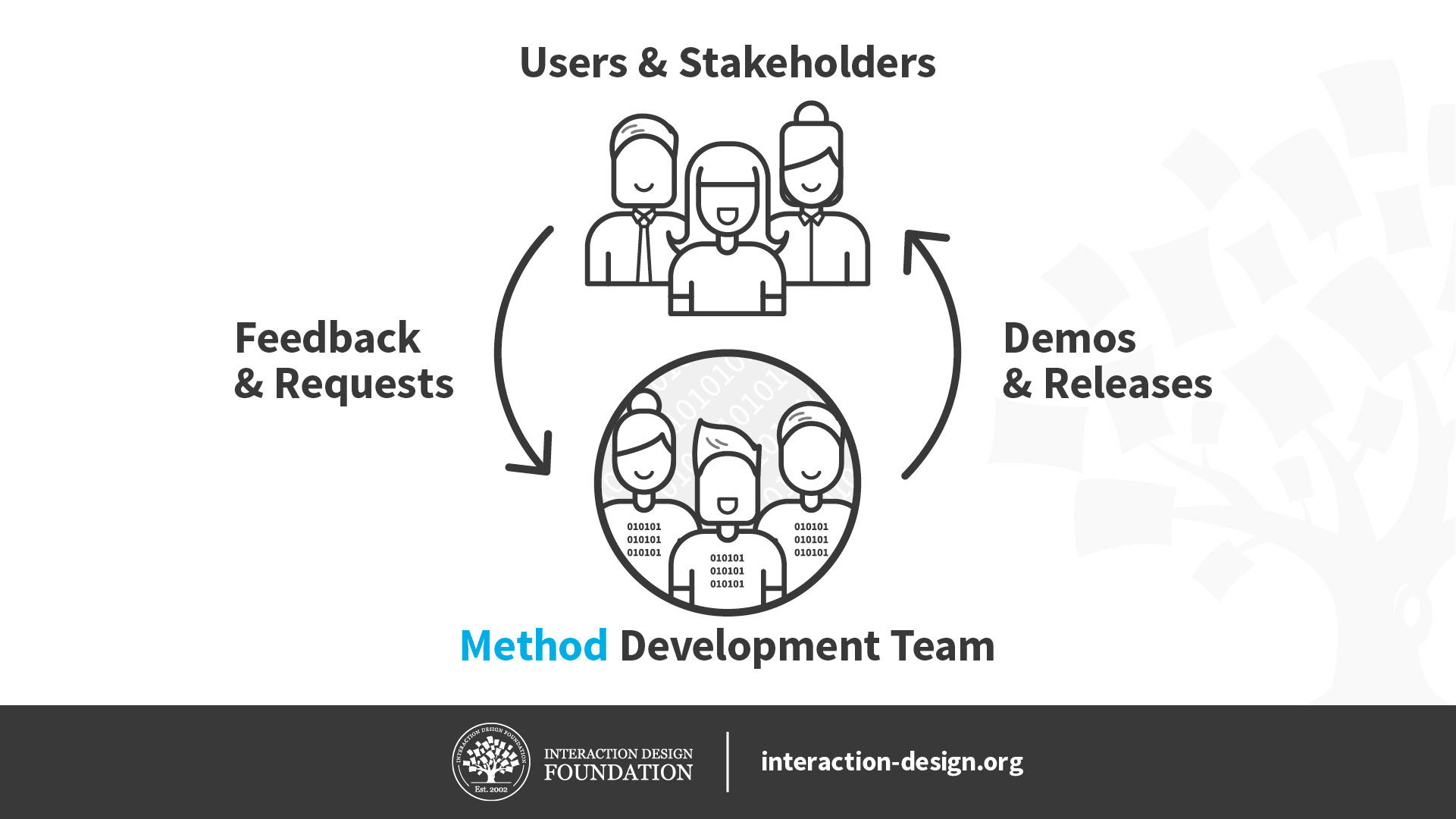
In an agile methodology, every iteration incorporates feedback from the previous release. This process can help you tackle wicked problems when it’s combined with systems thinking.
5 Ways to Apply Systems Thinking and Agile Methodology in Your Work
If you’ve been faced with a wicked problem in the past, you’ll have undoubtedly experienced frustration from not knowing where or how to begin. There’s no shame in that—issues which are difficult or nearly impossible to solve will do that to a person! The next time you and your team must tackle a wicked problem, you can use these five handy methods which are based on systems thinking and agile methodology:
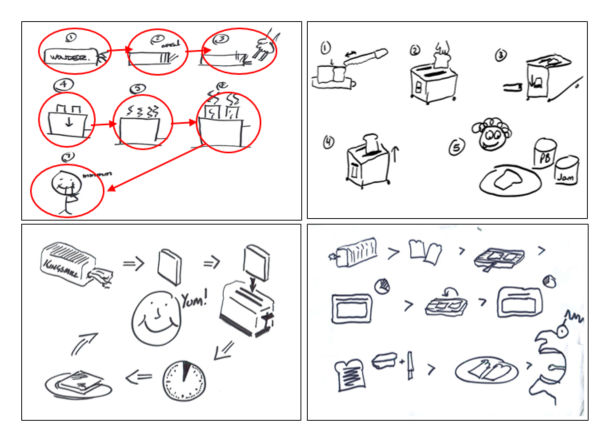
1. Break down information into nodes and links.
You can utilize systems thinking if you break the information down into nodes (chunks of information such as objects, people or concepts) and links (the connections and relationships between the nodes). This will make your private mental models (your representations of external reality) visible to the outside world and help you face wicked problems more effectively. Jay Wright Forrester, a pioneer in computer engineering and systems science, put it nicely when he said:
"The image of the world around us, which we carry in our head, is just a model. Nobody in his head imagines all the world, government or country. He has only selected concepts, and relationships between them, and uses those to represent the real system.”
—Jay Wright Forrester
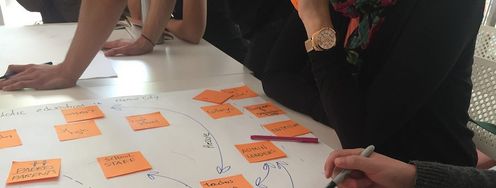
In this illustration, the nodes are circled in red and the links are the red lines drawn between the nodes. All four illustrations are systems models that participants created from Tom Wujec’s workshops on collaborative visualization and systems thinking.
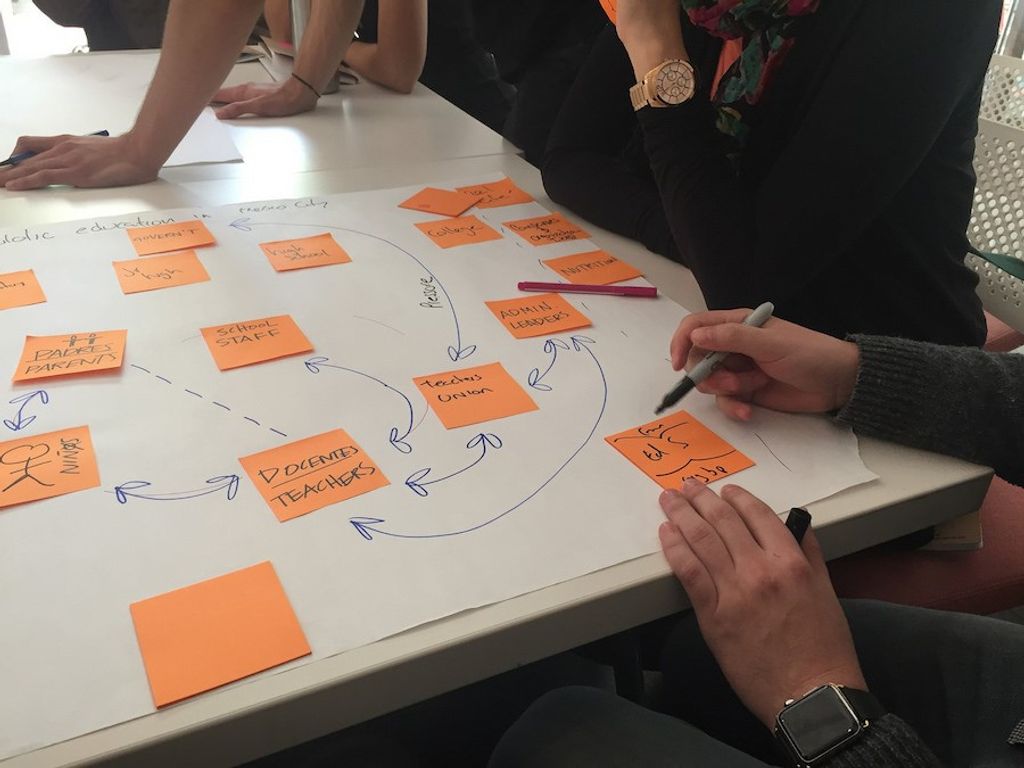
When you sketch out and place information into a physical space, it will help both you and your team take in and understand the systems at hand—as well as the relationships within and between them.
3. Collaborate and include stakeholders in the process.
Share your mental models to help other people build on your ideas, and vice versa. Your team can synthesize several points of view when you create physical drawings and group notes to produce different systems models.
4. Release solutions quickly to gather continuous feedback.
Feedback of success helps to solve problems which we don’t have one single obviously correct answer for. The more feedback you gather from your users and stakeholders, the more guidance you’ll have to get to the next step.
5. Carry out multiple iterations.
You and your team have the chance to utilize feedback at each iteration. The more iterations you do, the more likely you’ll determine what changes are needed to further improve the solution to your wicked problem.
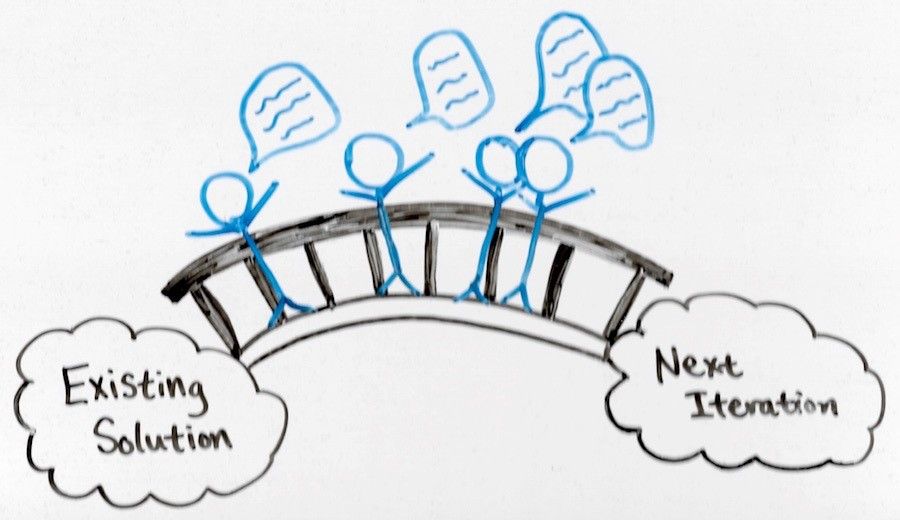
You’ll build a bridge between the existing solution and the next iteration when you combine user and stakeholder feedback with your team’s thoughts and ideas.
As designers, we have the responsibility to generate the best solution possible even when the wicked problem itself is indeterminate and the best solution does not yet exist. A combination of systems thinking and agile methodology can help us tackle these wicked problems. It encourages us to utilize these practices and share them with others so that we can, together, get to the next iteration of the design process.
When you start to tackle wicked problems, you can start to improve the world and the lives of the people who live in it. As a reminder, the five steps to do this are:
Break down information into nodes and links.
Visualize the information.
Collaborate and include stakeholders in the process.
Release solutions quickly and gather continuous feedback.
Carry out multiple iterations.
References & Where To Learn More
Ready to shape the future, not just watch it happen? Join the Father of UX Design, Don Norman, in his two courses, Design for the 21st Century and Design for a Better World, and turn your care for people and the planet into design skills that elevate your impact, your confidence, and your career.