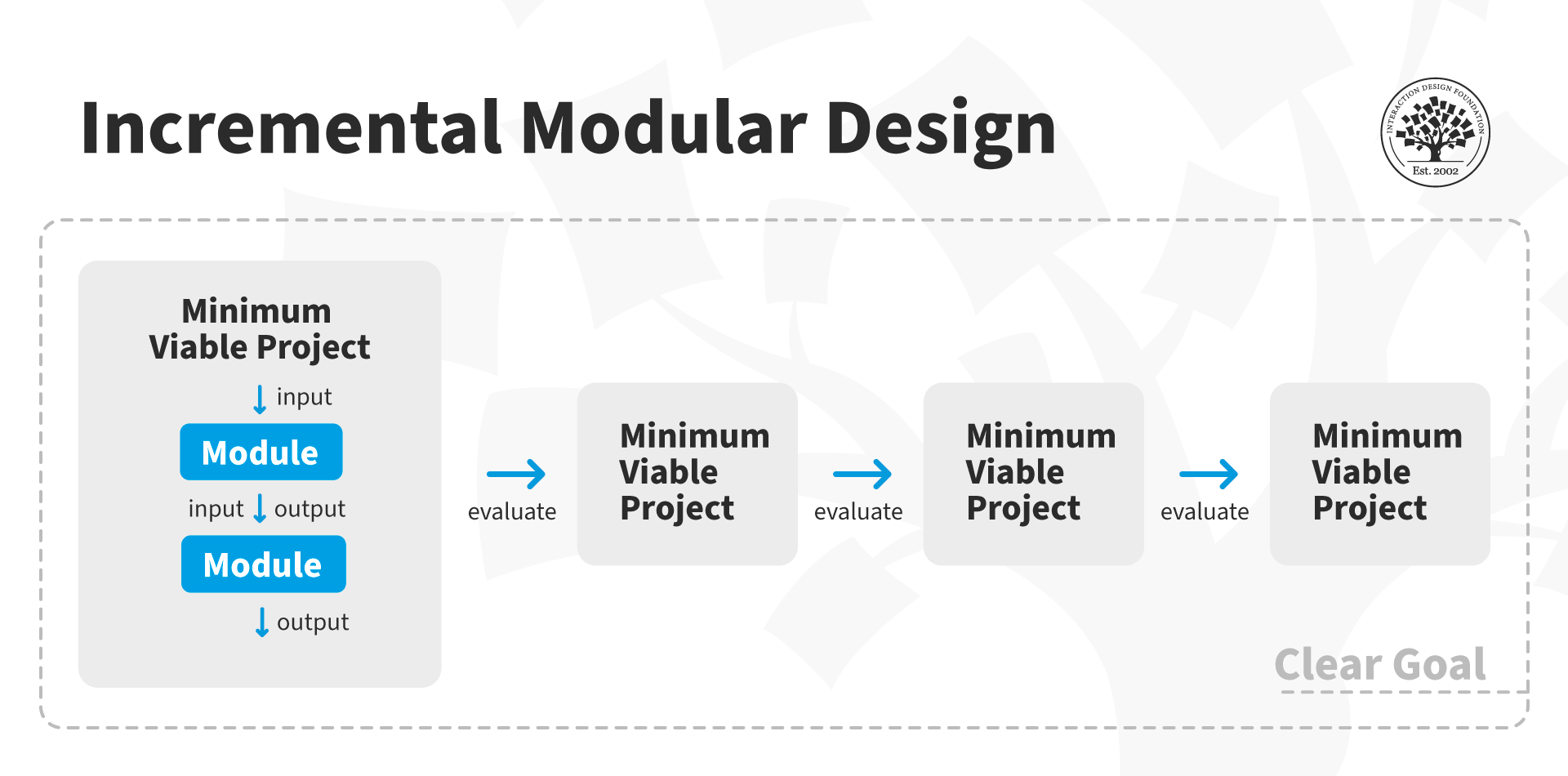
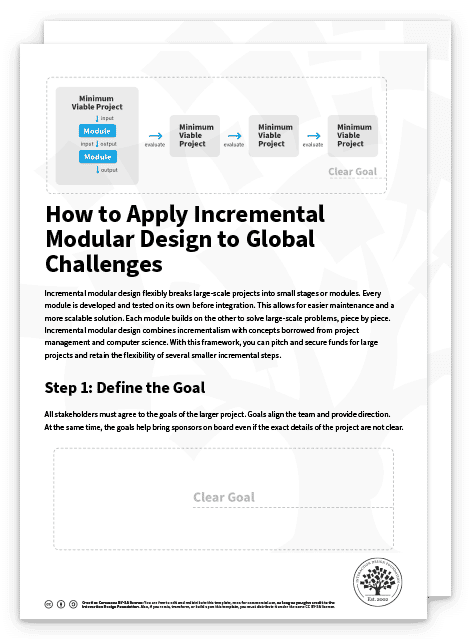
Incremental modular design breaks large-scale projects into small, independent modules. Each module adds or improves functions to reach a larger goal.
This approach to project management allows for easier maintenance and scalability because every module is developed and tested on its own before integration. Each of these modules builds on the success or failure of the others to solve complex problems, piece by piece, which aligns with principles of sustainable design.
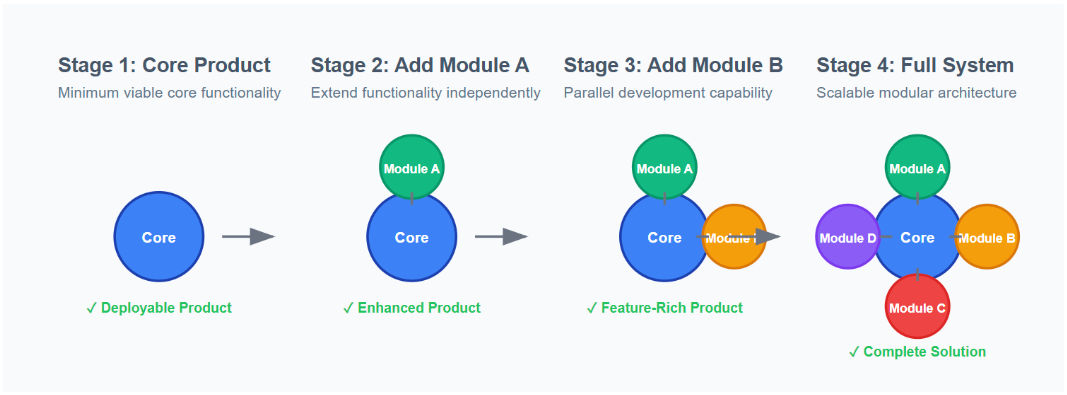
We can adapt to different social and technical conditions when we have a clear goal and use multiple smaller projects divided into standalone modules.
© Interaction Design Foundation, CC BY-SA 4.0
Incremental modular design allows people to:
Work on smaller projects for shorter spans.
Analyze the results of one module before investing in another.
Learn from mistakes as they work towards a larger goal.
Be flexible and pivot when conditions, technologies, or situations change.
The godfather of user experience design, Don Norman, explains what incremental modular design is in this video.
This approach combines concepts from agile development, object-oriented programming and incrementalism to help teams work on large complex problems without getting stuck in unwieldy projects that could become irrelevant when they are finally ready to be implemented.
Incremental modular designs add one module after the other, like laying bricks for the foundation of a house. Evaluating the performance of the first steps can help plan the next steps and determine if the project blueprint needs to be adjusted.
Key Features of Incremental Modular Design
Define the goals: Get the funders, the communities, and all the stakeholders to agree on the goals of the large project.
Democratize design: Involve the people we are designing for, ideally by following participatory design principles. They will identify their problems and needs and help us develop solutions.
The minimum viable project: Deliver the solution in small steps, analyze the results, and decide the next action based on the analysis, which contributes to a circular economy by ensuring resources are efficiently used and reused.
Independent modules: Develop modules with clearly defined input and output requirements but hidden internal workings. Teams must be able to change how the modules work internally without affecting the inputs and outputs.
Advantages of Incremental Modular Design
Incremental modular design offers flexibility with:
Requirements: As the team delivers, tests and learns from each incremental step, it can adapt and course-correct easily and even tweak the requirements if needed.
Module replacement: Since modules are independent, the team can update any module without harm to the overall system as long as the input and output requirements remain the same.
Local adaptation: It doesn’t matter how the module works internally. So, the team can change the internal workings to suit local cultures.
Why use Incremental Modular Design?
Incremental modular design is an applied and practical approach to incrementalism with the added benefit of offering a roadmap to fund and plan future work.
Good UX relies on a feedback loop of empathy, user research, ideation, prototyping and testing, incorporating human-centered design principles. It is far riskier to adjust to user feedback and try new design ideas with larger projects. Stakeholders often hesitate to fund purely incremental projects. An incremental modular design approach makes it easier to secure stakeholder buy-in for each module.
This approach is a great fit for large, non-digital projects. For a digital product, a complete redesign can be relatively simple to implement through a software update.
Larger projects such as city infrastructure, electrical grids or transit systems are difficult to change all at once.
For example, an incremental modular approach might focus on one transit station or part of a power grid. After evaluating the solution, designers can decide if the module was successful enough to be scaled up or repeated.
Incremental modular design allows small teams to tackle large problems by proving the validity of their solution on a small scale. If their project is successful, they can then bring more teams to replicate or expand on that module.
Incremental Modular Design in Technology Production
In the design of technology, the incremental modular design method allows us to add new modules and functions and improve existing features continuously. We can develop and test every module on its own before integration. This allows for easier maintenance and a more scalable solution. Each module builds on the other to solve large-scale problems, piece by piece.