Systems Thinking

Your constantly-updated definition of Systems Thinking and collection of videos and articles.
Be a conversation starter: Share this page and inspire others!

394 Shares

What is Systems Thinking?

Systems thinking is an approach that designers use to analyze problems in an appropriate context. By looking beyond apparent problems to consider a system as a whole, designers can expose root causes and avoid merely treating symptoms. They can then tackle deeper problems and be more likely to find effective solutions. 

“You have to look at everything as a system, and you have to make sure you're getting at the underlying root causes.”

Don Norman: Father of User Experience design, author of the legendary book The Design of Everyday Things, co-founder of the Nielsen Norman Group, and former VP of the Advanced Technology Group at Apple.

See why systems thinking helps prevent wasted time and resources on the wrong problem.

Copyright
Transcript

Everything is a System: Think of Each as One

Systems surround us, including within our own bodies, and they’re often highly complex. For example, that’s why doctors must know patients’ medical histories before prescribing them medicines. However, our brains are hardwired to find simple, direct causes of problems from the effects we see. We typically isolate issues we notice by considering how to combat their symptoms, since we’re more comfortable with “If X, then Y” cause-and-effect relationships. Cognitive science and usability engineering expert Don Norman identifies the need for designers to push far beyond this tendency if they want to address serious global-level problems effectively. That’s why systems thinking is not only an essential ingredient of 21st century design but also a principle of human-centered design.

The concept of systems thinking emerged in 1956, when Professor Jay W. Forrester of MIT’s Sloan School of Management created the Systems Dynamic Group. Its purpose was to predict system behavior graphically, including through the behavior over time graph and causal loop diagram. For designers, systems thinking is therefore vital to tackling larger global evils such as hunger, poor sanitation and environmental abuse. Norman calls such problems complex socio-technical systems, which, like wicked problems, are:

●      Difficult to define.

●      Complex systems.

●      Difficult to know how to approach.

●      Difficult to know whether a solution has worked.

The danger of not using a systems thinking approach is that we might oversimplify a situation, take problems out of context, treat symptoms and end up making matters even worse. Norman considers electric vehicles an example of an apparently good solution (to pollution) that can obscure what should be the real focus. If the fuel source that generates their electricity comes from coal, etc., it defeats the purpose and, worse, could cause even more world-damaging pollution, especially if so much electricity perishes between the generating source and the consumers’ power supply.  
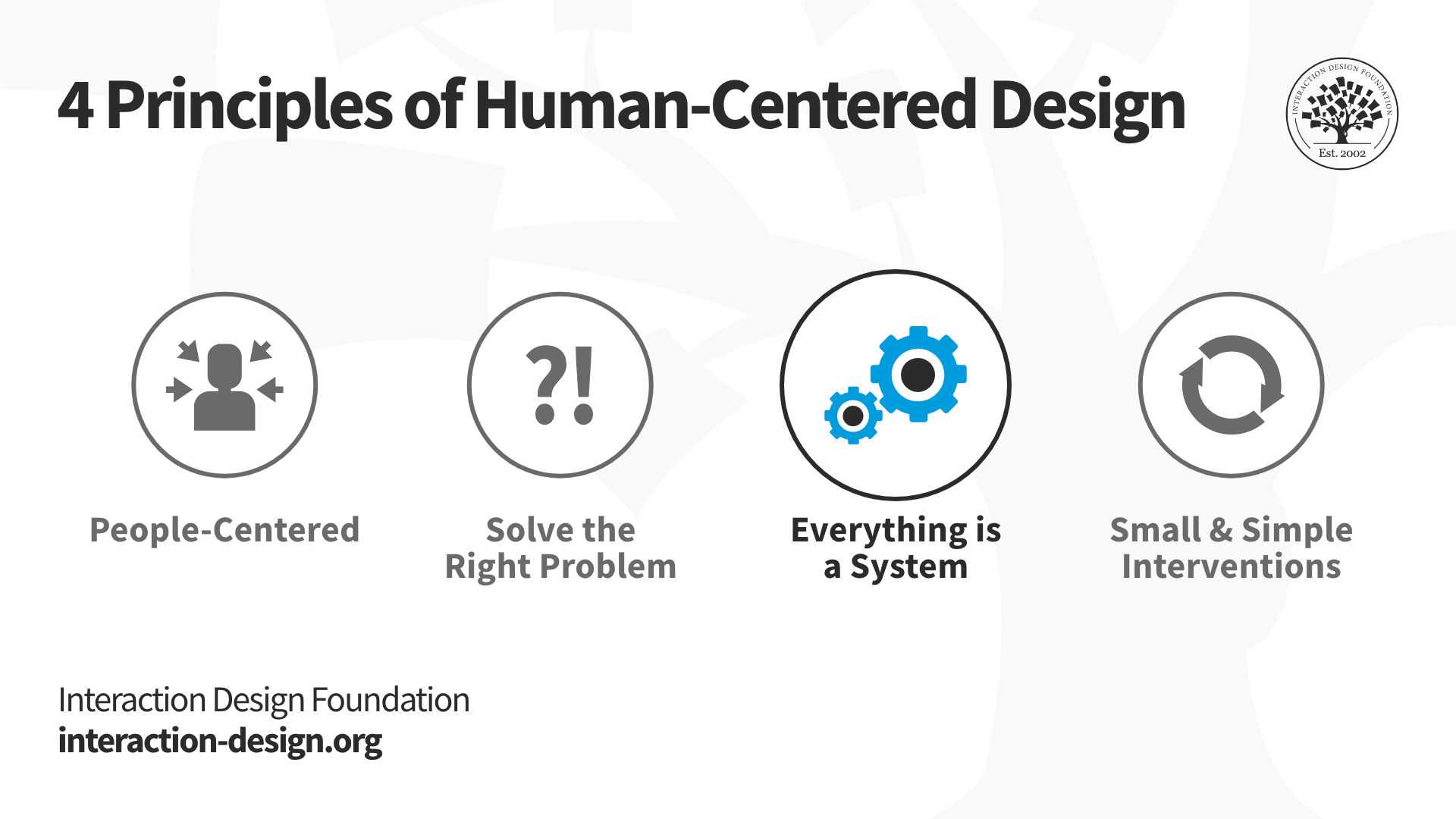
Systems thinking is the third principle of Human-Centered Design. The other principles are Peopl-Centered, Solve the Right Problem, and Small & Simple Interventions.

© Daniel Skrok and Interaction Design Foundation, CC BY-SA 3.0

How to Use Systems Thinking in Design

Systems thinking is also the third principle of humanity-centered design; therefore, integrate it within this approach:

●      Be people-centered. Spend a long time living among the people you want to help, to understand the true nature of their problems, their viewpoints and solutions they’ve tried. For example, a village’s crops might be failing even though the water source seems adequate.

●      Solve the right problem. Closely examine the factors driving the people’s problems. Try the 5 Whys approach. E.g., the soil is damp enough, so might it be exhausted of nutrients? Or does it contain toxins? Why? Sewage? If not, what then?

●      Consider everything as a system. Now, leverage systems thinking to untangle as many parts of the problem(s) as possible. Complex socio-technical systems such as (potential) famine demand hard investigation and working alongside others: principally, the community concerned; so:

  • Keep consulting the community leaders for their insights into the problems you uncover.

  • Evaluate the feedback loops. E.g., the collected clean water from a small stream and secondary well should be enough to irrigate the village’s few fields. The people seem to be doing things correctly: using pipes and a small ditch they’ve diverted from the stream and enclosed using plastic sheets strung over metal frames. The soil is adequately fertilized; the farmers water after dusk (operating taps and a sluice from the tunnel). Still, the problem persists.

  • Dig past the apparent problems to root causes. E.g., thinking of the village’s irrigation system as a system, you notice it’s not the amount of water or soil quality. The water is slightly too hot — due to the dark-colored plastic pipes and the black plastic sheeting of the improvised tunnel — for the crops to handle.

●      Proceed towards a viable solution using incrementalism:

  • Wait for the opportunity to do a small test of the small-scale solution you’ve co-created with the community. E.g., fortunately, here, a good solution involves just lightening the color of the irrigation system to reflect sunlight. The village has enough white paint for the pipes, and you collect white sheeting and tarpaulins to cover the stream tunnel.

  • If it’s successful, evaluate how successful; then adapt and modify it or repeat it several times until you fine-tune a sustainable solution. E.g., fortunately, you just need to find more light-colored tarpaulins.

Overall, systems thinking is about reframing a problem to expose its addressable underlying causes. Thinking broadly, you can deduce real problems and stop to consider potential solutions with (e.g.) design thinking. That’s how community-driven projects — and people-centered design — arrive at inventive, economical and culturally acceptable best-possible solutions.


At Ta Prohm's ancient temple ruins, the stone structures are covered in thick foliage. In this image, a large tree's roots cover an entire temple.

Questions About Systems Thinking?
We've Got Answers!

How does systems thinking differ from traditional UX approaches?

Systems thinking differs from traditional UX approaches by shifting focus from isolated user interactions to the broader ecosystem surrounding a product. While traditional UX often zeroes in on optimizing specific touchpoints—like a button or a user flow—systems thinking looks at how all parts of a product, user, and environment connect and influence one another.

Systems thinking helps designers anticipate ripple effects across teams, technologies, and social contexts. For example, changing one feature might improve a workflow but negatively impact user trust or data flow elsewhere. Designers using systems thinking map these relationships and design holistically.

This mindset is essential in complex environments like healthcare, finance, or smart cities—where user experiences span multiple platforms, policies, and people.

Enjoy our Master Class Systems Thinking for Designers: A Practical Guide with Erik Stolterman, Author and Professor in Informatics at Indiana University, Bloomington.

Watch as UX Pioneer and the Godfather of UX Design, Don Norman explains important points about systems:

Transcript

Why should UX designers learn systems thinking?

UX designers should learn systems thinking because it helps them design for the whole and not just the parts—and the whole is far more than the sum of the parts. Products today exist in complex environments—across devices, user groups, organizations, and real-world contexts. Systems thinking trains designers to see patterns, relationships, and feedback loops that traditional UX might miss.

By thinking in systems, designers can anticipate unintended consequences, solve root causes rather than symptoms, and create solutions that scale. It helps teams align across departments, too, especially when UX decisions impact data, operations, or customer service.

For example, a small design tweak in a healthcare app might ease user flow but could disrupt data compliance or medical workflow. Designers who use systems thinking can help avoid these disconnects by focusing on the full ecosystem.

Enjoy our Master Class Systems Thinking for Designers: A Practical Guide with Erik Stolterman, Author and Professor in Informatics at Indiana University, Bloomington.

Watch as UX Pioneer and the Godfather of UX Design, Don Norman explains important points about systems:

Transcript

How do I apply systems thinking to digital product design?

To apply systems thinking to digital product design, start by mapping the ecosystem around your product. Look beyond the screen—and consider users, teams, technologies, policies, and social dynamics. Use tools like system maps or causal loop diagrams to visualize how parts influence one another over time.

Next, identify feedback loops. For example, if users skip onboarding, does that cause support tickets to spike? If so, that’s a signal for systemic refinement. Frame problems in terms of relationships, not isolated touchpoints.

Co-create with cross-functional teams—systems thinking thrives on multiple perspectives. And always zoom in and out: design the micro-interactions, but never lose sight of how they connect to macro-level goals.

Firms like IBM and SAP use this approach to build scalable, resilient, and user-aligned systems.

Enjoy our Master Class Systems Thinking for Designers: A Practical Guide with Erik Stolterman, Author and Professor in Informatics at Indiana University, Bloomington.

Watch as UX Pioneer and the Godfather of UX Design, Don Norman explains important points about systems:

Transcript

How does systems thinking help me understand user behavior better?

Systems thinking helps you understand user behavior by revealing the broader systems that shape it. Instead of just asking what users do, systems thinking uncovers why they do it—by examining relationships, influences, and context.

For example, if users abandon a signup flow, a “traditional” UX approach might blame the form. However, systems thinking might reveal upstream issues—like confusing pricing, social distrust, or inconsistent messaging across touchpoints. By mapping these interconnected parts, you uncover root causes instead of surface symptoms.

It also helps you track how user behavior evolves over time. Behavior doesn’t happen in isolation—it reflects policies, feedback loops, and interactions with other people or tools.

In short, systems thinking gives you a dynamic lens for user behavior, which leads to smarter, more holistic design and designs as a result.

Enjoy our Master Class Systems Thinking for Designers: A Practical Guide with Erik Stolterman, Author and Professor in Informatics at Indiana University, Bloomington.

Watch as UX Pioneer and the Godfather of UX Design, Don Norman explains important points about systems:

Transcript

How do feedback loops play a role in UX design?

Feedback loops play a key role in UX design as they help systems learn and adapt based on user input they get. A positive feedback loop reinforces user behavior—like when Duolingo celebrates a streak, encouraging users to keep coming back. A negative feedback loop, by contrast, corrects or balances behavior—such as when a system warns users before deleting data.

Well-designed feedback loops keep users informed, in control, and emotionally engaged. They’re not just about function—they shape how users feel during and after an interaction and as such are vital to the overall user experience.

In systems thinking, feedback loops reveal how small actions ripple across the user journey. Designers can identify where experiences break down, or where friction becomes frustration.

Smart UX uses feedback loops to align product behavior with user expectations—and create designs that improve over time.

Enjoy our Master Class Systems Thinking for Designers: A Practical Guide with Erik Stolterman, Author and Professor in Informatics at Indiana University, Bloomington.

Watch as UX Pioneer and the Godfather of UX Design, Don Norman explains important points about systems:

Transcript

How do I map complex user flows using systems thinking?

To map complex user flows using systems thinking, begin by identifying every actor, system, and touchpoint involved—not just screens or features. Then, visualize how these parts interact over time using tools like ecosystem maps, system maps, or causal loop diagrams.

Unlike linear user flows, systems-based maps account for feedback loops, delays, dependencies, and multiple user paths. For example, a user action in one interface might trigger back-office workflows or third-party integrations—and systems thinking helps you trace these chains clearly.

Collaborate across departments to include operational and technical perspectives. This gives you a full picture of what supports, influences, or disrupts the user journey.

Think like a service designer: zoom out to understand the whole system, then zoom in to optimize the flows that matter most.

Watch as CEO of Experience Dynamics, Frank Spillers explains important points about how to map the ecosystem of a service design:

Transcript

Enjoy our Master Class Systems Thinking for Designers: A Practical Guide with Erik Stolterman, Author and Professor in Informatics at Indiana University, Bloomington.

How do I identify unintended consequences in design systems?

To find unintended consequences in design systems, use systems thinking to trace cause-and-effect relationships across the product’s ecosystem. Start by asking: “What happens after this feature works as expected?” Then map ripple effects, not just user flows. Look for feedback loops—are you reinforcing harmful patterns, like dark patterns or addictive loops?

Tools like causal loop diagrams help visualize side effects and delays that might not appear in a prototype or sprint review. Engage cross-functional teams—engineers, policy experts, support staff—to uncover blind spots you might miss from the design view alone.

For example, adding a “streak” feature might increase engagement but cause anxiety or burnout for some users. Systems thinking helps surface these contradictions early.

Watch as UX Pioneer and the Godfather of UX Design, Don Norman explains important points about systems:

Transcript

Enjoy our Master Class Systems Thinking for Designers: A Practical Guide with Erik Stolterman, Author and Professor in Informatics at Indiana University, Bloomington.

How do I use systems thinking in UX research?

To use systems thinking in UX research, expand your scope beyond individual users and screens. First, identify the system: who are the stakeholders, what external factors shape behavior, and how do different elements interact over time?

Instead of focusing solely on isolated pain points, use tools like ecosystem maps, stakeholder maps, or causal loop diagrams to trace patterns, feedback loops, and indirect influences. For instance, a usability issue might stem from policy constraints or backend limitations—not just poor UI.

Interview across roles and departments to capture how different parts of the system perceive the same experience. You’ll likely uncover far deeper insights by studying what happens between touchpoints—not just at them.

Systems thinking helps UX researchers reveal root causes and design insights that resonate far beyond the interface.

Watch as UX Pioneer and the Godfather of UX Design, Don Norman explains important points about systems:

Transcript

Enjoy our Master Class Systems Thinking for Designers: A Practical Guide with Erik Stolterman, Author and Professor in Informatics at Indiana University, Bloomington.

How do I introduce systems thinking to a UX team or organization?

To bring systems thinking to a UX team or organization who aren’t familiar with it, start with shared language and visuals. Host a workshop using real product challenges to map out systems diagrams, feedback loops, or stakeholder maps. This hands-on approach helps teams see how systems thinking reveals hidden patterns and interdependencies.

Frame it as a complement—not a replacement—for existing UX practices. Show how it adds depth to research, aligns cross-functional teams, and prevents unintended consequences.

Use small pilot projects to demonstrate impact. For example, apply systems thinking to redesign a user journey across departments or touchpoints. Share outcomes widely and invite others to build on the approach.

Organizations like IBM and Salesforce have embedded systems thinking by creating shared toolkits and embedding systems-minded roles in UX teams.

Watch as UX Pioneer and the Godfather of UX Design, Don Norman explains important points about systems:

Transcript

Enjoy our Master Class Systems Thinking for Designers: A Practical Guide with Erik Stolterman, Author and Professor in Informatics at Indiana University, Bloomington.

What are some highly cited scientific articles about systems thinking?

Pourdehnad, J., Wexler, E. R., & Wilson, D. V. (2011). Systems & design thinking: A conceptual framework for their integration. University of Pennsylvania ScholarlyCommons.

This paper by Pourdehnad, Wexler, and Wilson explores the conceptual integration of systems thinking and design thinking. It argues that addressing today’s complex and evolving challenges requires blending the holistic, interconnected perspective of systems thinking with the creativity and user-centered approach of design thinking. The authors propose a combined framework that incorporates the philosophical underpinnings of both approaches to tackle complex social systems more effectively. Particularly relevant for UX and organizational design, this work highlights how such integration can improve decision-making, innovation, and the sustainable implementation of solutions. It’s influential for those developing methodologies to address complexity in user experience and design strategy.

Meadows, D. H. (2008). Thinking in Systems: A Primer (D. Wright, Ed.). Chelsea Green Publishing.

Thinking in Systems is a foundational text by environmental scientist Donella Meadows, edited posthumously by Diana Wright. The book introduces systems thinking—an approach to understanding complex issues by analyzing how their components interact through feedback loops and systemic behaviors. With accessible language and everyday examples, Meadows unpacks concepts like reinforcing loops, system resilience, and time delays. She emphasizes that many global challenges, from climate change to economic inequality, are system-based problems. This book is lauded for translating complexity into clarity and remains essential for leaders, educators, and designers seeking sustainable, big-picture solutions in an interconnected world.

Senge, P. M. (1990). The Fifth Discipline: The Art & Practice Of The Learning Organization. Doubleday/Currency.

Peter M. Senge’s The Fifth Discipline redefines how organizations can cultivate continuous learning and adaptability. By introducing five core disciplines—personal mastery, mental models, shared vision, team learning, and systems thinking—Senge establishes a blueprint for building "learning organizations" capable of sustained innovation and resilience. The book is particularly notable for elevating systems thinking as the “fifth discipline” that integrates the others into a cohesive framework. It has become a foundational text in organizational development, offering strategies for long-term success in a complex, changing world. Senge's blend of theory and practical advice makes it indispensable for leaders, educators, and change-makers seeking transformative growth.

Earn a Gift Earn a Gift, Answer a Short Quiz!

1
2
3
4
1
2
3
4
Question 1
Question 2
Question 3
Get Your Gift
Interaction Design Foundation logo

Question 1

Why is systems thinking important in complex design problems?

1 point towards your gift

  • It encourages reliance on first impressions.
  • It focuses solely on the end product.
  • It helps designers understand and address the root causes of problems.
Interaction Design Foundation logo

Question 2

What tool do designers use in systems thinking to predict outcomes over time?

1 point towards your gift

  • Aesthetic assessments
  • Behavior over time graphs
  • Immediate feedback loops
Interaction Design Foundation logo

Question 3

How does systems thinking benefit community-driven projects?

1 point towards your gift

  • It encourages isolated interventions.
  • It focuses on quick fixes.
  • It promotes incremental changes after understanding the system.

Learn More About Systems Thinking

Make learning as easy as watching Netflix: Learn more about Systems Thinking by taking the online IxDF Course Design for the 21st Century with Don Norman.

Why? Because design skills make you valuable. In any job. Any industry.

In This Course, You'll

  • Get excited as you learn to design a better world. Whether you want to help families save money while reducing their carbon footprint, redesign how cities manage waste, or improve public health systems, this course will show you how. You don't need to be a designer. You just need the desire to make things better. Led by world-renowned designer Don Norman, you'll learn the powerful tools of human-centered design, systems thinking, and design thinking to tackle real-world challenges like climate change, inequality, public health, and more.

  • Make yourself invaluable when you build timeless human-centered design skills that are essential to make AI your superpower, so speed never comes at the cost of people's wellbeing. This course builds on and expands your deeply human skills like empathy, problem framing, and root-cause thinking that guide AI toward better, more responsible outcomes. You'll learn to apply these skills to drive innovation at work, lead meaningful projects, communicate your ideas clearly, and capture people's attention. This course helps you grow your impact, salary potential, and confidence—and feel deeply fulfilled. Did you know that design-driven companies are twice as likely to outperform their industry peers in revenue growth? The key is to go beyond traditional approaches and solve the real problems behind surface-level symptoms while integrating solutions seamlessly into real people's lives. You'll get the ability to design lasting change and learn how to work effectively with stakeholders to make it happen. You'll also discover how to move up in your company and take on bigger challenges.

  • Gain confidence and credibility as you apply your new skills from day one with ready-to-use templates such as the 5 Whys method. Create an optional case study aligned with the UN Sustainable Development Goals. By the end of this course, you'll have the skills and mindset to make a difference, whether that's in your job, your community, or the world. Let's co-create a better future starting now.

It's Easy to Fast-Track Your Career with the World's Best Experts

Master complex skills effortlessly with proven best practices and toolkits directly from the world's top design experts. Meet your expert for this course:

  • Don Norman: Father of User Experience (UX) Design, author of the legendary book “The Design of Everyday Things,” co-founder of the Nielsen Norman Group, and former VP of the Advanced Technology Group of Apple.

Get an Industry-Recognized IxDF Course Certificate

Increase your credibility, salary potential and job opportunities by showing credible evidence of your skills.

IxDF Course Certificates set the industry gold standard. Add them to your LinkedIn profile, resumé, and job applications.

Course Certificate Example

Be in distinguished company, alongside industry leaders who train their teams with the IxDF and trust IxDF Course Certificates.

Our clients: IBM, HP, Adobe, GE, Accenture, Allianz, Phillips, Deezer, Capgemin, Mcafee, SAP, Telenor, Cigna, British Parliament, State of New York

All Free IxDF Articles on Systems Thinking

Read full article
What Are Wicked Problems and How Might We Solve Them? - Article hero image
Interaction Design Foundation logo

What Are Wicked Problems and How Might We Solve Them?

Have you ever come across a problem so complex that you struggled to know where to start? Then you might have stumbled upon a wicked problem. While wicked problems may not have a definite solution, there are certainly things you can do to mitigate any negative effects. When you learn how to tackle w

Social shares
1.2k
Published
Read Article
Read full article
Human-Centered Design: How to Focus on People When You Solve Complex Global Challenges - Article hero image
Interaction Design Foundation logo

Human-Centered Design: How to Focus on People When You Solve Complex Global Challenges

When we design products and services, we use human-centered design insights to help us focus on the people. But how do we focus on the people in the context of complex global challenges? What should we be aware of? What are the pitfalls? And when should we reach out to help people? In this video, Do

Social shares
578
Published
Read Article
Read full article
The 4 Types of Designers Who Will Thrive in 2030 (And the One Most Schools Still Ignore) - Article hero image
Interaction Design Foundation logo

The 4 Types of Designers Who Will Thrive in 2030 (And the One Most Schools Still Ignore)

What is the future of design? Which skills will you need in the 21st century? In this video, Don Norman gives four examples of the tasks that designers might be doing in the 21st century, and the four types of designers that will be needed.“So there you are. Four different kinds of design problems,

Social shares
637
Published
Read Article
Read full article
System Usability Scale for Data-Driven UX - Article hero image
Interaction Design Foundation logo

System Usability Scale for Data-Driven UX

Ever wondered how the top designers, researchers, and product developers manage to create products that are user-friendly, efficient, and enjoyable—consistently? One of the key things there is what’s called the System Usability Scale (SUS), a vital tool and questionnaire-based method that profession

Social shares
932
Published
Read Article

Feel Stuck?
Want Better Job Options?

AI is replacing jobs everywhere, yet design jobs are booming with a projected 45% job growth. With design skills, you can create products and services people love. More love means more impact and greater salary potential.

At IxDF, we help you from your first course to your next job, all in one place.

See How Design Skills Turn Into Job Options
Privacy Settings
By using this site, you accept our Cookie Policy and Terms of Use.
Customize
Accept all

Be the One Who Inspires

People remember who shares great ideas.

Share on:

Academic Credibility — On Autopilot

Don't waste time googling citation formats. Just copy, paste and look legit in seconds.