UX Ecosystems

Your constantly-updated definition of UX Ecosystems and collection of videos and articles.
Be a conversation starter: Share this page and inspire others!

197 Shares

What are UX Ecosystems?

UX (user experience) ecosystems are interconnected systems of interactions and touchpoints that users have with a product or service. This includes all digital and physical elements such as websites, mobile apps, customer support and physical products. Well-designed UX ecosystems ensure a seamless and consistently good user experience across all these touchpoints. 

CEO of Experience Dynamics, Frank Spillers explains how to map an ecosystem in service design

Transcript
 

How to Understand UX Ecosystems

A UX ecosystem is a holistic framework—and one that’s crucial for designers to use to enhance user experiences. A UX design ecosystem is a complex network that includes not only the user interface but also technological, content, social and physical environments. For a basic example, a product such as a mobile phone doesn’t exist in a vacuum. One design consideration is that a user may need to regularly switch their notification mode from sounds to vibrations so they don’t disturb others in certain situations. It’s a designer’s role to anticipate the ways in which users will encounter the products and services of brands they work for. When designers understand the realities that these users find themselves in at those times, they can fine-tune things to make the best designs to meet their users’ expectations. 

One thing that’s particularly important is to appreciate just how many factors and channels are involved in UX ecosystems. There are many ways that users encounter and access brands—both digitally and physically. All of these factors are interconnected, and they shape how users interact with a product or service. Because of this, they influence how users come to perceive—and trust—the brand that’s behind the product or service they use.  

When designers approach ecosystems of UX like this, they recognize just how important various tools and components are. These include UX ecosystem mapping and mobile UX ecosystems—among others. These factors play vital roles with which designers can create seamless and effective digital experiences, services and more. Designers need to craft products and services that slot neatly into the lives and realities of the people who will use what they provide for them. Due to this, the ecosystems that designers must consider can be highly intricate and involved, for products, services and brands that combine products with services.   
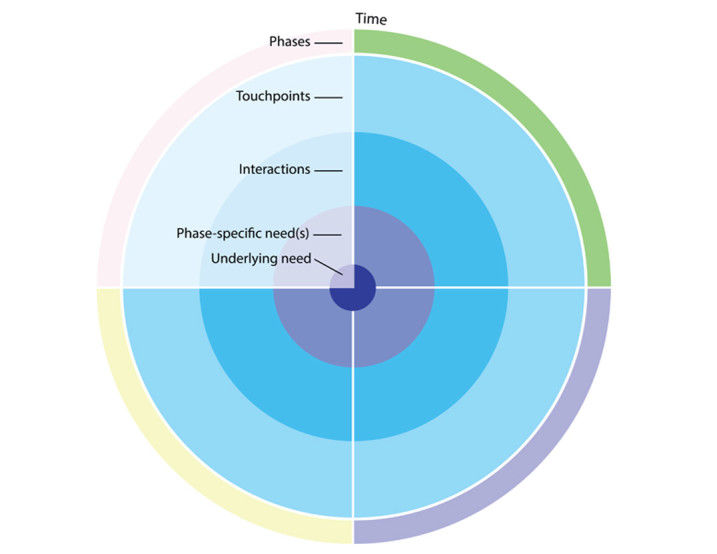
A circular diagram of a service ecosystem.

Pictured here are the elements in a service ecosystem, reading in a clockwise manner.

© Jesse Grimes, Fair Use
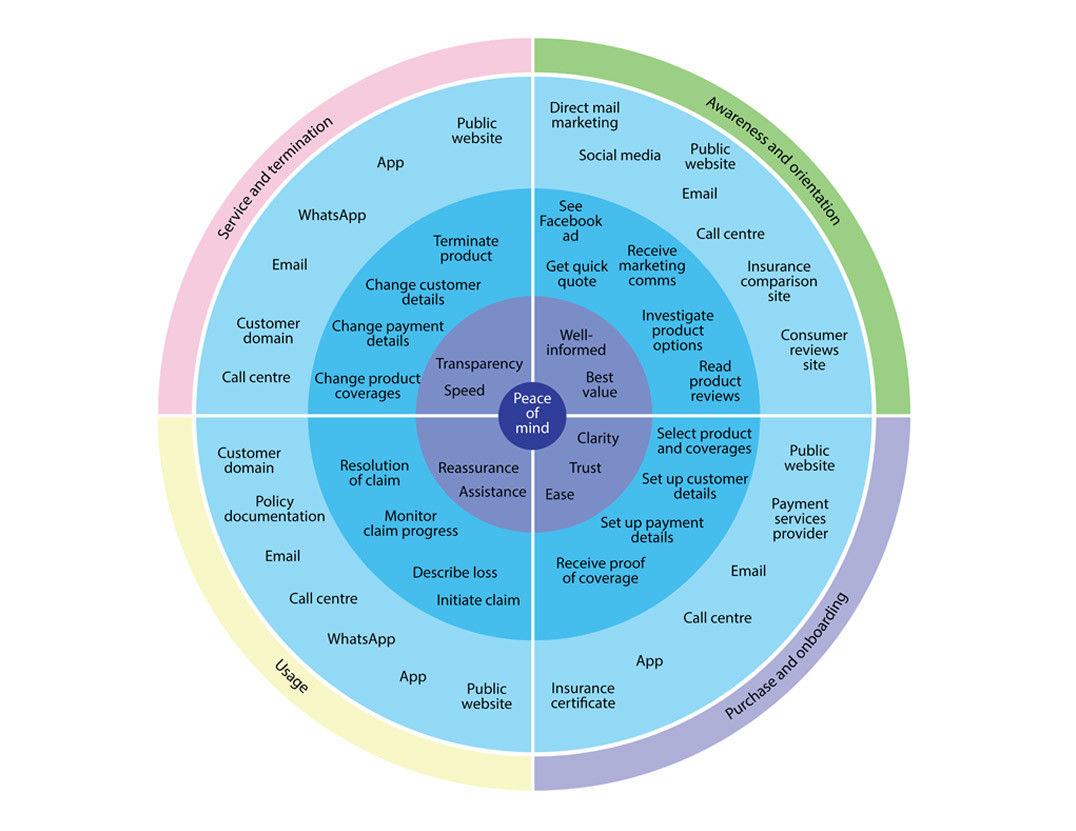
A more detailed circular diagram of a service ecosystem.

This example is of a high-level service ecosystem for an insurance provider.

© Jesse Grimes, Fair Use

To design a UX ecosystem takes a profound understanding of its multifaceted nature.  Designers need to orchestrate an array of elements—including data, physical items and personnel—in a way that goes beyond individual interactions. The goal is to create a user-centered ecosystem that doesn’t just address the immediate needs but anticipates the dynamic context and device preferences of users, too. This helps to make sure a cohesive and delightful experience does happen across all touchpoints.  

Components and Their Interdependence

To fully grasp UX ecosystems as a concept, it’s vital to recognize the diverse components that make up this comprehensive framework. First of all, a UX ecosystem consists of five main elements: the user interface (UI), technological environment, content ecosystem, social environment and physical environment. Each of these components plays a critical role—and that’s because it shapes the interactions that users have with products or services. 

  1. User interface (UI): This is the point of interaction between user and digital product—and it includes design elements like layout, visual hierarchy and visual aesthetics

  1. Technological environment: This encompasses the software, hardware and networks that support both the user interface and the delivery of content. 

  1. Content ecosystem: This involves the creation, management and distribution of content that users interact with within the UI. It includes the design of information architecture, microcopy—like button text—and more. 

  1. Social environment: This considers the human interactions and social contexts in which users use the product, including shared user experiences and community feedback mechanisms. 

  1. Physical environment: This is the actual physical space where interactions with the product or service occur. It can influence accessibility and usability and also requires sharp insights for designers to meet users’ expectations and needs. 

Dynamic Information Flow and User Participation 

One aspect of UX ecosystems that’s essential is the dynamic flow of information across various components within an ecosystem. It evolves with user interactions and feedback as the basis. Users aren’t passive recipients. They’re participants, and actively manage information and contribute to the production of knowledge within the ecosystem. For example, a GPS app may have real-time updates about traffic conditions or reports about events or potential hazards from user feedback on the road. 

This active participation helps to refine and evolve the ecosystem so designers can better meet these users’ needs and expectations. So, users’ feedback is a vital item for designers and brands who want to both achieve good UX design and excel at great experiences. It guides service and product design in the real world—towards creating products and services with higher conversion rates and optimal features such as exceptional visual design.  

Designers must—therefore—look on the ecosystem as a whole, and understand the interdependencies between its various components. They need to design not just for individual users or single applications but for a community with its own social standards and communication practices, too. 

Designers need to see interfaces as more than just on-screen interactive elements for single users. In a UX ecosystem, interfaces act as proxies that mediate communication between participants. So, designers need to make sure that these interfaces make for easy and seamless information flow and enable effective interactions within the ecosystem. 
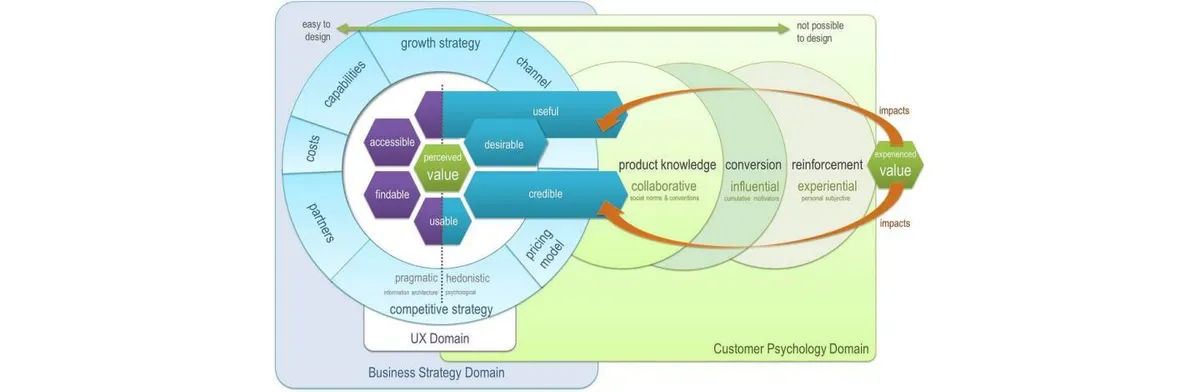
A diagram of a user experience ecosystem.

The factors of UX ecosystems go across many categories for designers and brands to consider.

© Matthew Hodgson, Fair Use

Benefits and Challenges of UX Ecosystems 

Some major benefits include these: 

1. Consistent User Experiences

When organizations take an ecosystem approach, they make sure a uniform experience happens across various platforms and devices. This consistency is vital both to maintain brand identity and to build user trust. That’s because it eliminates confusion and reinforces familiarity with the product. 

2. Deeper User Insight

A comprehensive understanding of the UX ecosystem lets designers get valuable insights into user needs and behaviors. This deepened understanding empowers them to develop more effective design solutions—ones that are more empathetic, too. This gives a boost to both users’ satisfaction and their engagement. 

Watch this video to understand the need for empathy in design: 

Transcript
 

3. Enhanced Innovation

When designers view UX through the lens of an ecosystem, it encourages them to think outside the box. This perspective helps stoke the engines of creativity and innovation—powering towards groundbreaking solutions that redefine user experiences. 

Author and Human-Computer Interaction Expert, Professor Alan Dix explains out-of-the-box thinking in this video: 

Transcript
 

4. Efficient Problem-Solving

The ecosystem approach helps brands spot pain points and address them more effectively. When designers think about the entire system, they can pinpoint issues that bit more accurately and develop holistic solutions that address these challenges in comprehensive ways. 

Challenges of UX Ecosystems

Some significant challenges include: 

1. System Disconnections

Often, UX ecosystems suffer from inefficient manual workflows—and these are due to disconnected systems. The lack of communication between channels, together with the presence of siloed systems, results in a fragmented approach—and it’s something that can hinder seamless user experiences. 

2. Lack of Automation and Data Insights

When there’s no automation in managing ecosystem components, it can lead to inefficiencies. What’s more, without robust data insights into content performance and user interactions, it can be a real challenge to optimize an ecosystem for better results. 

When designers address these challenges while leveraging the benefits, they can enhance the effectiveness of UX ecosystems. And they can—ultimately improve the overall user experience in this way. 

UX Ecosystems in Service Design 

In service design, it’s vital to understand how the various actors and parts come together to create a service, and how they use all the items required, and help optimize the service for customers. The structure of an ecosystem consists of: 

  1. The actors who together create the customer experience—including employees and contractors, on the frontstage and backstage (the customer-facing areas and behind-the-scenes or production areas, respectively). 

  1. Their practices: the services or value they deliver to customers. 

  1. The information they need, use or share to deliver their parts of the service. 

  1. The people or systems these actors interact with so they can perform their functions. 

  1. The services available to them—that is, to supporting organizations, like carriers. 

  1. The devices they use, such as mobile phones. 

  1. The channels they communicate through, such as email. 

Watch as Frank Spillers explains frontstage and backstage elements of service design: 

Transcript
 

Ecosystem Maps and Design Considerations 

When designers use ecosystem maps, these can be powerful tools for them to visualize the relationships and flows between all relevant actors and components. These maps help designers and design teams find gaps or disconnects that may exist. And maps like this give a holistic view—one that’s crucial for effective UX design. For instance, if designers understand just how different devices and services interconnect within the ecosystem, it can help them to make sure that seamless user experiences become a reality across multiple platforms. 
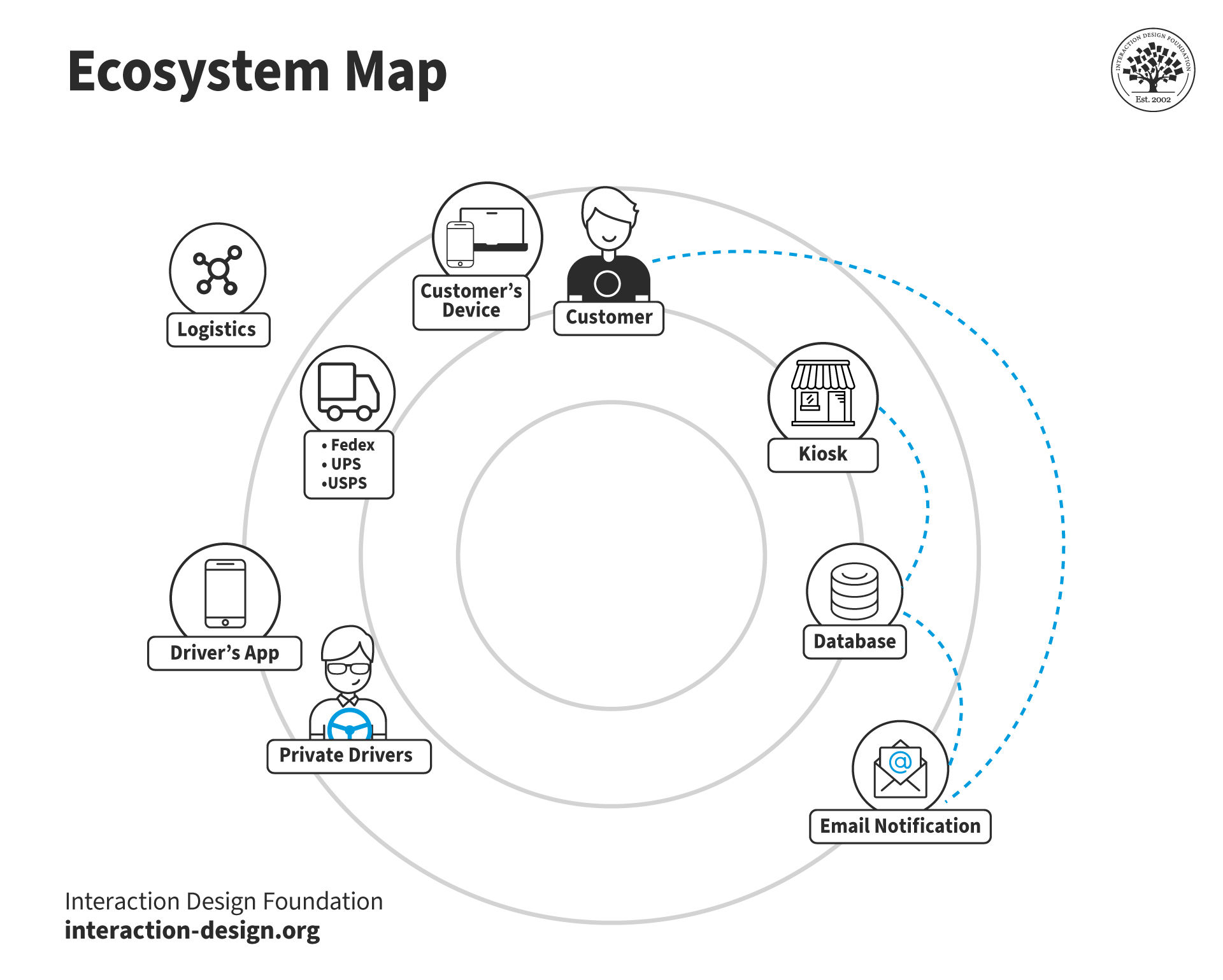
A service design ecosystem map.

An ecosystem map of a service design, in this case mirroring an aspect of Amazon’s service.

© Frank Spillers and Experience Dynamics, CC BY-SA 3.0

Ecosystem maps also show a brand’s service as a system and how the components within that entire system connect. These maps are UX deliverables like personas in terms of their value and how they represent a service as a “living” entity. When designers map out how all the actors, support brands or ancillaries, information and the other components work together, they can find areas to improve. There could be disconnects that keep information from flowing properly. For example, there could be a disconnect between the store that should have processed food orders and the app that mistakenly told customers their meals were ready for pickup. 

For an example of a service UX ecosystem, Amazon’s ecosystem (from a delivery perspective, depicted above) includes: 

  • Delivery services and vehicles. 

  • A database. 

  • Email notification. 

  • Logistics occurring behind the scenes. 

The actors, devices, infrastructure and other elements interplay to support the best customer experiences. It’s vital to understand the ecosystem as more than the sum of its parts. The dynamics and connections between the parts are vital to the service’s—and brand’s—health. From the ecosystem maps that designers make, they’ll be likely to find breakpoints.  

Examples of Other Successful UX Ecosystems

1. Multi-Device and Content-Driven Ecosystems 

  • Apple's integrated ecosystem: Apple exemplifies a really successful multi-device ecosystem where devices such as the iPhone and Apple Watch interact seamlessly. The ecosystem enhances functionality over time—with the iPhone providing real-time analytics through its connection with the Apple Watch, showcasing a beautifully designed user interface, one that evolves with user needs. 

  • Google's open ecosystem: Unlike closed systems, Google’s ecosystem thrives on an open software environment that leverages user data to boost experience and ad relevancy. The more users interact with Google services, the more tailored and predictive their user experience becomes—and that’s thanks to sophisticated data analysis techniques that anticipate user needs. 

2. Social-Interactive Ecosystems and Customization 

  • Customizable banking experience: Banks offer customizable user experiences, and they let users personalize their banking cards and mobile app interfaces. This personalization extends to the functionality—with features designed to simplify finance management while they give users a streamlined, user-friendly interface. 

  • Innovative online shopping: E-commerce platforms have transformed the online shopping experience by integrating bright, vivid imagery and well-positioned calls to action. Advanced filters and clear product categories improve user interaction, and they make shopping intuitive and engaging as well. 
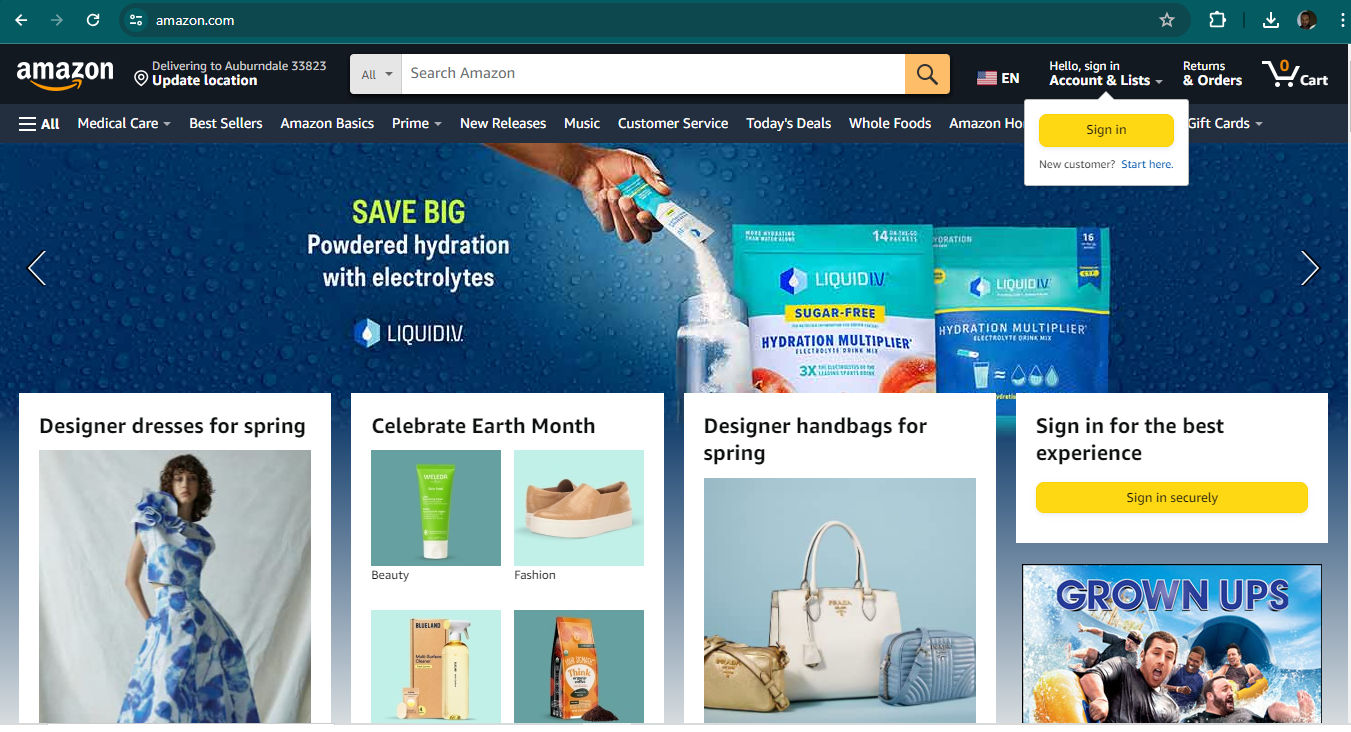
    A screenshot of Amazon.com's home page.

    Amazon’s site captures the essence of UX ecosystems well with its grasp of how its many users encounter the brand and the various qualities, services and more that they expect.

    © Amazon, Fair Use

3. Educational and Gamification Elements

  • Language learning platforms: Platforms like Duolingo use gamification to make learning new languages engaging and effective. By scoring users and offering positive reinforcement, they make a stimulating learning environment that encourages both daily engagement and long-term retention. 

  • Digital asset management (DAM): DAM systems unite multiple storage locations for assets—and they create variations at scale for each channel and provide valuable insights into asset usage, too. Integration with systems like Product Information Management (PIM) and e-commerce enhances the DAM’s effectiveness. This shows an application of UX in complex information environments that’s successful. 
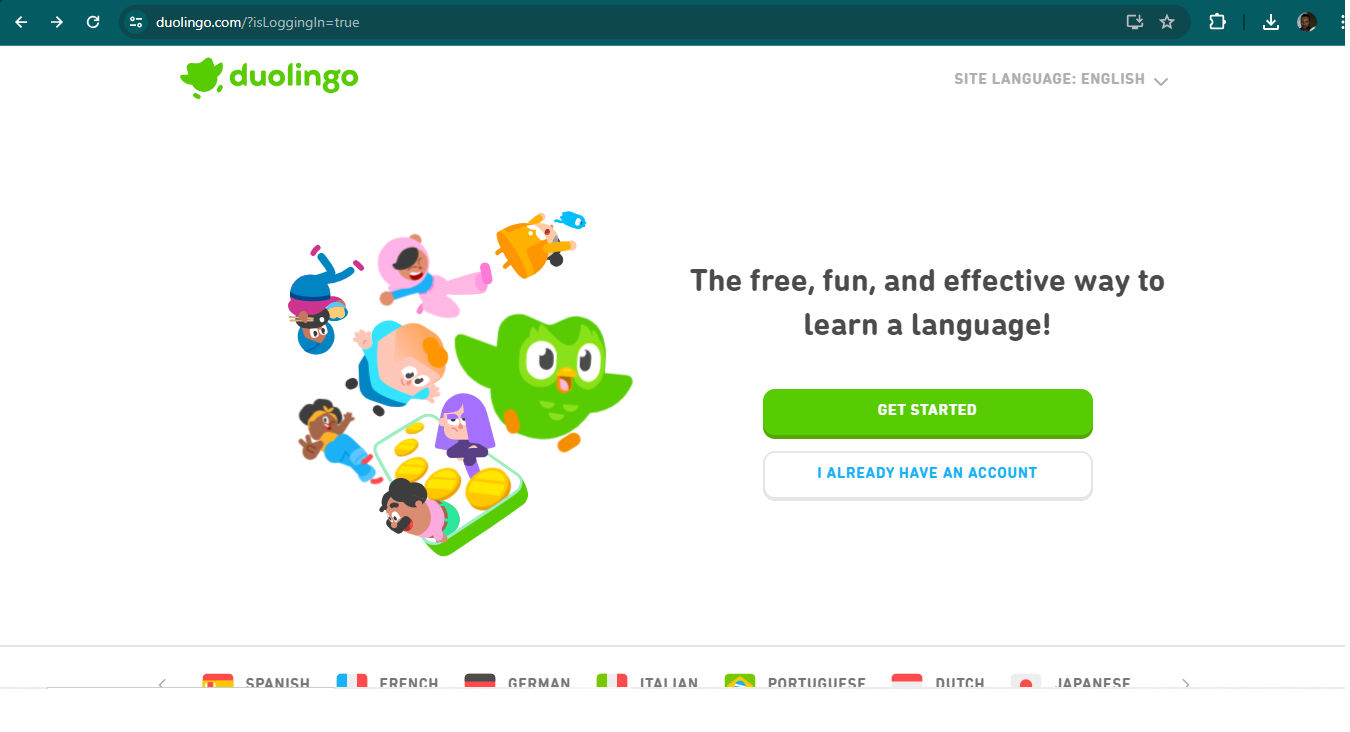
    A screenshot from Duolingo's home page.

    Duolingo leverages gamification to help users learn new languages, appreciating the wide range of contexts and needs of new language learners.

    © Duolingo, Fair Use

Best Practices to Craft UX Ecosystems 

How to design for UX ecosystems? It calls for a strategic and systematic approach. Here are some best practices: 

1. Understand the Ecosystem

Start by getting a really comprehensive understanding of the UX ecosystem. Find all the actors, components and their interdependencies within that ecosystem. 

2. Design for the User 

Always keep the user at the core of the whole design process—and understand the user's needs, behaviors and expectations. Design the ecosystem to cater to them. Do UX research—and thoroughly so—to establish exactly what users would need and expect. 

UX Strategist and Consultant, William Hudson explains the importance of user research

Transcript
 

3. Ensure Consistency

Keep a consistent user experience going across all touchpoints. That includes consistency in design, functionality and information flow. 

4. Facilitate Seamless Transitions

Design the ecosystem to make it easier for seamless transitions to happen between different devices, platforms and interfaces. Make sure that the user can easily switch between different touchpoints—and so they don’t have any disruption. For example, consider a user who’s trying to book a flight on a laptop—but then needs to be on the move and use a smartphone. Make sure they can pick up where they left off with maximum convenience.  

5. Design for Evolution

Keep in mind that UX ecosystems are dynamic and they’re constantly evolving. It’s really important to be ready to adapt and evolve a design to keep up with changes in user needs, technological advancements and other factors that can have an influence. 

6. Test and Iterate

Designers need to continually test their design with real users and iterate based on the feedback these users give. It’ll help designers spot and address any issues or gaps in the user experience. 

William Hudson explains important dimensions of usability testing

Transcript
 

When designers approach the problem and solution space properly, they can create robust UX ecosystems that aren’t just functional and user-friendly but also sustainable and adaptable to future advancements and changes in user behavior

Overall, it’s important for designers and brands to envision the realities of their users and be mindful of how no designed part should exist in a vacuum. Rather, they should remember to meet their users’ expectations and needs as they move through their user flows or customer journeys. When designers do this—and do it well—they help establish their brands firmly as being more relevant, helpful and desirable to the users who engage with them and come back for more. 

Questions About UX Ecosystems?
We've Got Answers!

How does a UX ecosystem differ from a UX design?

A UX ecosystem encompasses all elements that affect the user experience—and these include internal and external factors. UX design—though—focuses more on creating products that provide meaningful and relevant experiences to users. A UX ecosystem stretches beyond the product to include every touchpoint a user might encounter in their interaction with a brand or system. That includes customer service, physical and digital environments—and even company policies that impact user satisfaction.  

In contrast, UX design has a narrower scope—and it concentrates on the usability, accessibility and pleasure that the interaction provides between the user and the product. It involves processes like user research, prototyping, usability testing and final design implementation. All of these are for the purpose of enhancing the user's interaction with a specific product. For instance, a well-designed app (UX design) might still end up with a poor user experience if the customer service or company policies (parts of the UX ecosystem) aren’t so strong. 

Watch this video to understand UX design better: 

Transcript
 

Take our User Research – Methods and Best Practices course. 

Transcript
 

How do UX ecosystems impact user experience?

UX ecosystems greatly shape the user experience by integrating all aspects of a user's interaction with a brand—both direct and indirect ones. This system includes every product, service and various touchpoints like customer support, digital interfaces, physical environments and even company policies. The impact of a well-integrated UX ecosystem is profound. When all components work harmoniously, users often enjoy seamless experiences that don’t just meet their immediate needs but build positive long-term relationships with the brand, too.  

This holistic approach helps both to retain customers and to raise their levels of satisfaction. Think about a smartphone brand, for example. If the device operates smoothly, the customer service responsive and the apps user-friendly, users are likely to enjoy a positive experience. If, though, any part of this ecosystem fails—like poor customer service or buggy software—the overall user experience suffers, and it can potentially drive users to head over to competitors. 

See what goes into the seven factors of UX in this video: 

Transcript
 

Take our Master Class How To Design UX That Users Love To Convert Through with Talia Wolf, Founder, GetUplift to understand more about how to access users and customers profoundly. 

How do you map a UX ecosystem?

To map a UX ecosystem, start by identifying every one of the components that impact the user's experience with a brand or product. That includes direct interactions—like using the product itself—and indirect interactions, such as customer service and marketing. 

Here are the steps to map a UX ecosystem effectively: 

  • Identify stakeholders: List everyone who’s involved in the ecosystem—and that includes users, designers, developers, customer service agents and marketers. 

  • Define touchpoints: Pinpoint where and how users interact with various elements of the ecosystem—like websites, apps and physical stores. 

  • Assess connections: Work out how these touchpoints connect to each other—and to the overall objectives of the business. 

  • Analyze impact: Evaluate how each touchpoint affects the user experience—think about factors like usability, satisfaction and emotional response. 

  • Visualize the map: Create a diagram that can visually represent the relationships and flows between all of the ecosystem’s elements. 

When you map a UX ecosystem, you can see the big picture of how different elements have an influence on the user experience. That will help you spot which strengths to enhance—and which weaknesses to address—aiming for a more cohesive and satisfying user journey all around. 

Watch as Frank Spillers explains user journeys from a service design perspective: 

Transcript
 

Take our Service Design: How to Design Integrated Service Experiences course.  


What role do stakeholders play in a UX ecosystem?

It’s a crucial one—they have a direct bearing on how users experience products and services. These stakeholders can include anyone from designers and developers, to managers and customers—and each group contributes in a different way:  

  • Designers and developers: They create and refine the user interface and functionalities—and they focus on ease of use, accessibility and aesthetics.  

  • Business leaders: These individuals make strategic decisions that shape the project's direction and priorities—and they often determine budget allocations and project scopes.  

  • Marketing teams: They communicate the product's value to potential users and collect user feedback—something that’s vital for iterative improvements.  

  • Customers and users: By providing feedback—whether through direct testing or indirect usage patterns—these people guide ongoing development and refinement of the product.  

  • Support staff: Their interactions with users can shed insights regarding user satisfaction and areas that need improvement.  

Each stakeholder brings a unique set of perspectives and skills to the table. They drive the ecosystem's success as they make sure the product doesn’t just function well but meets user expectations and raises the overall satisfaction levels, too. Effective collaboration among these stakeholders is a vital thing for designers to fashion a seamless and engaging user experience. 

Take our Master Class How To Deal With People Who Don't Get Design with Morgane Peng, Design Director at Societe Generale. 

Transcript
 

How do UX ecosystems evolve over time?

UX ecosystems evolve over time as technology advances, user needs change and businesses adapt to new market conditions. This evolution has several key factors involved:  

1. Technological innovation: New technologies can change how users interact with products—and radically. For example, the rise of smartphones fundamentally changed the way designers think about web and app interfaces. And the continuing rise of artificial intelligence (AI) may lead to important new UX ecosystem developments, too. 

2. User feedback: Continuous input from users helps identify what works—and what doesn't work. This feedback drives updates and improvements to make sure the ecosystem really can meet user expectations and needs effectively.  

3. Market trends: As trends emerge, companies must adapt their UX strategies if they hope to stay competitive. This might mean that they bring in elements like voice control or augmented reality—elements that are in line with user interests and industry directions.  

4. Business goals: Changes in a company's objectives can lead to shifts in UX priorities, too. And if a business decides to enter a new market—or target a different demographic—its UX ecosystem must evolve to accommodate these strategic shifts.  

5. Regulatory changes: New laws and regulations can call for changes in how companies handle user data and privacy, and these can have a huge impact on UX designs and practices. 

As these factors interplay, the UX ecosystem continuously refines itself to serve users and support business goals in better ways. This dynamic evolution is something that makes sure that user experiences remain engaging, relevant—and effective over time. 

Watch our Master Class How to Design with and for Artificial Intelligence with Daniel Rosenberg, UX Professor, Designer, Executive and Early Innovator in HCI. 

What are the biggest challenges when managing a UX ecosystem?

There are big challenges involved there—regarding how to:  

  1. Align stakeholder goals: Different stakeholders often have varying priorities and objectives—and to get these aligned so you can be sure of a cohesive user experience is something that can be tricky. 

  2. Make sure things are consistent across channels: To make sure of a consistent user experience across multiple platforms and touchpoints—from mobile apps to physical stores—it takes meticulous planning and execution.  

  3. Keep up with technology: Rapid technological advancements mean that UX ecosystems has got to continually adapt and incorporate new tools and practices—a fact that can strain resources.  

  4. Integrate user feedback: To collect and integrate user feedback into the UX design process is critical but challenging—that’s because it involves constant monitoring and responsiveness to user needs.  

  1. Ensure scalability: As a business grows, there’s a challenge if it wants to scale the UX ecosystem to accommodate more users, increased traffic and expanded services—without losing quality.  

  2. Make sure of compliance with regulations: To stay compliant with laws and regulations regarding privacy, accessibility and data protection while keeping a user-friendly experience can be complex and take resource-intensive effort.  

These challenges require strategic planning, ongoing communication among team members and a flexible approach to design and development, to maintain an effective and user-friendly UX ecosystem. 

Watch as UX Designer, Author, Speaker and Podcaster, Darren Hood explains important points about UX maturity: 

Transcript
 

Take our Master Class Evaluating Your UX Maturity: Limits and Opportunities with Frank Spillers, CEO at Experience Dynamics.

How do you align business goals with UX ecosystem strategies?

To align business goals with UX ecosystem strategies requires a structured approach that ensures both aspects support each other effectively. Here’s how you can achieve this alignment:  

  1. Define clear objectives: Start by clearly defining your business goals and UX objectives. Understand what you aim to achieve from a business perspective—such as increased sales or market expansion—and from a UX standpoint, like improved user satisfaction or engagement. 

  2. Involve stakeholders early: Include stakeholders from various departments—for example, marketing, product development, customer service—early in the planning process. This helps gather diverse insights and makes sure that the UX strategy supports broader business objectives.  

  3. Conduct user research: Use user research to understand your customers' needs and preferences. This data makes sure that the UX strategies don’t just enhance the user experience but drive users towards actions that align with business goals, too.  

  4. Prioritize features based on goals: Identify which features of your product or service are most important for achieving your business goals—and focus your UX efforts on enhancing these areas.  

  1. Measure and adjust: Measure the outcomes of your UX initiatives against your business goals, continuously. Use metrics like user engagement, conversion rates and customer satisfaction to assess how effective things are and make necessary adjustments.  

Take our Master Class Win Clients, Pitches & Approval: Present Your Designs Effectively with Todd Zaki Warfel, Author, Speaker and Leadership Coach. 

Transcript
 

What is the difference between a UX ecosystem and a service blueprint?

A UX ecosystem and a service blueprint both focus on user experience but from different perspectives. 

A UX ecosystem refers to the overall experience a user has with a brand—and that includes every touchpoint and interaction, whether it’s direct (like using a product) or indirect (such as seeing an advertisement). It considers all aspects that have an influence on a user's perception and their interaction with a brand—these include digital tools, physical environments and customer service. 

A service blueprint—though—is a specific tool that design teams use, one with which they plan service processes and interactions. It maps out the visible customer interactions and the behind-the-scenes actions that support them. This blueprint helps designers and managers understand how service delivery occurs. It highlights areas for improvement or innovation. Typically, it includes customer actions, frontstage (employee) actions, backstage actions and support processes. 

The main difference is scope and application: The UX ecosystem encompasses the entire set of experiences around a product or service, while a service blueprint focuses on the detailed operational aspects of service delivery within that ecosystem. 

Take our Service Design: How to Design Integrated Service Experiences course.  


How do touchpoints interact within a UX ecosystem?

In a UX ecosystem, touchpoints are the various moments where users interact with a brand or product. These interactions might happen across different mediums—like websites, mobile apps, customer service calls and physical store visits—and the way these touchpoints interact within a UX ecosystem is crucial for a brand to deliver a seamless user experience.  

  1. Connection: Touchpoints connect through the user journey. For example, a user might discover a product through an online ad—that’s the first touchpoint—visit the website for more information—the second touchpoint—and then use a mobile app to make a purchase—third touchpoint.  

  2. Consistency: Consistency across touchpoints makes sure that users receive the same message and level of service, whether they’re interacting online or in person. This helps to build trust and really reinforce the brand identity. 

  3. Feedback loop: Touchpoints create a feedback loop, too. User interactions at each touchpoint can generate data that informs improvements to make in other areas of the ecosystem. For example, common issues reported in customer service calls can lead to changes in the website design or app functionality.  

  4. Integration: Effective touchpoints are fully integrated—meaning that information flows smoothly from one to another. If a user fills out information on a website, that information can pre-populate in the mobile app—and so simplify the process and enhance the experience, too. To understand and optimize the interaction of touchpoints within a UX ecosystem is a key way to boost the overall user satisfaction—and loyalty. 

Take our Service Design: How to Design Integrated Service Experiences course.  


How can one integrate artificial intelligence into UX ecosystems?

It’s possible—by automating processes, personalizing interactions and improving usability. Here’s how AI can play a role:  

  1. Personalization: AI analyzes user data—such as browsing habits, purchase history and preferences to offer personalized recommendations and content. This makes the user experience more relevant and engaging.  

  2. Automation: AI automates routine tasks—like answering frequently asked questions through chatbots. This frees up human resources for more complex issues—and it improves response times for user inquiries.  

  3. Predictive analytics: AI uses historical data to predict future user behaviors. This insight lets designers anticipate user needs and refine the UX—proactively rather than reactively.  

  4. Accessibility: AI enhances accessibility features, like voice recognition and predictive text—and so make digital products more accessible to people with disabilities.  

  1. User testing and feedback: AI tools can simulate user interactions and predict how changes in the UX design might have impacts on user behavior. This permits more rapid and efficient testing before implementing changes. 

See why accessibility is vital in design: 

Transcript
 

Take our AI for Designers course. 

Transcript
 

What are highly cited scientific articles about UX ecosystems?

1. Benyon, D., & Resmini, A. (2017). User Experience in Cross-channel Ecosystems. In Proceedings of the British HCI Conference 2017.  

This publication has been influential in the field of UX ecosystems as it explores the concept of "cross-channel ecosystems"—and how user experience can be designed and understood within these complex, interconnected environments. The paper examines the idea of "blended spaces"—where physical and digital elements are combined, and how this impacts the overall user experience. It provides a framework for considering the various components that make up a UX ecosystem—and these include place, context and information architecture. By taking a holistic, systems-level view of user experience, this publication has helped shape the understanding of UX ecosystems as an important area of study and design practice. 

2. Dahlén, M., Murray, M., & Nordenstam, S. (2004). An empirical study of perceptions of implicit meanings in world wide web advertisements versus print advertisements. Journal of Marketing Communications, 10(1), 35-47.  

This publication has been influential in the field of user experience (UX) ecosystems as it compares the perceptions of implicit meanings in web-based advertisements versus traditional print advertisements. The study examines how the digital, interactive nature of web-based advertising can shape user perceptions and experiences differently than static print ads. By exploring these differences, the publication provides insights into how the broader digital ecosystem—including various channels and platforms—can impact the overall user experience. This understanding is crucial for designing cohesive and effective UX ecosystems that seamlessly integrate various touchpoints and mediums. The findings highlight the importance of considering the unique characteristics of digital environments when crafting user experiences that span across channels and platforms. 

3. Hess, S., Braun, S., Feldhaus, J., Hack, M., Kiefer, F., Magin, D., Naab, M., Richter, D., Lenhart, T., & Trapp, M. (2015). Building Mobile Software Ecosystems - A Practical Approach. In M. Kurosu (Ed.), Human-Computer Interaction: Users and Contexts (pp. 165-177). Springer International Publishing.   

This publication has been influential in the field of UX ecosystems as it presents a practical approach for building mobile software ecosystems (MSEs). The authors emphasize the importance of providing an excellent user experience within these complex, interconnected environments. They introduce methods such as "mPOTENTIAL" and "mConcAppt" to assess the mobility potential of an application domain and ensure the expected user experience, respectively. The chapter also discusses the challenges of sharing data and maintaining consistency across multiple apps within an MSE. By addressing these key considerations, the publication offers valuable insights for designers and developers who aim to make cohesive and user-centric mobile ecosystems. The practical nature of the approach and the real-world case study examples make this an influential contribution to the understanding and design of UX ecosystems.  

What are some highly regarded books about UX ecosystems?
  1. Levin, M. (2014). Designing Multi-Device Experiences: An ecosystem approach to user experiences across devices. O'Reilly Media.  

Designing Multi-Device Experiences by Michal Levin is a pivotal resource in understanding the integration of user experiences across a variety of devices, such as smartphones, tablets, PCs and TVs. This book introduces the concept of the 3Cs—Consistency, Continuity, and Complementarity—which are crucial for creating a seamless user experience in today’s multi-device world. Levin explores how these elements work together to ensure that interactions are intuitive and coherent across different platforms, enhancing the user’s overall engagement and satisfaction. The book is particularly influential for designers and developers looking to create cohesive experiences in an era where users frequently shift between devices to complete tasks. It offers practical insights and case studies that demonstrate how to effectively implement multi-device design strategies in real-world applications. 

  1. Youngblood, M., Chesluk, B., & Haidary, N. (2020). Rethinking Users: Design and Ecosystem Thinking. BIS Publishers.  

Rethinking Users: Design and Ecosystem Thinking is a transformative book that offers a fresh perspective on user-centered design. The authors, Michael Youngblood, Benjamin Chesluk and Nadeem Haidary, challenge traditional notions of “the user” by advocating for a more complex and interconnected approach to design. This book is particularly influential because it introduces a toolkit that includes a set of user archetype cards and activities aimed at fostering new ways of thinking about users and their interactions with products and services. It's an essential read for designers, strategists and innovators who seek to understand and implement user-centered thinking in a world where technological interconnectivity is the norm. The inclusion of practical tools and activities makes it a really valuable resource for applying theoretical concepts in real-world scenarios—pushing the boundaries of how we conceptualize and cater to users in diverse ecosystems. 

Earn a Gift Earn a Gift, Answer a Short Quiz!

1
2
3
4
1
2
3
4
Question 1
Question 2
Question 3
Get Your Gift
Interaction Design Foundation logo

Question 1

What makes up a UX ecosystem?

1 point towards your gift

  • Only digital interfaces like websites and apps.
  • A network of interactions across physical and digital touchpoints.
  • Isolated user experiences with specific devices.
Interaction Design Foundation logo

Question 2

Why is consistency important in UX ecosystems?

1 point towards your gift

  • It ensures users do not need to explore new designs.
  • It helps maintain brand identity and builds user trust.
  • It limits the need for user feedback.
Interaction Design Foundation logo

Question 3

How does user feedback improve a UX ecosystem?

1 point towards your gift

  • It reduces the need for further testing.
  • It provides insights that help refine and evolve the ecosystem.
  • It helps avoid innovation in design.

Learn More About UX Ecosystems

Make learning as easy as watching Netflix: Learn more about UX Ecosystems by taking the online IxDF Course Service Design: How to Design Integrated Service Experiences.

Why? Because design skills make you valuable. In any job. Any industry.

In This Course, You'll

  • Get excited when you learn how to turn everyday services into seamless experiences people love. Service Design helps you make life better for others and more fulfilling for yourself by applying timeless human-centered design skills to everyday services. Whether you help people book a flight, order takeout, or use government services, every interaction matters. Service Design is valuable to everyone, in all jobs and industries, because every role involves creating, improving, or interacting with services in some way. As automation and AI take over more of the technical execution, you stay in demand when you can understand the full service from the human side and decide where improvements actually matter. Whether you're designing customer experiences, improving internal workflows, or streamlining processes, you'll create smoother, more efficient, and more people-friendly interactions. You'll learn the Service Design secrets used by brands like Amazon, Disney, and Southwest Airlines.

  • Make yourself invaluable as the go-to expert in a field where 1 in 3 leaders admit they're in the dark. With 82% of people happy to pay more for great service, this is your chance to stand out and bring in those profits left on the table. With Service Design skills, you'll improve the customer experience, optimize workflows, and save time and resources. Your efforts will pay off in increased revenue, customer loyalty, and recognition—a win for your users, your company, and your career. Why? Because people love smooth, thoughtful service—and so do businesses. You'll create more love, more impact, and the kind of salary that reflects your value. With step-by-step guidance and real-world case studies, you'll apply your skills right away.

  • Gain confidence and credibility as you build a research foundation with journey mapping, role-based personas, and service safaris. You'll work with lifecycle maps, ecosystem maps, and service blueprints as you prototype. You'll master the Business Model Canvas and learn how to connect service design decisions to business goals and strategy. With over 30 downloadable templates, you'll easily apply what you've learned to your own work. Showcase your ability to lead and collaborate on Service Design initiatives with an optional portfolio-ready project.

It's Easy to Fast-Track Your Career with the World's Best Experts

Master complex skills effortlessly with proven best practices and toolkits directly from the world's top design experts. Meet your experts for this course:

  • Frank Spillers: Service Designer and Founder and CEO of Experience Dynamics.

  • David Bill: Interaction Designer who led service design for five U.S. federal agencies at Booz Allen Hamilton before driving innovative design solutions as a Senior UX Designer at Amazon Web Services (AWS).

  • Kendra Shimmell: Vice President of Design at Remitly and former Senior Director of Research and Central Science at Twitch (Amazon).

Get an Industry-Recognized IxDF Course Certificate

Increase your credibility, salary potential and job opportunities by showing credible evidence of your skills.

IxDF Course Certificates set the industry gold standard. Add them to your LinkedIn profile, resumé, and job applications.

Course Certificate Example

Be in distinguished company, alongside industry leaders who train their teams with the IxDF and trust IxDF Course Certificates.

Our clients: IBM, HP, Adobe, GE, Accenture, Allianz, Phillips, Deezer, Capgemin, Mcafee, SAP, Telenor, Cigna, British Parliament, State of New York

All Free IxDF Articles on UX Ecosystems

Read full article
Align business and design because all user-brand touchpoints matter! – UX Ecosystem Design Part II - Article hero image
Interaction Design Foundation logo

Align business and design because all user-brand touchpoints matter! – UX Ecosystem Design Part II

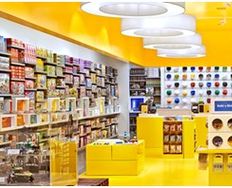
What brand comes to your mind when looking at the image above?Lego has succeeded in utilizing the power of a holistic user experience design.Designing aholistic user experience means embracing all company components a part of a whole thing. In these cases, no matter the world – digital, physical, hy

Social shares
490
Published
Read Article
Read full article
Making sense of new UX words: A first dictionary for UX Ecosystem Design - Article hero image
Interaction Design Foundation logo

Making sense of new UX words: A first dictionary for UX Ecosystem Design

User experience (UX) is very much about communicating, advocating and spreading. As UX practitioners, we spend a great amount of our time engaged in these types of activities. To help you learn and understand new buzzwords, I have written this article to introduce some of the words related to the Us

Social shares
538
Published
Read Article

Making sense of new UX words: A first dictionary for UX Ecosystem Design

Making sense of new UX words: A first dictionary for UX Ecosystem Design

User experience (UX) is very much about communicating, advocating and spreading. As UX practitioners, we spend a great amount of our time engaged in these types of activities. To help you learn and understand new buzzwords, I have written this article to introduce some of the words related to the User Experience Ecosystem Design. You will see how often different words cover the same terms in slightly different ways. How do you make sense of this?! Well, I suggest that you pick the words that are easier for you to remember, explain and show with examples.

Not that long ago, we had trouble explaining and conveying the importance of usability. Now, even the term "usability" seems outdated. Human-computer interaction has always been very technical. User-centered design (UCD) is closer to the industry and working environment. It is also self-explanatory. However, as humans, we tend to prefer getting our minds around the shortest concepts.Certainly, UCD is not short enough. It is a framework of processes; as such, it shows the end user's wants, needs, and limitations extensively concerning a particular product or service. It is an intricate, multi-stage process for problem solving: hardly the sort of thing that the human mind can comfortably take in. User experience, on the other hand, is just about right in terms of length and is easier to understand. The difficulty with UXis that most people have not yet grasped its real meaning. UX is as much about strategy as it is about design. It encompasses all of a company’s activities. Nowadays, with the ecosystems invasion in full swing, we definitely need to embrace the holistic meaning of UX.

I’m writing this article using Microsoft Word, and the fact that it keeps highlighting its keywords shows the newness of them. Be aware, though: this will soon change. Omnichannel, touchpoint, transmedia, inter singularity, cross-channel, inter-usability, etc. are words that will, most likely, become part of our everyday vocabulary very soon.

Since language molds our understanding, we need to absorb these new words and use them everyday if we want to keep on top of the changes. We no longer live in just the information age. For this new cross-channel, multiplatform, transmedia information age, we need a whole new glossary.

Dictionary: Cross/Multi/Omni-channel UX Design

The first concepts that I want to introduce have to do with the idea that the ecosystem environment has more than one channel. Not so long ago, we were designing for a single component, such as a website. Now, to design an interactive product, we need to take care of several channels that are related to each other.

  • Cross-channel seems to be the oldest term used to define our current environment, where technology has faded into the background and information has become shapeless. Information has also got more contextual, and it just surrounds us - it's everywhere. On our hand-held devices and at our desks, we are swimming in a constant flow of information. You can be anywhere in the physical world and still have your personal, professional, and social worlds in the palm of your hand. Modern living is highly interactive and highly personal.

  • But cross-channel is not alone on this; the same idea goes for multichannel and omnichannel, too. It is about the user having a seamless experience. Whether he or she is using one more screens at the same time on a desktop or mobile device, using a telephone, or is in a traditional bricks-and-mortar store, the experience is one that is smooth and uninterrupted.

  • The well-known User Advocate, Jakob Nielsen, uses the word transmedia design. In discussing this design, he emphasizes the need to create a separate and distinct UI (user interaction) for each device. At the same time, however, it is vital to retain the feel of a product family, ensuring continuity at several levels. These levels (visual, feature, data, and content) are essential for us to identify products in the marketplace and recognize the brands we know and love.

Do you still feel that all this is too far from your everyday life?

UX Ecosystem Design is here, there and everywhere!

Just think about your book shopping experience, or what the airplane ticketing process is like for you. Or, how about when you are doing your banking. How many channels do you use to deal with these sectors? In the old days (not quite all that long ago, though!), the relationship was 1:1; now, we are in the age of the 1:N relationship. The aim is the same: read a book, take a trip, or manage your bank account. But, where we used to have only one way of doing each activity, and spending an expected amount of time doing it, things have changed. Now, there are multiple ways of reading a book, booking a flight, or doing your banking. There are also multiple stages, or moments, involved in each of these processes now.

Most of us can still recall going to the travel agency to buy a plane ticket. It involved going into town and sitting down at an agent's desk. That was not that long ago! At the same time, though, just to show how much has changed in such a short space of time, those three examples I just used - publishing, air travel, and banking - seem quite old to mention as illustrations now. There are plenty of other industries where we can see this idea in action: home automation, transportation, and health and fitness, for example. There are trendier playgrounds for user experience ecosystems now, not just the old traditional conveniences we once marveled at: times have changed indeed.

In 2014, the best example of the new ecosystem came from the Walt Disney Company with their Magic Band, an RFID (radio-frequency identification) wristband. Walt Disney Park guests wear it to get in priority queues for the attractions, pay for their purchases at the concession stands, and they can even get into their hotel rooms with it. This small wearable accessory is part of the My Magic + service. The Walt Disney Company has invested $1 billion in this set of services. As intended, this has completely changed the park experience.


The Magic Band is a simple wristband that guests can also customize with their favorite Disney characters.

Doesn’t Disney and everything that Disney does and touches feel like an ecosystem all of its own? Concerning the parks, the company has always worked hard to make the guests feel like they are “in a whole new world”. This could largely be why guests go there; they have expectations of being catapulted into a whole new world. The users' wants and needs are being met by a signature and standard that only Disney can deliver. The Magic Band is many things in one package: a device, a website, an app, and, above all, a holistic user experience, right there on the user's wrist. The Walt Disney Company created the Magic Band to enable a seamless interaction of channels, systems, and divisions that goes across boundaries smoothly and effectively. It is a good cross-channel UX strategy and design because of this, and all packed into a single wristband!

The term "ecosystem" has its origins in biology and in the rich and complex interaction between animals, plants, natural resources and the environment. As user experience designers, we can easily relate to this idea that nothing exists in isolation and free from the effects of context.

  • Dave Jones, a user experience designer at The Nerdery in Minneapolis, defines a UX ecosystem as, "...a set of interdependent relationships between components within an information environment”. The components are the people, their goals and practices, the digital and analog technologies that they use to connect and share information, and the information they share.

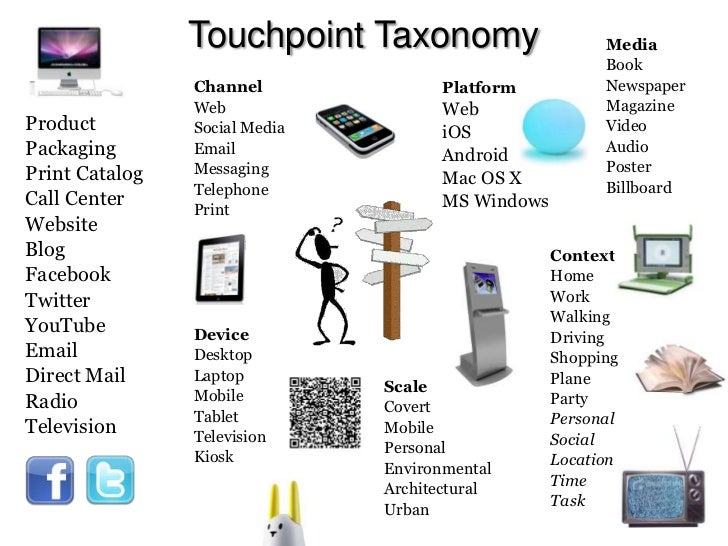
  • This means that they are points of interaction between a business and its end users. Peter Morville, a pioneer in the fields of information architecture and user experience, gives us (in the image below) a touchpoint taxonomy. Although it is not comprehensive, it does make the point that the sheer diversity of products, channels, devices, platforms, scales, media, and contexts is an awesome one.

  • This is where service design comes in handy. It is not just about website or app design; it is about taking into account ALL touchpoints, both in the digital and physical worlds. Service design, with tools such as the service blueprint, the touchpoint matrix, or the customer experience map, is the approach to use in the UX design of ecosystems. If we want to ensure seamless interactions across systems and devices, we need methods and tools that help us point them out and ensure a consistent experience among them.

  • The definition of service design on the Service Design Network website outlines the main characteristics of this “new” type of design. “Service design is the activity of planning and organizing people, infrastructure, communication and material components of a service in order to improve its quality and the interaction between service provider and customers. The purpose of service design methodologies is to design according to the needs of customers or participants, so that the service is user-friendly, competitive and relevant to the customers.”

Service design and the taxonomy of touchpoints

With the ecosystem concept comes the “touchpoint” idea. It is very important to understand that we cannot view these “points” as the components mentioned above. Instead, we must look on them as being key moments of contact between the company and the user.

In a single image, we see the myriad of components that we need to take into account. Yes, it is about user interface and interaction design. However, there is much more to it than that. We also have the topics of inter-usability (a new way of coping with cross-platform design so that the user feels that all his or her devices are working in concert), industrial design, service design, conceptual models, manufacturing and productization, and platform design to consider here.There are others, too.


Author/Copyright holder: Peter Morville. Copyright terms and licence: All rights reserved Img source

Peter Morville created this slide to advocate for cross-channel strategy and the importance of touchpoints.

Doesn’t the definition ring a bell? Isn’t the last sentence also applicable to user-centered design or UX? Indeed, the aim is to tailor the design to the customer.Therefore, the mindset is the same, except that, in the design of services, we consider more components and apply methods and tools conceived to take all touchpoints into account.

Intertwingularity and the cross-channel crystal

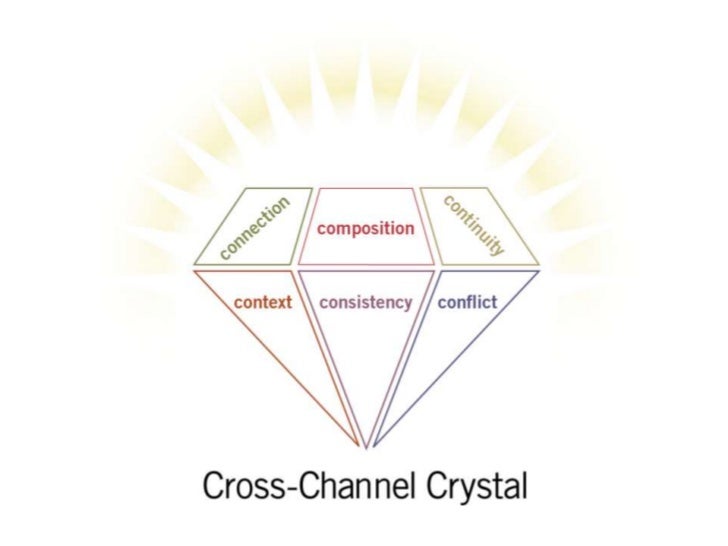
We have briefly outlined a definition of ecosystem design and the techniques related to it. Let’s see some of its design principles now. Seamless interaction is the end goal, but how do we ensure it? Jakob Nielsen mentions continuity at different levels. Peter Morville has put the main aspects in the cross-channel crystal, in which we also find the continuity principle:

Author/Copyright holder: Peter Morville. Copyright terms and licence: All rights reserved Img source

These are Morville’s explanations for each facet:

  • Composition: The mix of platforms, devices, and media (and their features). Is the service multi-channel or cross-channel?

  • Consistency: The company has to balance its brand, features, organization, and interaction perfectly against platform-specific optimization so that there is symmetry between each part.

  • Connection: Bridges across channels (e.g., links, tags, addresses, barcodes, signs, maps) must be visible at the point of need.

  • Continuity: Apps should maintain state, so users can flow between devices while reading books, watching movies, shopping, etc.

  • Context: How will time, location, device constraints, and personal or social context impact usage and user psychology and behavior?

  • Conflict: To address channel conflict and free riding, we may need to realign incentives, metrics, the business model, and the organizational chart.

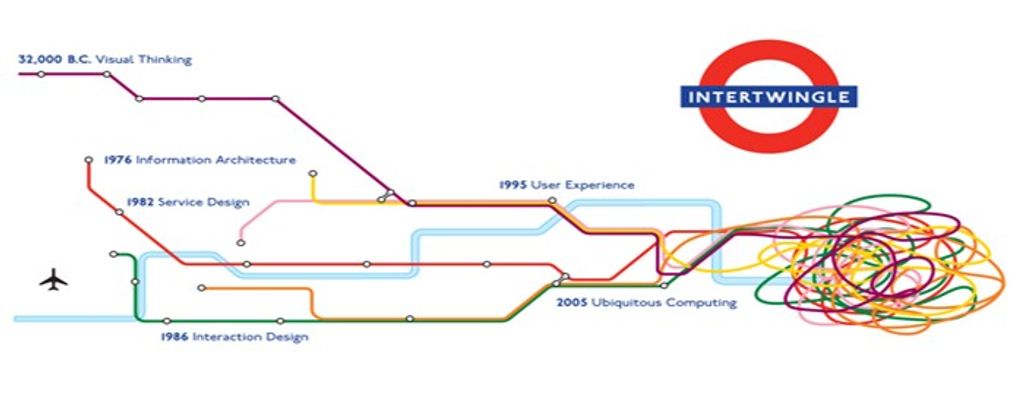
Remember that intriguing image we had at the beginning of the article? After shedding some light over multi-channel strategies and the wide spectrum of service touchpoints, we are now equipped to come full-circle and understand what inter singularity is:

  • Intertwingularity. The American pioneer of information technology, Ted Nelson, coined this term to express the complexity of interrelations in human knowledge. Basically, it refers to the point that, while people believe that they can put an order to information (i.e., categorize it and sort it into sequences, etc.), they actually can't do this. Intertwingularity is all about information being in a kind of flux, where there are no easily found subjects because everything is so cross connected. An example could be a university subject that is multidisciplinary, such as Linguistic Archaeology. There, there are many subjects buried by the complexity of their relationship to one another. Another example is a polyseme - a word with different but still related senses, such as "good" (you can be a good writer, but if you don't do anything else, you may not be a good friend, citizen, etc.). Intertwingularity defines an era at the crossroads of ubiquitous computing and the Internet. In an era where we can interact and access information anywhere and everywhere, we find ourselves at a place where information blurs the boundaries between products and services. It is ironic that the same advancements that enable cross-channel, multiplatform, transmedia, and physico-digital user experiences - things that simplify and improve life for us - are subject to inter singularity. Perhaps that is the price of sophistication.

I hope that this short dictionary helped you make sense of all the closely related words in the User Experience Ecosystem Design. Which one is your personal favorite and why? Do you keep your own UX dictionary?

Keep in mind that this is just the beginning! We are now setting the stage as we adapt our mindsets to something new. Next, we will have to get to know and get some practice with the methods and techniques we will need. For now, just watch this space!

References:

Feel Stuck?
Want Better Job Options?

AI is replacing jobs everywhere, yet design jobs are booming with a projected 45% job growth. With design skills, you can create products and services people love. More love means more impact and greater salary potential.

At IxDF, we help you from your first course to your next job, all in one place.

See How Design Skills Turn Into Job Options
Privacy Settings
By using this site, you accept our Cookie Policy and Terms of Use.
Customize
Accept all

Be the One Who Inspires

People remember who shares great ideas.

Share on:

Academic Credibility — On Autopilot

Don't waste time googling citation formats. Just copy, paste and look legit in seconds.