What brand comes to your mind when looking at the image above?
Lego has succeeded in utilizing the power of a holistic user experience design.Designing aholistic user experience means embracing all company components a part of a whole thing. In these cases, no matter the world – digital, physical, hybrid –, the interaction or the devices, everything is considered user-brand touchpoints. Powerful and uncommon at the same time! Now, take a few moments to think of 5 brands that provide a seamless experience between all your interactions with it. I’m sure that you will come up with less than a handful of companies.
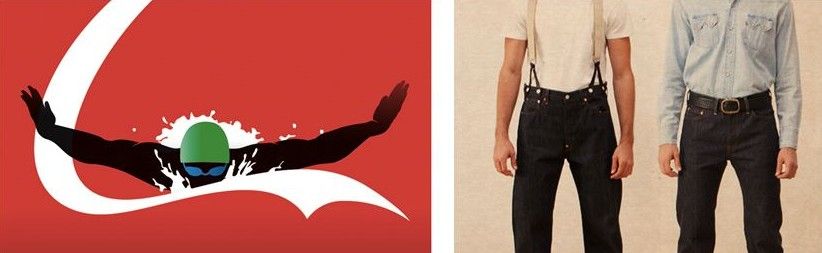
Let’s see: you most probably have thought of Apple. And outside the technology arena?Maybe Coca-Cola and Levi’s? An easy way to recognize these brands is when you see an ad and – before seeing the logo - you can guess the brand that it belongs to. Although this does not necessarily mean that they provide great user experiences across all touchpoints, they have for sure aligned their brand efforts.
Author/Copyright holder: Coca-Cola and Levis. Copyright terms and licence: Fair Use
The fact that our unconscious maps the red and white to Coca-Cola or the old-fashioned style to Levi's is an example that these companies have succeeded in creating a brand ecosystem
How does Lego manage to make you feel inside a set of Lego bricks when walking into one of their stores? From a company culture point of view, this holistic user experience can only happen if there is an organization-wide alignment. What about Amazon and Google? The reality is that a good user experience (UX) across and among all components of an ecosystem is very hard to achieve and even the brands that are best at it often have some breakdowns; like when you spend several minutes figuring out iTunes or Google releases a new user interface for their Drive app. There are so many elements at some many levels that it is very easy to miss some. However with this “user experience ecosystem design” series we point out concrete aspects to help you as a designer.
The Secret of Inventing the Future of Play
The secret of Lego is a combination of a strong and clear mission - inventing the future of play–with hard work and continual research into its customers and how to provide innovative products.As a result, Lego has grown into nothing less than the Apple of toys; a profit-generating, design-driven company built around intuitive hardware with lasting fans always wanting for more.But this has not always been the case.
The word “lego” is an abbreviation of two Danish words that mean “play well.” In Latin: “I put together”. Do you know that you can put together your current Lego bricks with those from the first Lego set in 1949 and all those produced in between? To us, this is a great proof of a solid mission carried over almost for 100 years now (Lego was created in 1932).
But it has not always been easy for Lego to align business and design. Between 1993 and 2004 Lego struggled to survive and solve their two main problems at the time: 1) Lego had reached its natural growth cycle and 2) the lack of connection between its innovation and its business goals.Since the business and creative teams were operating in silos, each department worked in different directions and with no communication between them.This lack of alignment between business and creativity led to the wrong choice of new products, such as short-term successes related to the hype of specific movies like the Harry Potter and Starwars lines, and generated losses. In order words, it made Lego go astray. As a result, the company laid off 1,000 employees, and Kjeld Kirk Kristiansen –son of the Lego founder - stepped aside to leave the place to a new president.
Building Organization-Wide Alignment
2004 marked the start of a new era for Lego. An era based initiated with the relinking of creativity and business. Lego’s Shared Vision strategy – a seven-year-old plan established then–facilitated this link and placed the process of innovation at the core of the organization. It brought the creative team out of its silo and connected it to the company’s business goals, creating a company-wide strategy. As a result, Lego 's strategy was back to life, with products that met both creativity and business needs.
As part of this new vision, the company created the Design for Business (D4B) model. This model provided a unique management process, allowing for design and innovation to be more holistically integrated in the organization; which in turn allows for a holistic user experience. As summarized in the D4B poster, design for business to:
to improve the contribution of design to business
by increasing its effectiveness & efficiency without losing creative power
with a series of related tools & processes including coaching & implementation
for management team, development teams and designers
That is: design is at the company core and affects and is affected by all departments and employees to make the most of the creative power.With the implementation of this model, user research brought the next missing link: the gap between marketing and the creative teams.
User research “in the jungle”
In 2007, Lego started to run deep ethnographic studies of how kids around the world really play. If you want to invent the future of play, you need to find out what is the present of play. Therefore, following the quote “if you want to understand how animals live, you don’t go to the zoo, you go to the jungle”, Lego started working on a real design-thinking approach to innovation.
This research has led to the launch in 2011 of Lego Friends, the crowdsourcing site Lego Ideas and Lego Fusion.Lego Friends – with its pink and purple colors – has tapped into the role-playing mode more often present among girls; thus increasing the number of customers that wanted to buy Lego products.
Lego Fusion was conceived from user research insights: kids no longer make meaningful distinctions between digital play and physical play. Although the Fusion series is now discontinued, the company is working on “One Reality”, a line of work that emphasizes novel hybrid digital-physical Lego experiences that combine playing with bricks alongside with software running on a phone, tablet, or computer.
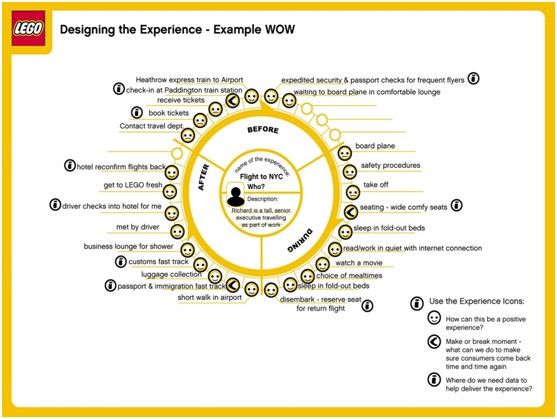
The success of these products and those like Lego Architecture or the Lego Movie are all examples of a fully aligned company during all moments and aspects of the user experience.A clear focus does not prevent the company to innovate in diverse products but ensures that they are all working towards the same goal. Lego encompasses a holistic user experience strategy backed-up by continuous user research and followed by a cross-channel UX design; each component is designed as an individual but interdependent piece. For this purpose, the company uses internal conceptualization and communication tools such as the “customer experience wheel” (see the image below).
Author/Copyright holder: Unknown. Copyright terms and licence: Unknown
The Lego experience map is one of the many forms used to build a customer journey map.
The Lego Customer Experience Wheel
While this wheel is just one of many tools and processes from Lego, we bring it in because it is a clear and visual example of what the holistic user experience means. The wheel below visually represents the experience of an executive visiting LEGO. Have a thorough look at it before moving on.
Let’s take our surgery tools and dismantle the wheel:
The wheel is divided evenly in 3 parts. If we are designing for the visit of an executive at Lego, why are we looking at the experience at the airport and the hotel? And giving even more importance to the “before” and “after” together than to the “during”? Well, because for that person the experience involves all these steps and all of them will affect how he feels about the visit.
The user is at the epicenter; it is not “someone’s” experience but Richard’s experience; who represents a specific user profile.
Gaps or breaks during the experience are noted. These are not “breakdowns” but moments in which the user loses contact with the brand and can decide to walk away.
The wheel is data-driven. Moments for which data is available are noted. Thus,real user data informs design.
Each step of the holistic experience is individually evaluated. You might think: it does not matter if the experience is not that great at some point. Well, definitely yes, since this negative experience is carried over the next step and sets the user expectations for what will come next.
How much information and power ingrained in a simple wheel, right? As much as a lamp in the form of a Lego brick part. Did you notice this detail when looking at the Lego store image?Both the wheel and the lamp are examples of how Lego curates every detail individually and also as part of a whole.
Experience maps and customer maps are used to convey all this information and much more because a seamless user experience requires an analytic look into all possible hem and pieces. Whether you prefer the idea of cross-channel or ecosystem, the evolution of technology means bringing in more devices and therefore more contexts and people to play. To avoid cracks, align your organization and work towards a holistic user experience.
Related links:
Learning More About Creativity And Innovation From LEGO:http://www.smashingmagazine.com/2014/08/learning-creativity-innovation-from-lego/
When Apple Became the Apple of Toys: http://www.fastcompany.com/3040223/when-it-clicks-it-clicks
The Lego History:http://www.lego.com/en-us/aboutus/lego-group/the_lego_history
Check the first article of the series: /ux-daily/670/user-experience-ecosystem-design-part-i.
Header Image: Author/Copyright holder: LEGO Group. Copyright terms and licence: All rights reserved. Img