Ecosystem Maps

Your constantly-updated definition of Ecosystem Maps and collection of videos and articles.
Be a conversation starter: Share this page and inspire others!

295 Shares

What are Ecosystem Maps?

Ecosystem maps are tools that designers create to understand the relationships and dependencies between the various actors and parts that contribute to creating customer experiences. An ecosystem is these actors, parts and dynamics. The maps reveal areas to optimize in services to deliver the best customer experiences.

“Our competitors aren’t taking our market share with devices; they are taking our market share with an entire ecosystem.”

— Stephen Elop, CEO of Nokia

See how to get the clearest view of everything that goes into—and on in—services via ecosystem maps: 

Transcript

Ecosystems are Like Theaters, Custom-made for Customers

In service design, it’s critical to understand how the various actors and parts come together to build the “theater” where a service plays out, using all the items (“props”) required, and help make the service perform best for customers. Structurally, an ecosystem consists of:

  • The actors who collectively create the customer experience – including the employees and contractors, on the frontstage and backstage.

  • The practices they perform – the services or value they deliver to customers.

  • The information they require, use or share to contribute their parts of the service.

  • The people or systems these actors interact with to play their roles.

  • The services available to them – i.e., to ancillary (supporting) organizations such as carriers.

  • The devices they use – e.g., smartphones.

  • The channels they communicate through – e.g., email.

Ecosystem maps show your service as a system and how that entire system is connected. They’re like personas in terms of their value and how they represent your service as a “living” entity. When you map out how all the actors, ancillaries, information and the other components work together currently, you can spot areas to improve. There could be disconnects that keep information from flowing properly between (e.g.) the store that should have processed orders and the app that wrongly told customers these were ready for pickup.

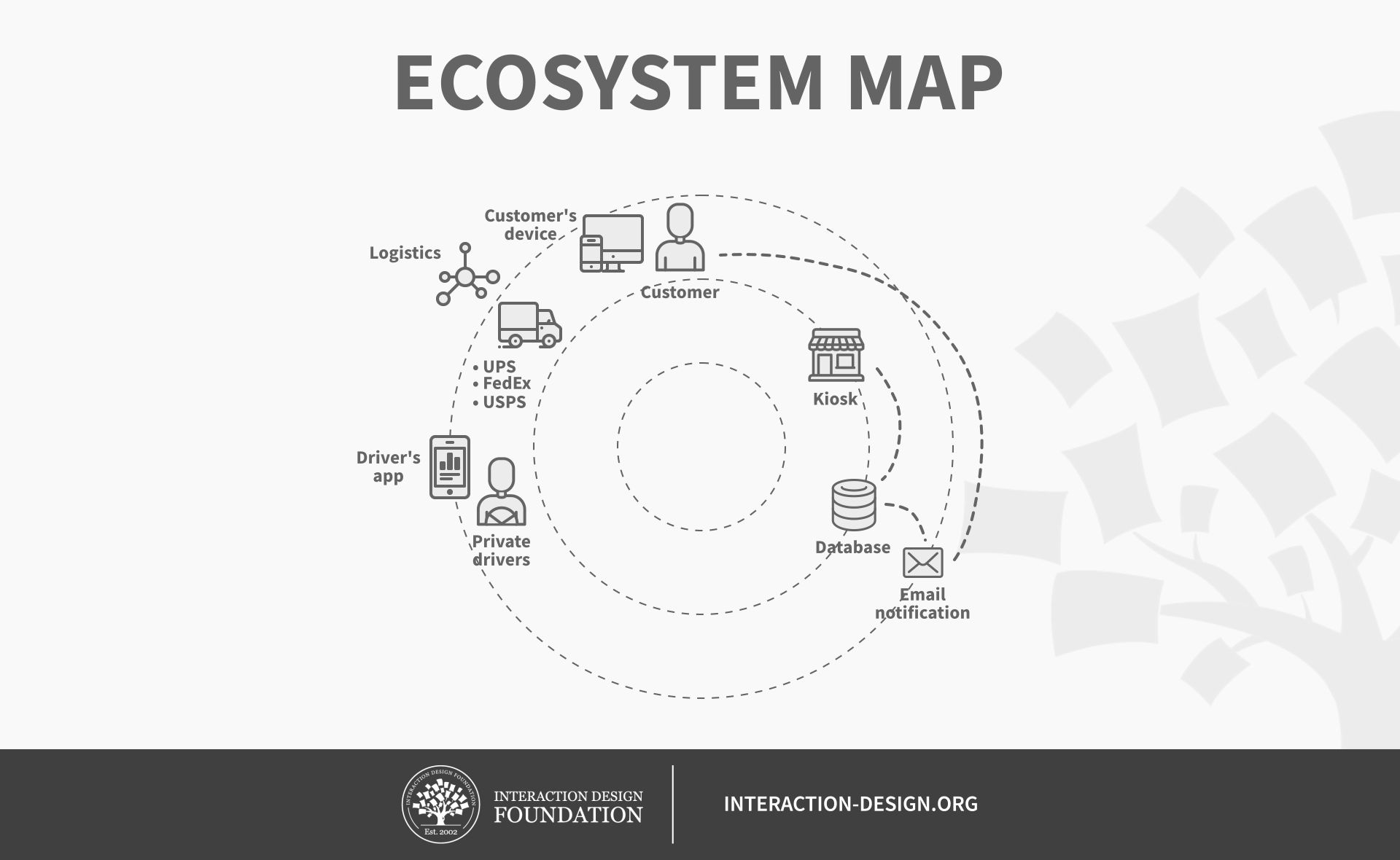
For example, Amazon’s ecosystem (from a delivery perspective, depicted below) includes:

  • Delivery services and vehicles.

  • A database.

  • Email notification.

  • Logistics happening behind the scenes.

The actors, devices, infrastructure and other elements interplay to support the best customer experiences. It’s vital to understand the ecosystem as more than the sum of its parts; the dynamics and connections between the parts are crucial to the service’s—and business’s—health. From your own ecosystem maps, you’ll likely find breakpoints: anywhere where the “left hand” doesn’t know what the “right hand” is doing, and the “magic” fails to delight customers.
© Frank Spillers and Experience Dynamics, CC BY-SA 3.0

How to Create Ecosystem Maps

Map out everything the service needs to work:

  1. List all roles/actors that help make it functional – E.g., employees, suppliers and contractors. 

  2. For each role, consider what they do, how they do it and what they need to do it. Include these sorts of things: 

    • Practices they perform (services/value they deliver) 

    • Information they need, use/need to use, or share 

    • People/systems they interact with 

    • Services available to them 

    • Devices they use 

    • Channels through which they communicate

  3. Place your service in the middle and the most important actors/roles close by. Draw as many circles as required; add each role or actor to the image, moving outwards for supporting actors/roles. If your system is complex, try grouping the roles/actors along the circle according to what role they play in relation to your service. 

  4. Consider how each actor depends on the other actors and draw lines of dependencies between them. This will show how actors must collaborate, and expose any breaks in your ecosystem.

As a group activity (recommended): Since ecosystem maps are often complex, it’s better to create them as a team to ensure you cover all actors/parts, like so: 

  1. Everyone draws a map of the current ecosystem from their point of view. 

  2. Everyone presents their map to the group; together the group notes similarities and differences.

  3. Post the individual maps on a wall and draw connections between them. 

  4. Combine the individual maps into one coherent map; use it to help create a service blueprint.

Tips

  • As with lifecycle maps, well-made ecosystem maps give an accurate overview where you can zoom in on specific areas. So, ensure you understand the details of how the various parts of your service work together and what each one involves. An oversimplification of just one part (e.g., a database) might make you overlook potential opportunities for improvement, or cause potentially costly oversights.

  • Because ecosystem maps should reveal services as functioning real-world entities, they can quickly expose problem areas. However, ecosystems can be highly complex; so, be careful that when you find a problem you don’t isolate it as a symptom to address—instead, look at the big picture cause-and-effects-wise. The smallest inappropriately considered change in one area can cause unforeseen repercussions.

  • Although it’s challenging, you can also make a map of a future/ideal service with a view of what, why, how, who, when and where

Overall, your best ecosystem maps will show you how to make the best of everything you have—and handle anything that may arise—when your service performs live in front of your customers.

Photo by 

Questions About Ecosystem Maps?
We've Got Answers!

How does an ecosystem map help in UX design?

An ecosystem map helps in UX design because of how it shows how users, products, services, and systems connect. Because it gives a big-picture view of interactions, it means designers get help in understanding pain points, dependencies, and opportunities.

To make one, you’ll want to start by mapping all key elements—users, touchpoints, tools, and third-party services—and show how they interact and where friction happens. For example, if a customer support system doesn’t sync with the main app, then users might get frustrated repeating information.

An ecosystem map also helps teams spot inefficiencies and streamline user flows. For example, if users switch between multiple platforms, you, as a designer, can simplify their journey and improve their experience and retention.

Another point is how such maps also work as collaboration aids—not least as product managers, developers, and designers get to align goals and identify gaps early. An ecosystem map helps teams see the whole UX landscape early on, and it’s an effective tool you, your design team, and other stakeholders can put to great use towards making products more efficient, connected, and user-friendly.

Watch as CEO of Experience Dynamics, Frank Spillers explains important points about how to map a UX ecosystem:

Transcript

What are the key components of an ecosystem map?

An ecosystem map has several key components to it that show how users, systems, and processes connect, and so there are:

  1. Users and stakeholders—Identify who interacts with the product (or service), and this includes customers, employees, partners, and third-party services.

  2. Touchpoints—Show where users interact with the product or service, and these can be apps, websites, customer support, emails, or physical locations.

  3. Systems and tools—List the platforms, databases, and third-party services that support the user experience, for example, payment gateways, chatbots, and CRM systems.

  4. Relationships and dependencies—Map out how elements connect, and if the checkout system relies on inventory databases, for instance, delays in updates may cause errors.

  1. Pain points and opportunities—Highlight bottlenecks, inefficiencies, and areas for improvement.

A good ecosystem map makes complex interactions clearly, and it will help teams improve UX and fix gaps, too, as it gives such a big-picture view and makes products more connected, efficient, and user-friendly.

Take our Service Design course, featuring an ecosystems map template.

How is an ecosystem map different from a user journey map?

An ecosystem map and a user journey map both help in UX design, but they focus on different aspects.

An ecosystem map shows the big picture—how users, systems, tools, and services connect—and it includes all stakeholders, touchpoints, and dependencies, helping teams understand interactions across the entire system. Businesses use it to find inefficiencies, improve workflows, and align teams to get tighter, more focused group efforts going on projects.

A user journey map, meanwhile, focuses on one user’s experience with a product or service. It shows their steps, emotions, and pain points from start to finish. This map helps designers improve specific interactions and make experiences smoother.

So, the ecosystem map covers multiple users and systems (so, more guiding business strategy), while the journey map tracks one user’s path (more about improving the user experience itself). You’ll want to use an ecosystem map to see how everything connects and a user journey map more to improve a user’s experience.

Take our course on Journey Mapping to get a full view of this important UX dimension:

Transcript

How do I create an ecosystem map step by step?

To create an ecosystem map, follow these steps:

  1. Define the goal—that is, decide what you want to map and focus on a product, service, or entire business system.

  2. Identify the users and stakeholders and list everyone involved, including customers, employees, partners, and third-party services.

  3. Map touchpoints—and show where users interact with the system, such as apps, websites, support channels, and physical locations.

  4. List systems and tools—include databases, payment systems, chatbots, and other platforms that support user interactions.

  1. Draw relationships—and connect everything to show how information flows between users, tools, and services, being on the lookout for bottlenecks or inefficiencies.

  2. Highlight pain points and opportunities. It’s best to identify areas where users struggle or where processes break down.

  3. Refine and share—Make the map good and clear, and then share it with teams for feedback and improvements.

Above all, a well-made ecosystem map helps your brand to improve UX, fix inefficiencies, and align teams.

Watch as CEO of Experience Dynamics, Frank Spillers explains important points about how to map a UX ecosystem:

Transcript

How do I choose the right level of detail for an ecosystem map?

To start with, ask who will use it and why, and a high-level map works best for business strategy, while a detailed map helps with UX improvements and technical fixes.

If the goal is to understand the big picture, then be sure you focus on major users, touchpoints, and systems. Don’t fall into the trap of listing every minor tool or interaction.

If you’re after UX design or process optimization, add more detail. Include specific user actions, dependencies, and pain points, and show where delays or inefficiencies affect experience.

Too much detail makes maps confusing, but then too little leaves gaps in understanding—so get that “sweet spot” and test things by sharing the map with others. If they grasp key relationships quickly, then well done; you’ve got the level of detail right.

More than anything, keep it clear and useful—put in details only if they help solve problems or improve decisions; everything has got to “pull its weight” on there.

Watch as CEO of Experience Dynamics, Frank Spillers explains important points about how to map a UX ecosystem:

Transcript

What are common mistakes when creating ecosystem maps?

Many teams make common mistakes when they’re creating ecosystem maps, and they’re errors that can lead to confusion and missed insights. One big mistake is adding too much detail—as listing every small interaction makes the map cluttered and hard to use. So, be sure to focus on the most important users, systems, and touchpoints.

Another mistake is a lack of detail. Yes, a vague map leaves gaps, and that will make it useless for problem-solving. It’s a balance; teams should include key relationships and dependencies without overloading the map.

Another one is that some teams forget to update the map—easy enough to do by accident, but it’s a mistake that can render it ineffective. Systems, users, and processes change over time, so the map should evolve to stay useful and current.

Yet another problem—and don’t worry; we’re coming to the end soon—is ignoring user pain points, not least because a good ecosystem map should highlight bottlenecks, inefficiencies, and opportunities for improvement.

Last—but not least—some maps lack collaboration, as in, they don’t have input from others, be it the UX designers, developers, or stakeholders; one of those groups of people may have important insights to offer, so make sure they’re on board and they get involved so you get to have—and keep—a map that’s clear, focused, and updated, and one that reflects the true user experience.

Take our Service Design course, featuring an ecosystems map template.

How does an ecosystem map help with omnichannel design?

From mapping out all interactions, teams can see where gaps or inconsistencies exist. For instance, if a customer starts shopping on a website but finishes in an app, the experience should feel smooth, not disconnected—and an ecosystem map highlights where data or processes break down, such as cart items not syncing across devices.

It also helps teams align different departments so that marketing, sales, and support teams can see how users move across channels and find ways to improve engagement.

A good ecosystem map also reveals pain points—things like long response times in support chats or confusing in-store pickup processes—and it’s from fixing these issues that the entire experience becomes more connected—and more seamless and user-friendly into the bargain.

Watch as Frank Spillers explains important points including omnichannel design:

Transcript

Can I combine an ecosystem map with a customer journey map?

Yes, you can combine an ecosystem map and a customer journey map—and it will give you a complete view of user interactions and system connections. An ecosystem map shows how users, platforms, tools, and processes connect, while a customer journey map focuses on a specific user’s experience across different touchpoints. Put them together, and they can help your teams understand both the big picture and detailed user pain points.

For example, an e-commerce company could use an ecosystem map to see how its website, mobile app, warehouses, and customer support interact. And if they add a customer journey map, it will help them track a user’s experience, from browsing to checkout to delivery. If customers abandon carts, for example, then teams can see whether the issue is UX-related or a backend problem.

It’s a great idea to combine both maps, as it helps teams improve user flows, fix inefficiencies, and align departments. It also ensures that business goals and user needs stay connected for better, more seamless experiences.

Take our course on Journey Mapping to get a full view of this important UX dimension:

Transcript

How do businesses use ecosystem maps alongside business model canvases?

Businesses use ecosystem maps and Business Model Canvases (BMCs) together to create better strategies and user experiences.

A Business Model Canvas focuses on how a business makes money by mapping key elements like customer segments, revenue streams, and partnerships—while an ecosystem map shows how all systems, touchpoints, and users interact.

From putting both tools together, businesses can get a full picture—the BMC shows what drives revenue, while the ecosystem map highlights how users and systems connect.

For example, a subscription-based streaming service could use a BMC to define revenue streams (subscriptions, ads) and an ecosystem map to track how users interact across devices. So, if users struggle with account syncing, then putting a good fix in place will improve both experience and retention—directly impacting the business model.

This “double-barrelled” approach helps businesses find inefficiencies, align teams, and improve customer satisfaction while keeping their business goals clear, thanks to a well-shaped strategy and smooth execution.

Watch as Frank Spillers explains important points about the Business Model Canvas and how to use it in service design:

Transcript

Kalbach, J. (2020). Mapping Experiences: A complete guide to creating value through journeys, blueprints, and diagrams (2nd ed.). O'Reilly Media.

This book provides practical frameworks for mapping customer experiences, including ecosystem maps, journey maps, service blueprints, and mental models. It teaches how to visualize and align business processes with user needs, making it an essential aid for UX and business strategists.

Stickdorn, M., Hormess, M. E., Lawrence, A., & Schneider, J. (2018). This is Service Design Doing: Applying service design thinking in the real world. O'Reilly Media

This book covers service design methodologies, including ecosystem mapping, stakeholder mapping, and service blueprints—and the authors considerately provide hands-on techniques for understanding complex systems and aligning business operations with customer needs.

Earn a Gift Earn a Gift, Answer a Short Quiz!

1
2
3
4
1
2
3
4
Question 1
Question 2
Question 3
Get Your Gift
Interaction Design Foundation logo

Question 1

What is the primary purpose of an ecosystem map?

1 point towards your gift

  • To map user personas for specific products.
  • To understand relationships and dependencies within a service system.
  • To create wireframes for a user interface.
Interaction Design Foundation logo

Question 2

How can ecosystem maps improve customer experiences?

1 point towards your gift

  • By showing areas where service delivery may break down.
  • By focusing only on visual aesthetics of the service.
  • By increasing product prices for premium services.
Interaction Design Foundation logo

Question 3

Which of the following elements is commonly mapped in an ecosystem map?

1 point towards your gift

  • The financial reports of the organization.
  • Roles, devices, channels, and information flows.
  • Product pricing structures.

Learn More About Ecosystem Maps

Make learning as easy as watching Netflix: Learn more about Ecosystem Maps by taking the online IxDF Course Service Design: How to Design Integrated Service Experiences.

Why? Because design skills make you valuable. In any job. Any industry.

In This Course, You'll

  • Get excited when you learn how to turn everyday services into seamless experiences people love. Service Design helps you make life better for others and more fulfilling for yourself by applying timeless human-centered design skills to everyday services. Whether you help people book a flight, order takeout, or use government services, every interaction matters. Service Design is valuable to everyone, in all jobs and industries, because every role involves creating, improving, or interacting with services in some way. As automation and AI take over more of the technical execution, you stay in demand when you can understand the full service from the human side and decide where improvements actually matter. Whether you're designing customer experiences, improving internal workflows, or streamlining processes, you'll create smoother, more efficient, and more people-friendly interactions. You'll learn the Service Design secrets used by brands like Amazon, Disney, and Southwest Airlines.

  • Make yourself invaluable as the go-to expert in a field where 1 in 3 leaders admit they're in the dark. With 82% of people happy to pay more for great service, this is your chance to stand out and bring in those profits left on the table. With Service Design skills, you'll improve the customer experience, optimize workflows, and save time and resources. Your efforts will pay off in increased revenue, customer loyalty, and recognition—a win for your users, your company, and your career. Why? Because people love smooth, thoughtful service—and so do businesses. You'll create more love, more impact, and the kind of salary that reflects your value. With step-by-step guidance and real-world case studies, you'll apply your skills right away.

  • Gain confidence and credibility as you build a research foundation with journey mapping, role-based personas, and service safaris. You'll work with lifecycle maps, ecosystem maps, and service blueprints as you prototype. You'll master the Business Model Canvas and learn how to connect service design decisions to business goals and strategy. With over 30 downloadable templates, you'll easily apply what you've learned to your own work. Showcase your ability to lead and collaborate on Service Design initiatives with an optional portfolio-ready project.

It's Easy to Fast-Track Your Career with the World's Best Experts

Master complex skills effortlessly with proven best practices and toolkits directly from the world's top design experts. Meet your experts for this course:

  • Frank Spillers: Service Designer and Founder and CEO of Experience Dynamics.

  • David Bill: Interaction Designer who led service design for five U.S. federal agencies at Booz Allen Hamilton before driving innovative design solutions as a Senior UX Designer at Amazon Web Services (AWS).

  • Kendra Shimmell: Vice President of Design at Remitly and former Senior Director of Research and Central Science at Twitch (Amazon).

Get an Industry-Recognized IxDF Course Certificate

Increase your credibility, salary potential and job opportunities by showing credible evidence of your skills.

IxDF Course Certificates set the industry gold standard. Add them to your LinkedIn profile, resumé, and job applications.

Course Certificate Example

Be in distinguished company, alongside industry leaders who train their teams with the IxDF and trust IxDF Course Certificates.

Our clients: IBM, HP, Adobe, GE, Accenture, Allianz, Phillips, Deezer, Capgemin, Mcafee, SAP, Telenor, Cigna, British Parliament, State of New York

All Free IxDF Articles on Ecosystem Maps

Read full article
User Experience Ecosystem Design – Part I - Article hero image
Interaction Design Foundation logo

User Experience Ecosystem Design – Part I

Looking forward to trying an Apple Watch? The expectations are high and the truth is that no one knows yet how far the Apple Watch will go. The product is in the market and many designers, developers, marketers and decision-makers are looking at its functionalities to decide what to do with this new

Social shares
569
Published
Read Article
Read full article
Align business and design because all user-brand touchpoints matter! – UX Ecosystem Design Part II - Article hero image
Interaction Design Foundation logo

Align business and design because all user-brand touchpoints matter! – UX Ecosystem Design Part II

What brand comes to your mind when looking at the image above?Lego has succeeded in utilizing the power of a holistic user experience design.Designing aholistic user experience means embracing all company components a part of a whole thing. In these cases, no matter the world – digital, physical, hy

Social shares
490
Published
Read Article
Read full article
Customer Lifecycle Mapping - Getting to Grips with Customers - Article hero image
Interaction Design Foundation logo

Customer Lifecycle Mapping - Getting to Grips with Customers

Customer experience is the key to running a successful business just as user experience is key to developing a successful product. Customer experience encompasses a larger range of interaction than user experience in that it not only takes into account UX but also the needs of those paying for the p

Social shares
905
Published
Read Article

User Experience Ecosystem Design – Part I

User Experience Ecosystem Design – Part I

Looking forward to trying an Apple Watch? The expectations are high and the truth is that no one knows yet how far the Apple Watch will go. The product is in the market and many designers, developers, marketers and decision-makers are looking at its functionalities to decide what to do with this new device. Take Meetic.com, for example, who launched the first Apple Watch application to help you meet (and date) people.

Author/Copyright holder: Piwee. Copyright terms and licence: All rights reserved Img source

However, from looking at this ad, what really concerns us – as designers – are the icons that appear at the bottom left side. Meetic.com users connect to the website via their computer, their smartphone, their tablet and now alsovia their Apple Watch. That makes four different – but interrelated – devices and therefore contexts you should design for. How do we face such a challenging task?

The answer lies in the concept of “User Experience Ecosystem”. The reason we call this phenomenon a “UX Ecosystem” as opposed to simply a “responsive design” in web design terminology is that a UX Ecosystem is very different from a mere responsive design across devices. A UX ecosystem encompasses a set of discrete but interdependent components, including, different domains (physical, digital, and hybrid), different types of entities (data, physical items, and people), and different media.

Like Dave Jones points out in his article, these components can be classified into:

  • People who are managing information, sharing data with one another, and collaboratively building knowledge for themselves or an organization.
  • The goals and practices of these people, both as individuals and as collaborators.
  • The digital and analog technologies that they use to share information and interact with one another in meaningful ways.
  • The information that these people share and value for their individual and collaborative purposes.

As a result, the individual’s goals and motivations, routines and processes, and the tools that he or she uses are always interconnected with other people, technologies, and practices.

The smartphone often seems to become the center of the UX ecosystem, but we constantly switch between devices and we expect all of them to synchronize; this is the genesis of the ecosystem.

How does this affect your work as a designer?

As a UX professional, you need to expand your skills and be able to focus on broader experiences than just individual users engaged with single applications.

Here are some initial takeaways. In a UX ecosystem:

  • Users expect simple interfaces to facilitate switching between devices
  • A consistent and – at the same time – device-specific interaction and graphic design
  • Each device should be used for what it is best at, and – at the same time– we expect to have the same information available everywhere.
  • The expectation of the experience is carried over the different devices and context. So far, Apple is the leading brand in creating these seamless experiences between the digital and physical world and between different software and hardware.
  • There is a consistent brand experience across all touch-points.
  • Interactions become non-linear due to the context and device switching.
  • Cloud and wireless interactions are also part of the ecosystem and need to be designed.


Author/Copyright holder: Pablo Sanchez. Copyright terms and licence: All rights reserved. Img sourc

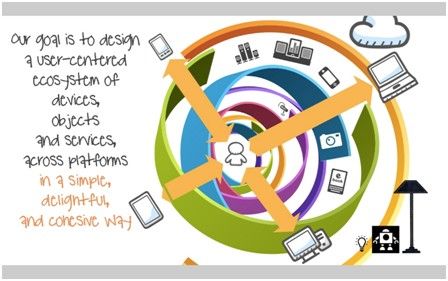
To sum up, your goal as a UX designer is to design a user-centered ecosystem of devices, objects and services across platforms in a simple, delightful and cohesive way which requires understanding people as social, cultural, and organizational components who are linked to other people, other technologies, and loads of information. Feeling stressed now? Don’t be! These new challenges will of course make your job much more demanding and difficult but that’s one of the reasons you became a designer, right? Because you love to solve complex design problems!


Feel Stuck?
Want Better Job Options?

AI is replacing jobs everywhere, yet design jobs are booming with a projected 45% job growth. With design skills, you can create products and services people love. More love means more impact and greater salary potential.

At IxDF, we help you from your first course to your next job, all in one place.

See How Design Skills Turn Into Job Options
Privacy Settings
By using this site, you accept our Cookie Policy and Terms of Use.
Customize
Accept all

Be the One Who Inspires

People remember who shares great ideas.

Share on:

Academic Credibility — On Autopilot

Don't waste time googling citation formats. Just copy, paste and look legit in seconds.