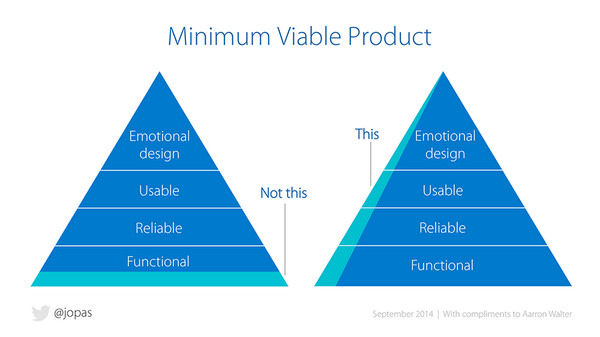
Lean UX (user experience) is a collaborative, outcome-driven design approach that thrives on rapid cycles of hypothesizing, prototyping, testing, and iteration. Teams work cross-functionally to reduce waste, get early user feedback, evolve high-value solutions fast, and launch successful products sooner.
Explore how Lean UX design helps teams ship products faster, particularly as Minimum Viable Products (MVPs), in this video with Laura Klein: Product Management Expert, Principal at Users Know, Author of Build Better Products and UX for Lean Startups.
Why UX Designers Value a Lean Approach
Lean UX prioritizes learning over deliverables and, true to its name, is a design methodology that removes nonessential work from design projects. The fruit of design teams’ efforts can therefore emerge faster and—from testing results—help inform and guide more promising design solutions.
Rather than plow weeks or even months into producing complete design documentation, teams use lightweight prototypes to test assumptions, collect user feedback, and iterate quickly. They can apply Lean UX to great effect especially in Agile environments—where change is constant and time is short—and Lean and Agile design are almost synonymous, like two management cabins on the same UX “building site.”
In Lean UX, the emphasis moves from producing detailed specs to driving product discovery—teams need to keep their attention on discovery so they can avoid rude awakenings when they release a product. Lean emphasizes collaboration, shared understanding, and measuring success according to outcomes—how users behave and what value the product brings home to them—instead of outputs like screens or features shipped.
Find out how continuous discovery helps teams stay on top of important design matters so they can create products that are more likely to succeed, in this video with Teresa Torres: Product Discovery Coach at Product Talk, speaker, and author of Continuous Discovery Habits.
Benefits of A Lean Approach
There are several benefits to the Lean UX approach.
Reduces Waste
When teams don’t overbuild features that users don’t need, they free themselves up to keep their fingers on the “pulse” of what users really want. So, they can avoid sinking huge amounts of time, efforts, and—indeed—money into the fine details of features they might believe their users should appreciate but which users might not even notice if they (the features) make it onto the final product.
Increases Speed
By testing early and often instead of waiting for perfect designs, teams can get into the spirit of MVP—and it’s especially important for startups. Imagine a UX design process where teams strive for the “best” product but don’t test and check versions of it frequently and from early on. Even if they’ve conducted their research properly in the beginning, they risk cutting themselves off from their users if they don’t check in with them. That’s like cutting off a steady flow of oxygen to a design team’s collective brain—their assumptions of “how things should be” might end up entering the picture and taking the product grossly off-course.
Improves Collaboration
A Lean design philosophy helps break down silos between design, development, and business stakeholders. To release a successful digital product, brands need to pull together, understand the various angles involved (such as business, marketing, design, and development), and get on the same “page.” For example:
Designers might over-estimate how easily developers can implement their ideas and get carried away with unfeasible feature suggestions.
Meanwhile, business stakeholders might misjudge the value of aesthetics or current trends and think a “pretty” design or a “fashionable” one should work rather than something that users truly need.
Grab a greater grasp of how cross-functional collaboration helps teams stay on course to reach effective design decisions, as Laura Klein discusses in this video.
Keeps Teams User-Focused
By continuously validating design decisions with real users, teams who test prototypes early and often can help keep what finally emerges as their product safe from the effects of not bothering to test with users. For example, feature creep can rear its ugly head if nobody is mindful of it, and assumptions can pollute the design teams’ consciousness with false hopes of “wonderful” functionality and looks which—sadly—few users would care about on the final product. These are all potentially expensive mistakes.
Pinpoint what prototyping does for design teams and the valuable lessons it can teach, in this video with Alan Dix: Author of the bestselling book “Human-Computer Interaction” and Director of the Computational Foundry at Swansea University.
Aligns with Agile
Teams work in sprints and iterate alongside developers. Lean and Agile reflect the adjectives in their names and help teams stay unencumbered and nimble as they keep their eyes “on the ball” and work together to produce fast and effective results. Teams leverage the principles of Agile design and gear their design decisions around continuous improvement, adaptability, and collaboration, all in the name of benefiting the users (and, by association, their brand) with a first-rate product.
Explore Agile design, why it came about, and how teams use it to create effective products fast, in this video with Laura Klein.
For designers, a Lean approach means they become a strategic partner alongside product managers and other stakeholders in product development. They’re responsible not just for how a product looks, but for whether it truly solves users’ problems and meets—if not exceeds—users’ needs, too.
Explore product design and how it’s behind what users ultimately take away from design teams, in this video.
A Rich History Rooted in Lean, Agile, and Startup Thinking
Lean UX didn’t come out of a vacuum; although principally a “product” of the 21st century, it’s the result of decades of evolution in how organizations think about work, innovation, and customer value.
From Factory Floors to Software Labs: Lean Thinking
The origins of Lean UX extend back to Lean Manufacturing, a philosophy which automobile giant Toyota pioneered in the mid-20th century. The Toyota Production System transformed automotive production through how it focused on reducing waste, improving flow, and empowering teams to make decisions right there on the spot. It eliminated overproduction, minimized defects, and optimized the entire value chain.
In the early 2000s, with the Digital Age picking up momentum, Mary and Tom Poppendieck adapted these ideas to software development in their influential book Lean Software Development. They proposed seven key principles:
First, to eliminate waste and take out anything that doesn’t add direct user value.
Second was to amplify learning and treat software development as a process of discovery.
Third was to decide as late as possible—postpone decisions to keep flexibility.
Fourth was to deliver as fast as possible and so speed up learning and value delivery.
Fifth was to empower the team and give responsibility to those doing the work.
Sixth was to build integrity in and ensure product quality is holistic, not stuck on as an afterthought.
Last, but not least, was to see the whole and focus on the full system, not individual tasks in isolation.
These principles laid the groundwork for Lean UX thanks to how they encourage continuous feedback, team collaboration, and a relentless focus on the user—all essential signatures of modern software design and management.
Enter Agile: Iteration over Perfection
Agile and Lean “inhabit” the same continuum for no small reason. In 2001, 17 software developers drafted the Agile Manifesto—a radical call to move away from heavyweight, plan-driven development models that had been bogging down many teams. Agile was like a breath of cool fresh air wafting over brands that might otherwise have become “overheated” by misdirecting their teams’ efforts—Agile valued working software over documentation, individuals over processes, and adaptation over prediction.
Designers working in Agile teams found that traditional UX methods—months of research, wireframes, and specifications—simply didn’t fit. They needed something faster and more collaborative if they were to provide their users with products that provided true value. Like Lean, Agile involves keeping a close watch on users with frequent fine-tuning to deliver what they want. By staying current, they can reduce the risk of (no pun intended) nasty shocks after the product launch.
It’s important to state the difference between Agile and Lean UX design. Agile UX design is all about aligning design work with the rhythm of Agile software development—which means working in short, iterative cycles (called sprints) and collaborating closely with developers throughout. It still follows core Agile values—like prioritizing working software and teamwork over heavy documentation—but it often results in more structured outputs like wireframes or prototypes which team members deliver during each sprint.
Lean UX design, on the other hand, shifts the focus from creating deliverables to learning as quickly as possible. It relies on rapid experimentation, feedback from real users, and lightweight MVPs (minimum viable products) to test assumptions early and often. The goal isn’t to produce polished design artifacts—it's to prove or disprove ideas fast, using just enough design to learn and iterate.
One key difference is their emphasis: Agile tends to be more process-driven, while Lean UX is more outcome-driven. Still, they’re not opposites—many teams actually blend the two. For example, a designer might use Lean UX methods to explore and validate ideas and then bring those validated ideas into an Agile sprint to build them out.
Imagine how revolutionary Agile must have seemed in an era when design had tended to take a Waterfall approach—often with siloed teams working on their piece of a project and then signing off in succession along a kind of production line. In a fast-moving market like software, long “gestation” periods between the first research findings and the final release of a product could mean serious risk for brands—especially, at the time, selling software as disks in boxes.
Discover how Agile teams use iteration to ship products from which they can learn and make improvements to, in this video with Laura Klein.
The Lean Startup Movement
That faster approach came in part from Eric Ries, a Silicon Valley entrepreneur who authored the 2011 book The Lean Startup, and who had observed that startups often failed because they built products nobody wanted. His solution was validated learning—a process where teams test business ideas quickly and cheaply, through experiments instead of assumptions.
Ries introduced the build–measure–learn loop, where teams build the simplest possible product (an MVP), measure how users respond, and learn whether they should pivot or persevere. Ries’s ideas resonated far beyond startups, and product teams in large companies soon took notice and began applying Lean Startup principles to reduce risk and raise the ceiling for real innovation.
The Birth of Lean UX
Lean’s next “stage” was where it got its “UX” suffix. Recognizing that UX needed a compatible process, practitioners such as Janice Fraser and Jeff Gothelf adapted Lean Startup and Agile principles for design. In 2013, Gothelf and his co-author Josh Seiden published Lean UX—a practical guide to designing products in fast-paced, collaborative settings, and which remains a chief reference for designers and teams around the world.
Their book argued that UX should be measured by user outcomes—improvements in behavior, satisfaction, or efficiency—not just polished interfaces. In 2021, they released a revised edition featuring the Lean UX Canvas, a one-page framework for aligning teams around assumptions, hypotheses, and experiments.
.png)
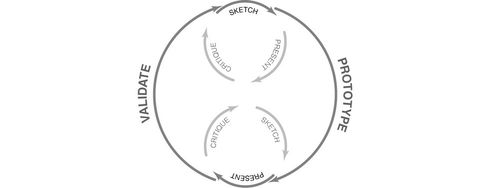
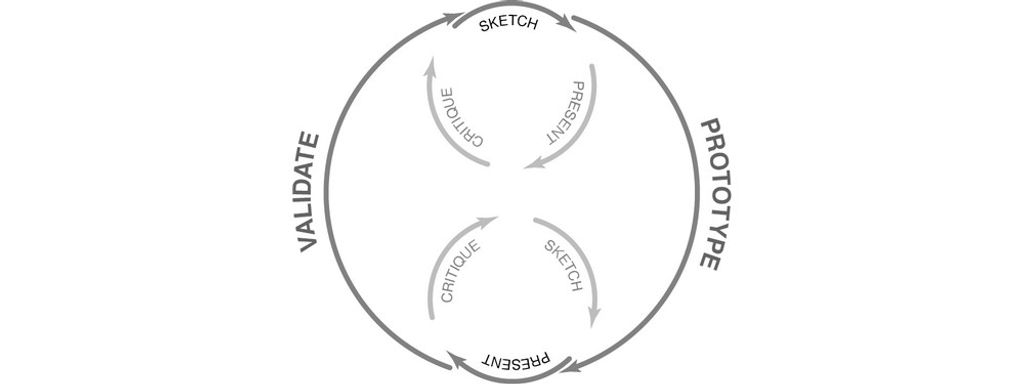
When teams apply a Lean process, they can speed their way on a more reliable road to product success—and not get stuck spinning their “wheels”—by taking things through cycles of sketching, presenting, and critiquing to prototype and validate.
© Interaction Design Foundation, CC BY-SA 4.0
The Lean UX Process: Think → Make → Check
Lean UX unfolds in a three-phase cycle:
1. Think
This is the discovery phase, where the team explores the problem space and finds the outcomes they want to achieve. Key activities for teams in this stage include to:
Understand the business goal.
Research the target user.
Brainstorm ideas.
Articulate assumptions.
Write hypotheses.
Example hypothesis:
We believe that adding a progress bar will reduce user drop-off during onboarding because it gives users a clearer sense of completion.
Explore the power of user research, especially how effective personas—fictitious representations of real users—help drive design decisions that work far better, in this video with William Hudson: User Experience Strategist and Founder of Syntagm Ltd.
Best Practices
Build a Cross-Functional Team
Include designers, developers, product managers, and stakeholders to get a well-rounded group who can cover all aspects of a potential product. Co-locate if it’s possible, or work closely via digital tools. In either case, you’ll want to work in an Agile setup to make the best use of frequent collaboration.
Align on a Shared Problem
Use tools like the Lean UX Canvas to define important points such as your business goals, user segments, assumptions, hypotheses, and success metrics.
Write a Testable Hypothesis
Once you’ve got the basis for something to test, structure hypotheses like this:
“We believe [this solution] will achieve [this outcome] for [this user] because [these reasons].” For example, “We believe adding a progress bar will reduce user drop-off during onboarding because users feel more in control.”
2. Make
Next, the team creates a simple prototype or MVP to test their hypothesis—“Make” doesn’t have to mean something fancy. The goal isn’t to launch a final product; it’s to learn something, and teams can begin to do this from making something as basic as a paper sketch, or a clickable prototype, or a mock front-end, or a landing page with a call to action
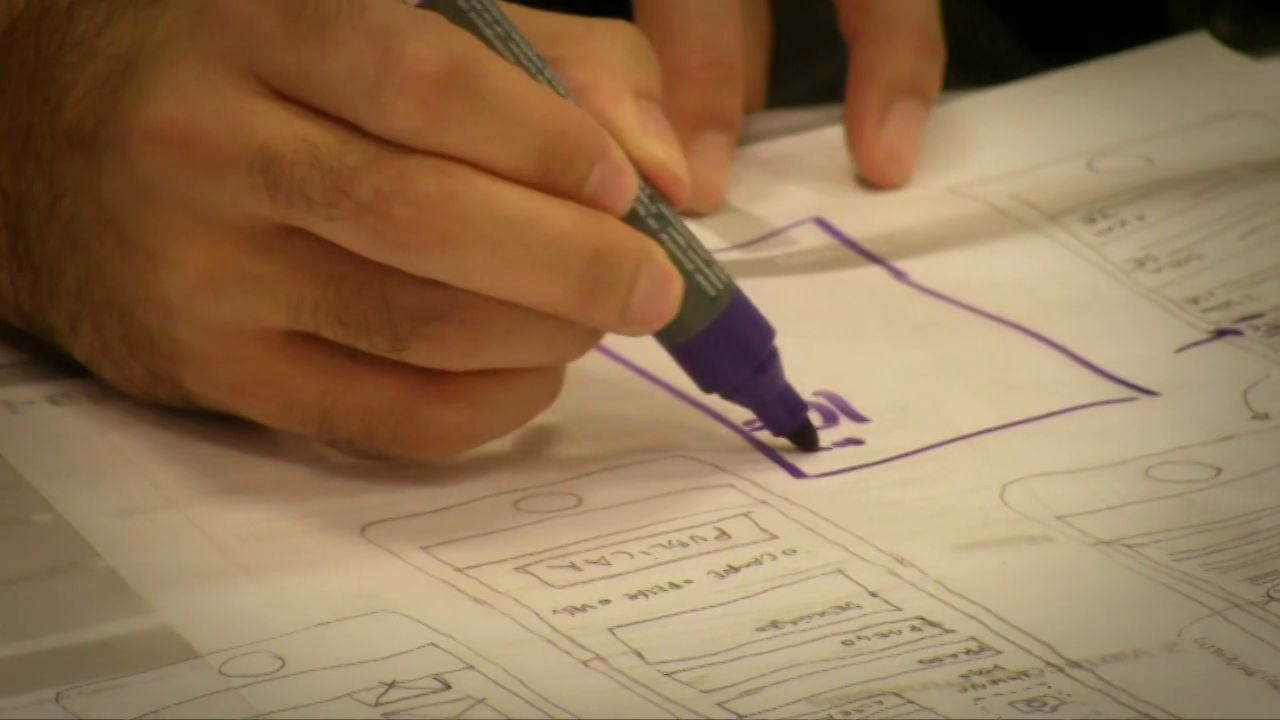
Find out how paper prototyping can signpost the way for designers to improve solutions from early on in the design process.
3. Check
Finally, it’s time to get some proof and see which assumptions hold up—the team tests their prototype with users, and gathers qualitative and quantitative feedback to assess whether the hypothesis holds. Teams typically use methods like usability testing and A/B testing to reap results which they can investigate for insights. They review the results, reflect on what they learned, and decide whether they should iterate, pivot, or proceed—and keep checking that what they deliver delights users.
Discover how A/B tests and multivariate tests help design teams find which version of a prototype or proposed solution is the one to consider improving, in this video with William Hudson.
Best Practices
Design the Smallest Test
Skip high-fidelity visuals—keep things lean and focus on what you need to learn. Testing is like a “magic key” to access the users’ reality regarding the prototype or tested item. That’s why it’s vital to plan properly: for example, sketch out flows on a whiteboard, create a basic clickable prototype, and find the best tools to test remotely with users.
Test and Observe
Conduct rapid usability tests—for example, remote unmoderated sessions are particularly valuable to gain accurate insights into use behaviors. In-app analytics or heatmaps can bring in massive amounts of helpful data.
Discover how to get analytics working for you, in this video with William Hudson.
Measure Outcomes
The results are in: Did users complete tasks faster? Did their satisfaction levels improve? Did frustration levels drop? Are more people converting? Know what to look for and what to measure—use metrics aligned with your hypotheses to find and understand how your proposed product did in tests. For example, how much did the progress bar help lessen drop-off during onboarding?
Share What You Learn
Document findings briefly—and keep it interesting. Use dashboards or team demos to keep everyone in the loop; knowledge is power, so make sure everybody who’s involved can understand how they might direct theirs in the next iteration.
Iterate or Pivot
Refine your design based on what you learned—or go back and test a new hypothesis. Keep fine-tuning your iterations until tests show it resonates with users and your MVP becomes a Minimum Desirable Product (MDP) that users will go for with more passion.
Get a better grasp of how to delight users through an MDP, as Frank Spillers: Service Designer, Founder and CEO of Experience Dynamics, discusses.
Integrate with Agile
Work well with your Agile team, and include design stories in sprint planning, attend stand-ups and retrospectives, and use backlog grooming to refine hypotheses.
Secure a stronger grasp of how storytelling helps team members communicate and understand important points, in this video with Laura Klein.
Minimize Documentation
Focus on real-time collaboration and document just enough to keep alignment—not for posterity. You’ll all want to keep in a lightweight environment where you’re not weighed down with overly detailed reports that nobody will read—let alone get anything really useful from—anyway.
Special Considerations with Lean UX
Lean UX works best when:
Teams have the freedom to experiment: Freedom, like knowledge, is power; so, the relevant business people should give their teams the time, room, and resources to explore and learn. And, yes, that includes the freedom to fail.
Stakeholders value learning over perfection: A success-oriented culture may work wonders in the marketplace, but teams won’t be able to learn valuable lessons from missteps if they don’t have the freedom to explore. Lean UX design is good for learning from early failures, and insights can lead teams into unchartered territory where users can show what they really want. Likewise, if teams have to play it “safe” and stick to what business stakeholders believe will work, the brand might end up releasing a product that lacks imagination, innovation, excitement, and a long lifespan in the marketplace. A little bit of failure, and at the right time, can go a long way; the powers that be just have to appreciate the “trade-off.”
Investigate the interesting gulf between what some stakeholders think is good design and what designers know is good design, in this video with Morgane Peng: Designer, speaker, mentor, and writer who serves as Director and Head of Design at Societe Generale CIB.
Designers and developers work in sync: For a product to be desirable, feasible, and viable, those who design and those who program need to collaborate closely every step of the way, putting aside any differences in the name of the user (or at least the health of their brand).
The teams have access to real users for research and testing: From informal guerrilla testing to other forms of usability testing, teams must keep their fingers on the users’ pulse; the sooner it starts in the design process with real people outside the building, the better.
Get Out Of the Building (GOOB) to understand why your brand needs an outside-in approach to engage with real users in their many user contexts, as Frank Spillers discusses.
Teams prioritize outcomes over outputs: A lesson well learned is worth many prettily designed screens. If a brand uses some of the money it would otherwise spend on those pretty screens on testing instead, teams might learn through such testing that users wouldn’t need those screens.
Where A Lean Approach Might Not Work Well
For all the good it does, Lean UX design may not suit rigid, compliance-heavy environments where deliverables are fixed up front—which can include industries like healthcare, legal, and insurance. In those cases, some Lean UX practices (like hypothesis framing or lightweight testing) can still offer value, but compliance with industry standards needs to come first.
Overall, Lean UX is far more than an approach or process—it’s a mindset for teams to cut to the chase and question assumptions, collaborate openly, and learn continuously. When they integrate with Agile and draw on Lean principles, they’ll likely find a powerful springboard to help them launch what truly matters—solutions that solve real problems for real people—and perhaps observe their product do extremely well in the marketplace because of it.
Design and technology may race on the same fast track, and the monitoring of—and improvements to—design solutions may seem relentless. However, the rewards are worth it, both monetary and prestige as a household name. Those treasures will tend to go to the brands who create better digital products faster and with greater user impact, and iterate from real-world usage insights to keep their digital apps, websites, and other offerings well maintained.
Lean UX designers keep their process trim and can keep up with what their users want—and in timeframes business stakeholders should like, too—to shape great solutions. A Lean user experience approach gives designers the framework to help set the stage and ensure the best design solutions can emerge, evolve, and elevate the expectations of the countless users who flock to use them.