The HEART Framework is a user-centered methodology that measures the quality of user experience (UX) through five key metrics: Happiness, Engagement, Adoption, Retention, and Task Success. UX designers use this framework to translate abstract user experience goals into concrete, measurable data points that drive product decisions and align teams around user needs.
The HEART framework helps designers empathize with users—and empathy for users is a vital ingredient in design, as this video illustrates:
What’s at the Heart of the H.E.A.R.T.?
Google researchers Kerry Rodden, Hilary Hutchinson, and Xin Fu introduced the HEART Framework in 2010 through their research paper “Measuring the User Experience on a Large Scale: User-Centered Metrics for Web Applications”—presented at the ACM CHI conference. The framework emerged because of a critical gap which Google’s UX team identified: although measuring user experience on a small scale through observations and interviews was common practice, no established framework existed for measuring user experience on a large scale through automated means.
Kerry Rodden, then Google’s lead UX researcher, developed HEART specifically to help UX design teams focus on a handful of essential areas of user experience while tuning out overwhelming amounts of raw usage data. The research team discovered a strong need for user-centered metrics that could measure progress toward key goals and drive product decisions in web applications. The framework represented a shift from purely technical metrics to metrics that reflected actual user experience quality; it put people in the picture while keeping business concerns involved—a “magic” balance.
Why Does The HEART Framework Matter to UX Designers?
The acronym “HEART” itself gives a clue. Traditional product metrics often focus on business outcomes like revenue, page views, or system uptime—cold, hard data—but they don’t consider the user’s actual experience. The HEART framework bridges this gap—and brings things to a more human level—by delivering user-centered metrics that allow teams to measure user experience on a large scale. Design teams and other brand stakeholders can take these metrics and use them for decision-making in the product development process. They can help take care of the human dimension of design so much better because of it.
The framework provides a holistic view of UX that makes it easier to balance multiple variables. Since designers and teams can apply it to see, and treat, the user’s experience and their proposed solution as a system, they can achieve a more sophisticated understanding of cause-and-effect relationships between what they include in a design and how individuals respond in their user contexts. That grasp helps lessen the likelihood that designers will make improvements that cause unexpected problems in other areas. It encompasses both micro and macro measurements to help determine the impact of a product’s user experience. Retention has the most direct relationship to revenue, while other metrics influence overall value.
What makes the framework important is how it connects UX improvements directly to business outcomes. Teams can use HEART to identify essential patterns—such as how if they improve one metric, their effort to do so might weaken another—which helps them understand trade-offs and make strategic decisions about resource allocation. This data-driven approach helps UX designers justify their decisions and demonstrate the business value of user experience improvements. At the same time, when teams create and use tools like personas—fictitious representations of real users—they can fine-tune more accurate pictures of who users are, what they need in a design solution, and which parts of a potential solution would resonate with them.
Explore how personas are more than just helpful for designers and teams—design without them falls short, in this video with William Hudson: User Experience Strategist and Founder of Syntagm Ltd.
What “H.E.A.R.T.” Stands For – Five Core Principles
The HEART acronym represents five distinct but interconnected aspects of user experience that teams can measure and optimize:
Happiness
Happiness measures user attitudes, satisfaction, and emotional response to the product. It’s a fine place to start. User happiness considers the feelings people have when they’re using a product—companies ask users direct questions to measure satisfaction and fulfillment levels. They typically measure this through user surveys, and satisfaction forms—a key indicator of attitude toward the product. Happiness may seem too challenging a category or a calculation of emotion to optimize—it can seem so unique or idiosyncratic to individual users. Nevertheless, it’s easy to measure through net promoter scores (NPS) and user surveys.
Discover when to use surveys and how they help guide design solutions, in this video with William Hudson:
Engagement
Engagement tracks how actively users interact with the product. This measures the level of use an average customer gets from the product. It may seem closer to the “cold” business side of analysis and perhaps more “scientific” and readily useful because of it. However, engagement has limited value in enterprise contexts because many users don’t choose to use a system; they have to use it as part of their job. That factor makes engagement less relevant when teams and user researchers examine such systems. Teams typically measure engagement through session duration, feature usage frequency, and depth of interaction.
Adoption
Adoption measures how successfully the product attracts new users and converts them into active users. This part focuses on how successful the product is at acquiring new users and whether they continue using the product after onboarding. Adoption as a category can seem “warmer”—and closer to the “heart”—than more “clinical” ones like task success (below). Teams should be cautious whenever they’re measuring adoption. Not all of it might be because of the design itself. Therefore, design teams might want to share credit with sales and marketing teams to at least keep the peace between their departments, but more importantly as if it’s not possible to tell if design is the main contributor then design teams won’t know if and where they need to improve. Arguably, this factor might extend to other areas, such as engagement.
.png)
© Interaction Design Foundation, CC BY-SA 4.0
Retention
Retention focuses on keeping existing users engaged over time. Retention involves keeping existing users for a specified amount of time, which might be indefinite for products with long-term utility. Even so, teams typically examine various time scales to identify where user dropout is most pronounced. This HEART metric directly correlates with product value and long-term business success.
Task Success
Task success measures how effectively users can complete their intended actions within the product. Even if a product enables users to complete tasks and they get what they need or want to do done, the time it takes them and difficulty level matter significantly, too. This includes metrics like task completion rates, error rates, and time-to-completion for key user workflows.
What Brands Do with HEART – The Goals-Signals-Metrics Process
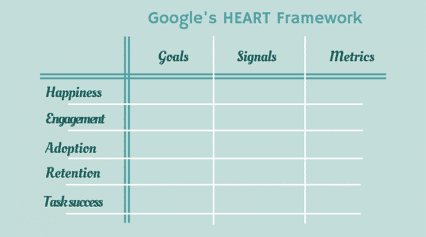
The HEART framework works with a Goals-Signals-Metrics model—which originated at Google—and it provides a straightforward approach to implementation. This three-step process, where each step is just what the title suggests, translates abstract objectives into measurable outcomes:
Goals represent broad, high-level objectives that align with user needs and business strategy. For Happiness, a goal might be to “increase user satisfaction.” When teams set goals upfront, it helps get every team member aligned and puts them in a position where they can decide whether it’s more important to attract new users or increase engagement for existing users.
Signals are observable indicators that suggest progress toward goals. For Engagement, a signal might be “users are spending more time per session in our software.” Such feedback can clearly signal factors for teams to act on. However, teams should ask how easy or difficult each signal is to monitor and whether they’ve designed the product to register relevant actions.
Metrics are the quantifiable data points that provide concrete measurement of success or failure. They answer the question, “By how much?” with good or not-so-good news, and they’re quantifiable data points that indicate success or failure. For example, for happiness, NPS (net promoter score) or number of five-star ratings would be trackable metrics; meanwhile, for adoption, registration rate might be better to follow.
Explore the power of data-driven design and how analytics help designers fine-tune better designs, in this video with William Hudson:
How To Use The HEART Framework Step-by-Step
When designers and teams implement the HEART framework, it’s wise to take a systematic approach that begins with strategic planning and moves through measurement and optimization phases.
Step 1: Select Your Focus Area
The HEART framework works best at the product feature level, avoiding use at very low levels like microinteractions or very high levels like entire product families. Narrow the list of goals to no more than three—it’s not practical to focus on every aspect of HEART at once.
Step 2: Choose Relevant HEART Categories
One benefit of HEART is its adaptability; not all projects require all five metrics, so you can concentrate only on what you need to. Therefore, pick metrics based on the outcomes required from the measurement. For example, if you want to improve product stickiness, you might focus on engagement and task success (ET). Still, evaluate which HEART categories make sense for your team to prioritize based on the specific context, such as HER, EAR, or whichever show the results you want to improve on.
Step 3: Define Goals for Each Category
Now, select business goals that align with the prioritized HEART categories. For example, product managers and design teams can ask, “What do we want a customer to tweet after using our product?” to help define goals—if they want users to talk about how easy an app is to use, they can focus on task success.
Step 4: Identify Observable Signals
The signals your team chooses should be ones you expect to be sensitive to changes in your design and consider how easy or difficult each signal is to monitor. For example, if you want to increase engagement, a signal for that would be more time spent using an app.
Step 5: Establish Quantifiable Metrics
Now, adjust signals into metrics you and your team can track over time or use in A/B testing—the specifics of which will depend on the particular setup. To go back to the engagement example, an appropriate metric might be “average session length.”
Find out how A/B testing can help guide you towards the most promising design decisions, in this video with William Hudson:
Step 6: Implement Measurement Systems
Once your team has a baseline reading, you can decide which metric is most crucial to improve next. That way, you can iteratively tackle other bottlenecks to strengthen feature UX health over time—such as reducing user frustration with key workflows, increasing task success rates, or deepening user engagement with underused features. This requires setting up analytics tools, survey systems, and data collection processes—and keeping in mind that you’re dealing with a system where improvements in one area can spill over into other areas of user experience.
Step 7: Analyze and Iterate
As each metric improves, your team can iteratively tackle other bottlenecks to strengthen overall UX health above just the features. Regular review cycles can help everyone on the team understand metric relationships and make data-driven decisions about future improvements.
Explore a helpful dimension of how iteration helps teams—in this case, teams using the Agile approach—get effective design solutions out to users faster, in this video with Laura Klein: Product Management Expert, Principal at Users Know, Author of Build Better Products and UX for Lean Startups.
Best Practices to Help Implement The HEART Framework
Focus on User-Centered Goals
The framework emphasizes user-centered metrics that your team can measure progress toward key goals with and use to drive product decisions. Resist the temptation to choose metrics simply because they’re easy to measure—instead, focus on metrics that truly reflect user experience quality.
Normalize Your Data
Overall numbers naturally increase as user bases grow, so normalize results using ratios, percentages, and averages per user rather than raw figures. When your team looks at things in proportion, metrics can remain meaningful as products scale.
Maintain Metric Relevance
Keep metric lists manageable—stick to metrics that will actually help make UX decisions. Don’t add “interesting stats” to your list or try to stretch to cover every category of the HEART acronym if it won’t help. Only use numbers that will help you reach decisions.
Encourage Cross-Functional Collaboration
A team effort creates, tweaks, and launches a successful product into the marketplace, so UX designers should spearhead the HEART Framework to establish user goals, while product managers should push to close gaps when frameworks aren’t in place. Implementation works best when the trio of product management, design, and development collaborate throughout the process.
Get a healthy dose of a vital ingredient in design—collaboration between teams—in this video with Laura Klein:
Regular Review and Adjustment
The data that teams generate over time using HEART can uncover valuable insights about which elements most significantly lead to increased revenue. It can take close monitoring, but the results are worth it to help inform smart decisions about resource allocation. Regular reviews help teams understand these patterns, make sense of the bigger picture, and adjust their focus accordingly.
Special Considerations for The HEART Framework in UX Design
While the HEART Framework provides significant benefits, potential challenges and limitations can affect how successfully a team can implement it.
Metric Interdependencies
The framework can help brands identify essential patterns—such as how improving one metric might weaken another—and teams can (potentially) learn that if they focus resources on increasing user adoption, it might also lower the product’s happiness score. Monitor these relationships carefully. Everything is a system, or a part of a bigger one, so be sure to examine bigger-picture contexts to avoid unintended consequences.
Get a greater grasp of how designers encounter and work with systems in this video with Don Norman: Father of User Experience design, author of the legendary book The Design of Everyday Things, co-founder of the Nielsen Norman Group, and former VP of the Advanced Technology Group at Apple:
Context-Dependent Relevance
On the subject of context, engagement is of limited value in enterprise contexts because many users don’t choose to use a system—often they’re required to use it as part of their job. Teams must carefully consider the user’s specific context when selecting which HEART categories to prioritize.
Discover how, when you know the context of use, you can tailor more successful designs more effectively to more users, in this video with Alan Dix: Author of the bestselling book “Human-Computer Interaction” and Director of the Computational Foundry at Swansea University:
Implementation Complexity
Remember, it might seem prudent to focus on every aspect of the HEART framework so your team can build a near-perfect UX design, but it doesn’t quite work that way in real-world terms. It’s not practical to juggle five goals and more than a dozen metrics simultaneously. Teams need proper prioritization and focus if they’re to keep safe from spreading their efforts too thinly and straying into design quagmires where business stakeholders likely become frustrated, too.
Resource Requirements
Implementing HEART takes significant investment in analytics infrastructure, survey tools, and data analysis capabilities. Research and what teams do with data can take a great deal of time, effort, and—indeed—money. That’s why teams must ensure they have adequate resources to collect, analyze, and act on the metrics they carefully choose to track.
Vanity Metrics – Beware
Speaking of “carefully,” teams should ask themselves, “Will these numbers help me make a decision?” and stay focused on metrics related to goals. The temptation to track impressive-looking but ultimately meaningless metrics—which will depend on what aspect of user experience the brand needs to understand—can undermine the framework’s effectiveness and throw the team off track.
Integration with Existing UX Practices
The HEART Framework complements rather than replaces existing UX research and design practices. UX designers and user researchers spend much time observing users, talking to them, and gathering feedback, and they track metrics like load time, crashes, and daily active users. However, nothing happens in a vacuum, especially at the system level of UX design where effects can spill over from one area into another. Teams need a holistic view of overall user experience to make smart product development decisions.
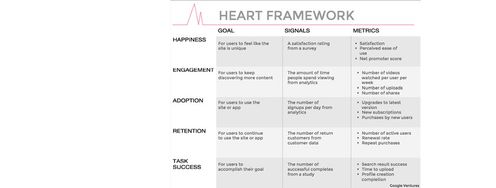
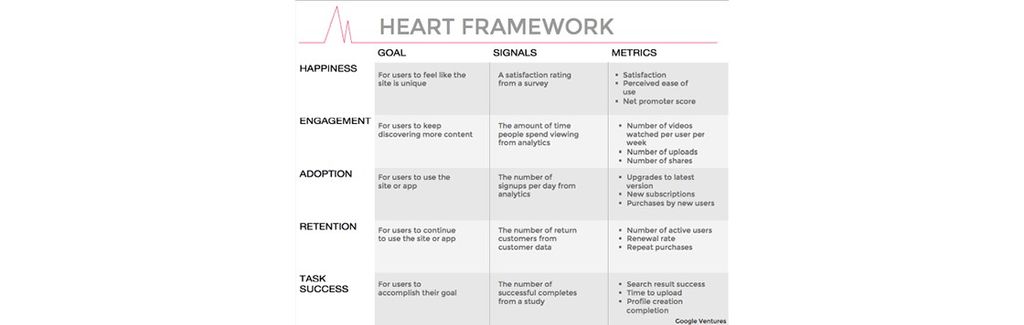
Goals | Signals | Metrics | |
Happiness | How satisfied users are | Users’ feedback coming from surveys and interviews | Rating (of satisfaction), NPS |
Engagement | Content discovery for users | How long users spend in the digital solution | How many page views, shares, average session length |
Adoption | Users’ onboarding | Downloads of apps, new features, new registrations | Rates of download, of registration, of adoption of features |
Retention | Loyalty of users | Returning users, renewals of subscriptions | Churn rate, Rate of subscription renewal |
Task Success | Completion of users’ goals | Usability studies, behavior of users | Completion of task |
The framework is designed for software UX teams—its five elements and Goals-Signals-Metrics model are most logically suited to user experience designers and researchers. However, product managers can find it useful when they prioritize competing projects. Teams can use HEART alongside other UX methods like usability testing, user interviews, and design thinking phases to home in on what’s important.
Check out the phases of the design thinking process and how they help design teams pinpoint effective digital products and more:
The framework particularly excels at bridging the gap between qualitative insights and quantitative measurement. While traditional UX research methods provide deep understanding of user needs and behaviors, HEART gives an extra lift in how it helps teams translate these insights into measurable outcomes that stakeholders can track and optimize over time.
Grab a greater grasp of the powerful research aids, qualitative UX research and quantitative UX research, and how they help inform better designs in different ways, in this video with William Hudson:
Years after its “debut,” Google’s HEART framework continues to offer valuable insights for measuring and improving user experience. Its enduring relevance stems from its practical approach to connecting user experience improvements with business outcomes through measurable, user-centered metrics. Teams use it also because it has a “heart” for them—empathizing with the point that mind-bogglingly large pools of data can come from research. As teams continue to grapple with increasingly complex data landscapes, they can take heart that when they use the framework properly, they won’t bury themselves under avalanches of numbers and other findings.
The framework and process have generalized to many products and areas—proof that its flexibility lets teams apply HEART principles across various contexts, from individual features to entire product ecosystems. Teams can take up the HEART framework as a powerful tool and leverage it mindfully to determine and optimize what’s important, no matter if they’re working on an app, website, or other kind of experience.
Overall, the HEART framework provides teams with a mature approach to UX measurement, one that balances rigor with practicality. As digital products continue to evolve and user expectations rise amid new contexts and technologies, frameworks like HEART can only become more valuable for teams committed to creating exceptional user experiences. The beauty of HEART lies in how it can help design teams with creating user love and increasing business outcomes.