User-centered design (UCD) is an iterative design process in which designers focus on the users and their needs in each phase of the design process. In UCD, design teams involve users throughout the design process via a variety of research and design techniques, to create highly usable and accessible products for them.
UCD is an Iterative Process
In user-centered design, designers use a mixture of investigative methods and tools (e.g., surveys and interviews) and generative ones (e.g., brainstorming) to develop an understanding of user needs. The term was coined in the 1970s. Later, cognitive science and user experience expert Don Norman adopted the term in his extensive work on improving what people experience in their use of items. And the term rose in prominence thanks to works such as User Centered System Design: New Perspectives on Human-Computer Interaction (which Norman co-authored with Stephen W. Draper) and Norman’s The Design of Everyday Things (originally titled The Psychology of Everyday Things).
4 Phases in User-centered Design
Generally, each iteration of the UCD approach involves four distinct phases. First, as designers working in teams, we try to understand the context in which users may use a system. Then, we identify and specify the users’ requirements. A design phase follows, in which the design team develops solutions. The team then proceeds to an evaluation phase. Here, you assess the outcomes of the evaluation against the users’ context and requirements, to check how well a design is performing. More specifically, you see how close it is to a level that matches the users’ specific context and satisfies all of their relevant needs. From here, your team makes further iterations of these four phases, and you continue until the evaluation results are satisfactory.
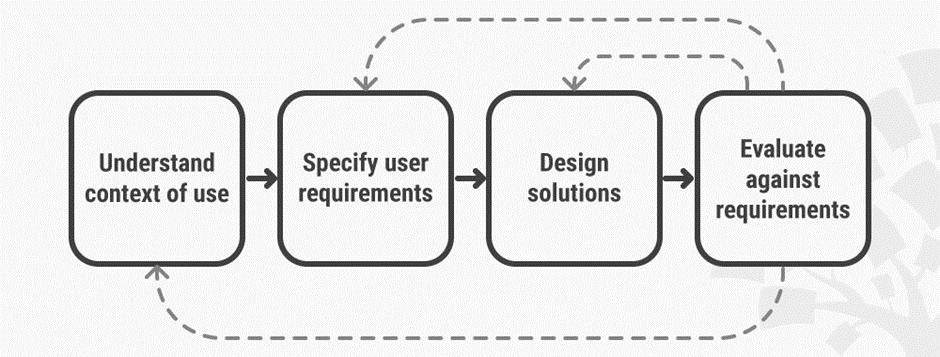
User-centered design is an iterative process that focuses on an understanding of the users and their context in all stages of design and development.
UCD Considers the Whole User Experience
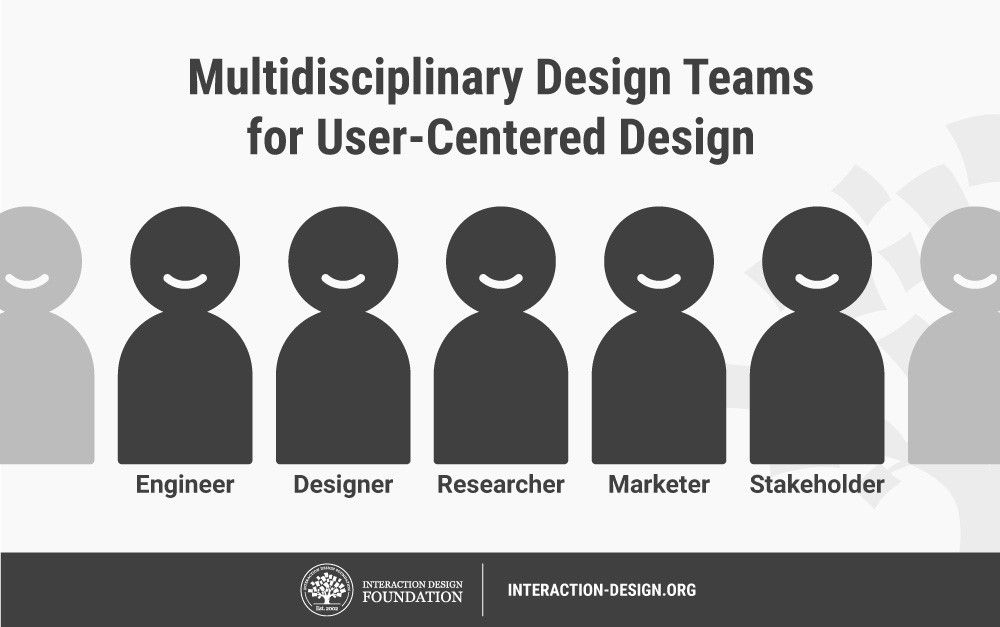
In UCD, you base your projects upon an explicit understanding of the users, tasks and environments. The aim of the process is to capture and address the whole user experience. Therefore, your design team should include professionals from across multiple disciplines (e.g., ethnographers, psychologists, software and hardware engineers), as well as domain experts, stakeholders and the users themselves. Experts may carry out evaluations of the produced designs, using design guidelines and criteria. However, you should bear two crucial points in mind. First, to span the entire user experience, you must involve the users for evaluation. Second, you'll need to ensure long-term monitoring of use.
Investment in UCD Pays off
When your design team brings the users into every stage of the design process, you invest your effort and other resources into a powerful way of finding out what works well, what doesn’t and why. Your users are an early-warning system you can use to course-correct and fine-tune your design. They can expose many aspects—positive and negative—your team may have overlooked regarding such vital areas as usability and accessibility. That’s why it’s so important to understand how powerful the benefits of a user-centered design approach are.
“Being human-centred is an additional cost to any project, so businesses rightly ask whether taking so much time to talk to people, produce prototype designs and so on is worthwhile. The answer is a fundamental ‘yes’.”
— David Benyon, Professor with over 25 years of experience in the field of HCI
David Benyon distinguishes four ways in which UCD pays off:
With close user involvement, products are more likely to meet users’ expectations and requirements. This leads to increased sales and lower costs incurred by customer services.
Systems designers tailor products for people in specific contexts and with specific tasks, thereby reducing the chances of situations with a high risk of human error arising. UCD leads to safer products.
Putting designers in close contact with users means a deeper sense of empathy emerges. This is essential in creating ethical designs that respect privacy and the quality of life.
By focusing on all users of a product, designers can recognize the diversity of cultures and human values through UCD – a step in the right direction towards creating sustainable businesses.









#/media/File:Ed_lines.jpg)