Storytelling in UX/UI (user experience / user interface) design is using the power of narrative to create more intuitive, engaging, and emotionally resonant user experiences, which you shape as coherent narratives. Each interaction (every screen, message, or transition) acts as a chapter to guide users toward their goals. A well-designed product tells a story that feels natural, intuitive, and emotionally resonant, and storytelling is not just about the end product but is an essential ingredient to sprinkle throughout the entire design process.
When you tell a story about a user’s life, goals, obstacles, and how your interface helps them, you make abstract user needs concrete, empathetic, and actionable.
Explore the powers of storytelling you can leverage to compelling levels and captivate audiences of all types, in this video with Ellen Lupton: Designer, Writer, Curator, Educator and Author of Thinking with Type, Graphic Design Thinking, Health Design Thinking, and Extra Bold.
Storytelling Helps You Make Better Designs that Resonate
For thousands of years, storytelling has been, and will remain, one of the most powerful ways for humans to relate information to each other and retain it well. In UX (user experience) and UI (user interface) design, storytelling helps you understand the people behind the screen, including their goals, their frustrations, and the daily realities they face. By framing design challenges as narratives with real characters facing real problems, you can step on the path to creating solutions that resonate with the actual lives you want to impact. Storytelling provides fertile ground to introduce personas, too, research-based fictional representations of those real users.
Explore how to bring personas into your design picture as powerful storytelling agents, in this video with William Hudson: User Experience Strategist and Founder of Syntagm Ltd.
More specifically, you can enjoy the benefits of storytelling through how:
Empathy Becomes Sharper and Shared
Designers frequently conduct user research and hold user interviews, take surveys, or do usability tests. However, especially with quantitative data with numbers in charts, spreadsheets, and metrics, this raw data tends to sit flat and “lifeless”; it takes something else to evoke empathy with users. A well-told user story helps you and your team feel what the user goes through: their frustrations, hopes, daily routines, and more. That emotional connection is like a sparkplug that can fire up a powerful engine and lead to more human-centered decisions.
A powerful benefit of storytelling done well is how it causes everyone (developers, product managers, marketers, and others) to hear the same story, which is key to how empathy spreads across the team. Rather than siloed assumptions (“I think users want X”), you all can refer to a shared narrative.
Discover what empathy can do in design and why it’s a vital ingredient for your brand, in this video.
You Center Design on Meaningful Problems
Since storytelling forces you to look deep and gain deeper insight into users’ emotional and behavioral motivations, you’ll find that all-important “what” element to accompany the “who.” You define conflict: namely, what the user is struggling with, that tricky gap between their current reality and desired future. That conflict highlights real, meaningful problems to solve rather than superficial features.
With storytelling, you get to sharpen your game so you’re on point, and you avoid designing for features that look cool but don’t matter. You ensure each interface decision ties back to a user’s real struggle or goal, something they can really apply in their user behavior to solve their real-world user needs.
Storytelling Permits Better Alignment and Less Rework
When your team clearly understands the user’s story and how your proposed design serves it, alignment happens earlier and you can build more effective solutions like digital products. It’s vital to communicate value clearly (inside your design team and externally) to minimize miscommunication and back-and-forth, as everyone can see, for example, how a feature fits into the narrative of solving user challenges. That leads to fewer pivots, fewer wasted prototypes, and smoother stakeholder buy-in.
Peak into the power of prototyping for essential tips and insights into a powerful design technique, in this video with Alan Dix: Author of the bestselling book “Human-Computer Interaction” and Director of the Computational Foundry at Swansea University.
Storytelling Helps Make Memorable Experiences and Emotional Resonance
Humans remember stories far more easily than lists or specs; for example, facts and figures can’t make themselves relatable without you to frame and shape them into something meaningful for the target audience. When you embed narrative principles, your design can feel like a story unfolding because it speaks to them and their needs. When users feel emotionally connected, they engage more, stick around longer, and become advocates and even loyal followers of your brand.
Storytelling Helps Secure Stronger Communication and Marketing
Later in the project lifecycle, you’ll need to pitch or market your product, especially when giving UX presentations to stakeholders. You already have the story of how your design changes a user’s life. That narrative can now become your messaging: “Meet Jane… here’s how she struggled… now she succeeds with our app.” That dovetails with marketing, onboarding copy, and content strategy, another storytelling-related win you can enjoy.
Find out how you can use effective communication to get stakeholders on your side so they can support your ideas more readily, in this video with Morgane Peng, Managing Director, Global Head of Product Design and AI Transformation.
How to Use Storytelling in the UX Design Process, Step by Step
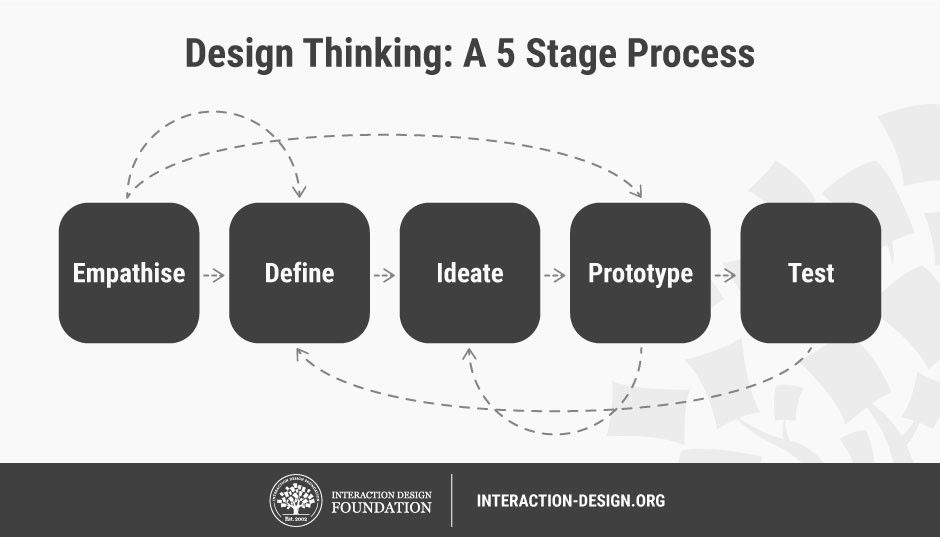
Storytelling isn’t something you tack on at the end of design; it runs through every stage and needs to start early on. To see it in action, try this process step by step with Clara, a user persona built from user research. “Clara” is a composite character who is based on recurring insights from interviews with, in this example, several freelancers. By blending shared patterns into one representative figure, Clara becomes easier for a team to empathize with and remember.
Here’s how her story helps you weave narrative into the design process:
1. Conduct User Research → Get Raw Insights → Find Narrative Seeds
Let’s say you interview a dozen freelancers. Across conversations, you hear:
“I have to reschedule tasks almost every day.”
“I’m always toggling between five different apps to get things done.”
“I feel guilty when I miss family time because of deadlines; as a freelancer, I was hoping to be ‘freer’ and living under my own rules.”
These are raw data points; but they’re also narrative seeds. They highlight motivations (work-life balance), tensions (too many tools, constant rescheduling), and potential turning points (a system that adapts to real life).
2. Create a Persona with Character and Context
From those patterns, you might create Clara the Persona:
Fictional but representative: Clara is a made-up character, a persona, but she embodies what you learned from multiple freelancers.
Profile: 32, freelance graphic designer, and single parent to an 8-year-old son.
Goals: Finish projects on time and retain her freedom away from what she terms “corporate control” and “HR-dictated hours” without sacrificing family life.
Pain points: Overlapping deadlines, juggling multiple apps, burnout, niggling doubts about the true value of “freedom” as a freelancer.
Emotional arc: Starts stressed and reactive → hopes for more control → feels calmer when routines hold and can believe in herself more.
When you personify the data, you give your team a protagonist to design for. Clara isn’t “User Group B”; she’s someone with a name, face, and story, and a person worth helping enjoy a better life.
3. Use Journey Mapping / Storyboarding
You map Clara’s week as a journey, almost like a plotline for a good story:
Morning: Prepares her son for school, checks emails on her phone.
Midday: Works across multiple apps, constantly switching contexts.
Afternoon: Gets urgent client requests while she’s already overbooked.
Evening: Works late after her son goes to bed, exhausted.
At each of these stages, you mark conflict points: double-bookings, last-minute changes, and wasted effort switching apps. You sketch a storyboard: Clara is stressed at her laptop, then feels relieved when a system auto-adjusts her calendar. These visuals make her struggles, and her future transformation, tangible as a happy ending worth your efforts to help realize for her.
Explore how journey mapping helps you and your design ideas get to where you want to go, in our video.
4. Define the Narrative Arc (Beginning, Middle, End)
In our example, Clara’s story follows a classic arc:
Beginning: She’s juggling chaos with no clear overview.
Middle: She experiments with different tools, but they overwhelm her further.
End: Your design simplifies her schedule, gives her back evenings, restores her belief in herself as a freelancer and mother, and lowers her stress.
This arc becomes the backbone of your design decision; in the case of this persona, every choice should move Clara from “overwhelmed” to “in control.”
5. Integrate Conflict and Transformation
Note how conflict drives the story. For Clara, conflict is the gap between her desire for balance and the messy reality of tools and client demands. It’s a painful gap, one that challenges her self-belief and wears her down, almost into a state of despair.
Your app in this example acts as the guide, not the hero. Clara is the hero. The app enables her transformation: fewer reschedules, smoother weeks, calmer evenings, and far more security in the knowledge that she can be a good mother, an effective freelancer, and enjoy her life more as an individual, too, without burnout.
6. Embed Storytelling in Design Decisions
At each design choice, you test it against Clara’s narrative:
Flows: Does this idea or feature help her quickly see her schedule, or does it add clutter?
Content: Does the copy you include empathize with her (“Here’s your week simplified”) or alienate her with jargon?
Visuals: Do calming colors and clean layouts reinforce her story of balance?
Anything that doesn’t serve her journey needs to get cut out.
7. Prototype and Test the Narrative Path
You create a prototype and frame the test in Clara’s context. It could be a low-fidelity one where you use paper and card to simulate a proposed user interface, for example.
“Imagine you’re Clara. It’s Monday; you have three projects due this week and your son’s school project to check on top. Show me how you’d handle this in the app.”
Then, ask the users you test your prototype with to narrate their actions and think out loud:
“Oh good; I can see overlaps right away.”
“Wait; I thought dragging a task here would auto-adjust timing.”
These narrations reveal whether the intended story holds up in practice. If the flow doesn’t match expectations, you revise both design and narrative.
8. Use Storytelling in Stakeholder Presentations and Launch
When you pitch your design, you don’t start with UI screens; you start with Clara’s story:
Introduce the persona: “Meet Clara. She’s talented, but her work-life balance is slipping away and eroding her energy levels and self-esteem.”
Show her pain points and frustrations.
Walk through her transformation with your design.
End with resolution: Clara meets deadlines and has family dinners stress-free and starts to enjoy life much better.
Your storytelling approach here can make it so that stakeholders don’t just see features; they’ll see impact and become more likely to believe you can achieve great results.
Use Storytelling in Presentations to Shine
Storytelling isn’t just a design tool; it’s one of the most effective presentation strategies you can use, too. Whether you’re pitching a product, updating stakeholders, or presenting a portfolio case study, narrative frameworks like Freytag’s Pyramid and the STAR method can transform your delivery from a dry report into a story people remember and act on.
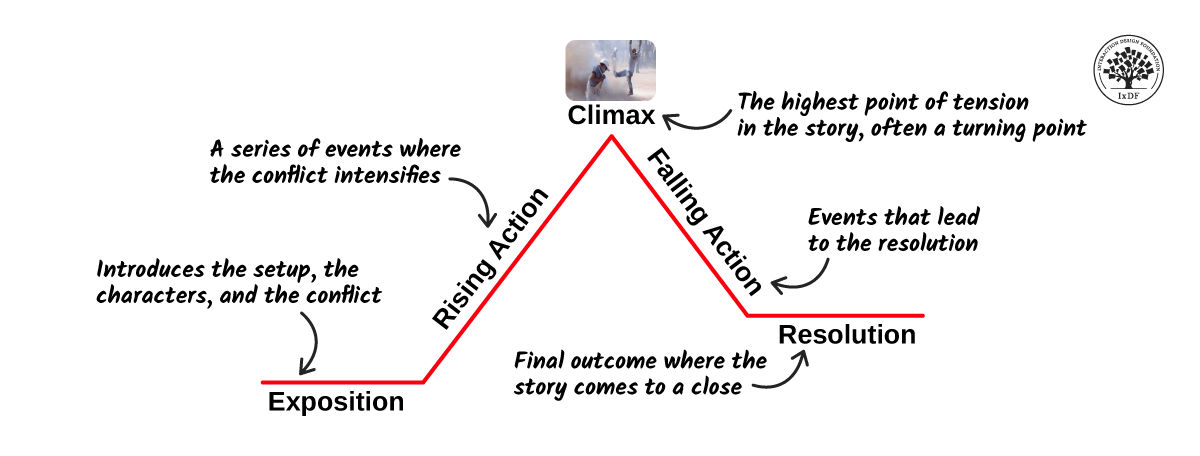
Use Freytag’s Pyramid to build up to an engaging climax and then take things neatly down to a satisfying resolution.
© Interaction Design Foundation, CC BY-SA 4.0
Use storytelling well when you present and you can:
Keep Attention Locked In
Stories hold attention far longer than bullet points can. Audiences can follow a narrative thread which, told well, can captivate them and compel them to want to hear how things end.
Boost Retention
Points stick better in audience members’ minds when they feel the impact at the human level, real results in the real world where humans buy and assess digital products like apps. Facts tend to fade, but a narrative can stick in the memory at that all-important human level.
Create Emotional Connection
Data appeals to logic, but stories engage feelings and prove you’re human (and can relate well to other human beings).
Build Trust and Influence
Storytelling humanizes your work, making you relatable and credible. As a professional you want to come across as competent and caring: those two ingredients of knowing your material and being a decent human being that come together to help you land powerful messages successfully with stakeholders.
Boost the levels of trust you inspire with your audience, through trust frameworks, in this video with Morgane Peng.
Position Yourself as a Leader
Structured storytelling shows confidence and clarity, elevating your professional presence above a likeable and knowledgeable specialist to coming across as a true leader who deserves that promotion soon.
Use Proven Approaches
In presentations, structure matters as much as story since, without it, even strong content can fall flat on its face. Two approaches in particular can help you resonate with your target audience and keep them on board with your stories and ideas.
Freytag’s Pyramid
This classic five-part arc works when you want to take your audience on a journey, and it’s perfect for case studies, portfolios, and workshops. However, business stakeholders may not want to sit for an extended story, preferring something more “bottom-line”-oriented.
Exposition: Set the context.
Rising action: Show the problem intensifying.
Climax: Present the turning point decision.
Falling action: Explain the changes that occurred.
Resolution: Share the outcome and impact.
For example, say you’re working on the redesign of a mobile banking app: the exposition sets up low onboarding rates, rising action shows growing frustration, the climax is the decision to fully redesign, the falling action describes smoother testing, and the resolution finds you sharing an increased conversion rate. Freytag builds the emotional resonance and suspense you can deliver through a strong story.
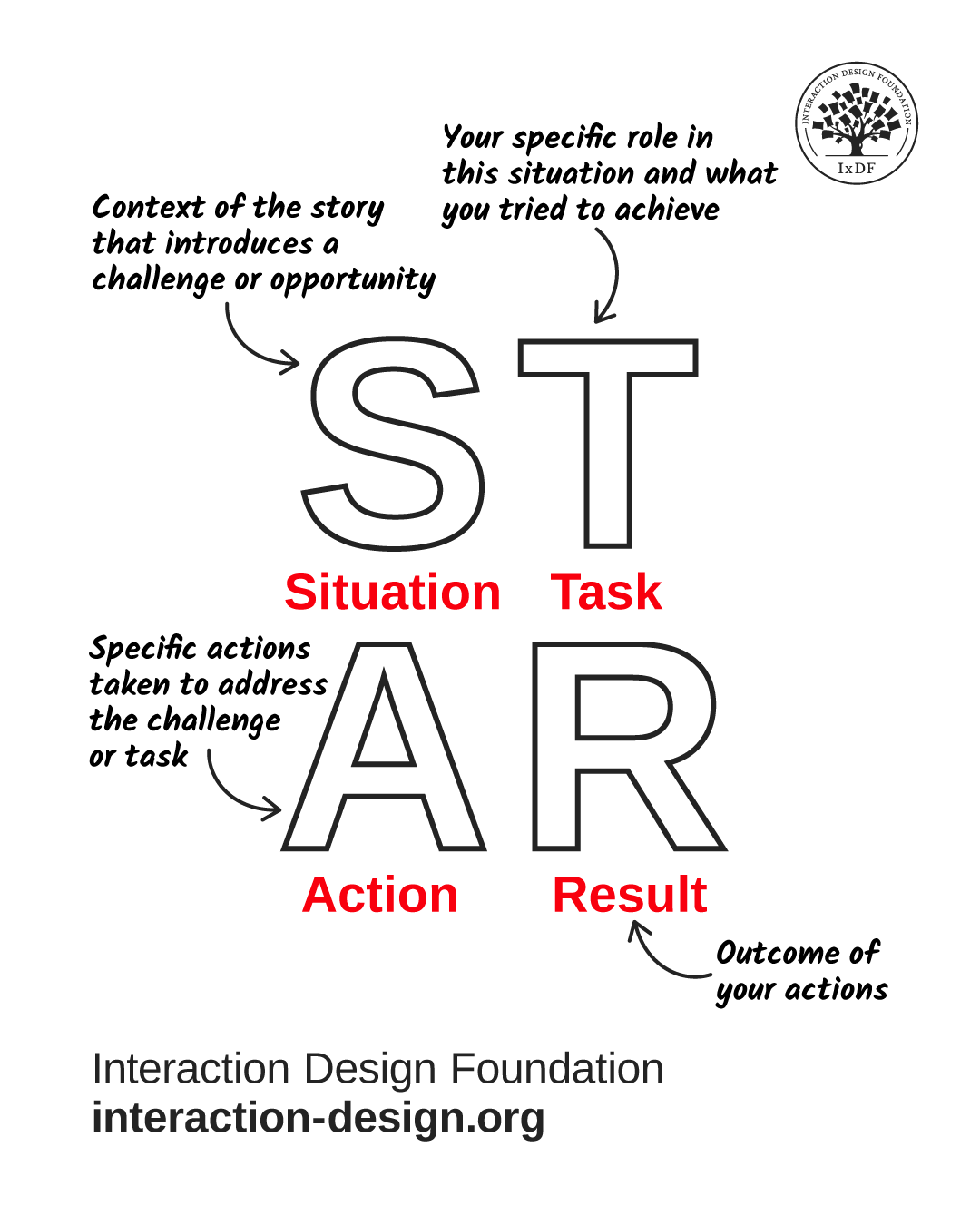
STAR Method (Situation, Task, Action, Result)
This one is best for executive updates, interviews, and status reports, STAR gets straight to the point, and hence why it’s great for when you’re facing time-starved business stakeholders. STAR stands for:
Situation: Define the challenge.
Task: Clarify your role.
Action: Detail the steps taken.
Result: Share measurable outcomes.
For example: “Our onboarding completion rate was only 55% (situation). As lead designer, I owned the redesign (task). I streamlined the flow and added progress cues (action). Post-launch, completion jumped 40% and tickets dropped by half (result).” Note how STAR delivers crisp clarity, a neat story that translates quickly and effectively.
© Interaction Design Foundation, CC BY-SA 4.0
Beyond frameworks, remember that, aside from the heroes in the storytelling, you’re the “star” of the show. So, you can shine in storytelling presentations when you focus on delivery:
Start with a hook: Anecdote, question, statistic, or scenario, perhaps something like: “Imagine you’ve just arrived in a foreign country, and your credit cards don’t work, you don’t have enough cash, and you turn to your mobile phone as a last resort.”
Make it relatable with characters: Personas, users, stakeholders, or your team.
Use conflict and resolution: Frame a problem-solution journey that resonates with your target audience.
Blend data with narrative: Marry hard facts with human stories; facts and figures might look dramatic, but you can bring it home to your audience with why they’re dramatic.
Adapt to context: Consider using micro-stories for quick updates, and full arcs for high-stakes pitches.
Get the delivery right: Voice, pauses, tone, and body language reinforce your message. Everyone can get nervous before and when they’re presenting; that’s natural. Try breathing exercises to stay calm, rehearse your presentation, and record how you look in your nonverbal communication.
Use audience awareness: Tailor depth and detail to who’s listening.
Explore how to help win over an audience when you use active listening to monitor and keep them engaged, in this video with Morgane Peng.
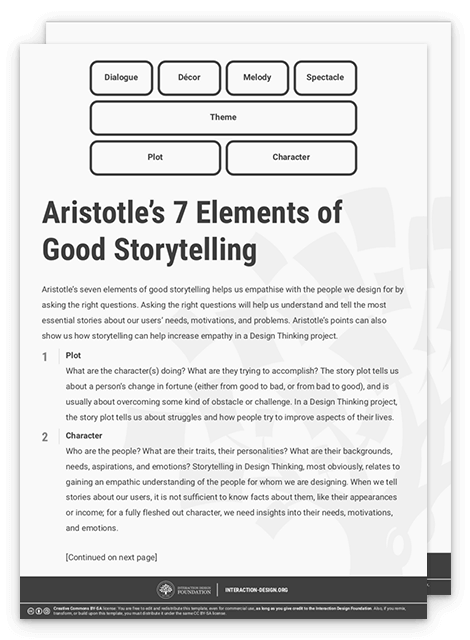
Overall, storytelling is a time-tested technique that accesses minds and hearts for good reason. Ancient humans knew that. The ancient Greek philosopher Aristotle “encoded” the “rules” of storytelling over two thousand years ago into a format that still speaks to humans, since it’s timeless. And people from all walks of life relate to stories whether they read them in fiction, watch movies and documentaries, or come to listen to presenters who’ll connect with them. For no small reason, storytelling gives you opportunities to connect, persuade, and inspire action.
Think of yourself as a narrator of change who offers an intervention that brings resolution. What makes a good UX story? It takes effective visuals to help set the stage and mood, for example, and complement the user journey narrative. It also needs a theme where your story has an underlying message or value, and let’s not forget memorable hooks to set a spectacle of standout “plot twists” and delightful moments.
UX designers who use storytelling effectively guide users from friction to flow. They take characters in specific situations through the barriers that bring conflict, and intervene with solutions that help these people realize goals and enjoy resolutions that really are happy endings.
In presentations, you guide your audience from confusion to clarity, from skepticism to buy-in, using tales that work because you don’t just explain something but make people feel it, remember it, and support it. When you master storytelling in both contexts, you don’t just inform; you inspire action, alignment, and lasting influence, and a happy ending for your own story as a professional who cares to make an impact.










 Author/Copyright holder: Teo Yu Siang and
 Author/Copyright holder: Teo Yu Siang and Interaction Design Foundation. Copyright terms and licence: CC BY-NC-SA 3.0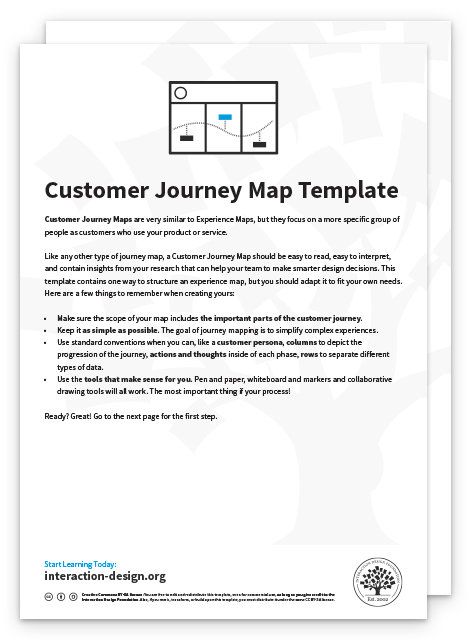
 Author/Copyright holder: Teo Yu Siang and Interaction Design Foundation. Copyright terms and licence: CC BY-NC-SA 3.0