User experience (UX) management is the practice of managing user experience design-related activities inside an organization to create growth and good management practices. Typical UX management activities define an organization’s UX design language and strategy and manage the work processes around UX design.
You can understand UX management both as a job title (i.e., a UX manager) and an organizational activity. Even when UX is the responsibility of a UX manager, it’s important that the entire organization (and especially senior management) also take an active interest in users and user needs. To practice effective UX management, leaders must ensure the strategic alignment of people and practices all in the interest of the product’s or service’s end users.
Start to build your own UX management strategy!
Good UX Management Shows in Healthy, Innovative Brands
“According to our study, design-led firms exhibit the following behaviors far more than their non-design-led peers: Consciously put the customer first. Nearly half (46%) of design leaders cited creating an emotional bond with customers as a defining characteristic of an advanced design practice.”
— Adobe (Forrester Research 2016)
A core principle of UX management is that an organization must enable and value UX resources, researchers, designers and design leaders. To do well at UX management, your company needs to have this level of organizational maturity so it can maximize its UX return on investment (ROI) and deliver consistently on it. UX ROI can be measured through metrics such as healthy conversion and drop-off rates. A solid understanding of users’ needs therefore should be at the center of all activities. The real value of effective UX management often shows when one considers the cost of UX mismanagement from such issues as stakeholders’ conflicts of interest and poor alignment between development and user needs. Naturally, a sign of good UX management is that your organization experiences growth.
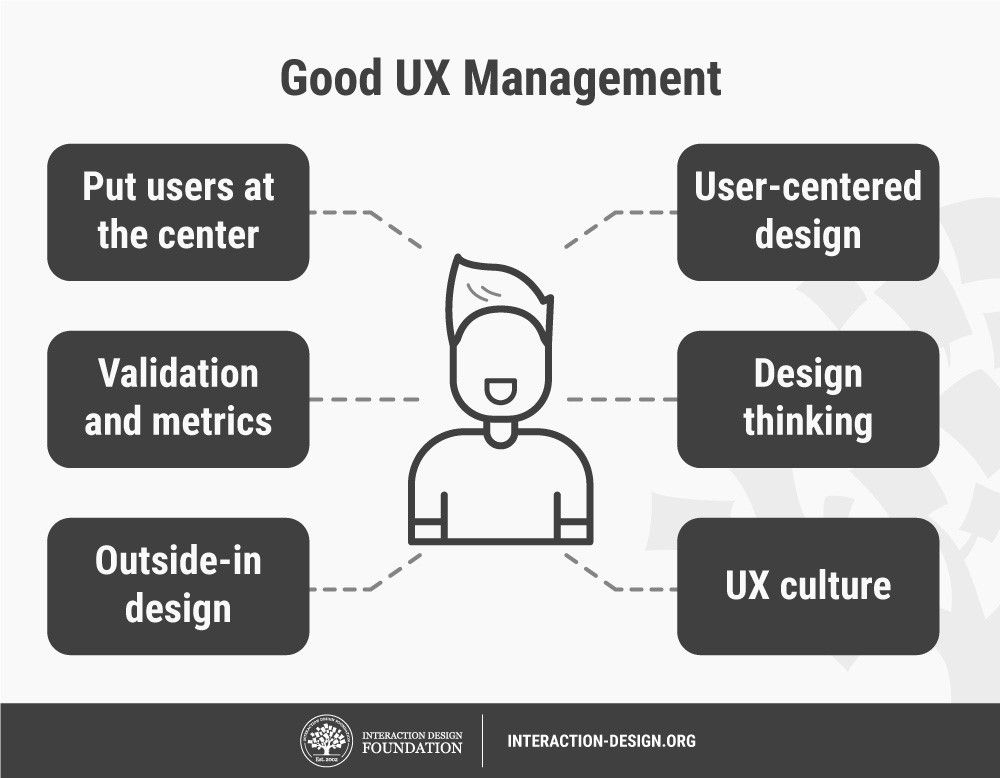
Good UX management boosts an organization’s innovation by growing a strong UX culture with a focus on user centered design and validation.
Types of UX Management
UX management comprises two dimensions – strategic and tactical. You can be adept at both, at different times.
Strategic –You focus on long-term plans: (e.g.) funding models and UX evangelism (where you promote UX in all dimensions, including aligning UX strategy with organizational goals, to identify your team as a corporate asset). You may also become involved in UX process development, project selection, etc. This is higher-level UX management.
Tactical – Aside from having solid coaching skills and addressing everyday issues, you’re a front-line leader who works directly with UX designers. However many projects your organization handles, you’ll always have one more – you need to manage your team as a collective supply of effort. UX design covers the areas of UI design, usability testing, human factors engineering, among others. Therefore, your skillset should reflect these areas. While it’s unlikely you’ll have all the intimate knowledge your various team members possess, you should still know enough to be able to direct them. Additional areas of focus are that you manage:
Up – Secure your leaders’ help to get resources/support for the team.
Across – Liaise with project managers and others as needs be.
Down – Take on administrative responsibility in regard to Human Resources concerns, training, performance assessment, geographic concerns of having an international team etc.
Besides defining experience strategies and how to deliver these, UX managers are likely to work closely with development and product managers in pursuing strategies. What’s more, they’ll likely need to master tools such as Agile and Lean.
“Management is doing things right; leadership is doing the right things.”
—Peter Drucker, Management consultant, educator and author