Storytelling plays a huge role in User Experience design and in the Design Thinking process. Storytelling creates a compelling narrative around the people we’re designing for so that we as designers can develop a deep and emotional understanding of their motivations and needs. Stories have the ability to form a common thread throughout a project, so team members can stay focussed and inspired. Stories are a great way to infuse empathy into your design project, and can be extremely useful for design thinkers. Here we’ll tell you about the elements of good storytelling, as they were taught by Aristotle, and we’ll go into the various design methods you can employ to enable stories to be a part of your design project.
Tim Brown, CEO of international design and innovation firm IDEO, advocates the use of stories to enhance a design thinking project:
“It is essential that storytelling begins early in the life of a project and be woven into every aspect of the innovation effort. It has been common practice for design teams to bring writers in at the end to document a project once it has been completed. Increasingly they are building them into the design team from day one to help move the story along in real time.”
– Tim Brown, Change by Design
It is no wonder that many of the ethnographic research methods which design thinkers use in the first stage of the Design Thinking process, the “Empathise” stage, involve some form of storytelling. To understand the true power of stories and why they teach us so much about the people we study, we can turn to the ancient teacher of storytelling, Aristotle.
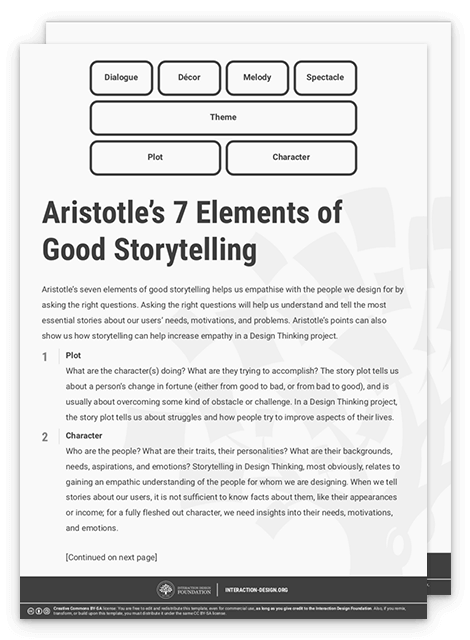
Aristotle’s 7 Elements of Good Storytelling
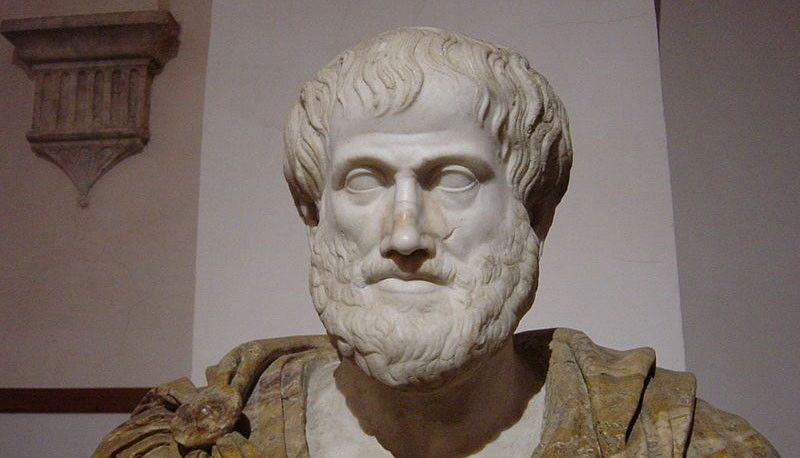
Author/Copyright holder: Giovanni Dall’Orto. Copyright terms and licence: Free to use.
Aristotle, student of Plato and teacher of Alexander the Great, knew a great deal about life, the universe and everything... and more than a fair deal about putting together stories.
Aristotle’s seven elements of good storytelling will help us empathise with the people we design for by asking the right questions. Asking the right questions will help us understand and tell the most essential stories about our users’ needs, motivations, and problems. Although initially written to describe the elements of good theatre (novels had not yet been invented yet), Aristotle’s writings on theatre are nonetheless widely used in general storytelling. Aristotle’s points can also show us how storytelling can help increase empathy in a Design Thinking project.
1. Plot
What are the character(s) doing? What are they trying to accomplish? The story plot tells us about a person’s change in fortune (either from good to bad, or from bad to good), and is usually about overcoming some kind of obstacle or challenge. In a Design Thinking project, the story plot tells us about struggles and how people try to improve aspects of their lives.
2. Character
Who are the people? What are their traits, their personalities? What are their backgrounds, needs, aspirations, and emotions? Storytelling in Design Thinking, most obviously, relates to gaining an empathic understanding of the people for whom we are designing. When we tell stories about our users, it is not sufficient to know facts about them, like their appearances or income; for a fully fleshed out character, we need insights into their needs, motivations, and emotions.
3. Theme
Why are you, the design thinker, undertaking the project? Why are the people you are studying doing what they are doing? The theme of a story tells us the overarching obstacle that needs to be crossed, or the end goal of the project. Use a theme to help keep yourself focussed and provide your team with a strong narrative to keep you going.
4. Dialogue
What are the people saying? Do they say different things when you observe them as compared to when you interview them? How are they saying it? Are they angry, disappointed, sad, or happy? While observing their dialogue, are you losing focus on the things they did not say? People often convey so much more in what they don’t say, compared to what they actually vocalise.
Dialogue is also a two-way process: it is crucial to keep track of how we, the observers, speak to the people we are observing. Having a superior or condescending tone when conversing with our users is a sure way to get their guards up and put a limit on how much we can learn from them.
5. Melody/Chorus
To be effective, your stories should have a pleasant “melody”, a chorus that resonates with your emotions and convictions. The power of storytelling often lies in its ability to stir emotion and motivate us to find a solution. When you design a solution with empathy, the story you present to your users will also help drive its success.
6. Décor
Décor is about the setting. It’s about the physical environment in which your characters perform their acts. What’s the décor, setting, and physical environment in which your users perform their acts like? Effective storytelling does not ignore the setting, because often the interactions between characters and the set will tell us a lot about their motivations and behaviours. As a design thinker, you should pay attention to the opportunities or obstacles present in your users’ environments.
7. Spectacle
Are there any plot twists in your stories? Any unexpected insights about your users? The spectacle is something that the audiences who listen to your story will remember, and will generate discussions and ideas. If your design thinking story includes a spectacle, it will be a powerful tool to drive the project forward.
Knowledge is captured in Stories
Aristotle’s seven elements of good storytelling show how a good story can not only allow us to have an empathic understanding of our users, but how it will also motivate the design team to push forward in search of a design solution. In fact, Mark Zeh, design leader at IDEO and Bose, says:
“Knowledge is captured in stories. Stories are the foundation of the process for examining a customer need and how they are behaving.”
– Mark Zeh
You can download a template for Aristotle’s 7 Elements of Good Storytelling method here:
How to add Storytelling into your Design Thinking Process
Stories are powerful tools that can inspire action, but how do you incorporate stories into your Design Thinking process? The Institute of Design at Stanford (or d.school) encourages a few methods that design thinkers can use in order to take advantage of the power of stories. We will examine two of them below — story share-and-capture and the journey map, and you will also find templates that you and your team can easily start using.
Story Share-and-Capture
 Author/Copyright holder: Teo Yu Siang and Interaction Design Foundation. Copyright terms and licence: CC BY-NC-SA 3.0
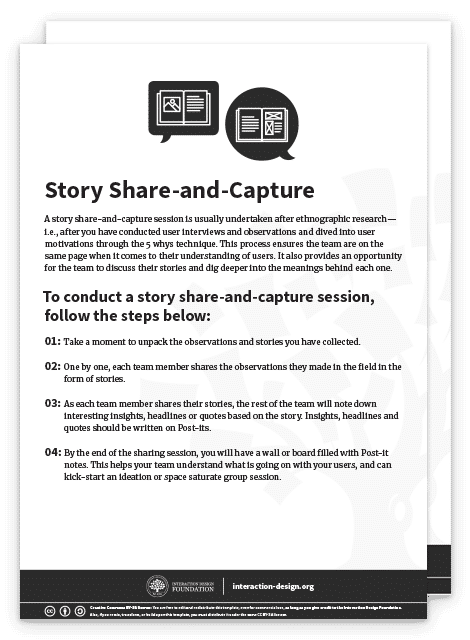
A story share-and-capture session is usually undertaken after ethnographic research—i.e., using design thinking methods such as “conducting interviews with empathy”, “building empathy with analogies”, and asking the “5 why’s.” In a story share-and-capture session, team members share the observations they each made in the field in the form of stories. Each member will share what they observed, and the rest of the team will note down interesting insights or quotes from the story.
This process allows the team to be on the same page when it comes to progress in understanding users. It also allows for discussions about the stories that each person has seen and heard, which enables the team to dig deeper into the meanings behind observations.
You can download a template for the story share-and-capture method here:
Journey Map
 Author/Copyright holder: Teo Yu Siang and Interaction Design Foundation. Copyright terms and licence: CC BY-NC-SA 3.0
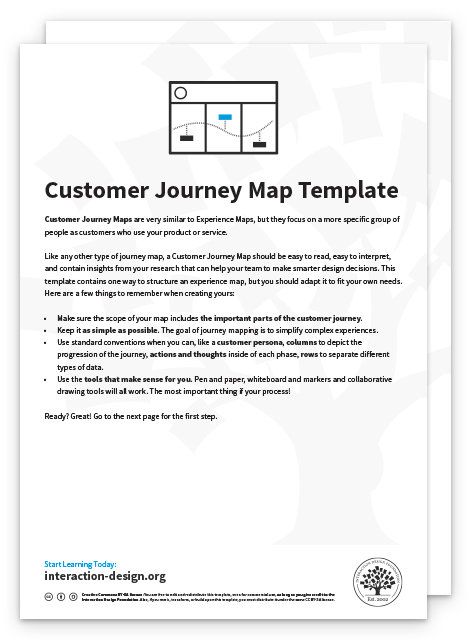
A journey map is a detailed record of a user’s experience of doing something. It could either be constructed based on your observations and interviews with the user, or it could be something that you ask the user to draw out and explain. It would contain a journey that the user goes through, and could be either closely relevant or even tangential to the focus of your project.
For instance, you could document the journey of a user’s experience of waking up in the morning and making their way to work via public transport. Try to be as comprehensive as possible, rather than filtering out details that you assume to be meaningless or irrelevant. You could organize the journey map in whatever way you think is most effective, from a timeline to a series of images.
A journey map can help you build empathy towards your users as you try to experience what they go through. It can also uncover insights, such as when you compare journeys between users to find common threads or find conflicting behaviours within a user’s journey.
You can download a template for creating a journey map here:
Storytelling and Design Thinking – When Should You Tell Stories?
 Author/Copyright holder: Teo Yu Siang and Interaction Design Foundation. Copyright terms and licence: CC BY-NC-SA 3.0
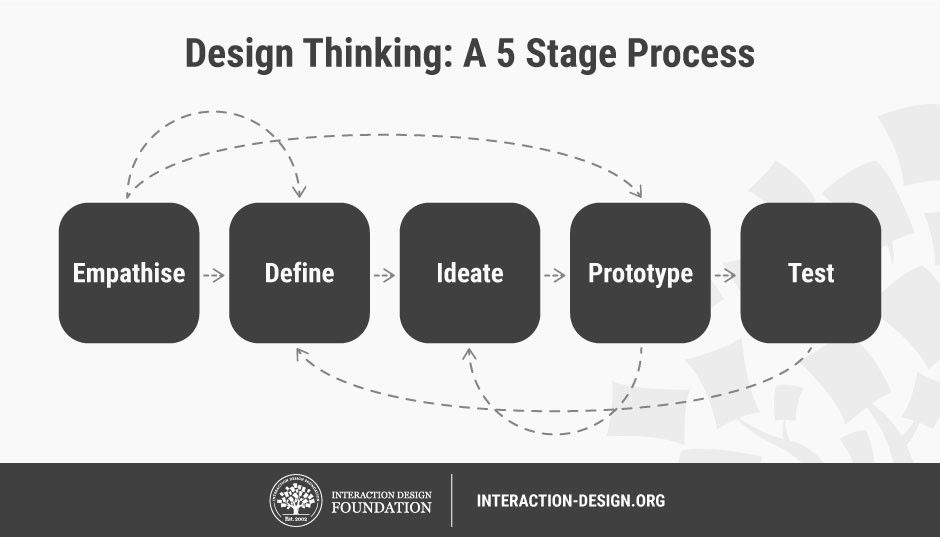
Stories can be a great help when you seek to develop empathy with your users, but they are not restricted to the Empathise stage of the Design Thinking process. In fact, you should use stories throughout the Design Thinking process and other Human-centred design processes. For example, you should tell stories when you create prototypes for users and when you try to figure out how the prototype is supposed to fit into users’ lives. It will often be a great idea to tell stories when you explain the prototypes to users when you’re testing them. Mary Catherine Bateson, writer and cultural anthropologist, sums it up beautifully in a sentence:
“The human species thinks in metaphors and learns through stories.”
– Mary Catherine Bateson
The Take Away
Stories play a significant role in the Design Thinking process. A story constructs a narrative so that we can gain a deep and emotional understanding of our users. It allows us to pay attention to various aspects of the users, including their environment, their needs, desires and problems, and allows us to design Human-centred solutions that meet their needs. Aristotle’s seven elements of good storytelling should always be applied to the Design Thinking process; doing so, we can have a holistic and well-rounded comprehension of our users. These seven elements will help us to observe and tell the essential stories—and there are also several methods, such as story share-and-capture and journey mapping, which enable us as design thinkers to take advantage of the power of storytelling so as to build empathy with our users.
References & Where to Learn More
Tim Brown, Change by Design: How Design Thinking Transforms Organizations and Inspires Innovation, 2009
d.school Bootcamp Bootleg, 2013.
Hero Image: Author/Copyright holder: Teo Yu Siang and Interaction Design Foundation. Copyright licence: CC BY-NC-SA 3.0