At its core, UX design is about fulfilling user needs — whether by solving a problem or offering enjoyable experiences. Each deliverable you create contributes to these larger goals. The whole, however, is greater than the sum of the parts. In order to succeed as a UX designer, you’ll need more than the “hard skills” to churn out deliverables. The “soft” skills aren’t merely an optional add-on to enhance your resume, but are complementary to your day-to-day design activities. Let’s see how.
In March 2022 we asked hiring managers across the globe for the top 3 skills they look for in UX candidates. An overwhelming majority of respondents (approximately 73%) chose communication and problem solving as the top skills. While understanding of design principles ranked high (61%), proficiency in design tools (the “hard” skills) was chosen by only 13% of respondents.
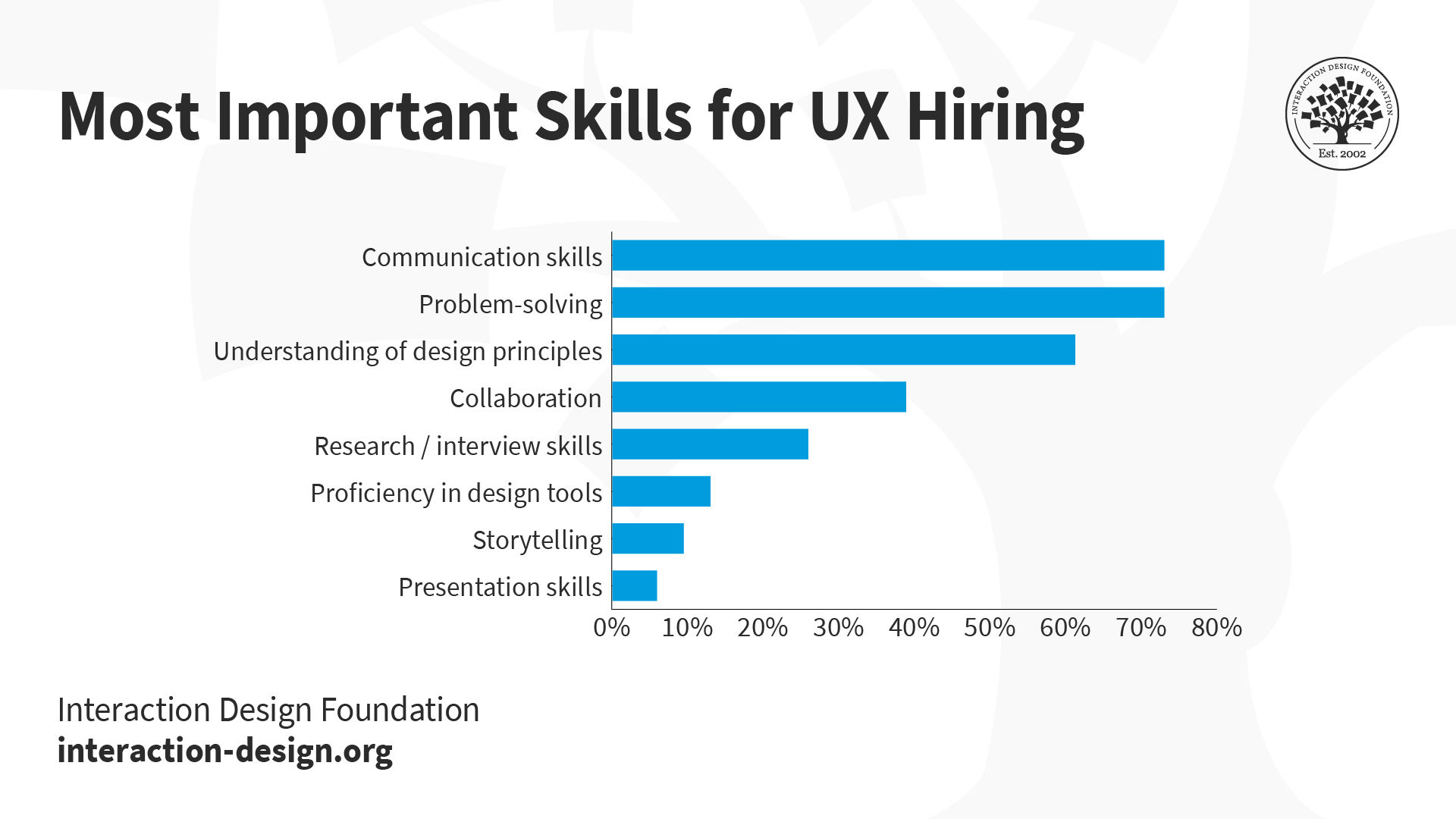
The Interaction Design Foundation surveyed hiring managers across the globe in March 2022 and asked them to choose the 3 most important skills they considered when hiring a UX candidate. They were given the options, Communication skills, Problem solving, Research / interview skills, Storytelling, Data analysis, Understanding of design principles, Knowledge of programming languages, Proficiency in design tools, Collaboration, and Presentation skills. Quite tellingly, none of the respondents chose data analysis and knowledge of programming languages among the top 3 skills they looked for.
Since many of the deliverables associated with design are tangible, it is easy to overlook the invisible skills that contribute towards those deliverables. These intangible skills are the glue that binds together the sometimes seemingly disconnected array of UX activities. More importantly, designers rely on them to carry out many of those activities. And the best part is that many of the skills prized by hiring managers are transferable to, and from other professions.
Communication Skills
Communication skills are extremely important for UX designers because several activities in UX depend on communication. In fact, the other skills that the survey respondents valued: interviewing and presentation skills also depend heavily on communication. Here is a partial list of the scenarios where communication plays a pivotal role:
To build rapport with interview and usability test participants.
To pitch ideas to business stakeholders.
To collaborate with engineers to develop the designs.
To sell the value of UX design to management and clients.
To facilitate brainstorming sessions.
In this video, Morgane Peng, Head of Product Design & AI Transformation at Societe Generale, shows why your ideas need you to speak for them.
Problem-Solving Skills
The products you design help resolve people’s pain points. Hence, it is crucial to understand users’ problems, before attempting to solve them. Hiring managers value problem-solving and critical thinking abilities in candidates — to be able to see the big picture, examine a problem from different perspectives and pay attention to the finer details. When you apply for a UX position, there is a high chance that your prospective employer will ask you to work on a problem statement.
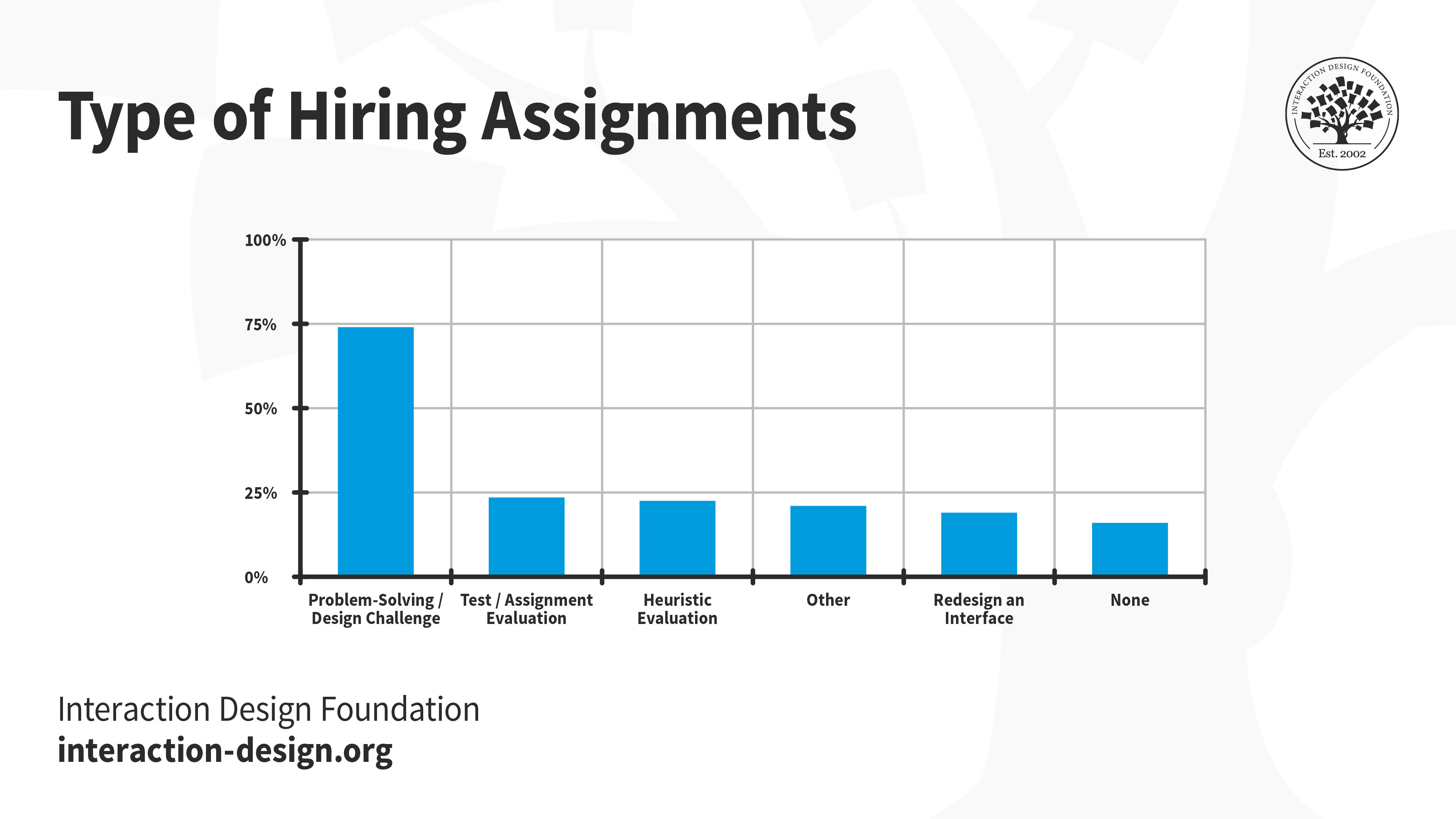
74% of hiring managers in our survey said that they gave design challenges to evaluate candidates for UX-related roles.
Understanding of Design Principles
As a designer, knowing how to use specific software programs doesn’t matter as much as staying true to the design process and knowing how to apply design principles. At a macro-level, a strong commitment to research, prototype, test and iterate is the hallmark of a good designer. You must be able to steer clear of biases, question assumptions, and most importantly, be open to changing your designs based on evidence.
As you craft the finer details of the design, a sound grasp of heuristics — both established and new research — will hold you in good stead. Similarly, knowing visual design principles and gestalt laws will help you create interfaces that are eye-catching. When you understand the underlying design principles — why certain patterns work — you can better understand competitors’ design choices and decide which of those might work in your context. This, in turn, will help you make informed decisions, instead of blindly copying patterns that work elsewhere.
Collaboration
Designers rarely work in isolation. In the early days of UX design, it was common for a one-person army to design and code. This might still be true of bootstrapped startups. But even there, you will almost certainly work with at least one more person. Most likely, you will work with people from diverse backgrounds and different types of expertise.
Cross-functional teams offer multiple perspectives, so that you (and your colleagues) can gain a well-rounded view of the problem and solution spaces. Hiring managers look for humility (being open to counter points of view) in candidates.
One of the respondents to the survey we conducted in March 2022 outlined the importance of collaboration for problem-solving. Here’s what they wrote anonymously:
“[We assess] Problem solving when there is conflict in project and team. I want to see how empathic they are and how wide their perspective is to assess and decide.”
Interview Skills
Interviews are a versatile method to glean key insights from users. Whether done stand-alone, or in combination with other methods such as usability tests and field studies, interviews present an opportunity to learn more about users and how your product fits in their context. Apart from users, sometimes you might need to interview other stakeholders such as business owners, or partners in a complex system. A genuine curiosity, and the ability to listen will help you gain the most from every interview.
Storytelling
We’re all hungry for stories, as is evident all around us: from grandma’s folk tales you heard as a child, passed down from one generation to the next, to the latest podcast or television series you’re (or rather, we all are) binging right now. Even religious texts are written as stories. We remember stories better than we remember cold facts or statistics. Marketers and advertising agencies have long capitalized on this to make us shed a tear or break into a song, whilst reaching out for money to purchase their wares. Steve Jobs’ presentations pitching Apple products are one of the finest examples of storytelling in action.
Stories help you communicate better. They also help you visualize and step into the shoes of your users. When you create personas and storyboards, you narrate the story of a character and how their story evolves. “Evelyn, a college graduate from Los Angeles who has found a rewarding career in the nonprofit sector” is far more relatable than “20-25 years old, first-time employees.”
Presentation Skills
At some point in your design career, you will need to present something — research insights, ideas, solutions, and yes, even yourself. Often, you’ll present in order to gain something from the audience to whom you are presenting. In other words, you’ll rarely present purely for communicating. You’ll most likely try to guide or convince your audience towards a decision.
Preparing and delivering a presentation is very similar to designing any other experience. You must understand your users (the audience) and what they need (the decision). You craft the story of the problem and make the case for meeting both your, and your audience’s objectives — to build your ideas, to invest in a product, or even to hire you as a designer.
The Take Away
UX designers must possess a healthy mix of both hard and soft skills. While the world often sees the former, it is the latter that helps you achieve them. Hiring managers value communication and problem-solving skills the most. And for good reason. Problem-solving is the core of UX design. And you’ll rely on communication and collaboration with a multidisciplinary team to both diagnose the problem (for example, through interviews) and come up with solutions (e.g., brainstorming sessions).
A sound knowledge, and diligent practice of design principles, along with storytelling will help you design those solutions. Finally, your presentation skills will help you string together a cohesive story that will help you “sell” your work — internally to management, and externally to clients.
These skills aren’t independent of one another — the lines between each are blurry, and each contributes to the others. For example, you can’t practice iterative design in a team without managing expectations and communicating well. Honing these skills takes practice, but the great news is, they are crucial to most project-based roles. There’s a high chance you’ve already practiced some of them as part of student, volunteer and professional work.
References and Where to Learn More
Take our course Present Like a Pro: Communication Skills to Fast-Track Your Career.
Read more on the role of storytelling in UX design here.
See our Master Class, “Learn How to Win Clients, Pitches & Approvals: Present Your Designs Effectively”. Author and Leadership Coach, Todd Zaki Warfel gives a framework to help you present your designs effectively.
Images
© Interaction Design Foundation, CC BY-SA 4.0