You may have noticed in life that few (if any!) people think like you do. So there’s absolutely no reason for you to think your users think like you either! You need to go out and meet your users if you want to properly understand and design for them, and user interviews are a great way to achieve this. They enable you to extract information about the user experience and usability of your product or service, and will also help you ideate for further solutions. All in all, user interviews are a great way to get to know your users... but is your company actually conducting them and, if so, in an effective way? Read on and learn not only how to prepare for and conduct user interviews but how to report on them too.
“Stories are where the richest insights lie, and your objective is to get to this point in every interview.”
—Steve Portigal
In this video, Joshua Seiden, Designer, Entrepreneur, Coach, and Author, explains how user interviews uncover the stories that lead to real insights, shows you how they support work from early discovery through post-launch, and walks you through a simple funnel-shaped discussion guide to structure them well.
Designers experience a constant internal battle between the temptation to design for themselves and the knowledge they should design for their users instead. Experienced designers will tell you a good mantra to follow throughout your design work is to understand your audience and design with them in mind. Whatever you do, don’t make assumptions about your users—that will lead you down a dangerous path!
You need to understand what your users’ goals are, what their needs are, and how they think and feel—as well as how all that differs from your perception of the context at hand. This will enable you to make objective decisions about how to take the design process further so it is truly centered around your users, and what delights and engages them. What’s good to know is there are many research techniques you can employ to achieve a deep understanding of your users, and a key one of those is user interviews.
What is a User Interview?
User interviews are guided interviews where a researcher asks existing or potential users questions to gain an understanding of their preferences, thoughts and feelings. User interviews can be used to examine the user experience and usability of a product or service, as well as flesh out demographic or ethnographic data for input into user personas.
The ideal user interview involves two UX researchers and one user. The first UX researcher asks questions and guides the interviewee through the interview, and the second researcher takes notes. If you’ve ever tried to ask questions, listen to responses and take notes all at the same time, you’ll know how hard it is to do all three! There’s a good chance the interview will be derailed and become hard to manage. If a second researcher is, however, unavailable and you have to go it alone, make sure to video or audio record the interview to ensure you don’t lose any information.
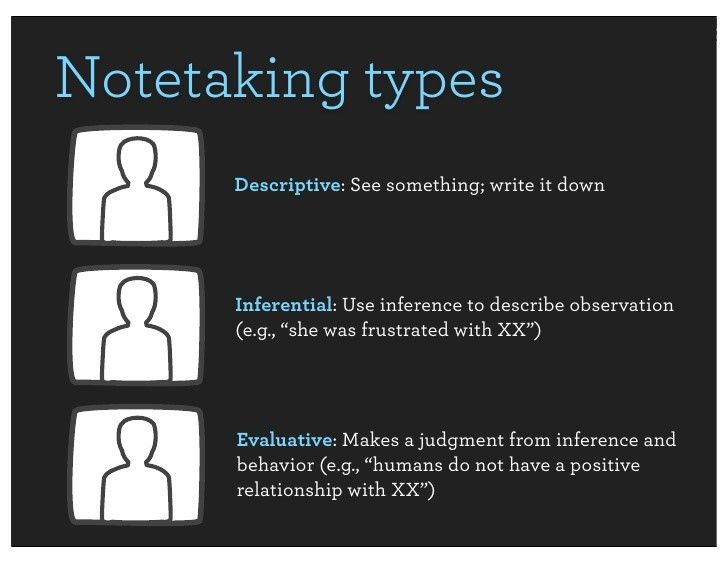
It’s important to have a second researcher when you conduct user interviews as they can then be the one to take notes. There are three types of notes you can take, however it is descriptive notes that are most important and relevant to user interviews.
© Danzico, Fair-Use.
Typical topics covered within user interviews include:
The background of the user (ethnographic data, for example)
The use of related technology
How the user uses the product
The user’s main objectives and motivations to use the product
The user’s pain points with the product
However, please don’t feel limited to these topics alone! If there’s something you need to know, and can find the answers by asking your users, make sure to include a few questions about it (as long as it’s not offensive or threatening of course!).
There is also a special type of user interview known as the contextual interview. This is an interview that is conducted after (or during) a user observation—it’s an interview “in context” with usage. You’ll find these are very common in usability testing, the assessment of products and even in information visualization.
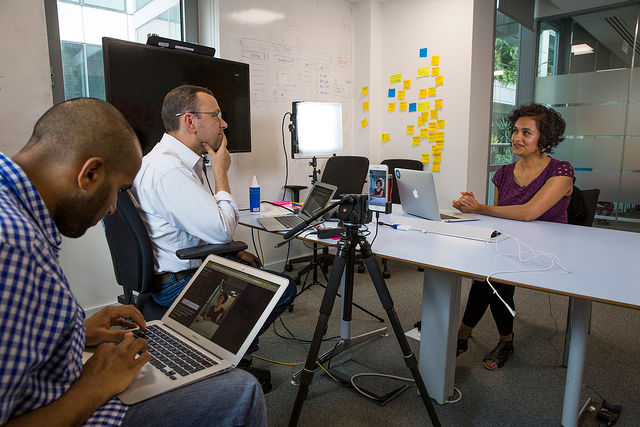
It’s important to have two interviewers when you conduct user interviews—one to focus on the questions and responses, and one to take notes. Regardless, you should also record the interview so you can look back over the footage to analyze it even further.
© gdsteam, CC BY 2.0.
When Should You Conduct User Interviews?
User interviews can be utilized at several points in the design process and, each time, they will provide key insights to ensure your project stays on track and remains user-centered. You should conduct user interviews:
At the beginning of a project, even before you’ve defined a clear concept. The information you collect during these initial user interviews will help you get a better understanding of your potential users, their wants and needs and what kind of solution you should aim for. The insights you gather will also help you develop your user personas and journey maps, as well as aspects of the product, such as features and workflows.
During the early stages of product development. Once you have an early prototype, you can conduct usability tests with your users to gain valuable feedback before the product gets properly implemented and mass produced. You should round up the observation part of the usability tests with user interviews. This will help you better understand users’ behaviors, how they perceive the product and any frustrations they face.
After the product has been put to market. Just because your product has been shipped, it doesn’t mean the user interviews have to stop! You should continue to conduct user observations and interviews (otherwise known as contextual inquiries) to give users even more of an opportunity to show you how they interact with your product.
3 Key Steps to Prepare for User Interviews
“Failing to prepare is preparing to fail.”
—John Wooden
Preparation is vital if you want your user interviews to generate useful and meaningful insights. There are three key steps you can follow to adequately prepare yourself, and they are as follows.
1. Set a Goal for Your Interviews
You need to form a concise, concrete goal for your user interviews—one that’s related to a specific aspect of your users’ behaviors or motivations is ideal. You should ask product stakeholders what they want to learn and base your goal on one of their realistic aspirations. Remember, don’t go too broad otherwise your interviews will generate too much irrelevant material. Keep your design needs in mind at all times!
2. Recruit the Right Participants
Once you’ve set a goal, you can move on to recruit participants for the interview. You’ll want to ensure you recruit a representative sample of users for your interviews, so you should start with your user personas and try to find interview participants that match them. If you have multiple user personas, now is the time to decide whether you want to focus on one particular group of users or several.
You can use various methods to source participants, including:
Personal connections
Former or current customers
Guerrilla or street interviews
Paid interviewees
You don’t need to go overboard when it comes to the number of people you recruit. There are no rules set in stone, but we recommend you start off with 5-7 participants and if by that point you’re not getting any new insights, you can leave it there.
When you schedule your interviews, pick a location that’s convenient and comfortable for both your participants and your team. Will a certain context help, for example? If the participants have certain items around them, would that help the interview? Also note that it’s a good idea to leave 30 minutes or so between each one. This will give you time to make additional notes and compile your thoughts before you move onto the next participant (you don’t want to get everything jumbled up in your mind!).

Your user personas are a great place to start when you want to decide which participants to recruit for your user interviews. If you have identified multiple personas, you’ll need to decide whether to stick to one or try to cover them all.
© Travis Isaacs, CC BY 2.0.
3. Write a Set of Interview Questions
Now you’ve got your interviews in the diary, it’s time to create a set of questions to ask your participants. Some tips to help you do so include:
Before you even start with your questions, script an explanation of the purpose behind the interview—what are you trying to achieve? In this introduction, also explain how the participants’ data and insights will be used.
Keep leading questions to a minimum—focus on open-ended questions, and leave out the closed-ended questions wherever possible. It’s much better to ask “Can you describe to me how you use instant messaging?” than “How often do you use Snapchat?”, for example. The former lets you explore what the user actually does whereas the latter presupposes the user uses Snapchat, and that this is the extent of their instant messaging activity. For more information on how and why to use open-ended questions, please see our free template:
Advance Your Career With This Free Template for “How to Ask Open-Ended Questions”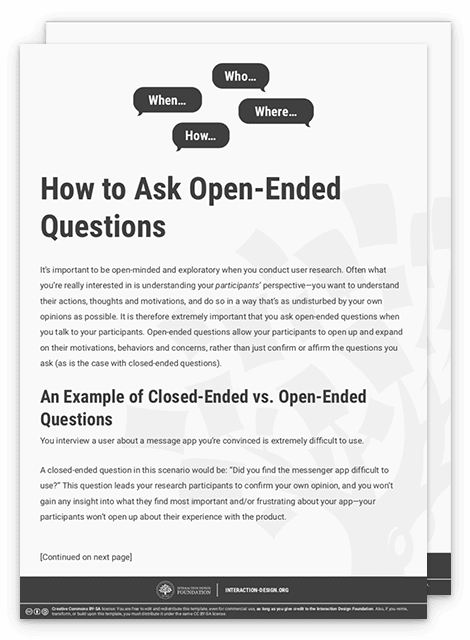
Prepare more questions than you think you’ll need. Make sure you include questions that allow you to approach the same issue from different angles yet also bear in mind the interviewee should be the person who talks for the majority of the interview (not you). It’s also good practice to start with the easy, less intrusive questions and build up to the more complex and thought-provoking ones—ease your participant into it in other words!
Anticipate different responses and create follow-up based questions based on your research goals.
Don’t forget your questions are a guide, not a script. If you find your interviewee says something particularly interesting in an interview and there are no relevant questions to explore that idea… explore it anyway. Amend your set of questions based on this in case something similar gets brought up in future interviews.
You can learn more about how best to create your interview questions in our Interview Guide templates:
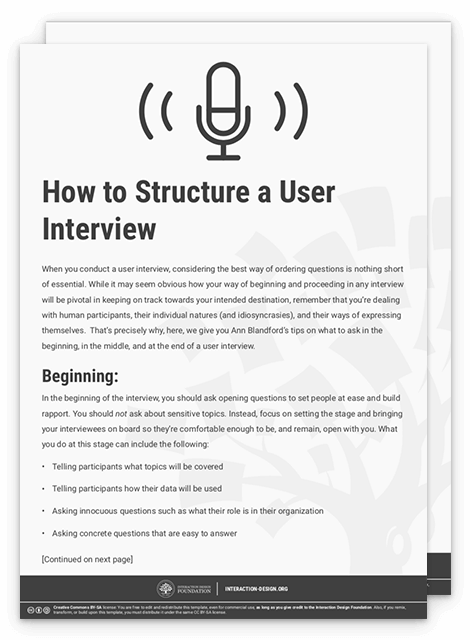
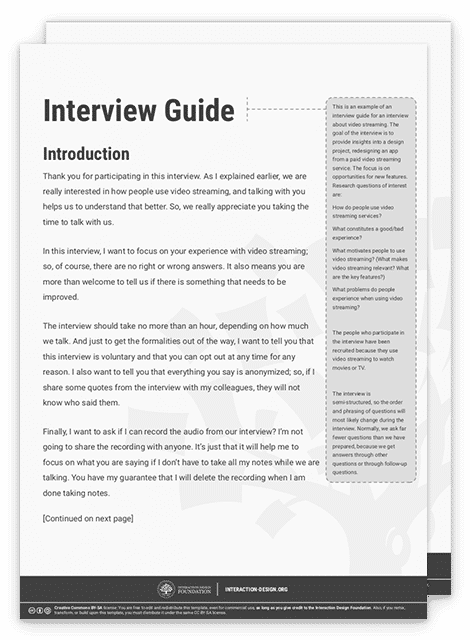
How to Conduct a User Interview
Preparation gets you to the door. What happens inside the room is a different skill entirely.
However, a few key techniques will take you from nervous note-taker to confident interviewer faster than you'd expect.
Start by Making the Participant Comfortable
Open every interview the same way. Introduce yourself, explain the purpose of the session, and remind the participant that there are no wrong answers. You're studying the product, not them.
Say something like: "We're here to learn from your experience. There's nothing you can say that would be wrong or unhelpful. In fact, the more honest you are, the better."
This matters more than it sounds. People instinctively try to give "correct" answers. Your job in the opening two minutes is to undo that instinct.
Hunt for Stories, Not Opinions
Opinions tell you what people think. Stories show you what people actually do.
Instead of asking "Do you find this process frustrating?", ask "Tell me about the last time you used this feature. Walk me through exactly what happened." Concrete stories are where your most valuable insights live.
Master the Pause
Silence can feel uncomfortable, but you must resist the urge to fill it.
When a participant finishes answering, wait three to five seconds before you respond. More often than not, they'll keep talking, and what comes next could be more revealing than what came first.
Jumping in too quickly is one of the most common interviewer mistakes. The pause is your most underrated tool.
Use “Why” and “Tell Me More” As Your Defaults
When a participant says something interesting, don't move on. Dig in.
"That's interesting. Why did you do it that way?"
"Can you tell me more about that?"
"What did you mean when you said it felt confusing?"
These simple follow-ups consistently reveal the deeper insights your discussion guide alone won't reach.
Stay Flexible With Your Discussion Guide
Your questions are a compass, not a script.
If a participant takes the conversation in an unexpected and genuinely interesting direction, follow them. You can always return to your guide. The most valuable insight from an interview is often the one you didn't think to plan for.
Watch Your Body Language
Nod. Make eye contact. Keep your expression open and neutral, not visibly excited when they say something that confirms your hypothesis, and not visibly deflated when they don't.
Your reactions subtly shape how participants answer. Stay curious and even throughout.
Close With an Open Door
End every interview by asking: "Is there anything else you'd like to share that we haven't covered?"
You'll be surprised how often this question surfaces something important. Then thank the participant genuinely: Their time is a real gift to your design process.
The more interviews you conduct, the more natural all of this becomes. Your first few will feel awkward. That's normal. Push through it. Because the insights waiting on the other side are worth it.
If you want to add even more empathy to your user interviews, check out the following template:
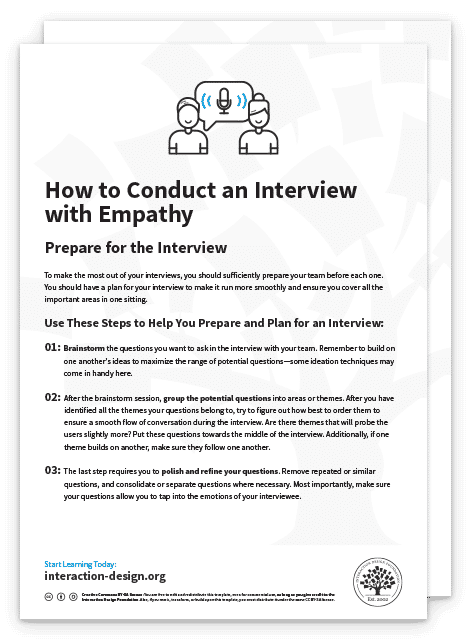
How to Report on a Series of User Interviews
Now your user interview is complete, it’s time to report on all the qualitative data you have collected. It can be a challenge to compile the results of several interviews, and techniques such as word clouds and mind maps are two good ways to present qualitative data in an interesting but easy-to-understand format.
To dig into your interview findings a little further, we recommend you follow the steps of a ‘thematic analysis’. This fancy sounding term means identifying, analyzing and interpreting patterns in data. What you heard in your user interviews is data, even though it may not seem like it!
Familiarize yourself with your data. Listen to your recordings and either transcribe or take lots of notes.
Generate initial codes. When you encounter a particularly interesting comment or section of the recording, create a descriptor code for it – e.g., “comparing products”. Apply the same code to other comments which you think belong in the same category, and create new codes for aspects that haven’t been discussed before. When you’ve coded all the key sections of your interviews, collate all the interview extracts so they fit into groups under each descriptor code.
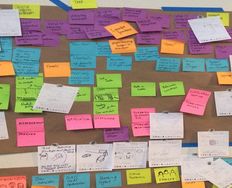
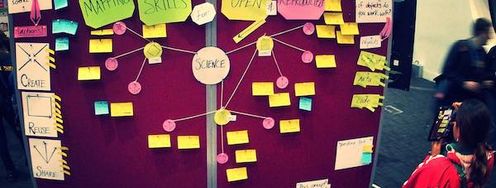
Search for patterns or themes in your codes across the different interviews. This is an iterative process where you can move codes around multiple times to form different themes. A good tip is to write your codes on sticky notes to make it easier to move them around and get a better overview.
Review and refine the themes. Read through all the interview extracts in each theme and consider if there is clear coherence inside each one, and also a clear difference between themes. Combine themes you find too similar and split up themes that don’t cohere meaningfully. When you think all your themes work, take a step back and consider if your themes cover what’s most interesting in your data, or if anything is missing. Add and remove themes in an iterative fashion until you’re satisfied your themes suitably represent the insights from your interviews.
Define and name themes. Look at each of your themes. Define what the theme is about and give it an appropriate name.
You can download more detailed advice about how to conduct thematic analysis in our template:
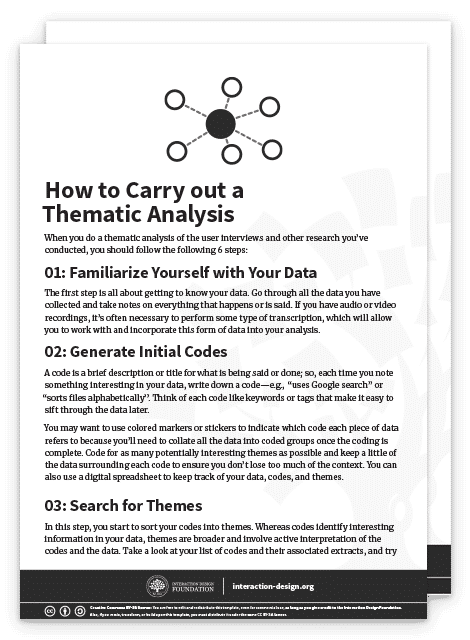
Once you’ve identified the themes in your data, you can translate the findings into a more formal written or visual report—something you’d be happy to show your manager or client.
The Drawbacks of User Interviews
Hopefully you now feel fully prepared to go and conduct some effective user interviews! Before you dive in however, you need to take a look at some of the drawbacks of user interviews to ensure you have a well-rounded mindset and approach to the process.
There’s a difference between what humans say and what they actually do. Even if they are contextual, interviews tend to give insights into what people say they will do and this is sometimes (often, even) not the same as what they actually do. This is why the 5 whys method is so crucial and can help you get more accurate insights.
Human memory is flawed and we can often struggle to recall details as clearly as we would like. Unfortunately, it’s a human tendency to try and create these details (this is not even a conscious process) to tell a story the way we think something happened, rather than how it happened. Ask the same questions in multiple ways to try and overcome this and help you spot discrepancies in the data.
Participants often leave out small details because they deem them insignificant. Make sure you repeat how important such details are for the purpose of your project and keep asking them “Why” to uncover more details about what they did and why.
It’s important to keep these drawbacks in mind when you design your interview questions and execute the user interview. You should also take them into account when you evaluate a set of user interviews—interview data gives you a starting point to examine problems but rarely provides a finishing point which delivers 100% certainty as to what to do next. As the designer, that decision will be up to you!
The Take Away
User interviews are guided interviews where a researcher asks existing or potential users questions to gain an understanding of their preferences, thoughts and feelings. They are a great opportunity to meet your users, understand and start to design for them.
As with most things in life, preparation is key! You need to set a goal for your interviews, recruit the right participants and write a set of interview questions if you want to have any chance of getting valuable insights from your participants.
When it comes to conducting the interview itself, it's important to build a rapport with your participants, explain the purpose of the interview, ask open-ended questions and make sure your body language keeps interviewees at ease throughout.
Thematic analysis is the best way to analyze your interview data and will help you discover the key insights that your manager and client will be interested in.
References & Where to Learn More
Course: User Research – Methods and Best Practices
Steve Portigal, Interviewing Users: How to Uncover Compelling Insights, 2013
Images
Hero Image: © David Davies, CC BY-SA 2.0.