Design education is the study and application of design principles across multiple disciplines. Designers learn how to communicate clearly and solve problems, and understand how to create visually appealing designs with aspects such as line, shape, color, typography, and much more.
Don Norman: Father of User Experience design, author of the legendary book The Design of Everyday Things, co-founder of the Nielsen Norman Group, and former VP of the Advanced Technology Group at Apple, explains how design education needs to adapt to changing times.
How Important is a Good Design Education?
A solid design education is critical for several reasons, whichever area of design work a prospective designer might choose. Among other principal areas, these include user experience (UX) design and user interface (UI) design. Here are the most prominent purposes to seek a good formal grounding in design:
Imparts Critical Thinking and Problem-Solving Skills
A strong educational background in design fosters creativity, critical thinking and problem-solving skills. The biggest challenge in any project is often to define problems correctly from the outset. A clear design mindset helps companies save time, effort and costs as it means they are far less likely to waste resources or even build the wrong thing. One of the foundational frameworks that helps teams and leaders develop these skills is design thinking.
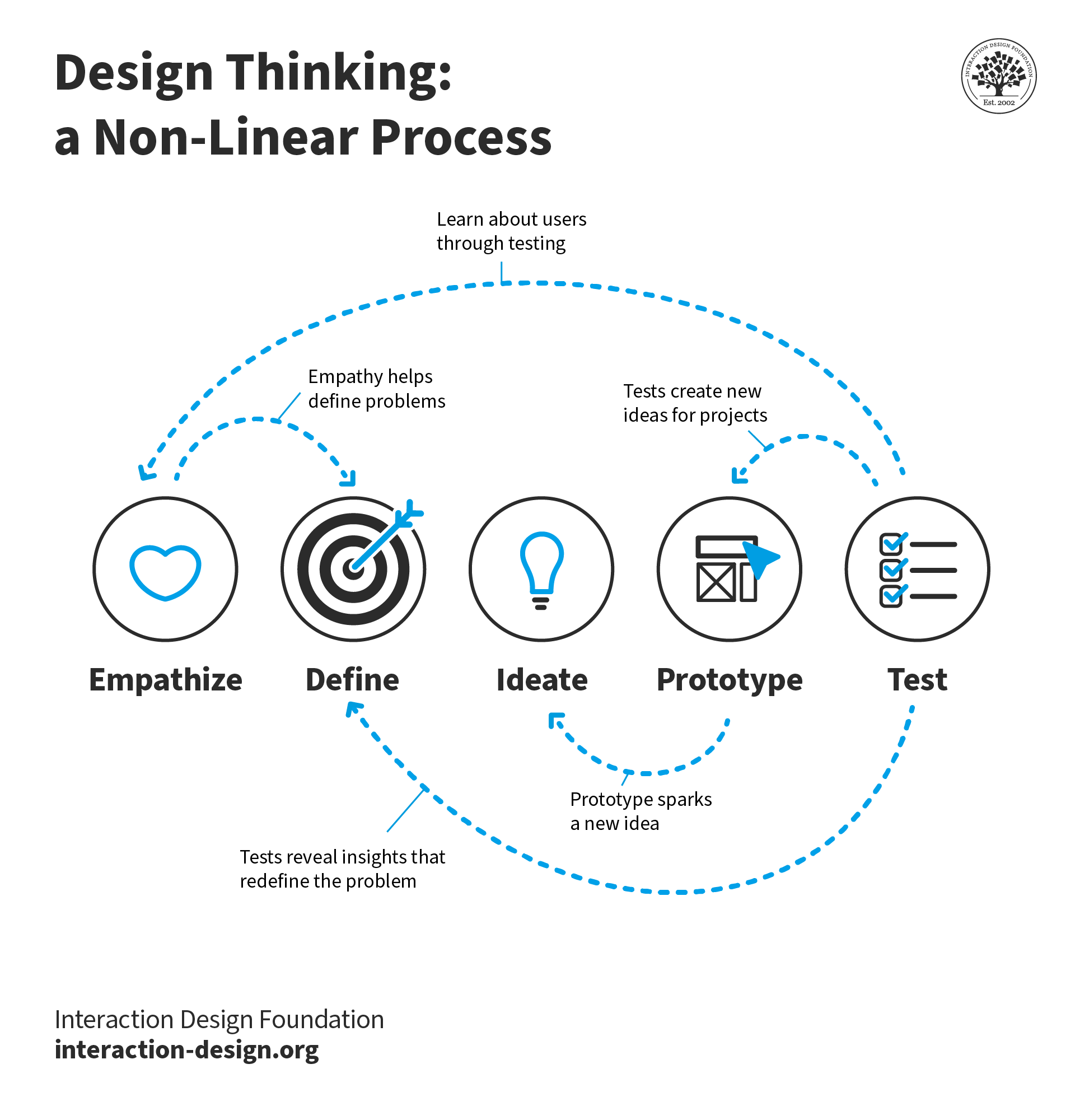
Design thinking is a non-linear process that fosters innovations. Design education often includes a version of this framework.
© Interaction Design Foundation, CC BY-SA 4.0
Designers often work in teams, and collaborate with different stakeholders and departments, such as management, marketing and development. Strong communication skills help designers voice their professional opinions well and always advocate for the user. Design itself is a form of communication. In the right educational environment, designers learn to optimize how to get their points across, listen, and collaborate to maximum effect.
Promotes Empathy towards the End User
Designers must be able to empathize with users. That empathy is key to seeing past assumptions or biases about the target audience. When designers understand users’ needs, they can create designs that appeal to them. This is particularly important in areas like web and application design, where people are quick to delete applications that don’t meet their expectations.
A solid educational foundation means designers can harness valuable knowledge and tools to design seamless interfaces. These will be what sustain their users through their many micro- or sub-tasks as they pursue their goals. For example, the people in a target audience who use a design will often be pressed for time. They’ll typically be using mobile devices with one hand while distracted. They’ll also likely have an exceedingly low tolerance for delays or confusion. The designers of that app will want to delight them, ideally, but at least not make them pause or become confused. So, it’s vital to bear in mind that the design of any digital product involves much foresight, painstaking preparation and carefully managed time to account for this. With well-applied design knowledge, designers can for example make effective personas, investigate user journeys, and engage in helpful journey mapping to address user needs. Then they can confirm or disprove assumptions about their users, expose oversights, and explore precious insights through user testing.
This short video explains how vital it is for designers to factor empathy, for the people who will use what they create, into their work.
Provides In-Depth Knowledge of Design Principles
A good educational program offers a systematic way to learn, practice, and apply an array of design concepts. These include Gestalt principles, use of white space and typography, and involve long-established “truths” about how humans perceive designs. There are also other fine points, such as the use of color to appeal best to users from diverse cultures.
A good education equips designers with the skills they need to create user-friendly and aesthetically pleasing digital interfaces. For example, a strong foundation in these principles will help them make good judgments about which UI patterns to implement for mobile apps or web design. Also, a deep appreciation of information architecture and hierarchy will be a deciding factor in how well designers can convert users through products.

Google’s iconic homepage represents the fusion of the above three points. Its simplicity may mask some carefully considered design decisions, but its effectiveness is practically self-explanatory.
© Google, Fair Use
Offers a Nuanced Approach to Design
It’s important to consider how learning design differs according to a designer’s chosen career path. For example, for UX designers, a good design education can help them to understand best how users interact with digital products. From there, they can appreciate what users expect from these interactions and why. It equips designers with the skills to conduct user research, create user personas, design user flows, and prototype and test their designs.
For UI designers, a robust tutoring in design can imbue them with the knowledge to create intuitive and attractive user interfaces. UI designers learn about color theory, typography, layout principles and other visual design elements. From there, they can significantly influence a user's experience with a digital product. Note that career paths can overlap, and some might find themselves in the role of a UI-UX designer.
Enhances Chances of Employment
Many designers, often self-taught, have learned “on the job” without obtaining certification as such. Still, while a design education is not strictly a requirement to get a good UX position, it certainly is a precious asset that employers and clients will likely prioritize. Plus, it provides massive funds of theoretical know-how that designers won’t get in, for example, an internship position.
Designers may have innate talent. However, to tap that talent and hone it to create impactful designed products, they will need a strong formal grounding in design. That’s why it’s crucial to spend a good amount of time hunting for the right type of education for their needs. It can prepare them well for design jobs that will be the most rewarding.
This analysis of YouTube sheds insights on how they leveraged design patterns to great effect.
What are Essential Skills from Design Education?
Good design education should equip designers with a wide range of skills. These include:
Visual Design Skills: Understand elements like color, typography, composition, and imagery.
UX/UI Design Skills: Be able to create user-friendly and aesthetically pleasing interfaces.
Problem-Solving Skills: Be able to identify design problems and create innovative solutions.
Communication Skills: Be able to convey design ideas and concepts effectively to members of the design team and other stakeholders.
Technical Skills: Become familiar with design software and tools like Adobe Creative Suite, Sketch, Figma, etc. Tools may change over time; the knowledge designers need to apply them is often timeless, however.
Research Skills: Be able to conduct user research and usability testing to inform design decisions.

User research, including qualitative research and quantitative research, is a key ingredient in winning products.
© Interaction Design Foundation, CC BY-SA 4.0
Critical Thinking: Have an enhanced ability to analyze situations or problems from a critical perspective. This will enable designers to make informed design decisions.
Empathy: Understand and share the feelings of others. This skill helps designers create products that resonate with users on an emotional level.
Innovation: Be able to think outside the box and come up with unique design solutions. This is a valuable skill that a good design education should nurture.
Collaboration and Leadership: Be able to work well with others and take ownership for producing deliverables, etc. Design education should also focus on developing leadership skills and the ability to work effectively in a team. This is because most design projects in the real world require collaboration among various stakeholders.
Project Management: Designers often must juggle multiple projects at once. That makes project management skills crucial, as well as proficiency in project management methodologies and project management tools. These include planning, organizing, and managing resources to successfully complete specific project goals and objectives.
Cultural Awareness: In an increasingly globalized world, it’s vital to understand different cultures and perspectives. This can help designers create products that are inclusive and resonate with a diverse user base.
Expert in human-computer interaction, Professor Alan Dix explains how it’s essential to have an appreciation for the many national and cultural groups that make up a product’s or service’s user base.
How to Gain the Best Design Education
Prospective designers will need to focus on both theoretical knowledge and practical application. So, they should go for courses that offer a comprehensive curriculum. A proper curriculum or diploma / degree study program should cover everything from basic design principles to advanced UX and UI design techniques. These courses should also provide opportunities for hands-on projects that allow designers to apply what they’ve learned.
For example, courses from the Interaction Design Foundation offer a wide variety of subjects to suit specific career paths. Students can fine-tune their study program based on whether they want to be UX designers, UI designers or UX researchers, among other roles. They can then become well-versed in the topics they will need to be fluent in when it comes to their design work. IxDF courses that can help a student become a UX designer include User Experience: The Beginner’s Guide, Human-Computer Interaction: The Foundations of UX Design, and Conducting Usability Testing. If students prefer UI design, courses like Mobile UI Design and UI Design Patterns for Successful Software are valuable essentials.
These courses not only cover the theoretical aspects of design. They also offer practical exercises and real-world examples to help students understand and apply the concepts. What’s more, with IxDF courses, students can flesh out their design education with portfolio projects. The IxDF also has a huge array of masterclasses on various subjects. Some of the industry’s most notable figures contribute massive funds of insights in these online classes.
Whichever school design students attend or courses they take, it’s vital to continuously update their skills and knowledge. The world of design is constantly evolving. So, it’s essential to stay updated with the latest trends and technologies. This could involve attending workshops, webinars, design conferences, or even online tutorials.
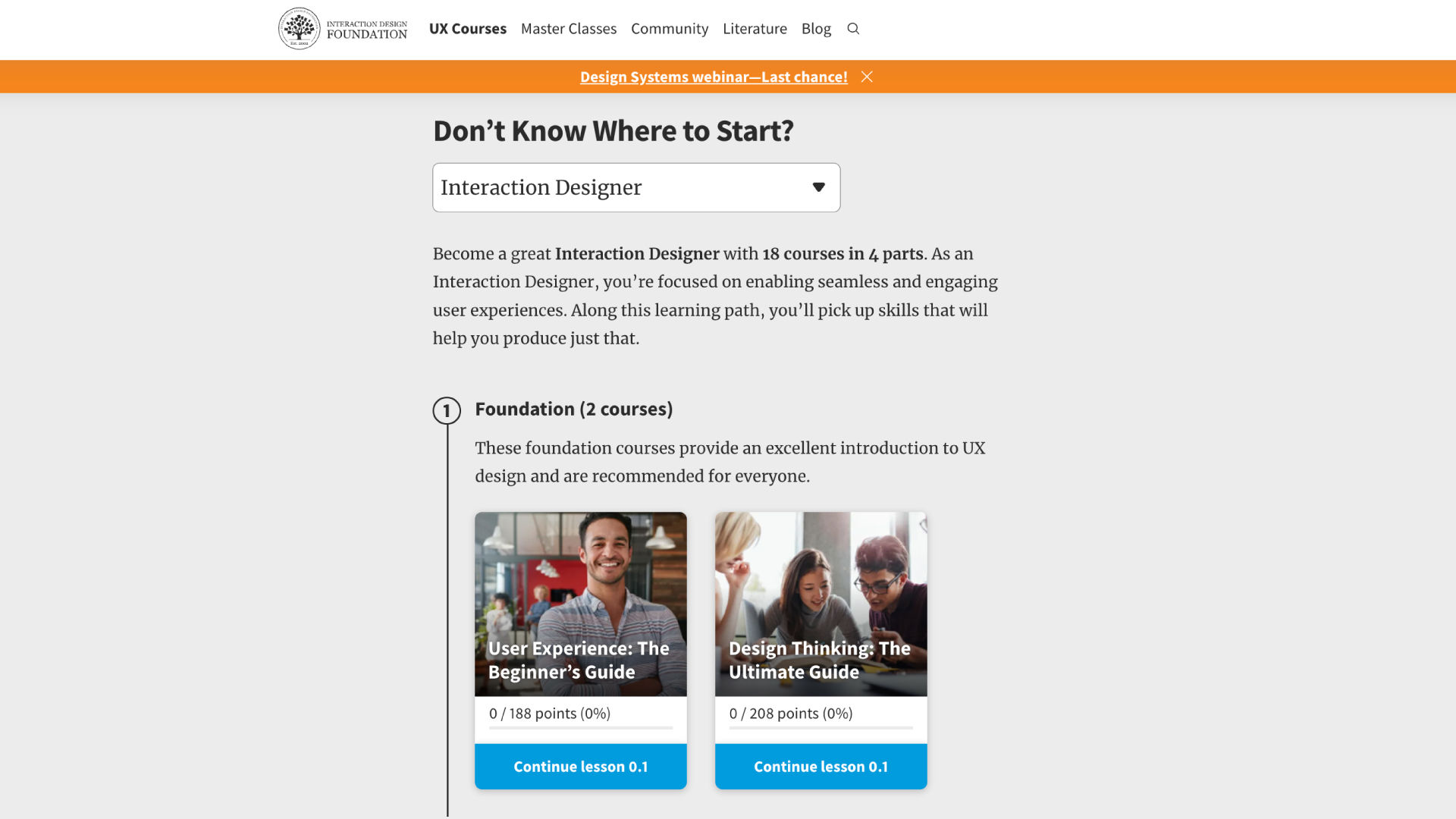
The IxDF offers dedicated curricula according to a student’s chosen career path. They start with the foundation and move onwards and upwards.
© Interaction Design Foundation, CC BY-SA 4.0
What’s the Duration and Cost of a Good Design Education?
The duration and cost of design education can vary greatly depending on the program and institution. For instance, a bachelor's degree in design can typically take around four years to complete. Meanwhile, a master's degree can take an additional two years. With some courses and bootcamp-oriented resources, however, students can be up and running with a certificate within a year or so. Some schools, such as the IxDF, offer highly convenient study programs that afford great flexibility for students with busy lives who might not be able to commit to full-time study away from the working world.
As for the cost, it can typically range from a few thousand dollars for online courses to tens of thousands for degrees from renowned institutions. However, many educational institutions offer financial aid, scholarships, or payment plans to help ease the financial burden. Still, it’s important to bear in mind that design education is a commitment to make, regardless of how costly and time-consuming it may be. Plus, students will need to ensure they keep up with the rapidly evolving design industry and its attendant technologies and tools. Also, traditional design education may not cater to all learning styles. It may not provide the flexibility that online or self-learning options offer, either.
In the mid-2020s, the cost of design education runs from approximately $5,000 to the $20,000 mark. The means of education likewise range between online classes, live Zoom-based classes, and in-person classes on campus. So, it's crucial to bear in mind that this represents a substantial financial commitment. However, remember too that a robust design education can pave the way for a broad spectrum of career opportunities. Plus, it can potentially result in an increased earning potential over time. Also, it's worth giving due consideration to the value of the skills and knowledge that a student stands to acquire. These could prove to be priceless in the dynamic and constantly evolving landscape of the design industry.
In the case of the Interaction Design Foundation, membership fees are less than $25 per month. This includes access to courses, community features, and downloadable resources such as templates.
What are the Best Schools for Design Education?
Several reputable schools offer excellent design education programs. In no particular order, these include:
1. Interaction Design Program at George Brown College
Study format: Possible to progress online (in-person may be necessary—based in Toronto, Canada)
Duration: 3 years (full-time)
Price: ~$20,000 USD (for domestic students)
George Brown College offers an exceptional program for beginners or experienced students who seek a deep dive into the realm of interaction design. It includes UX design. This is a traditional program of full-time study from a top-tier name.
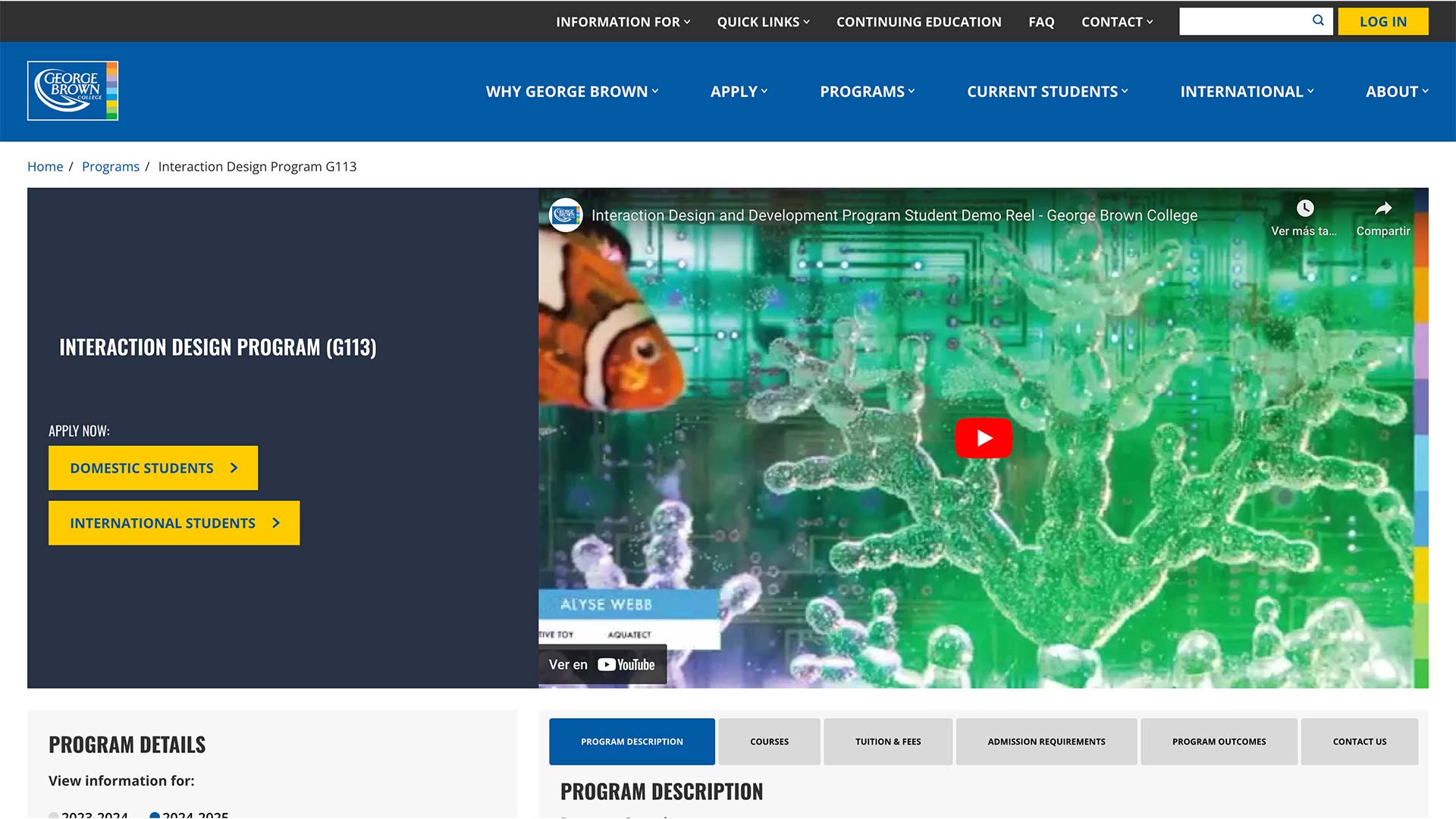
© George Brown College, Fair Use
2. User Experience Design Certificate at University of California San Diego
Study format: Currently 100% online
Duration: 15-21 months
Price: ~$5,400 USD
The User Experience Design Certificate is a solid choice for a certification accredited through an American institution, and it offers a wide range of electives. It’s typically administered online and in-person. Classes feature the Blackboard learning system. Most use a mixture of theory and hands-on work.
The program runs quarterly, so students register for and complete 1-2 courses every three months until they complete the full curriculum. The core curriculum covers UX basics and responsive design. Students can choose two electives, learning about topics such as UI design and various conforms of coding.
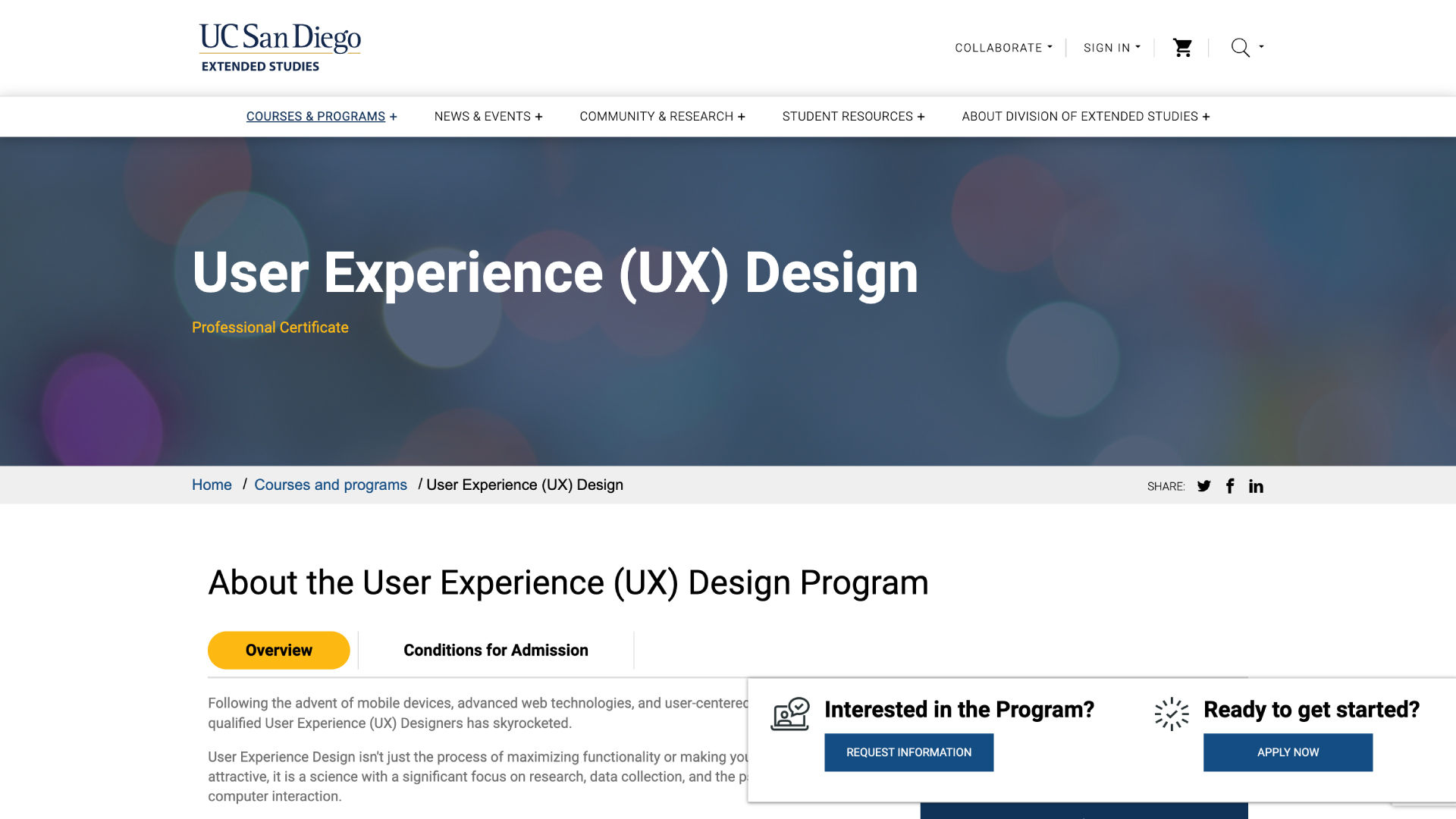
© UC San Diego, Fair Use
3. Professional Diploma in UX Design at the UX Design Institute
Study format: 100% online, asynchronous
Duration: 6 months or less
Price: €2550–3500 (or around $2929–3484 USD—depending on the exchange rate)
UX Design Institute’s Professional Diploma is a great option that provides the basics of design thinking, UX design, as well as the key processes and deliverables that professional designers user.
Upon enrolment, students can request early access to all modules, learning materials, and project briefs—or can wait for their cohort’s start date and proceed with the study plan. It takes an average of 5 hours each week on studying and completing projects to finish the study plan in 6 months.
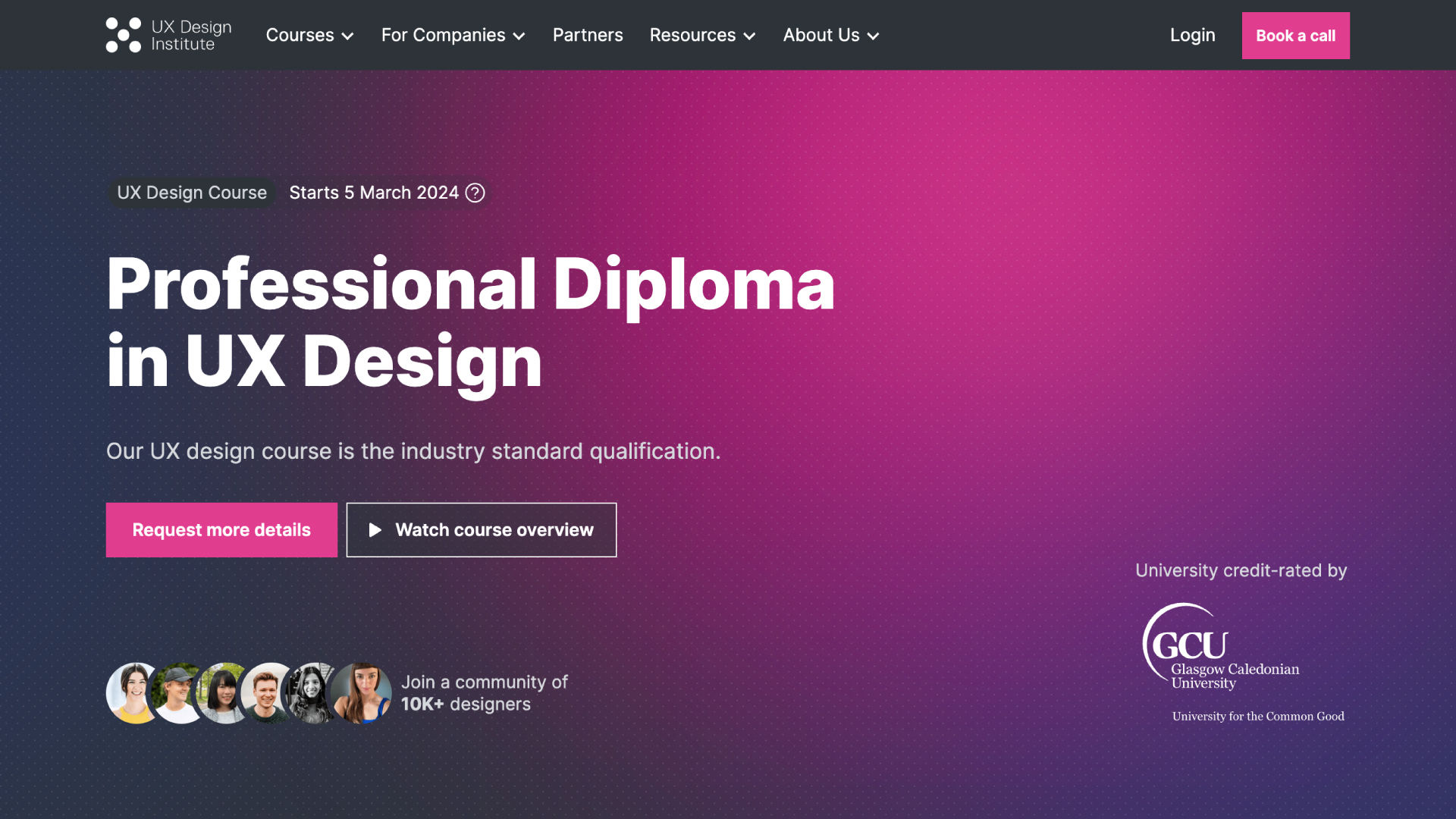
© The UX Design Institute, Fair Use
4. UX Design Program at CareerFoundry
Study format: 100% asynchronous, online
Duration: 5-10 months
Price: $7,505-$7,900 USD
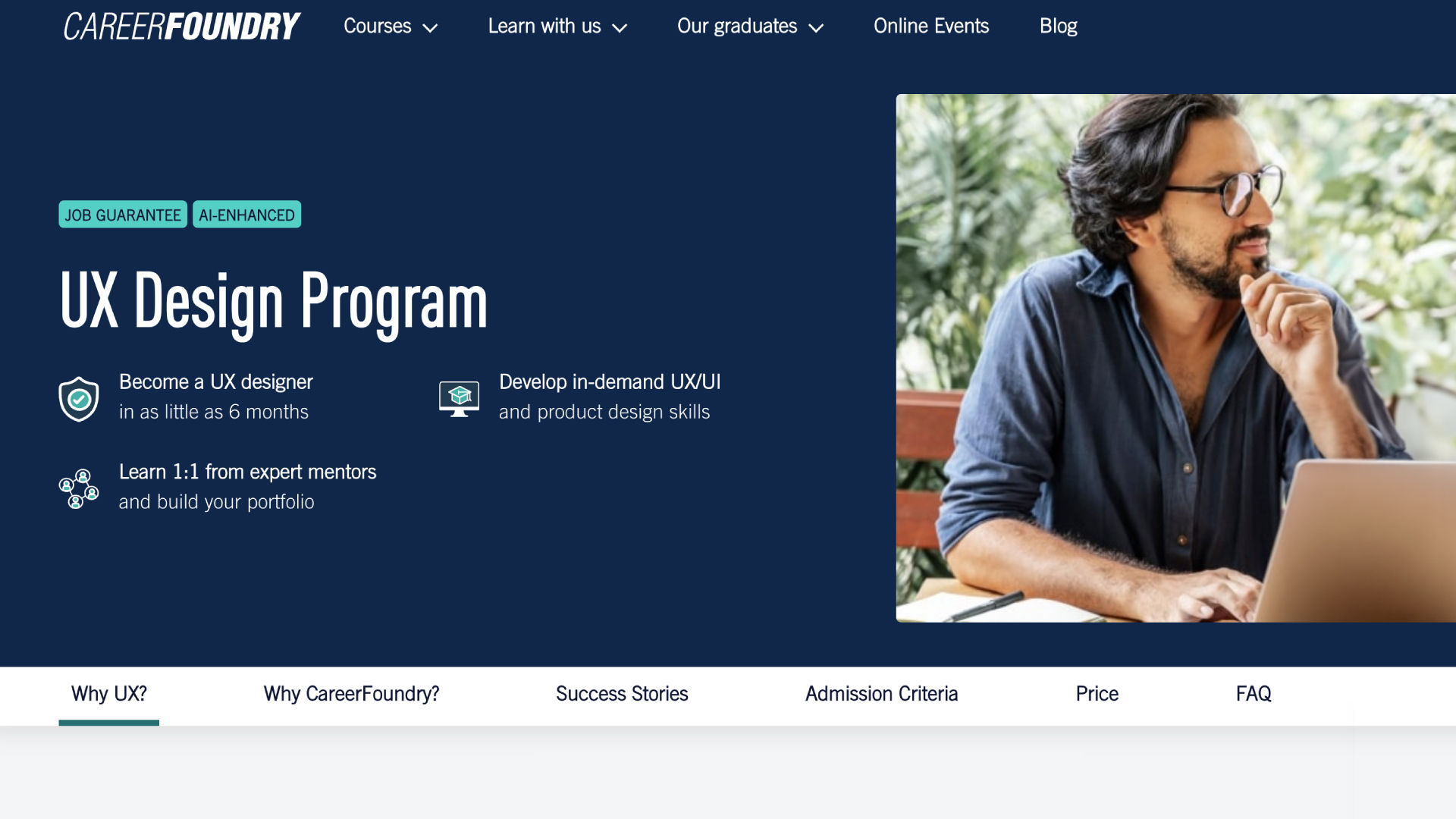
This UX Design Program is a great choice for students seeking a new career in UX who need a lot of flexibility around commitments, and who desire detailed, individualized mentorship from field experts. It gives a solid immersion in UX—from basics to highly specialized knowledge in key areas—and a job guarantee. Courses consist of reading materials that experts author and supplementary videos. The projects help students build UX design skills and a professional portfolio that get them ready for their chosen UX jobs.
© CareerFoundry, Fair Use
5. The Interaction Design Foundation
Study format: 100% online
Duration: Self-paced (no deadlines)
Price: <$20 USD per month for membership
The Interaction Design Foundation (IxDF) helps both individual students (see membership fees, above) and companies. With the IxDF, students can expect benefits such as:
Discounts on the best UX tools (e.g., Balsamiq, Justinmind).
Studying with a school that gets the best reviews.
Over 40 online courses that cover the full spectrum of user experience and design education.
Membership that pays for itself with unbeatable value.

© Interaction Design Foundation, CC BY-SA 4.0
The most important features to look for are, of course, the school’s reputation and level of industry recognition. For example, with over 167,000 graduates since its inception in 2002, the IxDF offers certification in numerous levels of design and has been acclaimed by Forbes.com as:
“Ivy League level education in UX, Product Design or Human-Computer Interaction”.
Brands that Value Design Education
The importance of UX design amid technological advances in the 2020s is undeniable. Naturally, many brands understand the importance of design education and invest in it. For instance, Google has a team dedicated to UX design and research. Google also continually invests in design education for their employees. IBM also places a high emphasis on design thinking and has an entire division dedicated to design research and education. IBM and Adobe also train their teams with IxDF courses.
The Future of Design Education
Advancements in technology and changes in the design industry will have a major influence on design education. Designers can expect more online learning options, as well as more focus on interdisciplinary and collaborative projects. Plus, they can anticipate a stronger emphasis on real-world, problem-solving skills. Design education will continue to evolve to meet the needs of learners and the demands of the industry.
An essential point comes from Don Norman, a prominent figure in the field of design. Norman is particularly known for his books on design and usability such as The Design of Everyday Things. He has advocated for change in design education for various reasons, including:
Interdisciplinary Learning: Norman emphasizes that design does not exist in isolation. Designers often need to understand the context in which their products will be used. That means integrating knowledge from fields such as psychology, sociology, and anthropology.
Emphasis on Complex Systems: Modern problems are becoming increasingly complex, requiring designers to think in terms of systems rather than standalone products. Design education should prepare students for systemic thinking and problem-solving.
As Don Norman explains, especially in the 21st century, everything is a system when it comes to design.
User-Centered Design: There is a continuing need for designers to focus on the users, their needs, and their behaviors. Education must instill a deep understanding of user experience (UX) principles.
Technological Proficiency: As technology advances, designers must be proficient with the latest tools and understand the implications of new technologies on design.
Sustainability and Ethics: Designers of the future must be educated about sustainability and the ethical implications of their designs, considering the environmental and social impacts.
Here, Niwal Sheikh, Product Design Lead at Netflix, states how to put ethical AI at the forefront. Particularly in the age of AI, it’s vital to keep ethics top of mind as a designer.
Business Acumen: Understanding the business aspects of design, including how to communicate the value of design to stakeholders, is becoming increasingly important.
Collaborative Skills: Design education should foster collaboration, as modern design projects often require cross-functional teamwork.
Adaptability and Lifelong Learning: The rapid pace of change in technology and society means that designers must be prepared to continually learn and adapt.
The Opportunity to work with Nontraditional Groups in addressing Local Problems: The chance to work with diverse groups such as city councils, engineers, etc. in tackling issues that are local to designers.
Considering these principles, it's clear that design education must be dynamic, multifaceted, and forward-thinking. It equips students with the technical skills necessary for their craft. At the same time, it should also foster a broader understanding of the contexts and implications of their work. Ultimately, the goal is for designers to use it to be not just proficient in their field, but also socially responsible, adaptable, and lifelong learners.
Lastly, a structured design education program can indeed provide a comprehensive understanding of design principles and their application. Still, remember that UX design is a cutting-edge field. Therefore, it's important for designers to continuously update their skills and knowledge to stay relevant in this rapidly evolving field.