The Ecosystem Map

Understand the Service Design Process

by Jodi Forlizzi and John Zimmerman • 13 min read

569 Shares

A user-centered design process maps the current state of the world and envisions preferred future states in the form of new computational artifacts. Service design relies on a similar process with some important differences. Most importantly, a service design process results in a system, a service concept and a strategy for transitioning from the current system to the preferred system. Unlike UCD and UX, which focus almost exclusively on the user, service designers discover solutions at the intersection of the service provider’s and customer’s needs. As a result, a service design gets expressed through a series of models that serve as a description of what a service is, how it meets the needs of customers and how it fulfills the goals and initiatives of multiple stakeholders (Goldstein et al., 2002).

You can get an overview of a typical service design process in this video where Frank explains the overall stages.

Transcript

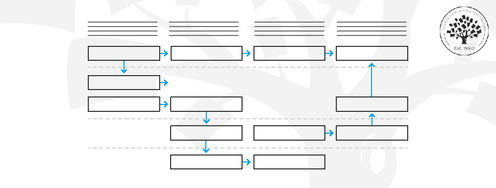
Three models commonly used to map the current state and investigate a preferred future for service design are a stakeholder model, a service blueprint and a customer journey map. A stakeholder model details the total set of relationships, generally from the perspective of a single stakeholder within the service system. A service blueprint maps a customer’s trajectory through a service, often to complete a task, such as buying a home (Bitner et al., 2008). It reveals the sequence of interactions the customer experiences across a collective set of touchpoints and then documents the elements and resources the customer interacts with and also the backstage business resources that must coordinate to provide the service. A customer journey map also maps a trajectory through a service, but with a focus on the customer’s motivations, experiences and emotions (Samadzadeh, 2015). The goal with all of these models is to represent elements in a way that rearrangement or alteration reveals changes to the whole system (Sevaldson, 2011). Products, services, people and relationships are represented in totality.

Service design models and plans become the basis for coordination of a service design team. Models are used to keep all team members in agreement, to develop scenarios and concepts and to consider implications of new products, services and systems that are introduced into the service ecology. They support a solution that is developed iteratively and holistically, evaluated and refined over time and put forth in the world with confidence.

In many ways, service design and design practice in HCI are quite similar. Both start with background research to understand the current state and to identify the needs of customers and users. Service design deviates a bit in that it also works to identify the strategic initiatives of the service providers. UCD, UX and service design all involve prototyping. With service design, this often includes construction or simulation of specific environments where customers and service providers interact with each other. One key difference here is that service designers often develop the scripts used by human service providers. Service design teams create the tools and technology being used and the workflow supporting the service. HCI work, in contrast, generally only addresses the computational device and the interface used by the customers and the service providers. HCI and UX generally do not design scripts detailing how people should carry out their work.

To reduce the risk of deploying services that fail both in terms of the desired customer experience and the service provider’s ability to perform a service, service design teams will prototype their service design, iteratively improving the design in order to reduce or eliminate risks. When prototyping, design teams assess and refine their designs focusing on how customers understand the service solution, how the design fulfills a customer need and how the service creates value for both the customer and the provider (Polaine, Løvlie and Reason, 2013). Service prototyping often starts with needs validation, where initial service concepts are evaluated by framing them around a customer’s expressed or latent needs. It then takes the form of iterative prototypes, where more and more detail is added to understand how the service unfolds in a physical and social context, and what resources and touchpoints are needed to deliver it. Often, an experience prototype or user enactment—a built-out prototype with the goal of sampling social interaction around the service—is used to assess a proposed service (Bucheneau and Fulton Suri, 2000; Odom et al., 2012).

References and Where to Learn More

  • Bitner, M. J., Ostrom, A. L., & Morgan, F. N. (2008). Service blueprinting: a practical technique for service innovation. California management review, 50(3), 66-94.

  • Buchenau, Marion, and Jane Fulton Suri. "Experience prototyping." In Proceedings of the 3rd conference on Designing interactive systems: processes, practices, methods, and techniques, pp. 424-433. ACM, 2000.

  • Goldstein, Susan Meyer, Robert Johnston, JoAnn Duffy, and Jay Rao. "The service concept: the missing link in service design research?" Journal of Operations management 20, no. 2 (2002): 121-134.

  • Odom, William, John Zimmerman, Scott Davidoff, Jodi Forlizzi, Anind K. Dey, and Min Kyung Lee. "A fieldwork of the future with user enactments." In Proceedings of the Designing Interactive Systems Conference, pp. 338-347. ACM, 2012.

  • Polaine, A., Løvlie, L., & Reason, B. (2013). Service design. From Implementation to Practice. New York: Rosenfeld Media.

  • Samadzadeh, Shahrzad. 2015.
    Customer Journey Map or Service Blueprint?

  • Sevaldson, B. (2011). “GIGA-Mapping: Visualisation for complexity and systems thinking in design.” Nordes, (4).

Image

Hero Illustration: © Interaction Design Foundation, CC BY-NC-SA 3.0

Topics in This Article

Learn More in This Course:

AI for Designers

12 days
13 % booked
View Course

What You Should Read Next

  • Read full article
    The Principles of Service Design Thinking - Building Better Services - Article hero image
    Interaction Design Foundation logo

    The Principles of Service Design Thinking - Building Better Services

    Service design is all about taking a service and making it meet the user’s and customer’s needs for that service. It can be used to improve an existing service or to create a new service from scratch. In order to adapt to service design, a UX designer will need to understand the basic principles of

    Social shares
    1.4k
    Published
    Read Article
  • Read full article
    UX Roles: The Ultimate Guide – Who Does What and Which One You Should Go For? - Article hero image
    Interaction Design Foundation logo

    UX Roles: The Ultimate Guide – Who Does What and Which One You Should Go For?

    Do you have the ambition and enthusiasm for a career in UX design but don’t know where to start? You’ll be pleased to know there are many paths you can take. Even as a relatively new field, user experience (UX) design has both general and specialist job roles. This variety means there is a role wait

    Social shares
    1.2k
    Published
    Read Article
  • Read full article
    Customer Journey Maps — Walking a Mile in Your Customer’s Shoes - Article hero image
    Interaction Design Foundation logo

    Customer Journey Maps — Walking a Mile in Your Customer’s Shoes

    Perhaps the biggest buzzword in customer relationship management is “engagement.” Engagement is a funny thing, in that it is not measured in likes, clicks, or even purchases. It’s a measure of how much customers feel they are in a relationship with a product, business or brand. It focuses on harmony

    Social shares
    1.1k
    Published
    Read Article
  • Read full article
    Service Design - Design is Not Just for Products - Article hero image
    Interaction Design Foundation logo

    Service Design - Design is Not Just for Products

    Service design is concerned with the design of services and making them better suit the needs of the service’s users and customers. It examines all activities, infrastructure, communication, people, and material components involved in the service to improve both quality of service and interactions b

    Social shares
    1k
    Published
    Read Article
  • Read full article
    The Moment of Truth: Build Desirable Relationships with Users and Customers - Article hero image
    Interaction Design Foundation logo

    The Moment of Truth: Build Desirable Relationships with Users and Customers

    In order to understand “the moment of truth”; it’s important to understand the customer lifecycle with a brand or product. There are many moments at which a customer (or potential customer or former customer) will interact with a brand.A moment of truth is simply any interaction during which a custo

    Social shares
    980
    Published
    Read Article
  • Read full article
    Product-Service Hybrids – When Products and Services Become One - Article hero image
    Interaction Design Foundation logo

    Product-Service Hybrids – When Products and Services Become One

    Mikal Hallstrup,, the Chief Visionary Officer of Designit says; “The world doesn’t necessarily need more products, it needs better solutions.” While a solution may commonly be a product or a service, it’s more likely to be a combination of the two in many instances today.The combination of a product

    Social shares
    896
    Published
    Read Article
  • Read full article
    10 Ideas to Help You Sell UX Work - Article hero image
    Interaction Design Foundation logo

    10 Ideas to Help You Sell UX Work

    We know that UX is important. Google knows that UX is important. But when it comes to selling in UX work it can often feel like nobody else knows that it’s important. Clients and colleagues often seem completely intractable on ideas when we present them. So how can we better serve those customers an

    Social shares
    841
    Published
    Read Article
  • Read full article
    Top Service Blueprint Templates - Article hero image
    Interaction Design Foundation logo

    Top Service Blueprint Templates

    Service blueprint tools are vital for effective customer experience design—and for designers to make experiences that are exceptional. Here, we’ll discuss why these tools are so important. What’s more, we’ll explore templates and practical resources to create high-quality, efficient service blueprin

    Social shares
    636
    Published
    Read Article
  • Read full article
    Making sense of new UX words: A first dictionary for UX Ecosystem Design - Article hero image
    Interaction Design Foundation logo

    Making sense of new UX words: A first dictionary for UX Ecosystem Design

    User experience (UX) is very much about communicating, advocating and spreading. As UX practitioners, we spend a great amount of our time engaged in these types of activities. To help you learn and understand new buzzwords, I have written this article to introduce some of the words related to the Us

    Social shares
    538
    Published
    Read Article
  • Read full article
    Keep These Goals in Mind to Create Successful Service Designs - Article hero image
    Interaction Design Foundation logo

    Keep These Goals in Mind to Create Successful Service Designs

    It’s important to have a good understanding of the ideal goals of service design—we need to know what to reach for if we want to create great service experiences! Here Frank explains the origins and goals of service design, so we know what to strive for in our own designs.[[video:138]]Download our T

    Social shares
    505
    Published
    Read Article

Top Articles

Top Topic Definitions

Feel Stuck?
Want Better Job Options?

AI is replacing jobs everywhere, yet design jobs are booming with a projected 45% job growth. With design skills, you can create products and services people love. More love means more impact and greater salary potential.

At IxDF, we help you from your first course to your next job, all in one place.

See How Design Skills Turn Into Job Options
Privacy Settings
By using this site, you accept our Cookie Policy and Terms of Use.
Customize
Accept all

Be the One Who Inspires

People remember who shares great ideas.

Share on:

Academic Credibility — On Autopilot

Don't waste time googling citation formats. Just copy, paste and look legit in seconds.

Feel Stuck? Want Freedom?

Join 326,020+ designers who get one powerful email each week. Learn to design a life you love.

Next email in
1
day
16
hrs
21
mins
29
secs

Free forever. No spam. Unsubscribe anytime.