You've searched for the perfect persona template, downloaded dozens, yet none quite hit the mark. Here's the problem: Most templates fail you because they focus on demographics, fancy sliders, and irrelevant details. None of these things help drive decisions or create solutions that improve lives. But search no more. You've found the simple, easy-to-use template that cuts the fluff and delivers the insights your team needs to build products people love. Get ready for fast decision-making and laser focus on your users. Your teammates, business, and customers will thank you.
Here's a liberating truth: The best personas fit on one page. They contain only what drives decisions. No fluff. No filler. Just pure, actionable insight that your team can use immediately. Every detail earns its place through usefulness.
Think about it this way: Would you rather have a 20-page report that nobody reads, or a one-page guide that everyone uses daily? When you use minimal personas, it makes them quick to scan and easy to remember. This way, you start solving problems immediately rather than getting stuck in endless documentation.
Need a quick recap on why we use personas? In this video, William Hudson, User Experience Strategist and Founder of Syntagm Ltd, gives a quick overview.
With this approach, you can create your first persona right now. Not next month. Not after extensive training. All you need is this template and your research. Let’s get started.
How to Create a User Persona with a Template: Step-by-Step
You’ve done your research, and you’re ready to pour it into a persona. Each element of this template serves a specific purpose, but remember—you should only include that which shapes your decisions. Think carefully about each inclusion. Quality beats quantity every single time.
Name and Photo
© Interaction Design Foundation, CC BY-SA 4.0
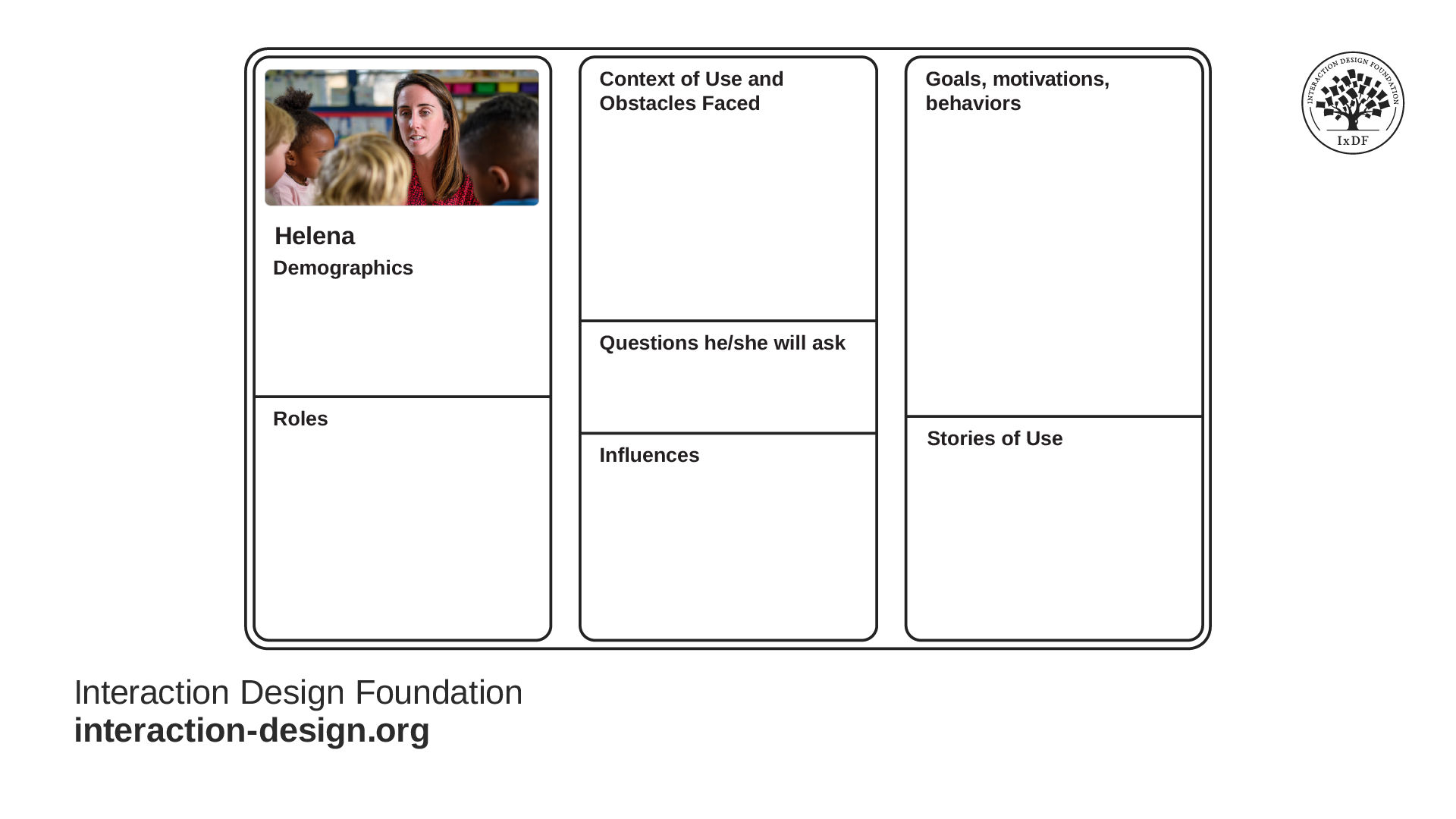
Names make your persona real. "Helena" becomes someone you care about, someone whose success matters to you. Choose natural names that fit your context. While alliterative names like "Busy Betty" or "Manager Mike" can help with memory, they're not necessary. What matters most is that the name feels real and doesn't carry stereotypes.
Your team will naturally start asking "What would Helena want?" instead of having abstract debates about features. It's a simple but powerful shift from "user" or "customer." In this video, William Hudson explains what happens when we design for individuals (Helena) instead of groups (users).
Next, it’s time to put a face to the name and create an instant connection. Use real participant photos when possible, as they are the most authentic option. When you can't use participant photos, the next-best choice is an AI-generated image since you can tailor it precisely to your needs. In this video, Pablo Stanley, Designer and CEO of Musho and Lummi, shows you how to write prompts that result in natural-looking and unbiased AI photos.
[[video: 1948]]
Always use an action shot where possible. A tired teacher mid-lesson tells more truth than a posed model with a textbook. Match contexts carefully: teachers in classrooms, restaurant owners in their establishments, retail managers in their stores. This authenticity builds the empathy that drives great solutions.
Demographics
© Interaction Design Foundation, CC BY-SA 4.0
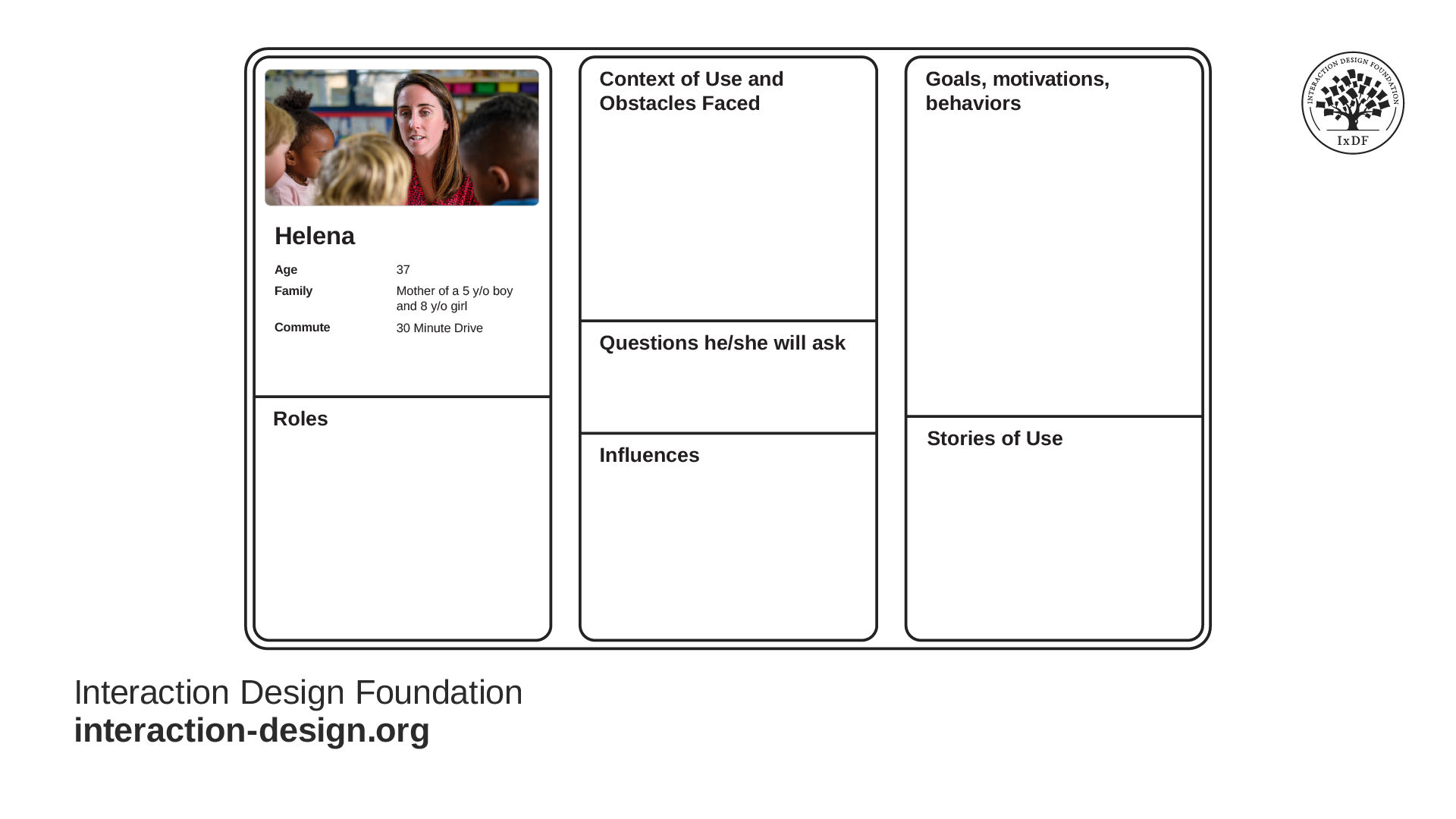
Demographics add specificity but reveal little about actual behavior. Two 42-year-old restaurant owners might face completely different challenges—one struggles with staff retention while the other battles rising food costs. Their age tells you nothing about these critical differences.
Keep demographics minimal and meaningful. Include only details that directly influence how someone interacts with your solution:
Age: Use exact numbers (42, not "40-45") because individuals have specific ages.
Occupation: Only when it shapes their daily needs.
Location: When geography affects behavior or access.
Education: If it influences their approach to problems.
Family: When it creates time pressures or responsibilities.
Your team needs behavioral insights, not statistical profiles. Focus on what people do, not just who they are on paper.
Roles
© Interaction Design Foundation, CC BY-SA 4.0
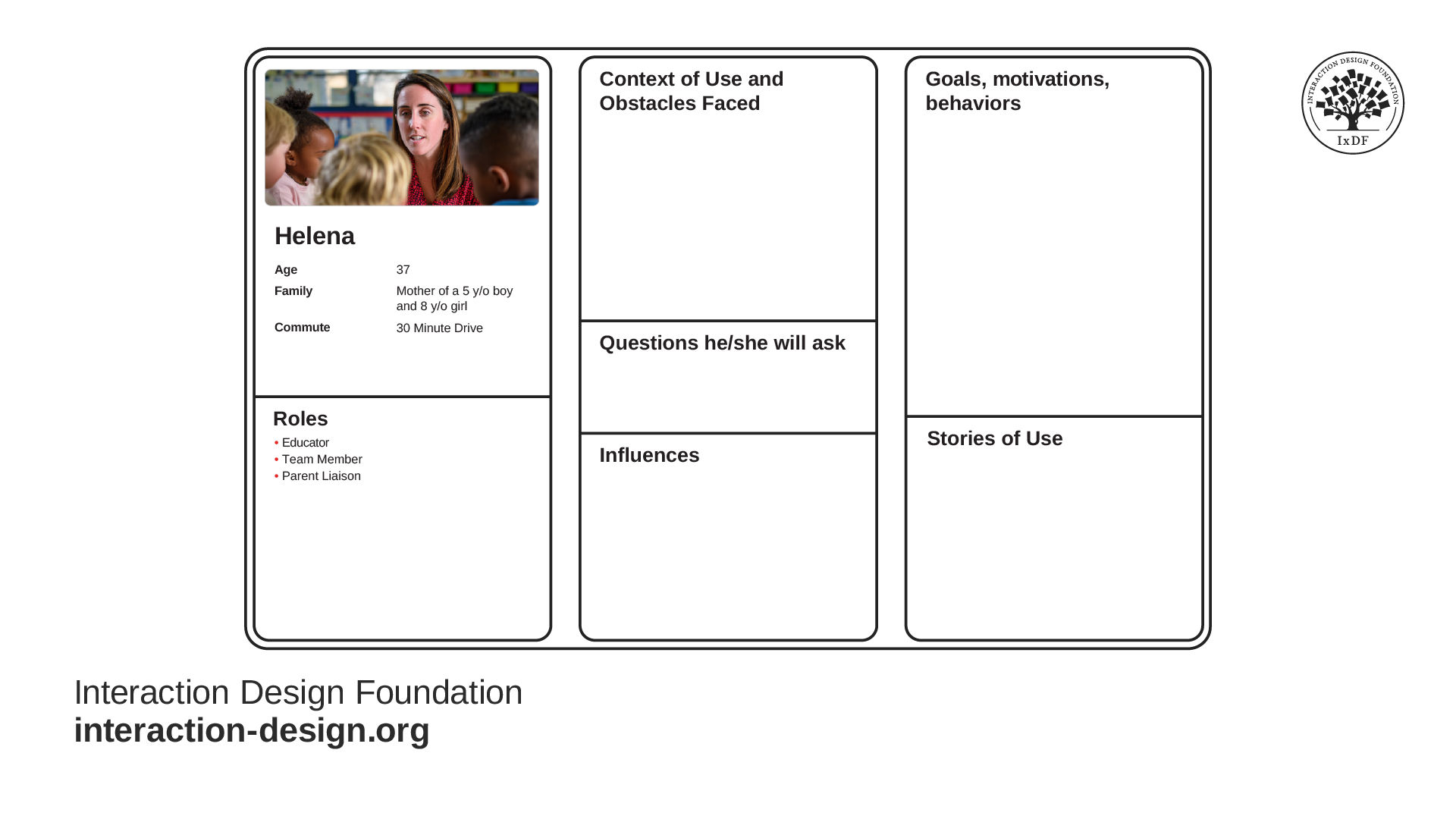
People juggle multiple identities throughout their day. When you understand these shifts, opportunities you might otherwise miss are revealed.
Consider Marcus, a business traveler who navigates distinct roles:
As a Customer, he needs transparent pricing and easy booking modifications.
As a Hotel Guest, he wants fast, contactless check-in after long flights.
As a Remote Worker, he transforms his room into a temporary office.
Each role demands different features, priorities, and interaction styles. Marcus the Customer comparison-shops carefully. Marcus the Guest needs efficiency. Marcus the Remote Worker wants uninterrupted productivity.
When you map these transitions, you stop building three mediocre experiences. Instead, you create one seamless journey that anticipates his changing needs.
Context of Use and Obstacles Faced
© Interaction Design Foundation, CC BY-SA 4.0
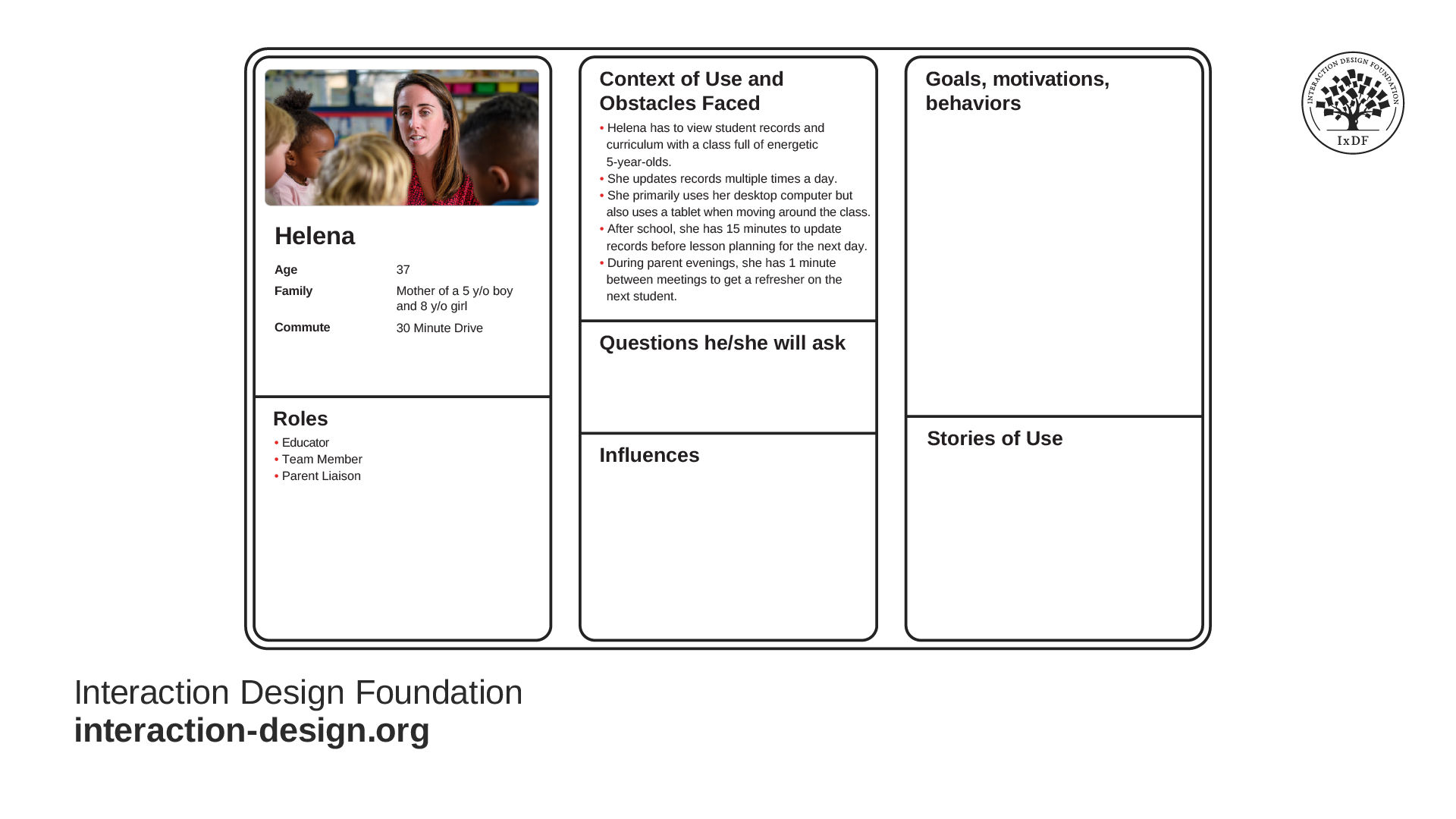
Paint the full picture of where and how people work. This section transforms abstract problems into concrete opportunities your team can tackle immediately. Context of use describes the environment, conditions, and circumstances where people engage with your product or service. Obstacles are the specific environmental and time barriers that block success. Frank Spillers, Service Designer and CEO of Experience Dynamics, explains context of use in this video.
Physical environment: Document where work happens. Does your persona operate in a noisy restaurant kitchen or a quiet library? Do they use specialized equipment or basic tools? Are they constantly moving between locations or working from one spot? Retail workers need solutions that survive chaos. Researchers need deep focus features.
Time pressures: Sarah has three-minute windows between patient appointments. Natasha dedicates Sunday evenings to financial planning. These constraints shape your approach. When you communicate your persona’s time pressure, your team will know how to eliminate friction and prioritize what matters.
Obstacles: Turn barriers into opportunities:
"Tom's delivery truck lacks reliable internet" will guide an offline-first design.
"Sergio works in sterile gloves all day" might be solved with voice controls.
"Connor works under cars with greasy hands" leads to laminated diagnostic charts.
Usage patterns: How often and for how long does your persona use your product? Daily users need shortcuts and efficiency, while monthly users need clear navigation.
Design for actual conditions, not meeting room assumptions.
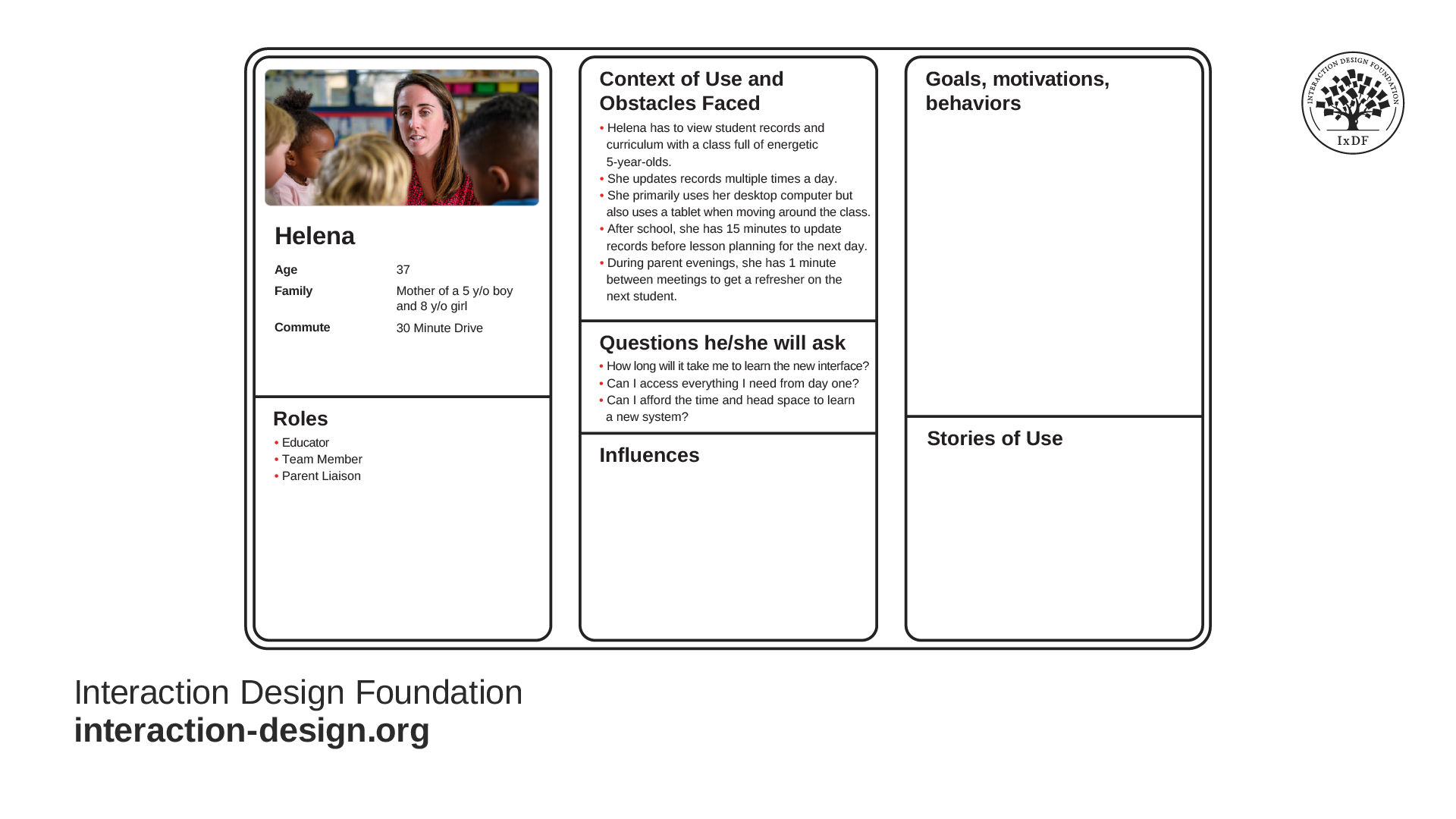
Questions He/She/They Will Ask
© Interaction Design Foundation, CC BY-SA 4.0
Include the critical questions that keep your persona awake at night. These are the doubts and concerns that shape decisions. Here are three types of questions with examples:
Immediate blockers:
"Will this integrate with our existing system?"
"How many hours will training steal from production?"
"Who fixes it when it breaks at 2 AM?"
Trust-building:
"Has anyone like me succeeded with this?"
"What hidden costs will surprise me later?"
"Can I test it without committing?"
Emotional concerns:
"Will my team resist this change?"
"Am I making the right choice?"
"What if I fail?"
The best personas capture 3-5 burning questions that your solution must answer convincingly. Skip generic concerns like "Is it good?" and focus on specific fears like "Will this require hiring new staff?"
When you address these questions proactively in your product, your messaging, and your support, you remove barriers before they block success. That's how you meet people where they are, not where you wish they were.
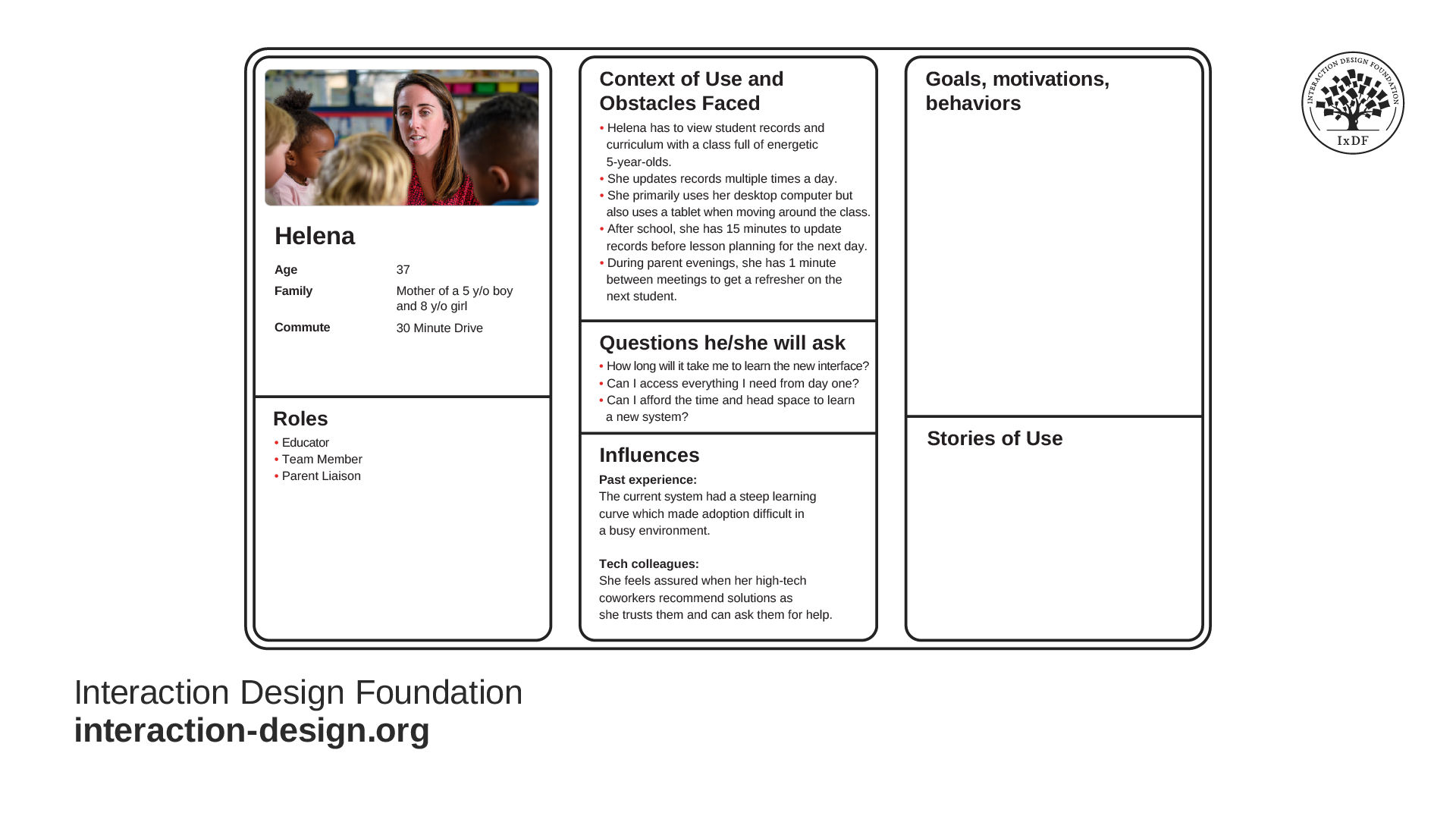
Influences
© Interaction Design Foundation, CC BY-SA 4.0
Who or what shapes your persona's decisions? When you understand influence, both positive and negative, it helps you design solutions that align with how people actually make choices. Here are three examples:
Trusted voices: “Diego watched his coworker transform chaotic spreadsheets into automated workflows, saving 10 hours weekly.”
How this helps: Your team can design visible transformations into your product and let users see others' before-and-after results.
Confidence builders: "Marcus needs to see immediate wins, like automated reports that save him 2 hours, before committing further."
How this helps: Your team can design quick wins into onboarding and show value fast through progressive disclosure.
Deal breakers: "Sofia abandoned the platform when setup required 47 configuration steps."
How this helps: You know you must simplify ruthlessly. Every extra step loses users. Design for the path of least resistance.
These influences shape your design decisions. For example, when you know peers matter most, you can prioritize social proof in your interface.
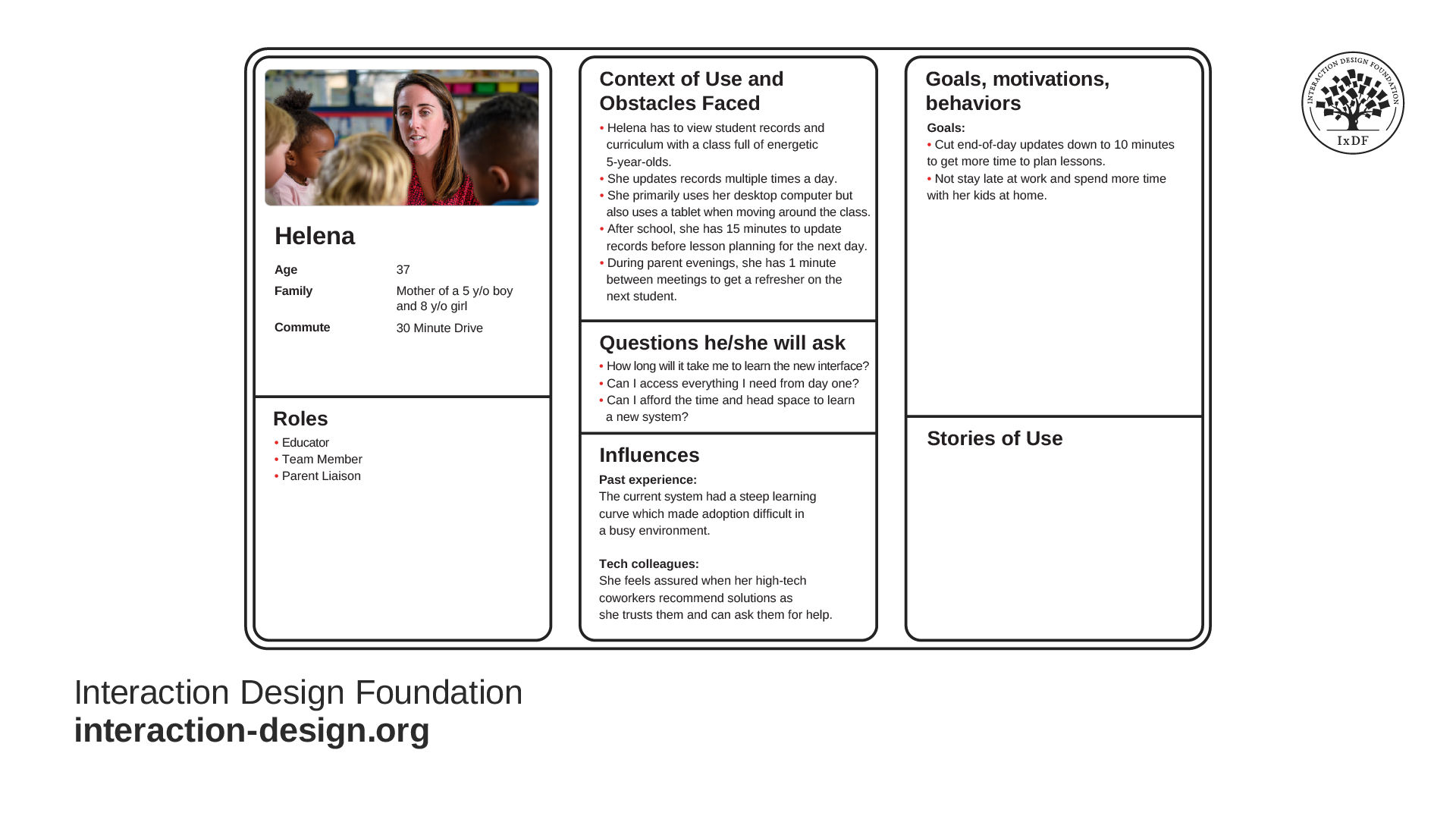
Goals
© Interaction Design Foundation, CC BY-SA 4.0
Goals transform vague desires into concrete achievements. Without specificity, "grow the business" becomes an endless, exhausting chase. Quantifiable goals show what to build. Human goals show why it's worth building. Together, they transform aimless work into meaningful impact. Include 2-3 of each in your persona—enough to guide decisions without distracting focus.
Quantifiable Goals
Numbers create urgency and accountability. Look at these two examples:
Vague: "Improve customer service."
Specific: "Reduce response time from 48 to 4 hours."
The second version tells everyone exactly what success looks like.
Human Goals
Help your team connect to the human want behind the goal:
"Cut inventory management from 8 to 2 hours weekly" influences another goal: "Get time to coach my daughter's soccer team."
"Increase profit margin by 25%" influences "Finally, afford health insurance for my employees.”
When you connect professional goals to personal dreams, you stop building features. You start changing lives. Your team will push harder to help Sven see his kids than to optimize a workflow.
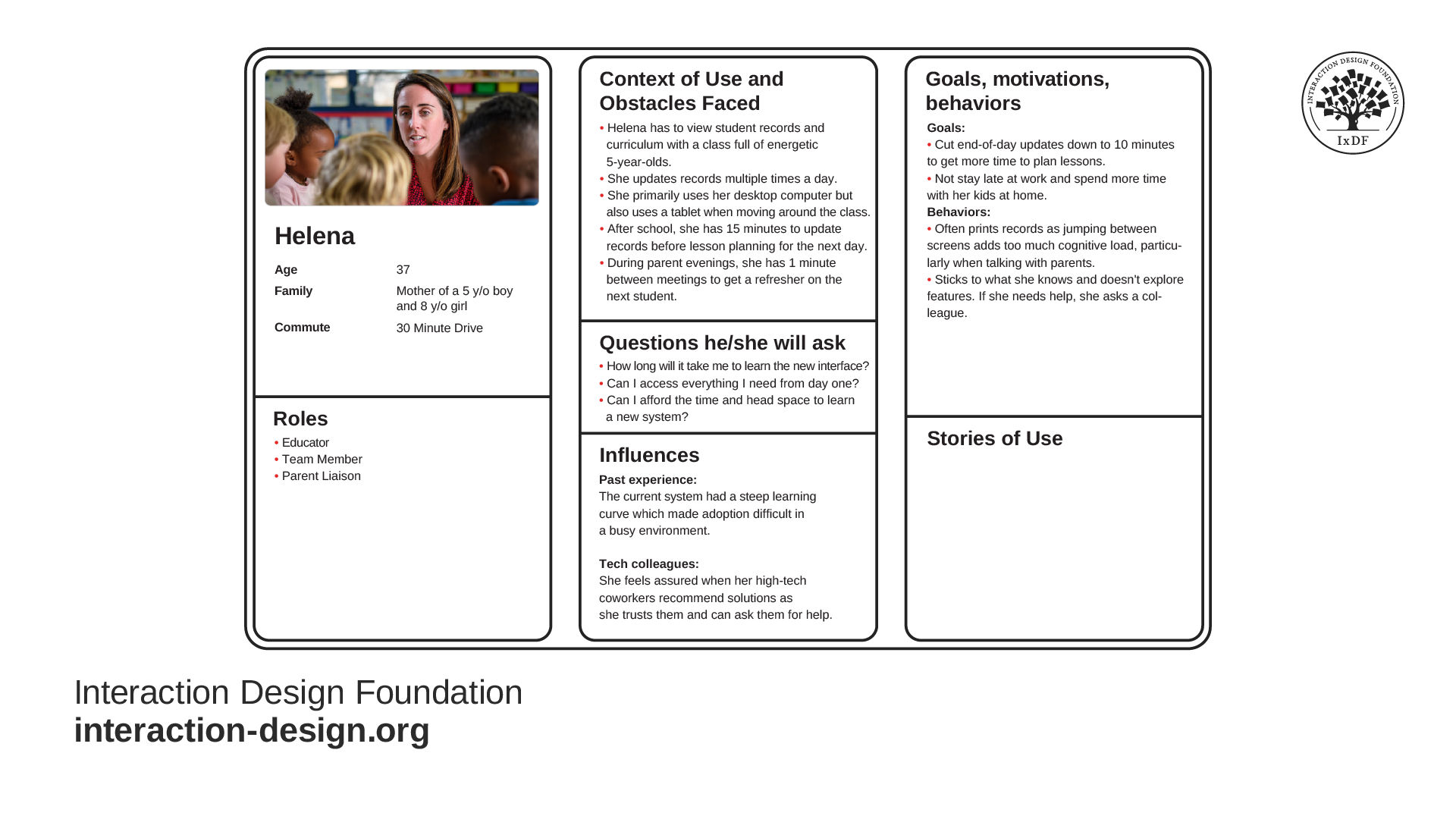
Behaviors
© Interaction Design Foundation, CC BY-SA 4.0
Behaviors are one of the most critical parts of your persona. While people tell you what they think they do, behaviors show what actually happens. When your team, managers, and stakeholders know how your persona behaves, you can build solutions that fit like a glove. Here are three common types of behavior with examples:
Workarounds
Workarounds signal broken systems and cost time and trust:
"Rajesh emails himself reminders because the task system overwhelms him."
"Elena screenshots confirmations—she doesn't trust the system to save."
"Tom tapes recipes to walls—the recipe binder stays buried during rushes"
Avoidance Patterns
Avoidance reveals friction. People don't skip valuable tasks; they skip painful ones:
"Clark always postpones expense reports until the deadline."
"Hiroshi asks his assistant to handle the booking system."
"Milena writes patient notes on her hand instead of using bedside charts."
Decision-Making Styles
How your persona makes decisions has a huge influence on how you should design for them:
Click first, read later. Need forgiving interfaces.
Study every option. Need advanced features and strong documentation.
Pass complex tasks to others. Need simplicity
Include 3-5 behaviors that directly impact your solution. Skip generic actions like "uses email" and focus on revealing behaviors like "checks email every 3 minutes during presentations."
Motivations
© Interaction Design Foundation, CC BY-SA 4.0
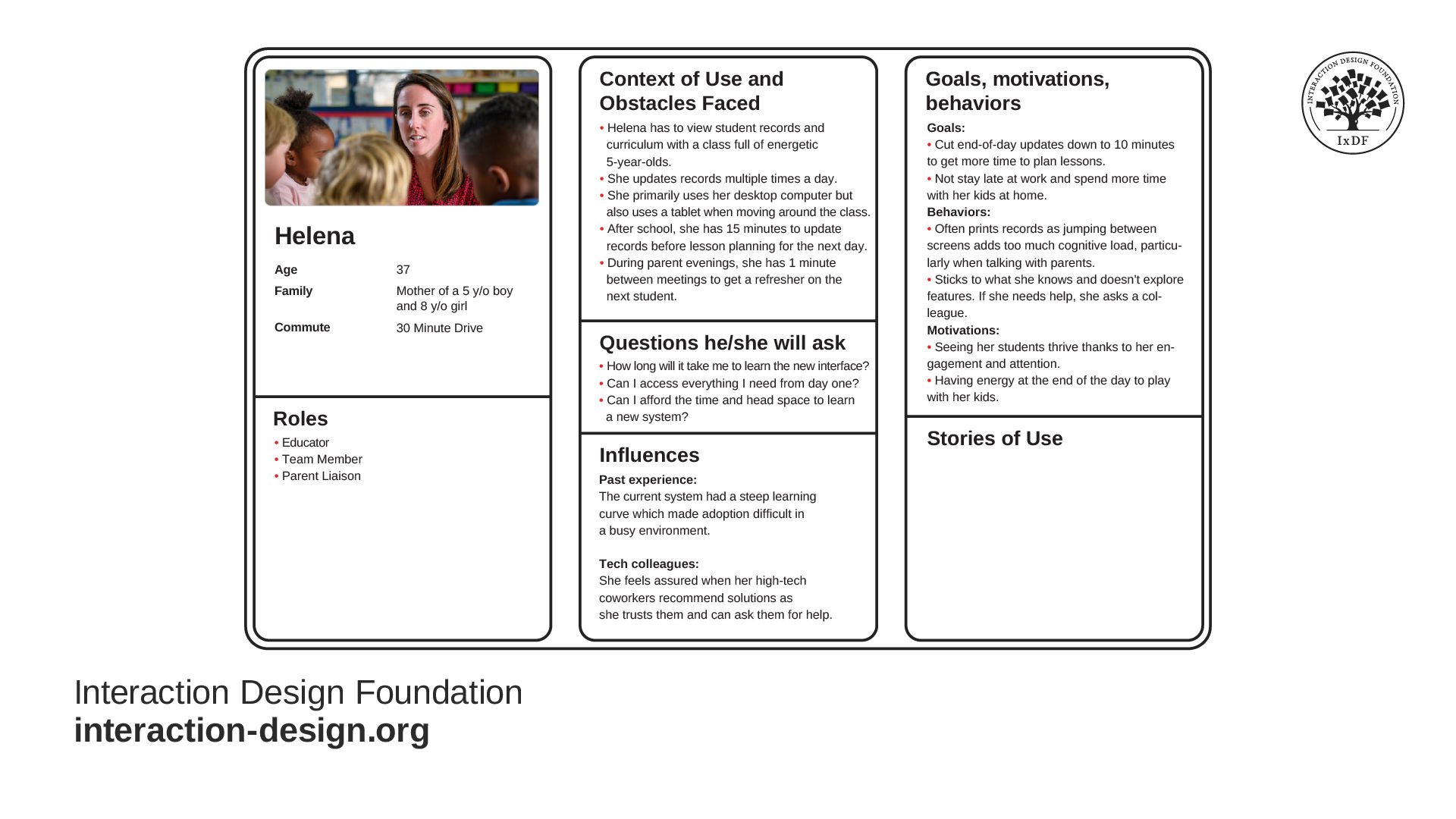
Motivations reveal the engine that drives every decision. When you understand why people push through obstacles, you design solutions that fuel their drive rather than drain it.
Your persona represents real humans with real dreams. Luka isn't just "a restaurant owner." He's a father who missed his daughter's recital last month because the inventory took too long. When you understand motivation, it changes how you approach every design decision. Here are two primary forms of motivation: personal and professional.
Personal Motivations
“Baker Elena wants her bakery to outlive her and be a place her grandkids will run."
"Salesman João saves every penny to afford his dream family home."
"Doctor Harry chose accident and emergency to save people like his brother."
Professional Motivations
"One bad review could damage Thabo’s 20-year car repair business."
"Priya knows automation is her only edge against mega-chains."
"Every saved minute doing inventory means Taylor might make bedtime stories."
Include 2-3 core motivations. Skip surface wants like "save money" and dig deeper: "Save money to finally take his mom to Italy before it's too late." That's motivation that moves mountains—and teams.
Stories of Use
© Interaction Design Foundation, CC BY-SA 4.0
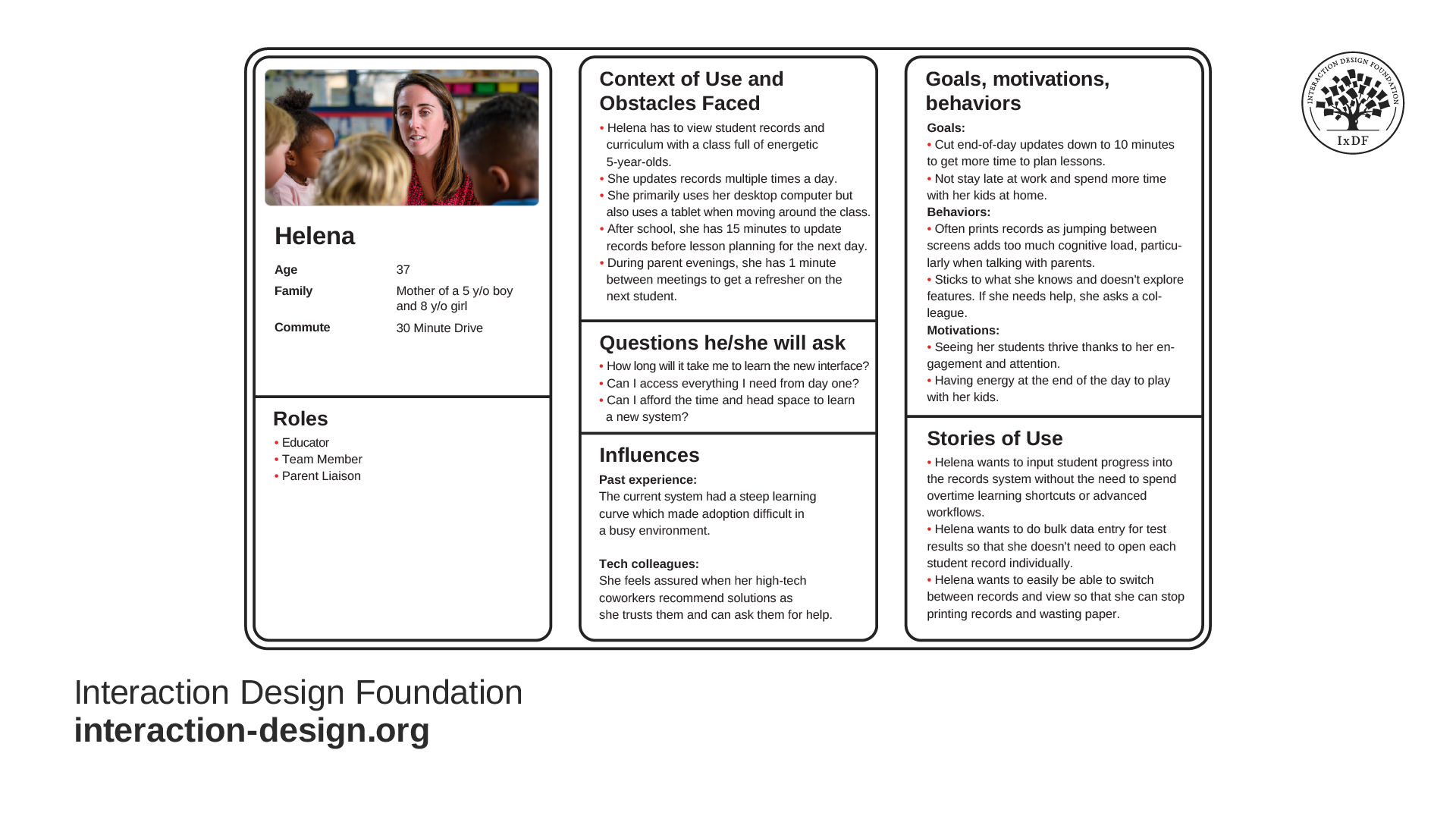
Stories make abstract needs unforgettable. They turn insight into emotion. You can use different types of stories; however, here we’ll focus on persona stories. These are short sentences that explain the needs and behaviors of your persona to help your team imagine them in action.
Persona stories take this form:
"<Persona (role)> wants to <goal> so that <outcome>."
For example:
Helena wants to do bulk data entry for test results so that she doesn't need to open each student record individually.
When you use persona stories, you are talking about a researched persona. Unlike user stories that take the form of "As a user, I want to...", persona stories make it clear that the persona benefits from the outcome of a decision, not the project team.
Download the Free Template
Now that you’ve mastered how to create a persona with insights that actually drive decisions, you can start filling in the template. It includes a recap on what to include in each section, plus an example persona to inspire you.
Amplify the Power of your Personas
With your persona in hand, it's time to put it to work. The real magic happens when you put it to work every single day. Here's how to get the most out of personas and ensure they remain influential:
Make them visible everywhere. Put personas on walls, screens, even coffee mugs—anywhere your team naturally looks. Some teams create life-size cardboard cutouts for meeting rooms. When Helena feels like a colleague sitting at the table, you naturally consider her needs in every decision.
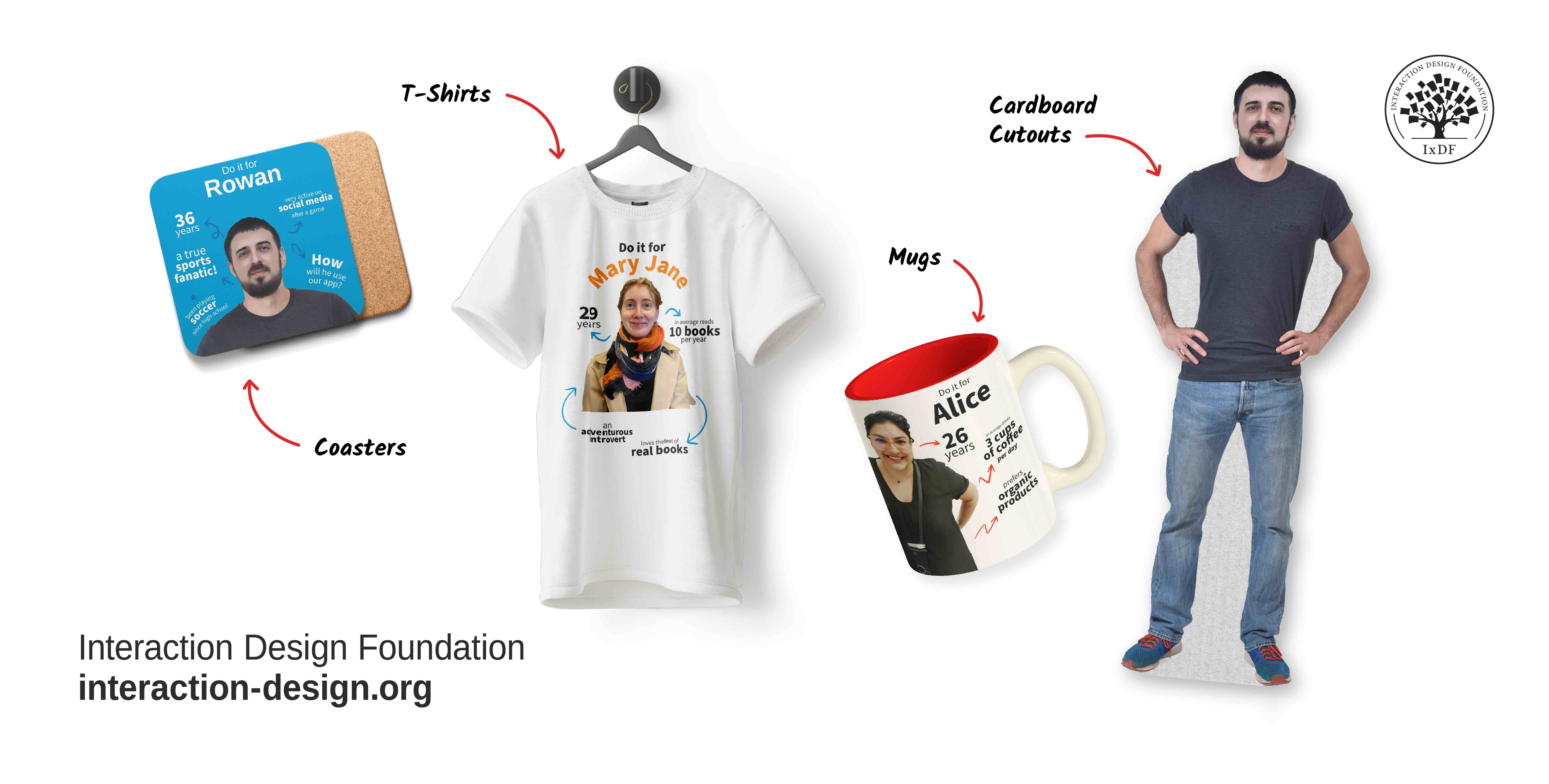
Surround yourself with personas through creative merchandise. When personas become part of daily life, customer focus becomes second nature. Every glance reinforces who you're really serving.
© Interaction Design Foundation, CC BY-SA 4.0
Reference them constantly. Start every meeting by asking, "What would Helena think about this?" Challenge new ideas against persona needs. Watch how quickly debates resolve when you center the discussion on real people with real problems.
Transform vague stories into human stories. Replace "As a user, I want to save my progress" with "Sarah needs to quickly save patient notes between appointments without losing her place in the workflow." Specificity creates empathy. Empathy drives innovation that matters.
Test everything through their eyes. Before launching anything, experience it as your persona would. Does it solve their real problems? Does it respect their time constraints? Does it move them closer to their dreams?
Measure what truly matters. Track how persona-driven solutions perform in the real world. Do they earn higher satisfaction scores? Create better retention? Generate passionate testimonials? Document the connection between understanding people and achieving remarkable success.
The Take Away
When you use this minimal persona template, you transform from someone guessing about “users” into someone who truly knows Helena, Marcus, and Sarah—real people with real problems you can solve. You and your team will make decisions 10x faster because every debate ends with “What would Helena need?” Your one-page personas become daily tools that guide every choice, not forgotten documents taking up space on your hard drive.
Your essentials persona template includes:
Name & Photo: Make them real and relatable.
Demographics: Only details that shape their needs.
Roles: Multiple identities they juggle daily.
Context of Use & Obstacles: Where they work and what blocks them.
Questions: What keeps them up at night?
Influences: Trusted voices and dealbreakers.
Goals, Behaviors & Motivations: What they want, how they work, and why they care.
Stories: Memorable narratives that create empathy.
Finally, make your personas visible everywhere, reference them constantly, and test everything through their eyes. You’ll create products that matter, not just exist. Most profoundly, you'll feel the deep satisfaction of truly understanding and helping real people, turning daily work into meaningful impact.
References and Where to Learn More
Want to know more about personas and how to use them effectively? Personas and User Research: Design Products and Services People Need and Want will show you how to gather meaningful user insights, avoid bias, and build research-backed personas that help you design intuitive, relevant products. You’ll walk away with practical skills and a certificate that demonstrates your expertise in user research and persona creation.
Get started with grounded theory in our article, Grounded Theory: Base Findings on Research, Not Preconceptions.
Discover how and why to use persona stories in William Hudson’s paper, User Stories Don't Help Users: Introducing Persona Stories.