User research is indispensable—and without it, well... UX design is guesswork. When you’re a user researcher, you know this well—but it can be hard to communicate your work in a way that grabs the viewer and holds their attention. And that’s what a portfolio is all about—grabbing the attention of your desired audience, be it a potential freelance client or a hiring manager. So, keep on reading for the best way to make your user research portfolio to communicate your value—and land your dream role.
User Research is Your Superpower—Show It Off!
The ability to understand users trumps visual flair—and it’s about the depth of insight, the rigor of your methodologies, and the clarity of your impact, as much as the pretty (and pretty powerful) end result an employer sees in the product might wow them. Employers are in charge of their brand’s welfare for a reason or three—and they’ll want to see how you understand users, how you gather and interpret data, and—most important of all—how your research guides design decisions. Your portfolio needs to show how great your ability to turn insights into action is—and it’s got to prove that your work delivers real, measurable value to whoever hires you.
Take Center Stage: How Your Research Shapes Design
A powerful research portfolio is one that tells the story of both how your work led to better design decisions and how it improved the user experience. And when your case studies are structured in a compelling, easy-to-follow way, you showcase not just your research skills but your ability to solve the problems you set out to answer, too. Each case study has got to walk the reader through your process—and it goes from the initial discovery phase to the final outcomes, as this effective approach to structure each case study shows:
The problem is where it begins, so clearly state what it was you aimed to understand—or, better yet, write this in the form of a “hook”. What problem was the product facing that called for research? For example, were users abandoning a sign-up process? Or did stakeholders not have a good enough grasp of user motivations?
Your role is up next, and so are you as you enter the scene proper. So, explain what you did in the research process—were you there to lead the effort, conduct interviews, or analyze data? You'll want to highlight how you worked alongside designers, developers, and other team members; and be sure to frame that your efforts were—and are—those of a team player.
The methodology is up next, and it's time to show your UX prowess and describe the methods you used—whether it was usability testing, in-depth interviews, surveys, field research, or diary studies. Be sure to outline why you chose these methods and how they fit the needs of the project, and that’s because they’ll be vital pieces of “evidence” to support how the person who’s looking at your portfolio sees you as a potential fit.
The insights enter the equation, so be sure to detail the insights you uncovered with a view to answer some questions: For instance, what did the data reveal about user behavior? What were the key findings, and how did they inform the design or product strategy?
The outcome is the end result of what you did, so explain how your research had an impact—or impacts—on the project. Did it lead to a change in design direction? Was there an increase in user engagement or a solution that addressed user pain points effectively? Be sure and use both qualitative and quantitative outcomes where possible to show what happened and how well it happened for the delighted brand you helped.
This approach highlights what you did and demonstrates why your research mattered and how it made a difference, too.
Case Study Example: Improving the Onboarding Experience
The problem: Users were dropping off during the onboarding flow of a health app, and that left many of them unable to complete their profiles.
My role: As the lead user researcher, I designed and conducted interviews with new users so I and other stakeholders could understand what their challenges were and how these affected the new users. I collaborated with UX designers to define user pain points with more clarity.
The methodology: I conducted a series of moderated usability tests combined with follow-up surveys to understand specific points of friction.
The insights: The research revealed that users were feeling overwhelmed by the sheer number of steps they had to go through and didn’t understand why all the information was needed upfront. I synthesized these findings and presented them to the design and product teams.
The outcome: The onboarding process was streamlined, dividing it into smaller steps with clear explanations. The redesign led to a 30% increase in successful onboarding completions and higher user satisfaction ratings.
The Power of Variety: Why Different Research Methods Matter
A well-rounded user research portfolio has got to highlight how versatile you are in research methodologies, so display a variety of methods to show that you can adapt your approach based on the specific problem you had to address.
Discovery or exploratory research is the category where you include examples of how you identified user needs and how you uncovered opportunities through ethnographic research or in-depth interviews. It’s a great idea to explain how your work influenced product strategy at the outset.
Evaluative research is the type where you showcase the evidence of usability testing or A/B testing where you assessed existing products—and be sure to show how your insights led to design improvements or enhanced user satisfaction.
Quantitative and qualitative is the area where you’ll want to highlight projects where you combined quantitative and qualitative research for a comprehensive understanding of user behavior—perhaps using analytics data to support your qualitative insights.
Use this template to present your user research in a clear and compelling way—so showcasing its value and impact within your case studies.
Advance Your Career With This Free Template for “User Research Show Hiring Managers You Understand Users”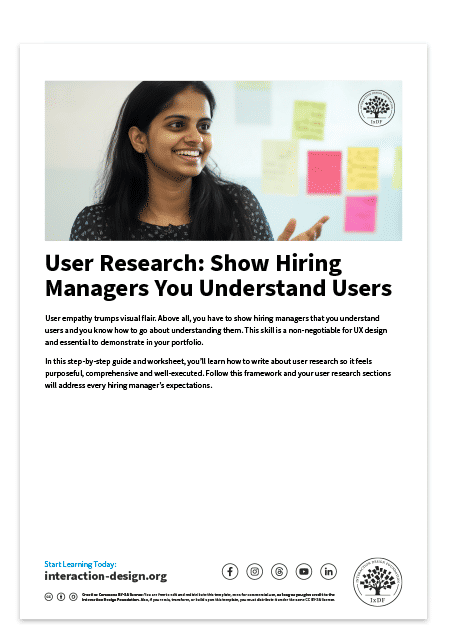
As you know, research projects can generate large datasets—as in, gigantic ones that can get to overwhelming proportions! Isn’t it a relief, then, that AI tools can help with processing and clustering insights more efficiently, and so save you a great deal of time and mental energy for interpretation! With that said, they don’t replace the need for research and testing with real users. For a quick look at how AI can support data analysis in user research, check out this video with AI Product Designer, Ioana Teleanu.
This breadth of research shows clients and hiring managers that you’re adaptable, that you’re comfortable using multiple methods, and that you can adjust based on project goals or constraints. This versatility will put you in their eyes as a well-rounded UX researcher—ever ready to tackle any challenge that comes your (and their) way.
Collaboration in Action: Show Your Team Spirit
© Interaction Design Foundation, CC BY-SA 4.0
UX design doesn’t happen in isolation; if it did, well—there’s a good chance that it wouldn’t be all that “UX-y” for the users who had to encounter the digital design or service! That’s a big reason why user researchers often work cross-functionally with designers, product managers, developers, and stakeholders—to advocate for user needs and ensure that what comes out on release day is for the users for sure. Your portfolio should illustrate you’re a team player and not a “siloed, solo virtuoso” (although that ability to work on your own is vital).
Stakeholder engagement: Include examples where you worked closely with product managers to align research questions with business goals—or helped developers understand usability findings so you could improve the product.
Workshops and co-creation: Describe moments where you facilitated workshops, co-design sessions, or helped stakeholders understand research findings to generate solutions—things that show you took the initiative to move things along in the right direction.
Connect research, design and business objectives: Explain how you translated research findings into actionable insights for designers to act upon. How did you ensure the design team had a nice and clear understanding of user issues—and how did you support them in ideating solutions?
While you’re at it, consider adding testimonials from team members or stakeholders to emphasize your collaborative impact. This will add credibility and shows potential employers that your insights were well valued by those you worked with.
Storytelling: Bring Your Findings to Life
Storytelling communicates the value of your research and does it in a compelling and accessible way—everyone loves a good story, or at least prefers it to dull mounds of dry research! To be sure, a well-structured narrative transforms raw data into an engaging story that stakeholders understand and remember—and will remember you for including it.
Make findings memorable and use storytelling to present research outcomes in an engaging way—or a gripping one, even. Go beyond the charts and numbers and include vivid examples like user quotes and personas, and it'll make the data feel all the more human and bring it closer to home for the viewers, something that's relatable.
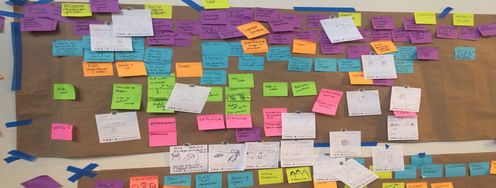
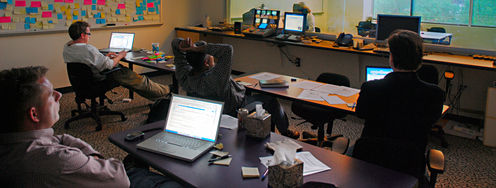
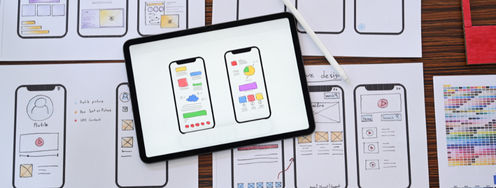
Visuals and artifacts are powerful, so it’s a superb idea to include visuals such as journey maps, empathy maps, or personas to illustrate the user journey and pain points. Even better than that; to illustrate your process in even more detail, insert photographs of your journey—pictures of your research activities or even your workspace “narrate” your process in a cool and interesting way.
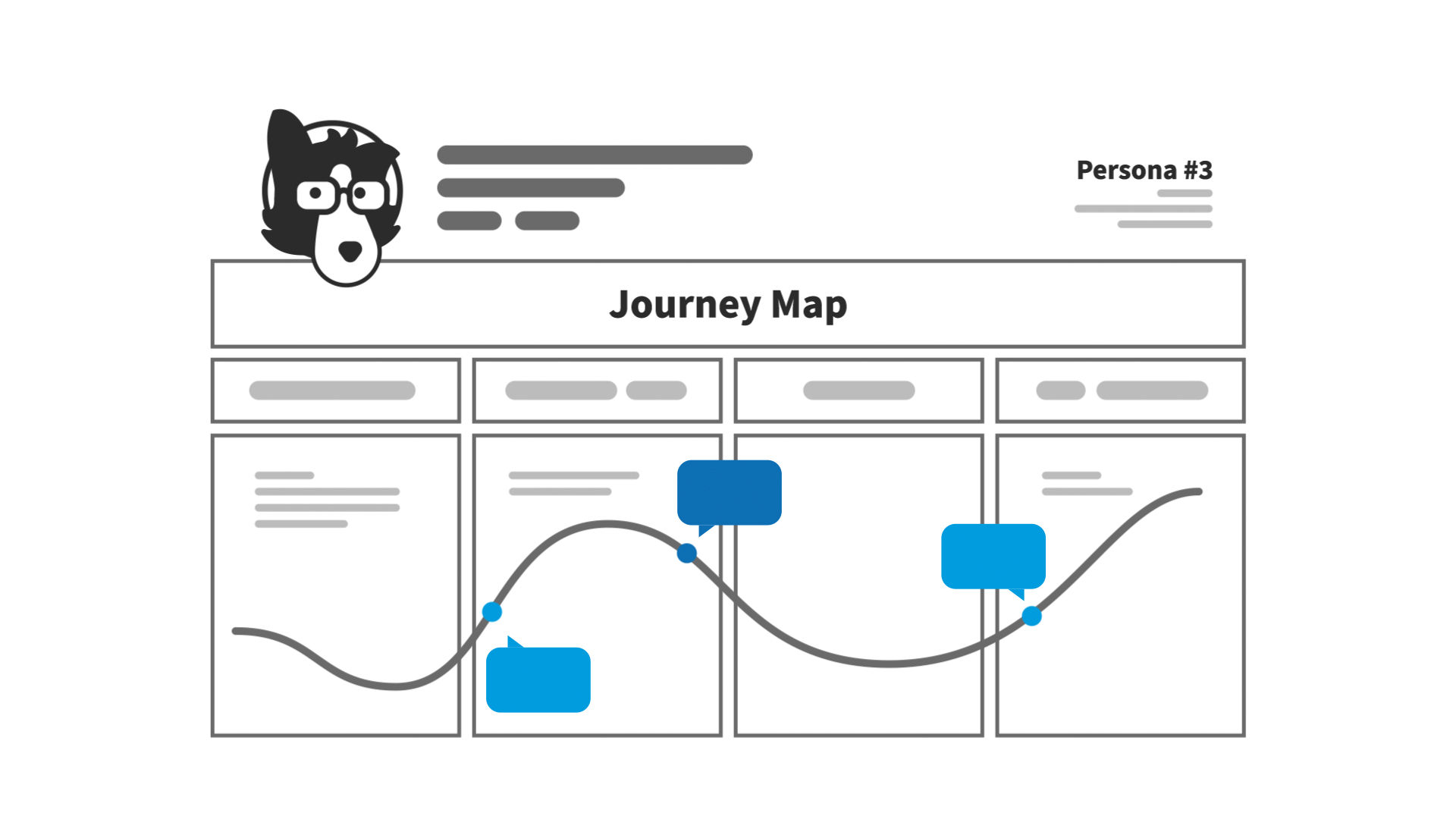
Include journey maps and other artifacts to bring your process to life.
© Interaction Design Foundation, CC BY-SA 4.0
Show Real-World Impact: How Your Research Drives Design Decisions
Sure, portfolios need to show what went into something and what that something was that came out—and to stand out, your portfolio should prove that your research leads to real, positive changes. Employers want to see how your work made a tangible difference then—so they can get an idea of what you can do for them in the, hopefully near, future.
Impact metrics speak volumes, so whenever you can, include metrics that show how your research contributed to the final outcome. For example, did simplifying a process increase engagement rates? Did new product features emerge directly from user interviews? What worked and how much did it do?
Team feedback is another biggie, so highlight qualitative impact—and this could be something like positive feedback from team members about how your research shaped their understanding of the user. These stories show that your work doesn’t just generate data—it influences decisions and leads to better user experiences, it’s that good (and so are you).
Case Study Example: Diary Study for Product Improvement
The problem: Stakeholders felt disconnected from real user experiences and lacked a clear sense of what daily challenges users had to face.
My role: I led a diary study to understand how users interacted with the product—over a two-week period—and how it fit into their routines.
The methodology: Participants documented their daily experiences using the product, and noted pain points and successes. I then analyzed the entries to see what patterns were there.
The insights: The study revealed gaps in product utility during certain times of the day. My insights led the product team to adjust features so they were more in line with user habits.
The outcome: Product updates led to a 20% increase in engagement during peak usage times—and stakeholders felt more connected to users’ daily lives through the qualitative data.
Shine Online: Engage and Delight with Your Portfolio
© Interaction Design Foundation, CC BY-SA 4.0
Treat your portfolio like a UX project in itself, which in truth it is—maybe the most important design you’ll ever make—and so you want it to be user-friendly, intuitive, and reflect both yourself and your range of skills.
Simple navigation is a must, in keeping with the “design” pulse we just mentioned, so keep the structure of your portfolio simple and make it easy for viewers to browse through your projects. Use clear labels like “Case Studies,” “Methods,” and “Results” to help guide readers and keep the UX amped nice and high.
Clarity needs to be spot-on and “crystal,” so be sure to use clear, concise language to explain your process. Avoid jargon, and make sure that anyone—regardless of their background—can understand the value of your work; aside from anything else, many stakeholders—or other types of clients out there—mightn’t be able to speak “designese.”
Consistency: Use a consistent color palette, typography, and spacing throughout your portfolio.
Get these details right and you’ll prove your ability to apply UX principles—demonstrating professionalism and attention to detail in a great UX design of a portfolio. And, as with a website, for example, a well-structured, visually cohesive portfolio engages viewers and makes them more likely to explore your work and remember you.
Encourage Action: End with a Strong CTA
All right, so you’ve demonstrated your expertise—nice work—and now, it’s time to guide potential clients and employers to take action. So, you want to make it nice and easy for them to reach out for interviews, discussions, or freelance opportunities.
Example CTA
“Are you looking for a user researcher who delivers actionable insights and understands the real needs of your users? Let’s connect and discuss how I can help.”
As with the need for clarity elsewhere in your portfolio, make sure your contact information is easy to find, including links to your email, LinkedIn, or a contact form.
The Take Away
Your user research portfolio is a prime product and a brand ambassador—with you as the brand! It’s got to go beyond showcasing skills—and you’ve got to tell the story of how your insights lead to better design decisions and improved user experiences. If you structure your case studies around the problem, your role, the methodology, insights, and outcomes, you’ll give potential employers or clients a clear view of how you approach and solve challenges. It’s a brilliant idea to highlight a variety of research methods and your ability to collaborate with cross-functional teams. The lower-level purpose of that is to demonstrate your versatility and the real impact of your research on product success; the high-level purpose? To get you hired.
Storytelling makes your portfolio stand out—don’t underestimate the power of a great story; it’s often the spark of life that energizes what might otherwise be hard-to-get piles of data and dull, dry, plodding sequences of events. Use user quotes, personas, and visual artifacts like journey maps to make your findings relatable and memorable. Show both qualitative and quantitative results to emphasize how your work influenced the overall success of the design and how it improved user engagement and satisfaction. You want to portray someone who infuses power, relatability, and empathy for real-life people with their real-world needs—delivering on point every time.
References and Where to Learn More
Want to create a portfolio that gets you hired? Take our course, Build a Standout UX/UI Portfolio: Land Your Dream Job, and learn how to showcase your skills, tell compelling project stories, and impress employers.
Watch the Master Class User Research for Everyone: Practical Strategies for Every Team.
Read Freytag’s Pyramid: Craft Compelling UX/UI Design Case Studies the Easy Way.
Read 7 Design Portfolio Mistakes That Are Costing You Jobs! And How to Fix Them.
Take our course User Research – Methods and Best Practices.
Read Land That Job: What Top Design Leaders Really Look for in a Portfolio.