Co-Creation in UX/UI Design

Your constantly-updated definition of Co-Creation in UX/UI Design and collection of videos and articles.
Be a conversation starter: Share this page and inspire others!

197 Shares

What is Co-Creation in UX/UI Design?

Co-creation is the practice of collaborating with other stakeholders to guide the design process. Participants with different roles align and offer diverse insights, usually in facilitated workshops. Designers can therefore get more holistic views of what a product or service should include.

“An individual can’t create anything itself. All of our dreams come true with the cooperation and co-creation of other souls.”

― Hina Hashmi, Intuitive Empowerment & Happiness Coach, International Speaker & Clinical Psychologist

See how co-creation is vital to working towards the best solutions:

Transcript

Co-creation – Service Design’s “Central Nervous System” 

In service design, you’ll typically find yourself working with (or towards) an intricate ecosystem that contains many factors and actors operating at different levels and in different ways. That includes all the supporting roles of other services and the hard-to-see limitations and cause-and-effect chains as systems communicate behind the scenes to help delight—or provide the most relief to—service users in their contexts. For example, customers’ experiences of a bank go across various touchpoints as they use it for a variety of purposes. The bank offers them a wide array of services, including front-door security, deposit services and savings plans: all the many frontstage and backstage parts that combine to make each customer experience. If you wanted to improve that experience or develop your brand’s version of it, you’d first need to get a precise understanding of all the actors and the nature of the relationships between their various systems before you could empathize properly with everyone involved. That means empathizing with the customers and the service providers, including all the people you’d need to collaborate with to find the right problems to define and address. That’s why design thinking is essential to co-creation. It’s vital to get the clearest understanding of the various constraints, workflows, processes and more that services involve before you can make the most accurate customer journey maps and personas, and move your design process forward.

Co-creation is particularly about alignment between participants and cross-pollination of expertise and viewpoints. A highly interactive agile approach is how you gather the clearest insights and collaborate progressively with stakeholders and others. That way, you can cover all the angles regarding how the service can be delivered to maximize value to customers and the business. First, it takes insight and diplomacy to get to the level where you and (e.g.) stakeholders can move forward as a unified group of decision-makers under a common vision. This means you start to work with stakeholders, other teams, etc., to get them on board by embracing their strengths — not isolating their faults — and pooling your knowledge towards solving smaller problems before you try to tackle large ones.

Moreover, co-creation goes deeper than user research. It’s about making the best of a culture of service design where organizations foster an environment in which design teams and stakeholders can comfortably cross-pollinate, get on the same page and achieve congruence in execution as a core strategy. It also means considering the entire organization, instead of isolating important points by working backwards from the customer needs alone. And to tap the sheer variety of viewpoints, information, solutions and levels of ownership that everyone who should be co-creating with you possesses, a well-facilitated workshop is the way to go.

How to Facilitate a Co-Creation Workshop

Follow these steps to plan and get the most from a productive collaborative workshop: 

  1. Begin with an overview of what you want to examine.

  2. Determine the goal – what do you want to achieve for your organization/service?

  3. Decide who needs to be there – only include relevant personnel.

  4. List tangible outcomes – to tightly manage the workshop and avoid getting bogged down in unrealistic pursuits.

  5. Decide when and where it will be.

  6. Work backwards to make a plan—determine what you want to achieve, then design the steps to achieve it.

  7. Detail each section’s activities.

  8. Warm up with improv games.

  9. Be careful with brainstormingbrainwriting is better here.

  10. Sketch out more ideas – use ecosystem maps, empathy maps, etc.

  11. Share the ideas.

  12. Keep track of the time – which also helps to keep on tangent, let everyone contribute, etc.

Tips

  • Ensure your workshops are interactive and build on design thinking methods.

  • Invite stakeholders from across the board, provided they can contribute.

  • Work to discover what’s viable, what’s a direct need and what will benefit the customer and the business.

  • Work with domain experts.

  • Stay curious and keep listening – it takes time to become collaborative partners.

  • Use techniques such as the 5 Whys to stimulate collaborative efforts.

Remember, co-creation is a chance to combine skill sets and knowledge to cover all the bases early on and, ultimately, co-design even the most complex services and systems more successfully. You can bring customers into co-creation with service staging, to test your prototypes. As design is often termed a conversation and service delivery happens inside the organization as well as outside to the customers, co-creation is the way to speak to everyone involved.

Questions About Co-Creation in UX/UI Design?
We've Got Answers!

How is co-creation different from collaboration?

Co-creation and collaboration both involve teamwork, but they’re different in approach and outcome.

Collaboration happens when different teams or individuals work together toward a common goal. In service design, this might involve designers, developers, and business stakeholders aligning their expertise to improve a customer journey. However, collaboration typically happens within an organization—users or customers may not directly contribute.

Co-creation, on the other hand, extends beyond the tight core of teams like design teams. It involves a broader range of stakeholders—such as frontline employees and “backstage” staff—actively shaping a service. They don’t just provide feedback—they participate in idea generation, prototyping, and decision-making.

For example, a bank redesigning its digital services might co-create by working directly with branch employees to map pain points and test solutions. This ensures the final service does meet real needs, not just internal assumptions.

In service design, co-creation leads to more user-centered, innovative solutions because it involves those who actually experience the service firsthand.

Watch as CEO of Experience Dynamics, Frank Spillers explains important points about co-creation:

Transcript

Take our Service Design course, which examines many aspects of co-creation and collaboration.

What are the benefits of co-creation for businesses and users?

Co-creation benefits both businesses and users by leading to more innovative, user-centered solutions.

For businesses, co-creation helps reduce guesswork by involving key stakeholders in the design process. This leads to products and services that better match real user needs, and so raises levels of customer satisfaction and loyalty. It also reduces development risks, since early user input helps identify issues before launch. What’s more, co-creation drives innovation, as fresh perspectives bring new ideas businesses might not have considered.

For users, co-creation gives them a voice in shaping the products and services they use. This leads to more intuitive, relevant, and satisfying experiences. It builds a sense of ownership, too, making users more likely to engage with and advocate for the brand.

Watch our video for important points about co-creation:

Transcript

Take our Service Design course, which examines many aspects of co-creation and collaboration.

How does the co-creation process work?

First, businesses identify key stakeholders—including stakeholders from different departments. Next, facilitate workshops, interviews, or brainstorming sessions to gather ideas and pain points. During the prototyping phase, users test early versions of the service, and provide hands-on feedback.

After testing, it’s important to refine and iterate based on user input to ensure the final solution is both functional and user-friendly. Throughout the process, continuous collaboration helps shape the design, reducing the risk of failure. When done well, co-creation leads to more innovative, user-centered solutions—ones that drive engagement, loyalty, and long-term success.

Watch our video on empathy, a key area to consider throughout the design process:

Transcript

Take our Service Design course, which examines many aspects of co-creation.

What are the key stages of co-creation in service design?

The co-creation process in service design follows key stages to ensure services meet real user needs through collaboration.

  1. Discovery and research – Identify stakeholders—like frontstage and backstage service providers—and gather insights through interviews, surveys, and observations to understand pain points and needs.

  2. Ideation & concept development—Run workshops or brainstorming sessions in which participants generate ideas and possible solutions together.

  3. Prototyping and testing – Create service prototypes—such as journey maps, mock-ups, or pilot programs—and test them with users to collect feedback.

  4. Iteration and refinement – Based on user feedback, refine the service and so improve functionality, accessibility, and user experience.

  1. Implementation and evaluation – It’s time to launch the final service—and ongoing feedback helps monitor success and identify areas for future improvement.

Watch our video about frontstage and backstage in service design for important insights:

Transcript

Take our Service Design course, which examines many aspects of co-creation.

What are the challenges of managing diverse perspectives in co-creation?

Managing diverse perspectives in co-creation can be challenging—but addressing differences well leads to better outcomes.

One major challenge is conflicting priorities—as many types of stakeholders and designers may have different needs and expectations. Clear communication and well-defined goals help everyone get “on the same page.”

Another issue is bias and power dynamics. Some voices may dominate discussions while others stay silent, so facilitators should encourage equal participation to ensure all perspectives are heard and valued.

It’s tricky to balance innovation with feasibility, too. Bold ideas may come up in ideation sessions, but businesses must consider budget, technology, and scalability. Testing and iteration help find the way to practical solutions.

Moreover, cultural and language differences can create misunderstandings—so inclusive language and visuals are needed.

Last—but not least—it’s vital to manage feedback effectively. Prioritizing and integrating diverse input without overwhelming the process will keep things on track. When they’re handled well, diverse perspectives fuel more inclusive, user-centered, and innovative solutions.

Watch our video for important points about co-creation:

Transcript

Take our Service Design course, which examines many aspects of co-creation and collaboration.

How can I balance creative freedom with project constraints in co-creation?

You need structure and flexibility to balance creative freedom with project constraints in co-creation.

Start by setting clear goals and boundaries—let participants know the budget, timeline, and technical limits upfront. When people understand the constraints, they can come up with realistic yet innovative ideas.

Use structured brainstorming methods to keep creativity. Encourage open collaboration—but always tie ideas back to user needs and business goals. If an idea isn’t feasible, look for ways to simplify or adapt it instead of shutting it down.

Prototype and test early to see what works within the given constraints. Prioritize solutions that offer the best mix of innovation, practicality, and user value.

By giving people the freedom to explore ideas while keeping them grounded in real-world limits, you create better, more user-centered designs without losing creativity.

Watch our video for important points about co-creation:

Transcript

Watch our Master Class Harness Your Creativity to Design Better Products with Alan Dix, Professor, Author and Creativity Expert

What are common mistakes to avoid in co-creation?

One big mistake is not involving the right stakeholders. For example, if you only gather input from executives and designers but leave out frontline employees or customers, the final service may not meet real user needs.

Another issue is the lack of clear goals. Without a clear purpose, co-creation sessions can become unfocused. That can lead to ideas that don’t align with either business or user needs and sessions that go nowhere.

Ignoring power dynamics is also a problem. Some voices may dominate while others go unheard—and it can be tricky if there are workplace politics, too. Facilitators should create a balanced space where all participants contribute and nobody “pulls rank” to suppress others. After all, one of those others may hold the key to a solution.

Another thing to watch out for is failing to prototype and test ideas early. That leads to wasted time on unworkable concepts, so iteration is key to refining solutions.

Last—but not least—not acting on feedback makes participants feel unheard, and gems of solution-finding insight might get lost. Successful co-creation turns insights into real, user-centered service improvements.

Watch our video for important points about co-creation:

Transcript

Take our Service Design course, which examines many aspects of co-creation and collaboration.

How do I measure the success of a co-creation process?

To know if what came out of a co-creation process is effective, you’ll want to evaluate both user experience and business impact. To start, assess user satisfaction. Surveys, interviews, and feedback forms can reveal whether participants feel heard and whether the final service meets their needs.

Next, analyze service improvements. Compare usability metrics like task completion rates, error reduction, and accessibility enhancements before and after co-creation.

Business impact matters, too. Track KPIs like customer retention, conversion rates, and operational efficiency. If a service redesign reduces complaints, increases usage, or streamlines workflows, well done—the process was effective.

Last—but not least—observe long-term adaptability—successful co-creation fosters continuous improvement by keeping users engaged beyond initial development. When a co-created service is both user-friendly and business-efficient, the process has achieved its goal.

Watch our video for important points about co-creation:

Transcript

Take our Service Design course, which examines many aspects of co-creation.

Hämäläinen, M., & Karjalainen, T.-M. (2018). The Art of Co-Creation: A Guidebook for Practitioners. Springer.

This book explores co-creation as a dynamic form of collective creativity that fosters breakthrough insights. It provides a practical guide for leaders and facilitators to unlock their teams' creative potential. Drawing from design and organizational development, the authors emphasize a human-centered approach—highlighting experience design as key to true co-creation. This work reveals how leaders can shift from control to facilitation, nurturing empathy and awareness to create collaborative spaces where innovation thrives. The authors offer insights into guiding stakeholders beyond existing expertise into new creative potential—equipping process designers with tools to develop more effective co-creative programs.

Deaver, C., & Clawson, I. (2023). Brave Together: Lead by Design, Spark Creativity, and Shape the Future with the Power of Co-Creation. McGraw Hill.

Brave Together explores co-creation as a transformative approach to leadership and culture, challenging the hustle-driven mindset that leads to burnout. Drawing insights from Apple, Pixar, and other innovators, the book highlights how collaboration fuels creativity and success. Authors Chris Deaver and Ian Clawson introduce powerful principles such as The Mirror Test, The Hero’s Sacrifice, and Become the Future, offering a framework for fostering inclusive, high-impact cultures. Through compelling stories and tested strategies, they guide leaders in shaping work environments where creativity thrives, ideas flourish, and success is shared—not just self-made. This book redefines leadership for a more connected future.

What are some well-cited scientific articles about co-creation?

Wetter-Edman, K., Sangiorgi, D., Edvardsson, B., Holmlid, S., Grönroos, C., & Mattelmäki, T. (2014). Design for value co-creation: Exploring synergies between design for service and service logic. Service Science, 6(2), 106–121.

This paper bridges Service Logic and Design for Service, exploring how human-centered design can shape service systems. It compares core concepts such as actors, resources, integration, and participation—showing how Service Logic explains value co-creation through resource integration, while Design for Service provides methods to redesign service systems. The study highlights design’s role in service innovation, shifting from a development phase to an active approach for engaging users in value creation. From distinguishing collaborative approaches for reconfiguring resources, the paper emphasizes the role of co-creation in designing service ecosystems that enhance user experiences and business innovation.

Earn a Gift Earn a Gift, Answer a Short Quiz!

1
2
3
4
1
2
3
4
Question 1
Question 2
Question 3
Get Your Gift
Interaction Design Foundation logo

Question 1

What is the main purpose of co-creation in design?

1 point towards your gift

  • To collaborate with stakeholders to guide the design process
  • To finalize design decisions independently
  • To only involve stakeholders
Interaction Design Foundation logo

Question 2

Why is co-creation beneficial in the design process?

1 point towards your gift

  • It incorporates diverse perspectives and expertise.
  • It reduces the number of ideas and increases bias.
  • It simplifies the design process.
Interaction Design Foundation logo

Question 3

What is a key element of successful co-creation?

1 point towards your gift

  • Align participants towards a common vision
  • Isolate individual contributions
  • Limit stakeholder and user feedback

Learn More About Co-Creation in UX/UI Design

Make learning as easy as watching Netflix: Learn more about Co-Creation in UX/UI Design by taking the online IxDF Course Service Design: How to Design Integrated Service Experiences.

Why? Because design skills make you valuable. In any job. Any industry.

In This Course, You'll

  • Get excited when you learn how to turn everyday services into seamless experiences people love. Service Design helps you make life better for others and more fulfilling for yourself by applying timeless human-centered design skills to everyday services. Whether you help people book a flight, order takeout, or use government services, every interaction matters. Service Design is valuable to everyone, in all jobs and industries, because every role involves creating, improving, or interacting with services in some way. As automation and AI take over more of the technical execution, you stay in demand when you can understand the full service from the human side and decide where improvements actually matter. Whether you're designing customer experiences, improving internal workflows, or streamlining processes, you'll create smoother, more efficient, and more people-friendly interactions. You'll learn the Service Design secrets used by brands like Amazon, Disney, and Southwest Airlines.

  • Make yourself invaluable as the go-to expert in a field where 1 in 3 leaders admit they're in the dark. With 82% of people happy to pay more for great service, this is your chance to stand out and bring in those profits left on the table. With Service Design skills, you'll improve the customer experience, optimize workflows, and save time and resources. Your efforts will pay off in increased revenue, customer loyalty, and recognition—a win for your users, your company, and your career. Why? Because people love smooth, thoughtful service—and so do businesses. You'll create more love, more impact, and the kind of salary that reflects your value. With step-by-step guidance and real-world case studies, you'll apply your skills right away.

  • Gain confidence and credibility as you build a research foundation with journey mapping, role-based personas, and service safaris. You'll work with lifecycle maps, ecosystem maps, and service blueprints as you prototype. You'll master the Business Model Canvas and learn how to connect service design decisions to business goals and strategy. With over 30 downloadable templates, you'll easily apply what you've learned to your own work. Showcase your ability to lead and collaborate on Service Design initiatives with an optional portfolio-ready project.

It's Easy to Fast-Track Your Career with the World's Best Experts

Master complex skills effortlessly with proven best practices and toolkits directly from the world's top design experts. Meet your experts for this course:

  • Frank Spillers: Service Designer and Founder and CEO of Experience Dynamics.

  • David Bill: Interaction Designer who led service design for five U.S. federal agencies at Booz Allen Hamilton before driving innovative design solutions as a Senior UX Designer at Amazon Web Services (AWS).

  • Kendra Shimmell: Vice President of Design at Remitly and former Senior Director of Research and Central Science at Twitch (Amazon).

Get an Industry-Recognized IxDF Course Certificate

Increase your credibility, salary potential and job opportunities by showing credible evidence of your skills.

IxDF Course Certificates set the industry gold standard. Add them to your LinkedIn profile, resumé, and job applications.

Course Certificate Example

Be in distinguished company, alongside industry leaders who train their teams with the IxDF and trust IxDF Course Certificates.

Our clients: IBM, HP, Adobe, GE, Accenture, Allianz, Phillips, Deezer, Capgemin, Mcafee, SAP, Telenor, Cigna, British Parliament, State of New York

All Free IxDF Articles on Co-Creation in UX/UI Design

Read full article
Stage 3 in the Design Thinking Process: Ideate - Article hero image
Interaction Design Foundation logo

Stage 3 in the Design Thinking Process: Ideate

In the Ideation stage, design thinkers spark off ideas — in the form of questions and solutions — through creative and curious activities such as Brainstorms and Worst Possible Idea. In this article, we’ll introduce you to some of the best Ideation methods and guidelines that help facilitate success

Social shares
1.3k
Published
Read Article
Read full article
Introduction to the Essential Ideation Techniques which are the Heart of Design Thinking - Article hero image
Interaction Design Foundation logo

Introduction to the Essential Ideation Techniques which are the Heart of Design Thinking

Ideation is at the heart of the Design Thinking process. There are literally hundreds of ideation techniques, for example brainstorming, sketching, SCAMPER, and prototyping. Some techniques are merely renamed or slightly adapted versions of more foundational techniques. Here you’ll get an overview o

Social shares
1.2k
Published
Read Article

Stage 3 in the Design Thinking Process: Ideate

Stage 3 in the Design Thinking Process: Ideate

In the Ideation stage, design thinkers spark off ideas — in the form of questions and solutions — through creative and curious activities such as Brainstorms and Worst Possible Idea. In this article, we’ll introduce you to some of the best Ideation methods and guidelines that help facilitate successful Ideation sessions and encourage active participation from members.

When facilitated in a successful way, Ideation is an exciting process. The goal is to generate a large number of ideas — ideas that potentially inspire newer, better ideas — that the team can then cut down into the best, most practical and innovative ones.

“Ideation is the mode of the design process in which you concentrate on idea generation. Mentally it represents a process of “going wide” in terms of concepts and outcomes. Ideation provides both the fuel and also the source material for building prototypes and getting innovative solutions into the hands of your users.”
– d.school, An Introduction to Design Thinking PROCESS GUIDE

The main aim of the Ideation stage is to use creativity and innovation in order to develop solutions. By expanding the solution space, the design team will be able to look beyond the usual methods of solving problems in order to find better, more elegant, and satisfying solutions to problems that affect a user's experience of a product.
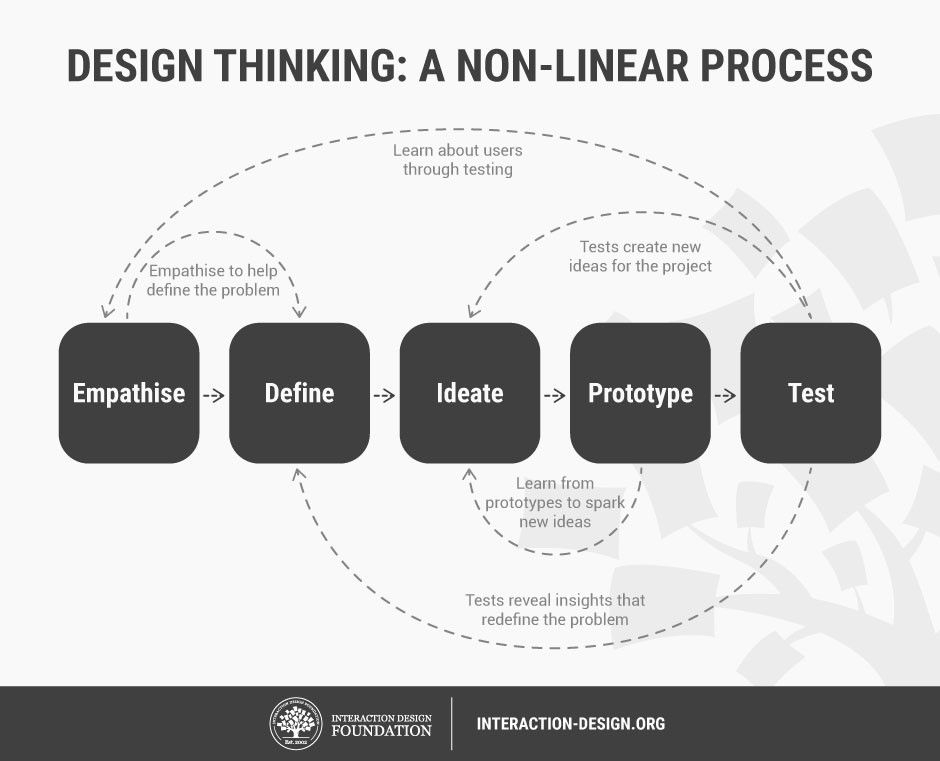
Author/Copyright holder: Teo Yu Siang and Interaction Design Foundation. Copyright terms and licence: CC BY-NC-SA 3.0

In the Design Thinking process, the Ideation stage often follows the first two stages, which are the Empathise stage and Define stage. There is a significant overlap between the Define and Ideation stages of a typical Design Thinking process. Interpreting information and defining the problem(s) and ideation both drive the generation of problem solutions. This overlap is represented in the types of methods design teams employ during these two stages. For example, Bodystorm and “How Might We” questions are often used in both of these stages.

Ideation Will Help You:

  • Ask the right questions and innovate.

  • Step beyond the obvious solutions and therefore increase the innovation potential of your solution.

  • Bring together perspectives and strengths of team members.

  • Uncover unexpected areas of innovation.

  • Create volume and variety in your innovation options.

  • Get obvious solutions out of your heads, and drive your team beyond them.

Ideation Methods to Spark Innovative Ideas

There are hundreds of ideation methods. Some methods are merely renamed or slightly adapted versions of more foundational techniques. Here you’ll get brief overview of some of the best methods:

Active Facilitation

Although many of us may have previously participated in a Brainstorm session, it is not always easy to facilitate a truly fruitful ideation session, which may be the reason why many of us have had negative experiences in the past. However, Ideation sessions can indeed be fun and exciting, but they demand a lot of preparation and team member concentration in order to be fruitful. To sit the team down with a blank piece of paper and ask them to come up with ideas will likely result in failure. Likewise, to have everyone shout out their own ideas is likely to result in failure.

People need guidance, inspiration and activities, in a physical and cognitive manner, in order to get the process started. Ideation is a creative and concentrated process; those involved should be provided with an environment that facilitates free, open, and the non-judgemental sharing of ideas.

In Ideation sessions, it’s important to create the right type of environment to help create a creative work culture with a curious, courageous, and concentrated atmosphere. Instead of using a boardroom with the CEO sitting at the head of the table, Design Thinking and Ideation sessions require a space in which everyone is equal. The Ideation room must have sufficient space for people to feel comfortable, but the atmosphere shouldn't be sterile, and team members shouldn't have to shout in order to be heard. You should also designate someone to take down contributors' ideas and draw/write them on the whiteboard/wall/poster. If the process begins to slow down and people seem to be running into a dead-end, the facilitator should impose constraints, such as: "what if there was no top-level navigation bar?" or "How-might-we go about the task if we were 8 years old?" Alternatively, you might want to set targets, such as filling a brainstorming sheet within ten minutes. To start understanding what it takes to facilitate a successful Ideation session, we’ll take a closer look at the best Brainstorming rules.

Brainstorming Rules
Author/Copyright holder: Teo Yu Siang and Interaction Design Foundation. Copyright terms and licence: CC BY-NC-SA 3.0

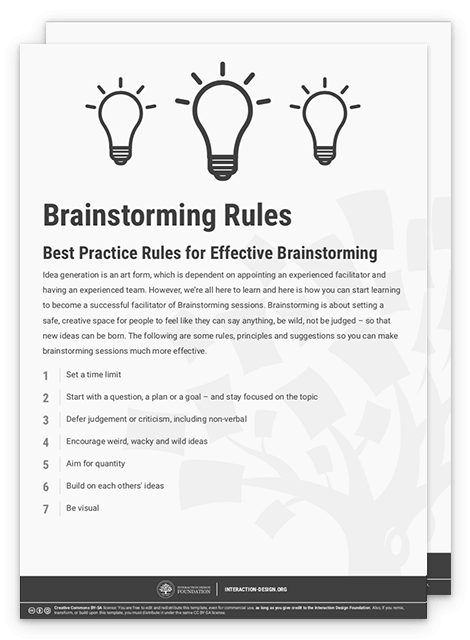
At its most basic level, a Brainstorm session involves sprouting related points from a central idea. Brainstorming is one of the primary methods employed during the Ideation stage of a typical Design Thinking process. Brainstorming is a great way to generate many ideas by leveraging the collective thinking of the group, engaging with each other, listening, and building on other ideas. This method involves focusing on one problem or challenge at a time, while team members build on each other’s responses and ideas with the aim of generating as many potential solutions as possible. These can then be refined and narrowed down to the best solution(s). Participants must then select the best, the most practical, or the most innovative ideas from the options they’ve come up with.

We’ve summarised the best practices and brainstorming rules from the Institute of Design at Stanford (d.school) and the successful design company, IDEO who celebrates Design Thinking.

  1. Set a time limit

  2. Start with a problem statement, point of view, possible questions, a plan, or a goal and stay focused on the topic: Identify the core subject or the main aim of the exercise. For example, what are you trying to achieve? Are you trying to improve a certain feature? Are you focusing on ways to improve the overall experience? Condense the main issue into a problem statement and condense it into a short “How Might We” sentence. You may even be able to synthesise this into single word. Your ideas should always branch off from this central headline.

  3. Stay on Topic: It is easy to veer off and take lots of different directions during brainstorming sessions, especially when you are trying to be open-minded and unconstrained in your efforts to come up with ideas. It is important that members stay on topic. Focus is essential; otherwise, the process can become confusing, or ideas can become muddled and cross between solutions for other problems. Every effort should be made by the facilitator to keep members on the central theme and goal. You might even want to designate a particular brainstormer to maintain the thread and prevent team members veering off course.

  4. Defer judgement or criticism, including non-verbal: The brainstorming environment is not the time to argue or for questioning other members’ ideas; each member has a responsibility to foster relations that advance the session. For this reason, judgement comes later so rather than blocking an idea, you and your other team members are encouraged to come up with your own ideas that sprout off from those provided by the other members of your team.

  5. Encourage weird, wacky and wild ideas: Once again, as brainstorming is a creative activity, each member should try to encourage other members and create an environment in which they feel comfortable verbalising their ideas. Free thinking may produce some ideas that are wide off the mark, but brainstorming is about drawing up as many ideas as possible which are then whittled down until the best possible option remains.

  6. Aim for quantity: Brainstorming is effectively a creative exercise, in which design thinkers are encouraged to let their imaginations run wild. The emphasis is on quantity, rather than quality at this stage.

  7. Build on each others' ideas: One idea typically leads on from another; by considering the thoughts, opinions, and ideas of other team members during the brainstorming session, new insights and perspectives can be achieved, which then inform one's own ideas. Thus, the team will continue to build ideas which hopefully become progressively more refined and targeted towards the central issue.

  8. Be visual: The physical act of writing something down or drawing an image in order to bring an idea to life can help people think up new ideas or view the same ideas in a different way. The brainstorming session is more likely to evolve if team members visualize and bring ideas to life rather than rely on discussion alone.

  9. One conversation at a time: Design thinkers (or brainstormers) should focus on one point or conversation at a time so as not to muddy their thinking and lose sight of the thread or current objective.

    Advance Your Career With This Free Template for “Brainstorming Rules”
    Brainstorming Rules
    We respect your privacy
    Get 1 powerful email each week: Design a life you love!

Ideation Methods to Select Ideas

Once the Ideation session is complete, the ideas must be collected, categorized, refined, and narrowed down, so the team is able to select the best solutions, ideas, and strategies from a shortlist. These methods can help you select the best idea at the end of an Ideation session:

  • Post-it Voting or Dot Voting.

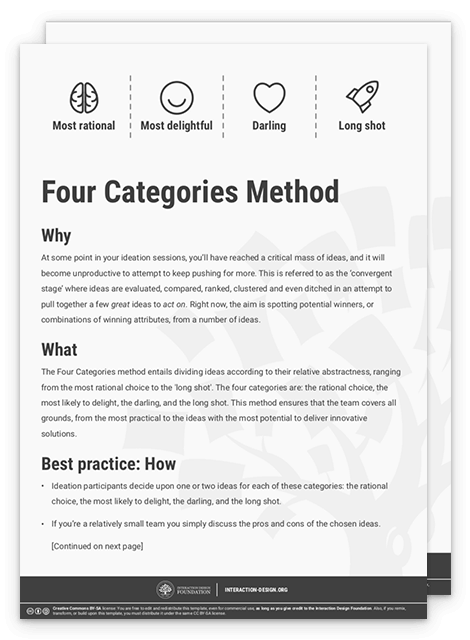
  • Four Categories Method

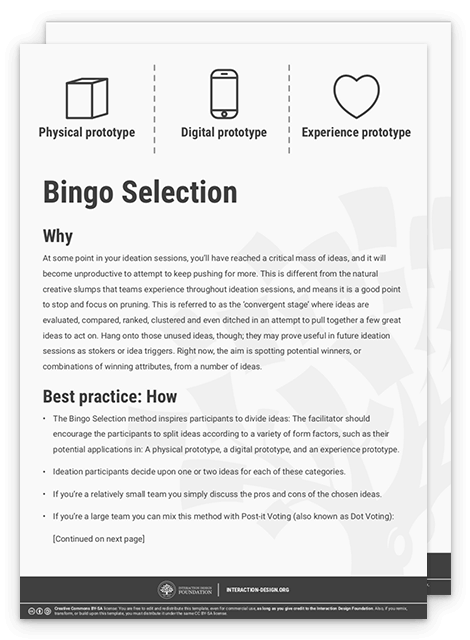
  • Bingo Selection

  • Idea Affinity Maps

  • Now Wow How Matrix

  • Six Thinking Hats

  • Lean Startup Machine Idea Validation Board

  • Idea Selection Criteria

In the following section, we’ll provide you with a brief introduction to some of the best methods.

Post-it Voting or Dot Voting
Author/Copyright holder: Teo Yu Siang and Interaction Design Foundation. Copyright terms and license: CC BY-NC-SA 3.0

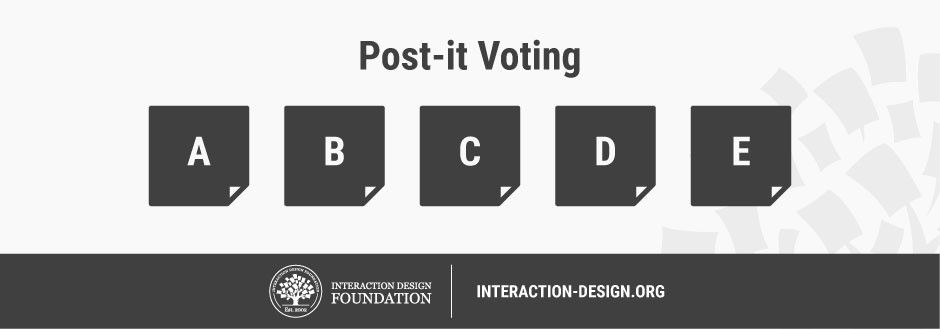
In post-it voting, all members are given a number of votes (three to four should do) in order to choose their favorite ideas. Ideas that are generated in the Ideation sessions are written down on individual post-its, and members can vote by using stickers or a marker to make a dot on the post-it note corresponding to the ideas they like. This process allows every member to have an equal say in choosing from the shortlisted ideas.

Four Categories Method
Author/Copyright holder: Teo Yu Siang and Interaction Design Foundation. Copyright terms and license: CC BY-NC-SA 3.0

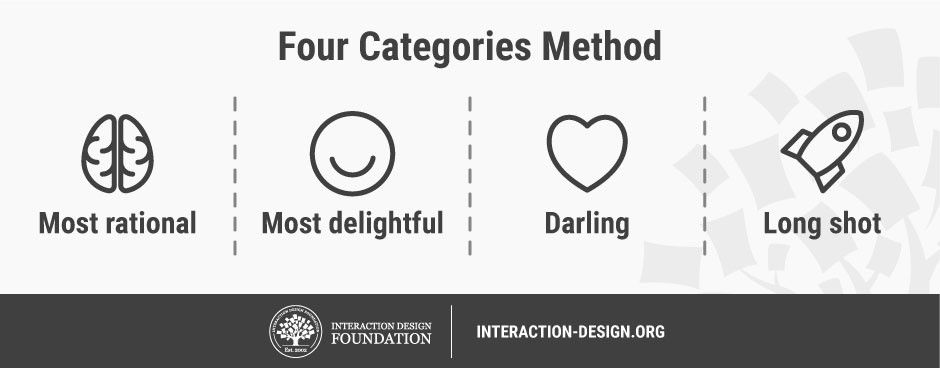
The four categories method involves dividing ideas according to their relative abstractness, ranging from the most rational choice to the 'long shot' choice. The four categories are the rational choice, the most likely to delight, the darling, and the long shot. Members then decide upon one or two ideas for each of these categories. This method ensures that the team covers all grounds, from the most practical to those ideas with the most potential to deliver innovative solutions.

Advance Your Career With This Free Template for “Four Categories Method”
Four Categories Method
We respect your privacy
Get 1 powerful email each week: Design a life you love!

Bingo Selection

Author/Copyright holder: Teo Yu Siang and Interaction Design Foundation. Copyright terms and license: CC BY-NC-SA 3.0

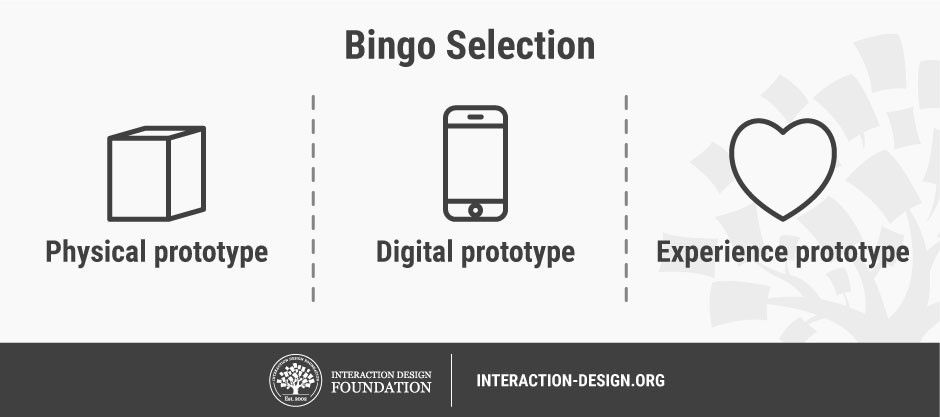
Similarly, the Bingo selection method inspires members to divide ideas. However, in this method, contributors are encouraged to split ideas according to a variety of form factors, such as their potential application in a physical prototype, a digital prototype, and an experience prototype.

Advance Your Career With This Free Template for “Bingo Selection”
Bingo Selection
We respect your privacy
Get 1 powerful email each week: Design a life you love!

The Take Away

Ideation is often the most exciting stage in a Design Thinking project because almost unrestrained free thinking can occur within the given field. In the Ideation stage, the aim is to generate a large number of ideas — ideas that potentially inspire newer, better ideas — which the team can then filter and narrow down into the best, most practical, or most innovative ones. There are many great methods that can help the design team during the Ideation sessions.

References & Where to Learn More

Course: “Design Thinking - The Ultimate Guide”.

IDEO U: Brainstorming.

d.school: “How might we” questions.

d.school, An Introduction to Design Thinking PROCESS GUIDE.

Hero Image: Author/Copyright holder: Adriadne. Copyright terms and license: CC0

Feel Stuck?
Want Better Job Options?

AI is replacing jobs everywhere, yet design jobs are booming with a projected 45% job growth. With design skills, you can create products and services people love. More love means more impact and greater salary potential.

At IxDF, we help you from your first course to your next job, all in one place.

See How Design Skills Turn Into Job Options
Privacy Settings
By using this site, you accept our Cookie Policy and Terms of Use.
Customize
Accept all

Be the One Who Inspires

People remember who shares great ideas.

Share on:

Academic Credibility — On Autopilot

Don't waste time googling citation formats. Just copy, paste and look legit in seconds.