Maps are one of the oldest tools humans have used to find their way around the world. They help us understand the lay of the land, where we are, and where we need to go.
Like a traditional map, journey maps also help us understand our customers’ world, where they are and where they want to go. They help us identify the roadblocks, twists, and turns they encounter and give the entire product team insights to help resolve those obstacles and create delightful customer experiences.
Find out how you and your team can benefit from these tools in Journey Mapping: Improve the Customer Journey. Here’s an overview of what you can find in this course.
1. Why Do We Need Journey Maps?
Imagine that you’ve ordered a frying pan from an online shop. The product is expected to arrive in three days. The next day, you receive notification that the product is out of stock because too many customers ordered the frying pan in the past 24 hours. Another week rolls by, the product is finally available, and you receive your frying pan, only to realize it’s two inches smaller than the one you ordered.
You would like to ask the company for a replacement. You head back to the shop, read through the entire FAQ section, and realize that your case isn’t covered. You look for a way to contact the company and decide to call the toll-free customer care number. A recorded message thanks you for your time and patience, and well, by now, you might have guessed where we’re going with this example.
As a customer, you likely have stories of both good and bad experiences. As a product manager or experience designer, you’re on the other side of the equation; your goal is to ensure your customers have the best experience using your product or service. As we’ve seen in the example above, the customer’s experience spans multiple touchpoints:
The online shop
The notifications about the product being out of stock
The shipping service
The FAQ page
The toll-free customer care service
And had we continued with the example, possibly the social media team, the customer loyalty program, the payment service…
Many of these touchpoints will likely be handled by different people, teams, or even different companies. And each group may be oblivious to the customer experiences outside of their domain. Enter journey maps.
2. What Is a Journey Map?
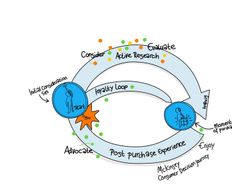
A journey map visualizes a person’s interaction (their journey) with your product or service (or both, in the case of digital products). It helps all stakeholders gain a shared understanding of the users’ journey and helps them identify gaps and opportunities to improve the user’s experience.
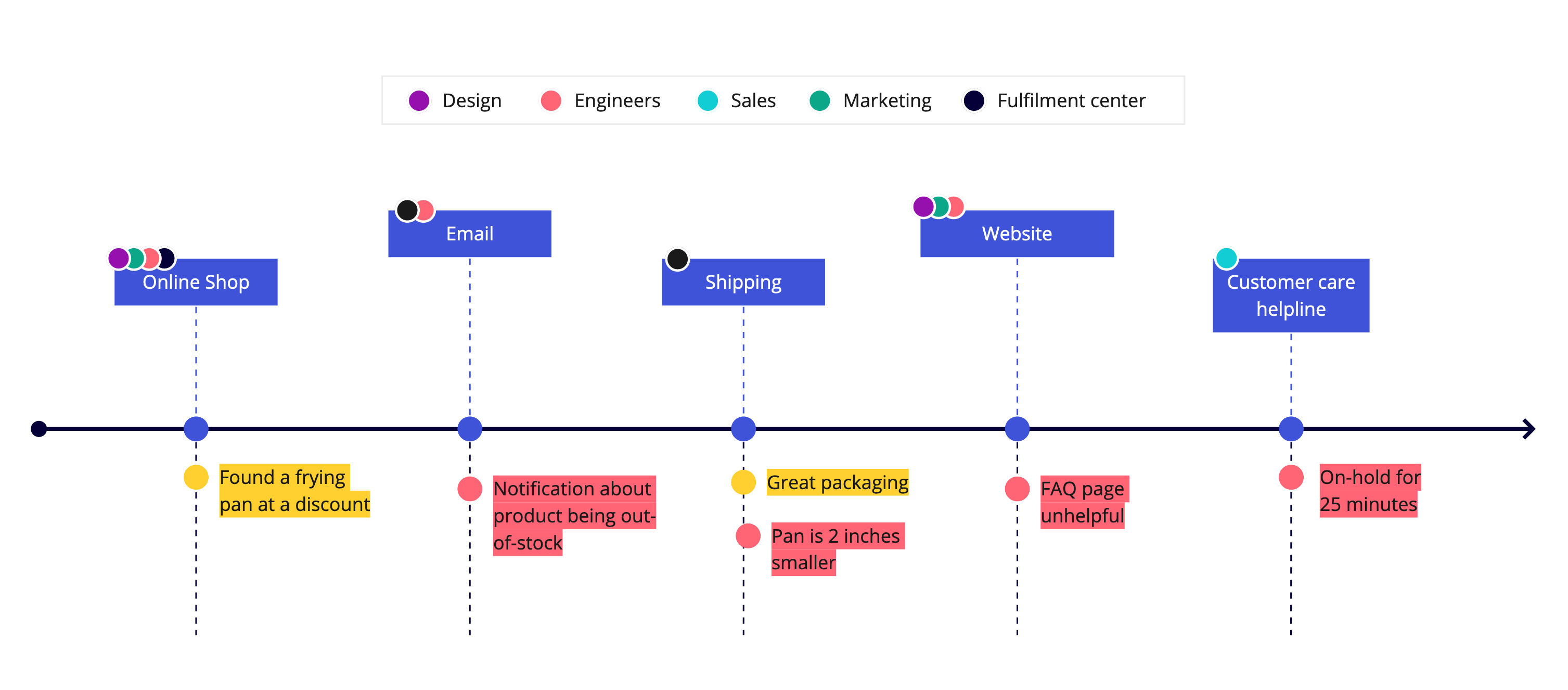
We would have explained our experience with the frying pan much faster with a journey map!
In a 2019 survey, the Nielsen Norman Group found that journey mapping was the third-most-popular activity for UX professionals. The first is collaborating with subject-matter experts (which is arguably part of journey mapping), and the second, prototyping.
3. What Does a Journey Map Contain?
What you include in a map depends entirely on your objectives. For example, you can draw a map of a city from different perspectives — one map for train or subway stations and routes; one that shows the topography or the terrain; another that shows the weather pattern and so on. Similarly, how you draw your journey map depends on your project and your objective while making it.
Three common types of journey maps are:
Experience maps have the broadest scope amongst journey maps. They focus on the experience of a generic person attempting to accomplish a goal regardless of the products or services they might use. Experience maps help you explore human behavior outside of your particular product or service and explore new product or service ideas. These maps help answer the question, “What is a user’s experience while accomplishing a goal?”
Customer journey maps have a slightly narrower focus than an experience map in that they focus on a specific group of people as customers who use your product or service. These maps answer the question, “What are our customers’ experiences using our products and services?”
Service blueprints are the behind-the-scenes version of customer journey maps. Like the customer journey map, they focus on the same group of customers and product or service, but from a business’s perspective. The service blueprint answers the question, “What do we, as a business, have to do to provide a delightful experience to our customers?”
4. What Are the Best Practices for Journey Mapping?
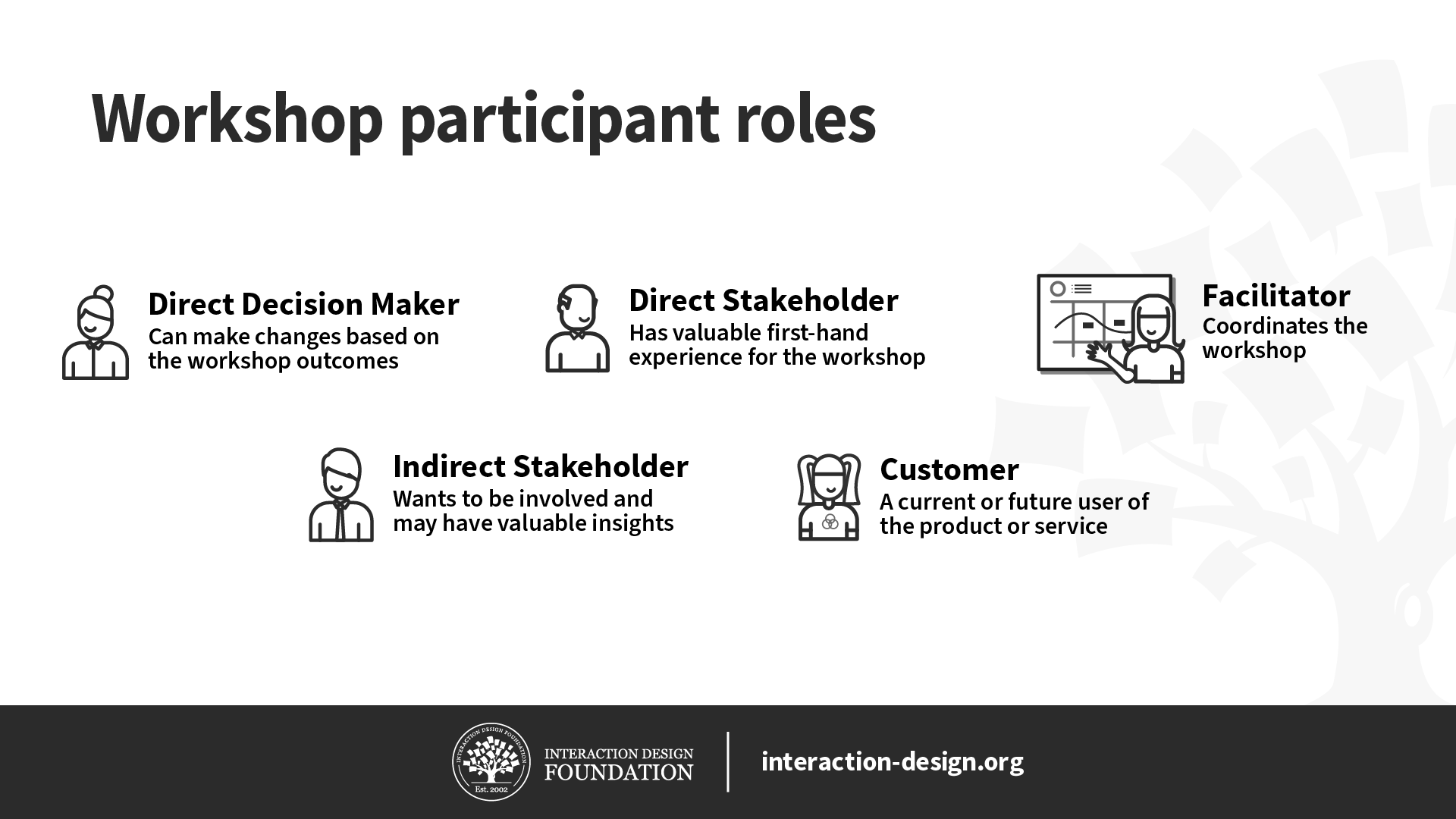
Make sure your journey mapping workshop includes direct as well as indirect stakeholders, customers and decision-makers to get different points of view. The idea is to make sure the team collaboratively identifies problems and develops feasible and viable solutions. The facilitator plays a vital role in ensuring no conflicts and chaos happen (due to several stakeholders being present) and steering the workshop smoothly.
Define the goal: Define who will use the map and what decisions you intend to make with the help of the map. Without an “X” mark for a treasure chest, even a pirate’s map would be worthless!
Conduct research: When you include quotes from interviews and audio-visual artifacts from field studies, it will be hard for stakeholders to refute the evidence and reduce the scope for bias.
Make it customer-centric: Even a service blueprint has to be drawn from the customer’s perspective. Introduce the persona and, if possible, even invite actual customers for the journey mapping session.
Involve all the stakeholders: Journey maps depict the whole gamut of experiences. When you involve all stakeholders, you will likely have a better, more holistic view. Each stakeholder will also offer their perspective and experience that others in the team may not be privy to.
Keep it simple: Given the heavy-lifting journey maps do, keeping it simple might sound difficult or even contradictory. This is where having a cross-functional team and involving direct decision-makers will help you prioritize and synthesize the insights from numerous data points. Your research will likely have given you several points to plot on your map. However, if you create a complex, data-heavy map, you might lose its value. At best, high-priority opportunities will get mixed with low-priority ones, and at worst, people may not even see the map after the workshop.
Iterate: Journey mapping is not a one-time activity. Revisit the map after you have implemented the ideas and decisions. Customer preferences can change, new competitors might disrupt the market, and legislation can restrict what you can offer (or even open up new possibilities).
About the Journey Mapping Course
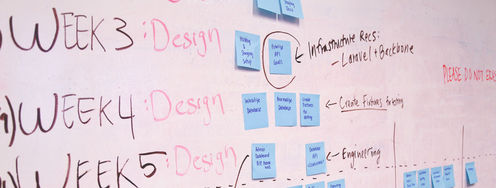
Journey Mapping is a five-week course that dives deeper into the three types of journey maps and explores different approaches to creating them. The course is ideal for designers across all levels and is especially useful for product managers who work with complex experiences. From research methods to facilitating the workshop, the course covers the entire journey of a mapping session (pun unintentional)!
Here is Christian Briggs, the lead course editor and senior product designer at the Interaction Design Foundation, with an overview of what you will learn:
Throughout this course, you will learn from four industry experts:
Indi Young, author of two books, Practical Empathy and Mental Models, and a founder of Adaptive Path, the pioneering UX agency that was an early innovator in journey mapping.
Kai Wang, a talented UX professional who has designed complex experiences for companies such as CarMax and CapitalOne.
Matt Snyder, former Sr. Director of Product Design at Lucid Software and Head of Product & Design at Hivewire.
Christian Briggs, a Senior Product Designer and Design Educator at the Interaction Design Foundation who has been designing digital products and has been using methods like journey mapping for over ten years.
Journey Mapping: Improve the Customer Journey includes a portfolio project to strengthen your learnings. It also includes downloadable templates that you can use in your projects with your team long after you have completed the course! So, why not enroll in the course today to level up your product design skills and design better experiences for your users!
Where to Learn More
Enroll in the course Journey Mapping: Improve the Customer Journey—it’s included in your IxDF membership.
Psst: You can sneak a peek into lesson 1. Simply scroll down the page and hit the preview links when you see them!
Not yet a member? Sign up here.
Image
Hero Image: © Interaction Design Foundation, CC BY-NC-SA 3.0