Trust frameworks are essential tools that help you build trust and credibility in professional interactions, whether you're leading a team, presenting to stakeholders, or designing user experiences. They’re conceptual models that provide a strategic lens to analyze how you and your work are perceived. Instead of leaving trust to chance, these frameworks give you a clear structure to shape your communication, behavior, and decisions in ways that earn confidence and respect.
In this video, Morgane Peng, Head of Product Design & AI Transformation at Societe Generale, shares two widely used trust frameworks: The Confidence and Warmth Model and the Giver and Taker Model.
Want Buy-In for Your Ideas? Use Trust Frameworks
No matter how sharp your ideas are, they won’t go far without trust. If people don’t believe in you—or aren’t sure of your intent—they’re less likely to listen, agree, or act. That’s true no matter your job or industry.
And in many professional settings—especially digital ones—you often have to earn trust quickly, without the luxury of building relationships over time.
That’s where trust frameworks come in. They help you understand how others perceive your competence and intentions, and give you a structure to communicate both clearly. When you apply a trust framework, you can make deliberate choices about your tone, language, and presence, so people feel confident in you and are aligned with your goals.
Whether you're speaking to users, clients, or colleagues, trust frameworks help you create the conditions for people to say “yes.”
Two Trust Frameworks You Can Use Right Away
When people decide whether to trust you, they’re not guessing. They're instinctively scanning for two things:
Do you know what you're doing?
Do you have good intentions?
Trust frameworks help you actively communicate the right signals. These two models give you a clear starting point.
The Competence and Warmth Model
This widely studied model shows that people quickly judge others based on two universal traits:
Competence: Are you capable, skilled, and credible?
Warmth: Are you trustworthy, friendly, and well-intentioned?

© Interaction Design Foundation, CC BY-SA 4.0
To build strong, lasting trust, you must be perceived as both highly competent and highly warm. Competence earns respect. Warmth earns goodwill. If you’re highly competent but seem cold or arrogant, people may listen, but they won’t necessarily trust you. And if you’re warm but not seen as capable, you might get liked but not followed.
Let’s say you're pitching a new design idea. You walk in with a deck full of data, a well-structured plan, and clear logic. But you are tense, avoid eye contact, and dive straight into numbers. You’ll come across as smart but distant. The team may agree with your logic, but they won’t feel bought in. That’s competence without warmth.
Now consider how you might shift that: Start by acknowledging your team’s goals or concerns. Ask a question. Use body language that shows openness. This doesn’t water down your expertise, it reinforces it by showing you're attuned to the people you're working with.
Ask yourself:
Do people listen to your ideas but hesitate to engage?
Are you known for being knowledgeable, but not necessarily approachable?
If so, it may be time to consider how you're showing warmth—not just competence—in your communication.
Warmth alone won’t carry you all the way either. While being approachable and supportive helps people feel comfortable with you, it’s just as important to demonstrate that you have the knowledge or insight to back up your ideas. If you focus only on connection without showing your expertise, people may enjoy working with you, but hesitate to fully trust your recommendations.
That’s why the most effective professionals combine both: they present with empathy and come prepared with strong reasoning, solid research, or relevant data. When you can connect and deliver, people are far more likely to trust you, and act on what you say.
The Giver or Taker Model
This framework, popularized by author Adam Grant, categorizes people's interaction styles based on reciprocity:
Givers offer support, share knowledge, and focus on creating value for others.
Takers prioritize personal gain, often aiming to extract more than they contribute.
Matchers strike a balance; they give, but expect fairness in return.
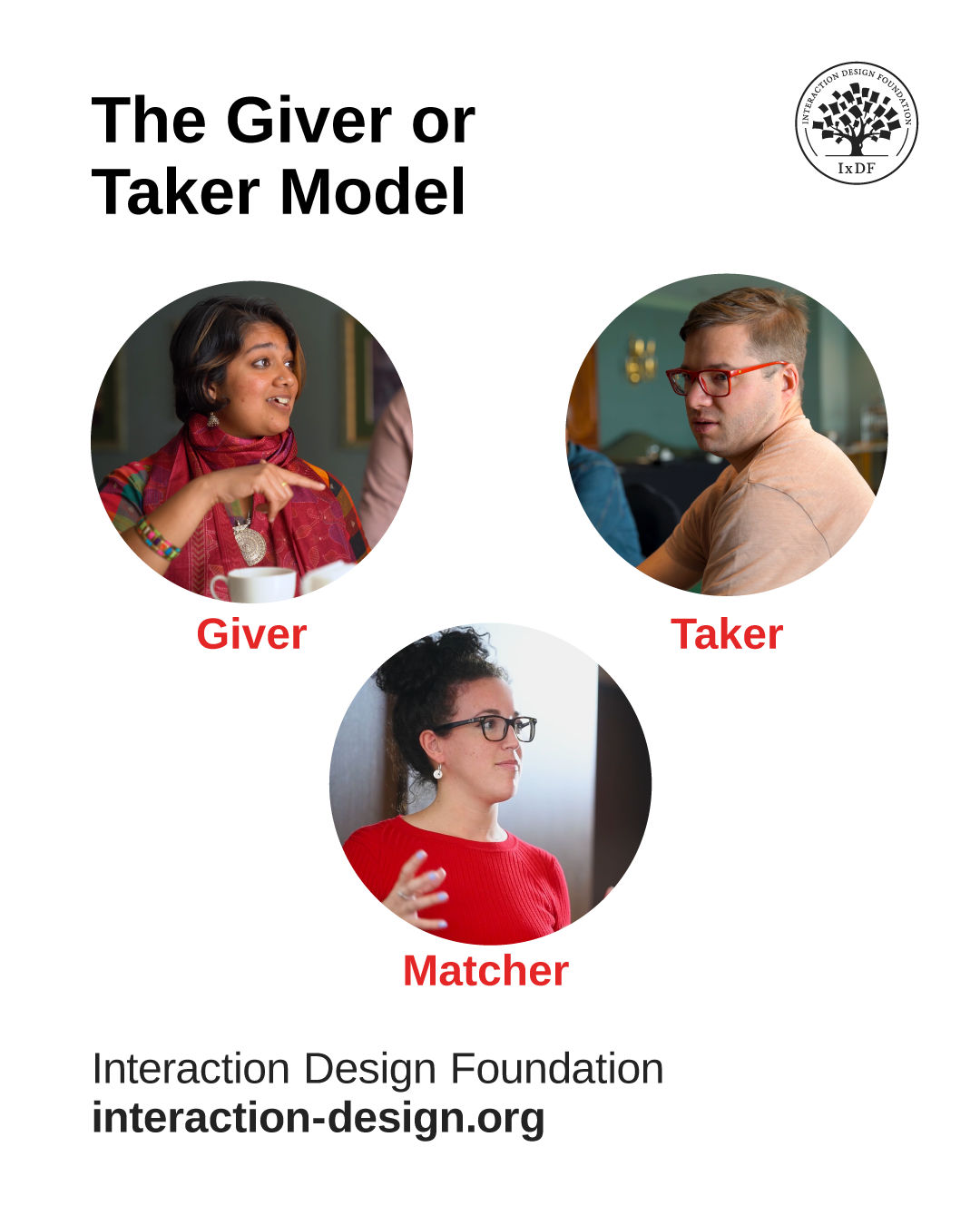
© Interaction Design Foundation, CC BY-SA 4.0
In most professional environments (and in life), being perceived as a giver or a matcher builds trust, strengthens your reputation, and opens doors to long-term collaboration. It signals that you're thoughtful, generous with your expertise, and committed to shared outcomes, not just personal wins.
Think about how you ask for support or pitch an idea. If your message is mostly about what you need: “We need more time, more budget, more support,” you might unintentionally come across as a taker. But when you lead with how your idea benefits the team, the users, or the business: “This feature will make onboarding smoother for new users and reduce support tickets,” you show that your goals are aligned with theirs.
You don’t have to give endlessly or put others ahead of yourself at every turn. But if you consistently show that you're thinking about the bigger picture—and not just your own corner—you’ll be seen as someone worth trusting, supporting, and following.
Ask yourself:
In your recent interactions, are you clearly showing the value others get from your ideas?
Are you positioning yourself as a collaborative partner—or just a requester?
A small shift in perspective can change how people respond and how willing they are to get on board.
What Happens When You Build Real Trust?
When you start applying trust frameworks with intention, your communication becomes clearer, your relationships stronger, and your influence deeper.
Trust isn’t something you’re born with. It’s something you build deliberately, moment by moment. And once you know how to shape it, you stop hoping people will understand you or support your ideas… and start making it happen.
You become someone people rely on. Not just because you’re smart, but because you show up with clarity, consistency, and care.
Your ideas get traction. When people trust your motives and your judgment, they don’t need convincing.
Collaboration becomes easier. When trust is present, people spend less time second-guessing and more time building together.
You get opportunities you used to watch from the sidelines. Leaders, clients, and colleagues are drawn to people who inspire confidence, not just in themselves, but in what’s possible.
Trust isn’t a vague trait you either have or don’t; it’s the result of clear decisions, practiced behaviors, and thoughtful communication. Trust is built through the small things: the way you listen, the questions you ask, how you respond under pressure, and how consistently your actions match your words.
And just like any technical skill, building trust is something you can practice. You can refine how you present ideas, how you build rapport, and how you show competence and intent, just as deliberately as you’d learn a design tool or coding language.
Advance Your Career: Sharpen Your Presentation with Skills Trust Frameworks
Building trust is one of the most effective ways to grow your career, and your presentations are often where that trust is tested most visibly.
When you speak in front of others, you're not just sharing ideas. You're revealing how you think, what you value, and how well you understand your audience. People don’t just judge the content, they form lasting impressions of you. That’s why presentations are a proving ground for trust.
Use these trust frameworks to make sure you're being perceived as both warm and competent; someone people believe and want to work with. They’re simple tools you can bring into every presentation without needing to change your style or start from scratch.
Before your next one, ask yourself:
Am I showing not just what I know, but why it matters to the people in the room?
Does my tone reflect openness and shared purpose, or just information delivery?
And afterward, take a moment to reflect:
Did I connect as well as I informed?
Where did I build trust? and where might it have slipped?
Then repeat. That’s it. With each presentation, you refine not just how you communicate, but how you're trusted. And that’s how you start being seen as someone ready for bigger roles and bigger decisions.
Want to Be Irreplaceable? Build the One Thing AI Can’t Fake: Trust
As AI becomes more capable, the value of purely technical skills is shifting. But there's one thing machines still can’t replicate: Your ability to build trust with other people.
Trust is deeply human. It’s not just about what you say, but how you say it, your timing, your tone, your presence, your ability to read the moment and respond with care. It’s how you make someone feel understood, respected, and safe to move forward. That’s not something AI can do. And it’s exactly what the most impactful professionals do well.
When you develop your ability to build trust—through how you present, how you collaborate, and how you show up consistently—you’re protecting your role and growing into the kind of professional others turn to when it matters most.
The more human your skills become, the more future-proof your career will be. And trust is one of the most human skills there is.