You’re new to UX design and on the hunt for your first job. You face a familiar paradox—to get a job, you need a portfolio, but to build a portfolio, you need a job. So, how do you solve the problem? It’s simple—even without UX experience, you can easily create job-landing case studies for your portfolio. We’ll show you three ways to find projects today.
How to Build a UX/UI Design Portfolio with No Experience
Who said you couldn’t build a UX (user experience) portfolio without professional experience? Don’t believe it! Design experts like Vitaly Friedman, Creative Lead at Smashing Magazine, and Niwal Sheikh, Product Design Lead at Netflix, value more than just experience. In this video, they share insights on what truly makes a job-winning portfolio:
It’s easy to find exciting projects to work on and transform them into stand-out case studies. Want to break into UX design? Let’s get started!
1. Hypothetical Projects
Hypothetical projects can be based on a product or service you know or use, or you can make up your own product entirely. This approach is excellent for UX beginners and students, as it allows you to get started right away without the need to find an actual client.
Think about a design you use daily and create a project. For example, you can evaluate the usability of your local cinema’s website and prototype an improved design. Or you could study the experience of commuting on your local subway system and suggest how to make it more pleasant. Everything is designed so you’ll never run out of things to analyze and improve.
You may be tempted to pick products or services from major companies like Apple or Google, as they will sound impressive on your portfolio. However, these companies have large design teams and well-established practices, so you’re less likely to find real UX issues.
For a guided approach, many IxDF courses include case study projects you can include in your portfolio. For example:
Design Thinking: The Ultimate Guide: Using the design thinking methodology, you’ll create a smartphone fitness app.
Visual Design: The Ultimate Guide: You’ll choose any design you like and focus purely on the visual elements to improve it.
User Research – Methods and Best Practices: You’ll work on three different projects, each with a distinct focus—user interviews, contextual inquiries and observations.
IxDF case studies are an excellent way to build your portfolio. Thanks to our incredible community, you can also get feedback on your projects and inspiration from your fellow learners.
© Interaction Design Foundation, CC BY-SA 4.0
2. Volunteering, Hackathons, Student and Community Projects
Real-world projects are often more valuable for case studies than hypothetical ones. They show off your design skills, experience with real users and ability to work in a team. However, while it’s not unheard of to land a paying project before you have a portfolio, it is a challenge. After all, this is why you are here!
Given this, an excellent option is to exchange your design skills for high-quality case studies. Many people are against working for experience or exposure—and with good reason—many new and young designers are taken advantage of. However, there are several ways to contribute your skills and ensure everything remains ethical:
Many charity and non-profit organizations and events rely on the services of volunteers. For example, a non-profit music festival might need a UI designer for its app, or a charity event might need a service designer.
Hackathons are events where developers and designers work together over short periods (often 24 or 48 hours) to build a functioning product. Hackathons are both fun and demanding, and a case study from one of these events will demonstrate your ability to work efficiently.
If you are a student (or recently graduated), your student projects will make excellent case study material. Similarly, you can find community projects both locally and online that fit around your other commitments.
You can find opportunities like these through IxDF Local Groups. You can meet people who share your passion for design and see how conversations open doors. Your new contacts may lead to future work—networking gives you the best return on investment!
3. Reframe Your Non-Design Experiences
Previous non-UX experiences can make fantastic UX case studies. Did you use customer research to inform layout decisions in your supermarket job? That’s a perfect user research case study! Did you help organize a school fair for optimal visitor experience? Add it to your service design portfolio!
© Interaction Design Foundation, CC BY-SA 4.0
If you are transitioning from another industry or career, you can translate your years of non-UX experience into UX case studies. Think about all the new design methods you know and if you unknowingly used them in the past. Alternatively, explain how you would approach these past projects now that you’re a UX professional.
Transferable skills like problem-solving abilities, time management and teamwork are fundamental in design work. Highlight these skills to give yourself an edge over those with more design experience but less professional experience overall.
5 Top Tips to Make the Most of Your UX/UI Design Case Studies
If step one is finding a project, then step two is to get stuck in! Follow these best practices to maximize your case studies and build a stand-out portfolio.
Choose Your Path Wisely
You should use the design methods and techniques most relevant to the role you want to apply for. For example, if you’re a UX writer, you will want to focus on methods like A/B testing and content strategies. If you’re looking for a UX research role, show off your mastery of usability testing and user interviews.
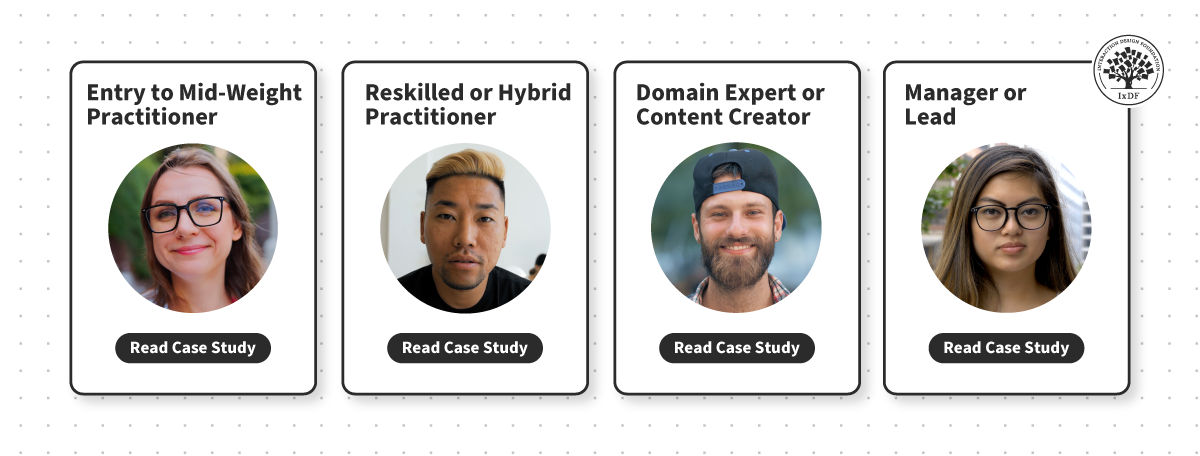
In addition to your field, consider your stage on the UX career ladder. The case studies of an entry-level designer and a reskilled designer will differ based on the roles they’re applying for. Tailor your case studies to the roles you’re applying for to appeal to hiring managers.
© Interaction Design Foundation, CC BY-SA 4.0
Practical Beats Theory
The best approach for your portfolio projects is to do, do, do! Want to conduct user interviews? Get your friends’ help and ask them questions. Need to do user testing of an app? Sit down with your friends, neighbors or even strangers at a cafe. Start sketching your ideas on paper. Create a journey map based on your friend’s day as a commuter on the subway. Start small, use what you have access to and do.
Document, Document, Document!
When the time comes to assemble your case study, you may have forgotten important discoveries or why you made certain choices. For these reasons, it’s essential to document as much as possible—you will thank yourself later! Documentation is invaluable to a successful portfolio—it gives a deeper look into your process and shows hiring managers the design challenges you’ve overcome. Rough sketches, photos, videos and voice notes also make case studies visually appealing and interactive.
Mike Rohde, Designer, Teacher and Illustrator, explains the benefits of documentation to your portfolio, plus some top tips:
Finally, documentation will help you evaluate your performance and processes. When you include a performance evaluation in your case study, it communicates to potential employers your ability to be critical of your own work and improve upon it.
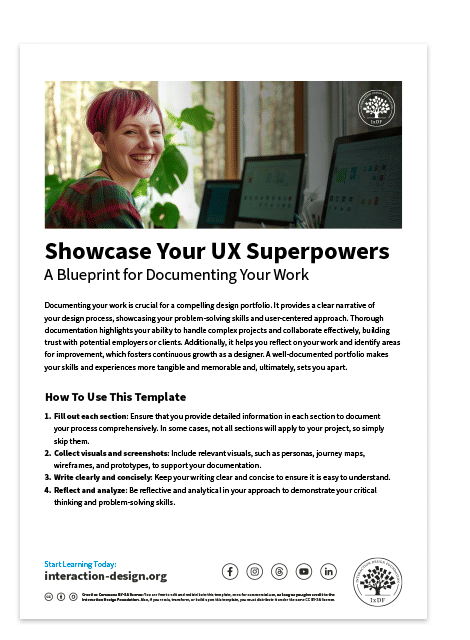
Download our free template, a blueprint for documenting your work, and showcase your UX superpowers.
What’s the Magic Number?
Once you’ve finished your first project, don’t stop there! The ideal number of case studies to include in your portfolio is between three and six. This range is enough to show the breadth of your abilities but not overwhelm potential employers or clients. Additionally, if you have multiple case studies to choose from, you can tailor your portfolio to specific job applications.
For example, if you are applying for a role that requires some UX research skills, you can choose the case studies that best showcase your abilities in this area.
As for the types of projects, include a blend of approaches. For example, a hypothetical project shows your ability to evaluate and improve an existing design. In contrast, a community or hackathon project shows you can design from scratch and work in a team.
Treat all your case studies as a complete package. They should differ enough to show your diversity, but combined, paint a complete picture of you as a designer. Avoid case studies that are too similar or too wildly different—unless the role requires it.
Visuals Count
The last step is to arrange your case studies in a way that grabs the attention of hiring managers and keeps them engaged. Morgane Peng, Design Director at Societe Generale CIB, explains the best practices for the visual design of your portfolio:
The Take Away
Projects for your UX portfolio are easier to find than you think. You can make projects up, find exciting ways to use your skills for free and reframe past experience as UX case studies. Mix and match these approaches to craft three case studies that represent you as a designer. Use documentation and practical experience to show hiring managers your abilities and processes. Finally, arrange it all to grab attention and exemplify your attention to detail. Follow these practices, and you will create a stand-out portfolio that impresses potential employers and lands you your first UX role.
References and Where to Learn More
Want to create a portfolio that gets you hired? Take our course, Build a Standout UX/UI Portfolio: Land Your Dream Job, and learn how to showcase your skills, tell compelling project stories, and impress employers.
Effortlessly create exciting case studies with the portfolio exercises in many IxDF courses:
Design Thinking: The Ultimate Guide: Using the design thinking methodology, you’ll create a smartphone fitness app.
Visual Design: The Ultimate Guide: You’ll choose any design you like and focus purely on the visual elements to improve it.
User Research – Methods and Best Practices: You’ll work on three different projects, each with a distinct focus—user interviews, contextual inquiries and observations.
Discover 7 Design Portfolio Mistakes That Are Costing You Jobs! And How to Fix Them.
Find out what Nielson Norman Group discovered when they asked over 200 hiring managers what they look for in a UX portfolio.
Watch our on-demand Master Class, How to Elevate Your Portfolio: Sketching Your Design Process, with Mike Rohde.
Make meaningful connections that fast-track your career and join an IxDF Local Group.
Master AI Optimization to Create a Winning UX/UI Portfolio.
Images
Hero image: © Interaction Design Foundation, CC BY-SA 4.0