Local Maxima in UX

Your constantly-updated definition of Local Maxima in UX and collection of videos and articles.
Be a conversation starter: Share this page and inspire others!

295 Shares

What are Local Maxima in UX?

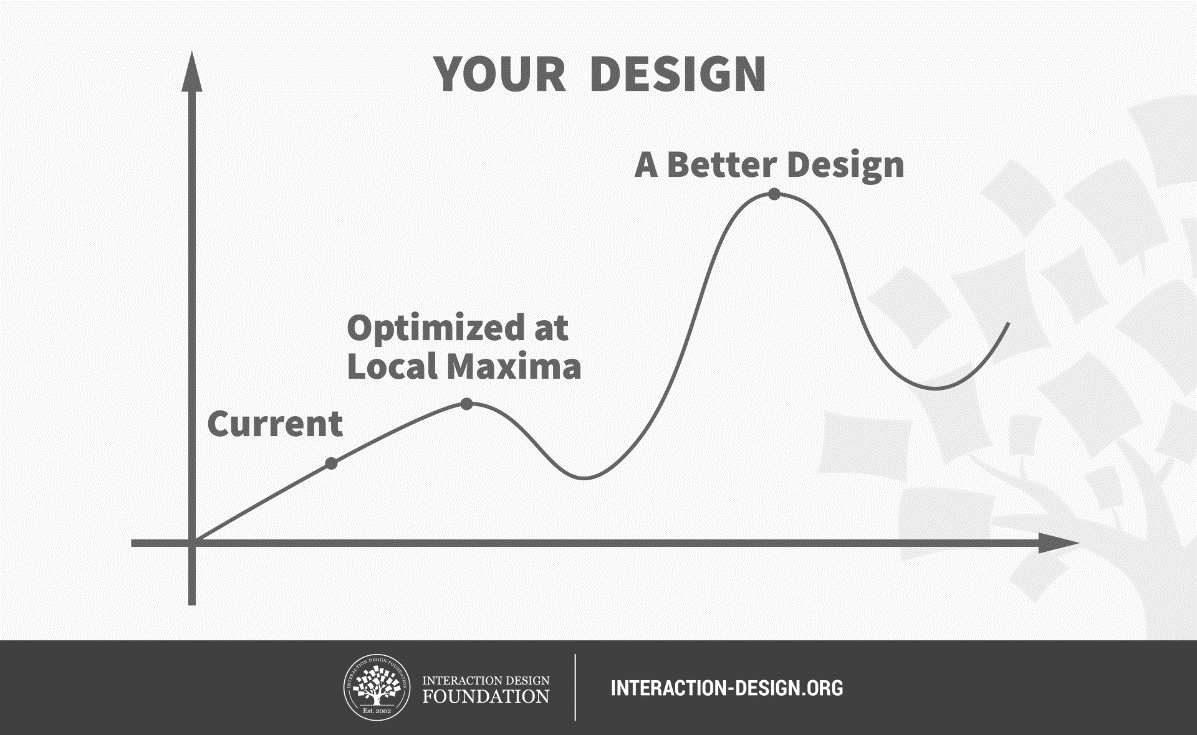
Local maxima of UX are points where designs seem to have optimal user experience but truly have room for improvement. Design teams can get stuck on them when they blindly react to data to improve design features. A user-centered design approach can overcome local maxima and help produce better, more innovative designs.

“You can achieve a shallow local maximum with A/B testing – but you’ll never win hearts and minds.”

— Jeff Atwood, Software developer, author & entrepreneur

Transcript

Learn how to spot local maxima of UX and get off the “hill” so you can reach the “mountaintop”.

Local Maxima are Warning Signs

Local maxima are the highest points organizations reach in their designs when they’re data-driven rather than data-informed. This means they let data from (e.g.) user testing guide the decision-making process, as opposed to leveraging that data more carefully. It’s easy to take data at face value and draw assumptions about what to fix in a design. It’s harder to view that data as part of a wider context. Consequently, brands fall into the trap of assuming they can optimize their products from what appears to be a reliable baseline.

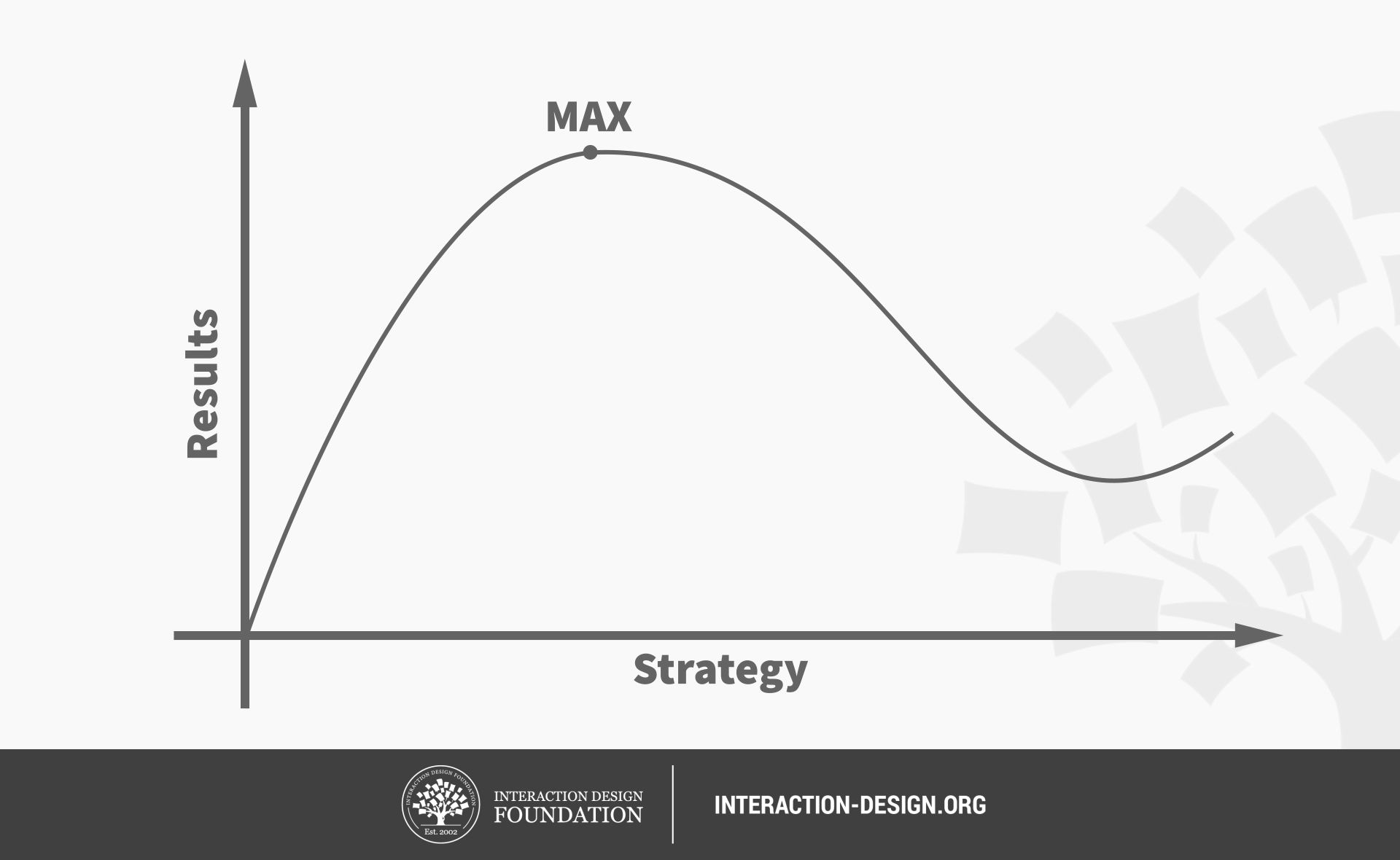
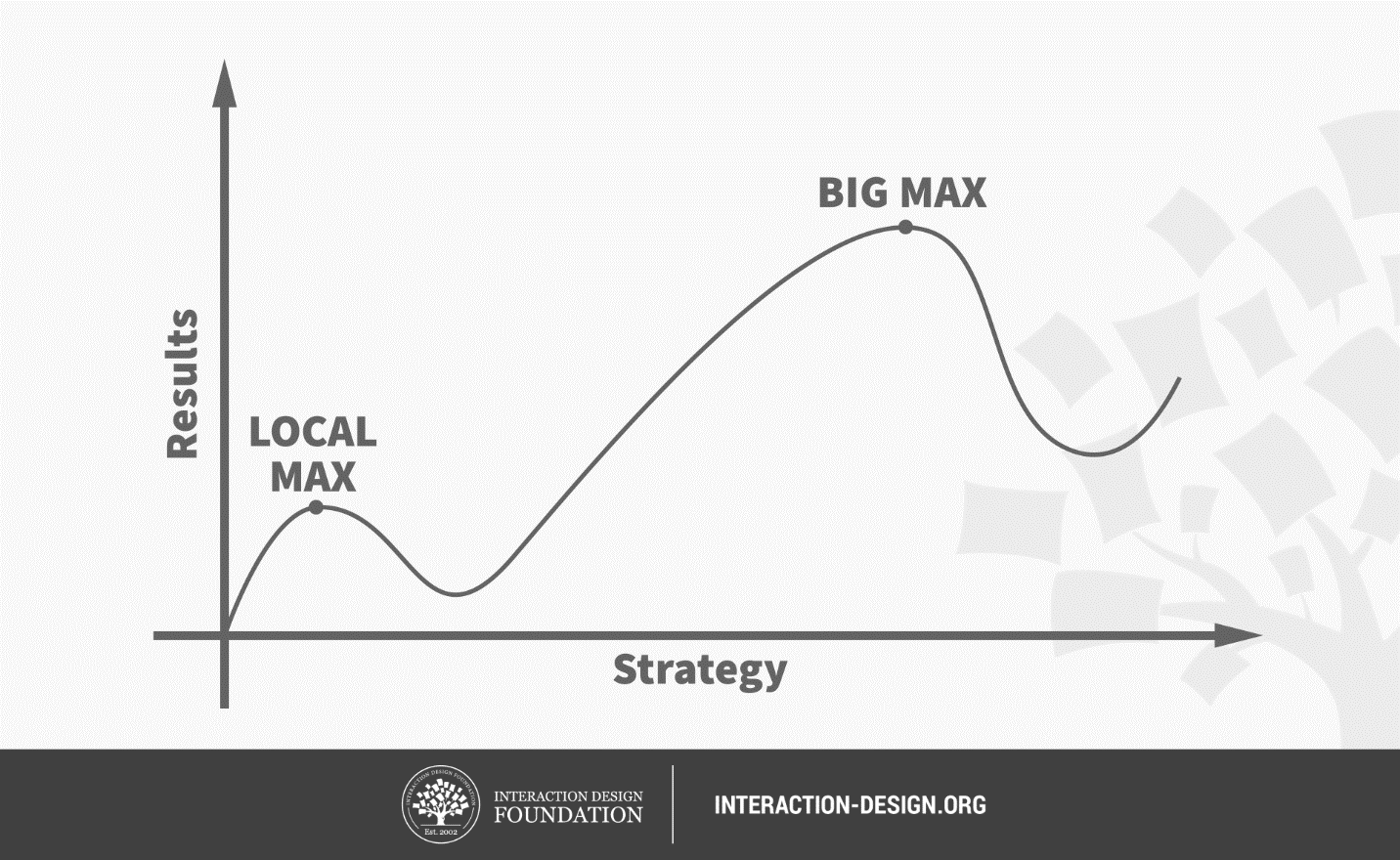
Local maxima typically occur in user experience (UX) design as symptoms that design teams have failed to start with a good-enough design. A local maximum appears as—initially—the highest point on the graph where Results and Strategy are axes. In a UX context, a brand will have found that users appreciate its product and worked with the data from (e.g.) A/B testing to validate its strategy. It fine-tunes and pushes to improve its design until it reaches what appears to be maximum payoff. The brand continues laboring under the illusion that more of the same effort and style/size of changes will bring more success. If it keeps to its original strategy of improving the design based on the data it receives from testing, it may view the local maximum as a point from which to ideate successful design tweaks. However, the danger is the brand will continue reacting to the data and back itself into a design dead-end, therefore disconnecting itself even more from its users. Without taking the initiative to re-examine its strategy and discover how to approach improving the UX effectively, it risks end up stagnating with a failing product.
How to Get Past Local Maxima and Climb Real Summits

Brands should strive to push beyond local maxima of UX and reach the true maximum of successful UX design. So, instead of tweaking each troublesome element to help users, their focus should be the users themselves and their real-world, human contexts. This is the mindset for breaking away from the tendency to focus on low-hanging fruit and take incremental steps in ultimately not-so-good directions. Larger organizations such as Amazon and Google can afford to follow a cycle of smaller improvements. They have the userbase to support frequent and ultra-fast usability testing. Smaller organizations lack this luxury – tests must run for longer, thereby delaying iteration. The challenge for designers is to find the right balance between working reactively from hard facts from tests and proactively adopting innovative measures where appropriate.

To realize the full potential of your existing design’s UX, you should:

  1. Find your local maximum’s exact position by optimizing your design until changes no longer yield desired results.

  2. Start using a user-centered design process such as design thinking, thereby:

    1. Empathizing with your users via, e.g., customer journey maps

    2. Defining their needs and problems via, e.g., personas

    3. Ideating to think outside the box using, e.g., brainstorming

    4. Prototyping

    5. Testing

  3. Continue iteratively until dramatic improvements stop occurring.

Overall, remember – you’re working in a complex, interconnected user-centric design space. This means finding out, for example, users’ higher-level goals and what obstacles they face on their user journeys. In your design sprints, think about the users and their real-world activities instead of your design’s elements and the low-hanging fruit. Once you shift your approach to consider the data rather than rely on it, you’ll find yourself moving beyond your local maxima of UX. You’ll then have the “big maxima” in sight: those massive wins where your team has applied the right measure of innovation and optimization to your design’s UX – insightfully, ingeniously and successfully.

Questions About Local Maxima in UX?
We've Got Answers!

What is a local maximum in UX design?

A local maximum in UX (user experience) design happens when a product or experience hits a point where further small improvements seem beneficial but actually block bigger, better changes. Designers fall into this trap by optimizing existing features so much that they miss out on exploring radically better alternatives. For example, a team might keep tweaking a checkout button’s color or shape when the real fix requires rethinking the entire checkout flow.

Local maxima can be difficult to notice. Teams can be so close to the content of their project or have “lived” with a design for so long that they can only focus on fine-tuning existing material. To avoid a rude awakening on the release of a final product, teams should carefully conduct usability tests or user interviews to uncover deeper pain points. For those who are stuck at a local maximum, the results users give should help instill the insight and “courage” to ask: “What if we started from scratch?”

Discover a wealth of insights and tips in our Master Class How to Get Started with Usability Testing with Cory Lebson, Principal and Owner - Lebsontech LLC.

How do I know if my UX has hit a local maximum?

You know your UX has hit a local maximum when improvements stop moving the needle. Users still face frustrations, but A/B tests on minor tweaks—like color changes or microcopy edits—show little to no impact. This plateau signals that you've optimized within a flawed system, not redesigned the system itself. Another problem is that web analysts often don't bother to measure the statistical significance of the result, or they ignore it. So, if they see a 2–3% improvement and think they have achieved something, but if the result isn't statistically significant, they'll likely get this amount of change and not improve the design.

Watch for these signs: Conversion rates stagnate. Feedback repeats the same issues. The team spends time refining details, not questioning core flows. If your design reviews focus on polish, not purpose, you're likely stuck. It's like trying to improve a car with a weak engine by making the interior more luxurious and seats more comfortable. It's time to zoom out and see what the “real deal” is with friction points and unmet needs.

Get the lowdown on effective research methods and more to help gain the altitude to spot local maxima, in our course Data-Driven Design: Quantitative Research for UX.

Can user feedback keep me stuck at a local maximum?

Yes—user feedback can trap you at a local maximum if you only listen to what users say, not what they need. Users often suggest tweaks to existing features, like “move this button” or “make it faster,” instead of challenging the core experience. If you act solely on these suggestions, you’ll polish flaws instead of solving root problems.

Even those few users who might see the deep-lying problems and believe a larger-scale fix or rethink is in order may not say so. It’s largely because they won’t want you to take offense. Many will be too polite to suggest anything so drastic. Watching users closely in tests will tell you much more than listening to their words. Use feedback as a clue, not a roadmap.

Empower your design process by being aware of 4 Common Pitfalls in Usability Testing and How to Avoid Them to Get More Honest Feedback.

How do I escape a local maximum in UX design?

To escape a local maximum in UX design, stop refining and start reimagining. You can’t reach a radically better solution by endlessly tweaking the current one. Instead, step back and challenge your assumptions. Ask: “If we started fresh, how would we solve this problem?”

Use journey mapping to spot friction points. Conduct field studies or diary studies to uncover what users actually do—not just what they say. Run design sprints to prototype bold alternatives and test them early.

Tip: Collaborate with people outside your team, like customer support or sales. Their fresh perspectives can spark breakthrough ideas that shake you loose from the local maximum.

One of the perils of local maxima is that designers are often too close to a project to be able to recognize deep-lying problems. Confirmation bias might keep them on the lookout for user feedback that looks positive, while they ignore feedback that says otherwise. It’s like a rotten apple that still looks fine on the outside; hoping users will like it won’t save it.

Explore the constraints of confirmation bias and learn how to overcome it.

How do I recognize when radical change is necessary?

You recognize that radical change is necessary when minor fixes no longer deliver results and users face the same core issues. If conversion rates plateau, engagement drops, or usability tests show repeated confusion, it’s a signal: optimization alone won’t cut it.

Ask yourself: “Are we solving the right problem, or just tweaking the wrong solution?” When your team starts debating button colors instead of customer pain points, it’s time to rethink. As annoying as it might seem to have to abandon work on the finer points and return to the “drawing board,” it can save your product from marketplace failure.

Tip: Apply user research and tools like 5 Whys or assumption mapping to uncover root causes. Validate your hunches with field studies or generative interviews. If current workflows no longer support user goals, a redesign (not a revision) is your next step.

How can user research reveal better directions beyond a local maximum?

User research reveals better directions beyond a local maximum by uncovering unmet needs, hidden pain points, and workarounds that users never articulate. Observing users in context, through field studies, usability tests, or diary studies, lets you spot friction in real time. These insights expose flaws that surface-level tweaks can’t fix.

When you dig deeper with generative methods like ethnography or open-ended interviews, you discover what users want in reality—not just what they say they want. These moments often spark bold design ideas that break free from incrementalism.

Tip: Look for mismatches between what users do and what they say. Those gaps often highlight opportunities for game-changing redesigns. Also, create personas that accurately reflect who needs your product and why. Personas (fictitious representations of real users) can point the way to fundamental changes in a design.

Learn how to research and build personas that promote empathy, align teams, and drive user-centered design in our course, Personas and User Research: Design Products and Services People Need and Want.

How does divergent thinking help overcome local maxima?

Divergent thinking helps overcome local maxima by pushing designers to explore a wide range of possibilities—not just what seems immediately feasible. Instead of narrowing in on quick fixes, divergent thinking encourages big-picture, “what if” ideas that challenge the status quo.

By generating many diverse solutions, you shift focus from refining a flawed design to imagining entirely new directions. This mindset unlocks breakthroughs that incremental changes can't reach. You can gain a perspective that will help you walk away from the problematic approach to one that can work well.

Tip: In ideation sessions, defer judgment. Aim for quantity over quality first. Use tools like mind mapping or “Crazy 8s” to stretch your thinking beyond the obvious.

Expand your mind to accommodate the power and scope of divergent thinking and how it can supercharge your design process.

How do I pitch a redesign when stakeholders are happy with the current version?

To pitch a redesign when stakeholders are content, show, don’t just tell, why change matters. Highlight data: stagnant metrics, user pain points, or missed opportunities. Use usability test clips or customer quotes to make the issues real. Stakeholders may not see the cracks because the current design “works,” but that doesn’t mean it works well.

Frame the redesign as a way to unlock value, not just fix flaws. Show how it aligns with business goals: higher conversion, better retention, or expanded reach. Even the most reluctant stakeholders should understand that it’s worth the trouble to do the redesign. How you communicate with them is essential; the facts and figures should be able to convince them.

Tip: Prototype your vision. A quick mockup or interactive flow makes the case far more effectively than a slide deck.

Watch as Todd Zaki Warfel, Author, Speaker and Leadership Coach discusses how to present design work to clients:

Transcript

What’s the risk of staying too long at a local maximum?

Staying too long at a local maximum stifles innovation and leaves your UX vulnerable to disruption. When teams focus only on small optimizations, they risk ignoring deeper user needs. Meanwhile, competitors who address those needs will pull ahead. Users may tolerate friction now, but if a better-designed alternative emerges, they’ll switch.

Over time, your product can become bloated, inconsistent, or outdated because no one questioned the core design. Stagnation invites decline, so it’s essential to strive for the vision to see a product for what it is and be bold enough to do what needs to be done before it’s too late. Your product’s users and brand will be glad you did, too.

Tip: Set regular checkpoints to review the entire user journey—not just performance metrics. Ask, “If we started from scratch today, would we design it the same way?”

Discover exciting new design territory and travel to get some helpful distance on what users and customers really want, with a customer journey map.

How do cross-functional teams help break out of local maxima?

Cross-functional teams help break out of local maxima by combining diverse perspectives to challenge assumptions and spark bold ideas. Designers, developers, marketers, and customer support each see the product from different angles. This variety leads to richer insights and more innovative solutions than a siloed team could achieve.

When everyone contributes to ideation and problem-solving, the team is more likely to reframe problems and uncover hidden opportunities. These collaborations shift the focus from tweaking features to redesigning systems. Professionals from different backgrounds can notice things designers themselves might not; the phenomenon called deformation professionnelle can constrain how people view the world.

Tip: Involve cross-functional peers early in discovery—not just during implementation. Host workshops where each role shares user insights and friction points they observe.

Discover what can happen when careers constrain viewpoints and other issues that can affect design teams in our article Deformation Professionnelle and the Dunning-Kruger Effect – When Expertise Isn’t So Great.

What role do KPIs and metrics play in identifying local maxima?

KPIs and metrics play a crucial role in spotting local maxima; they show when performance plateaus despite ongoing tweaks—like when conversion rates or engagement stay flat after minor updates. These signals tell you that you’ve likely optimized as far as possible within the current design constraints. It’s like finding a map that tells you what you thought was a mountain is actually a hill.

However, numbers alone won’t explain why growth has stalled; so, pair metrics with qualitative research to uncover root causes and new opportunities. From there, you’ll have a “compass” to find where the real mountain you need to climb is.

Tip: Track more than surface metrics. Watch for deeper indicators like task success rate, time on task, and user frustration signals to spot hidden UX issues.

Explore more about KPIs to see how they can work for your brand, product, and—of course—users.

What are some helpful resources about local maxima in UX design?

GeeksforGeeks. (2024, May 14). What are local maxima in UX? GeeksforGeeks.

This article explains the concept of local maxima in UX, highlighting how over-reliance on A/B testing and data-driven approaches can lead to design stagnation. It suggests methods like innovative testing and radical redesign to overcome these challenges, promoting a more user-centric approach to achieve optimal user experiences.

Porter, J. (2010). The local maximum. 52 Weeks of UX.

Joshua Porter discusses the limitations of incremental design improvements and the concept of local maxima. He illustrates how small, data-driven changes can prevent designers from achieving significant breakthroughs, advocating for a balance between optimization and innovation to enhance user experience.

90 Percent of Everything. (2011, January 6). Local maxima and the perils of data-driven design.

This article explores the dangers of a strictly data-driven design approach, using Facebook's experience to illustrate how it can lead to local maxima. It emphasizes the need for a data-informed strategy that considers broader user contexts to avoid design stagnation and achieve more impactful user experiences.

Earn a Gift Earn a Gift, Answer a Short Quiz!

1
2
3
4
1
2
3
4
Question 1
Question 2
Question 3
Get Your Gift
Interaction Design Foundation logo

Question 1

What are local maxima in UX design?

1 point towards your gift

  • Points where a designer cannot improve the design further.
  • Points where designs seem optimal but have room for improvement.
  • Points where the designer ignores user feedback and research.
Interaction Design Foundation logo

Question 2

How can design teams identify local maxima in UX design?

1 point towards your gift

  • They can change the design team frequently for fresh ideas and perspectives.
  • They can continuously tweak design elements without user feedback.
  • They can reach a point where further changes do not yield significant improvements.
Interaction Design Foundation logo

Question 3

What is an effective strategy to overcome local maxima in UX design?

1 point towards your gift

  • Follow the design strategy proposed by high-level stakeholders only
  • Ignore usability testing data if it interferes with the current design
  • Implement a user-centered design process

Learn More About Local Maxima in UX

Make learning as easy as watching Netflix: Learn more about Local Maxima in UX by taking the online IxDF Course Design Thinking: The Ultimate Guide.

Why? Because design skills make you valuable. In any job. Any industry.

In This Course, You'll

  • Get excited when you discover that you don't need to start from scratch to use the secret recipes that empower companies like Apple and Google to shape the future. You just need a structure and proven methods to optimize what you already do. As AI becomes part of your day-to-day workflows, your ability to guide it with timeless human-centered skills such as strategic thinking, creativity, and empathy for real users is what turns AI into your superpower and delivers meaningful results.

  • Build on your existing creativity, problem-solving, and people skills to learn the powerful 5-stage method called Design Thinking. It's one of the key drivers behind Apple and Google's continuous innovation and provides a clear, structured way to solve real-world problems. You've already got the instincts, so it's easy to learn the method. 

  • Make yourself invaluable with hands-on skills in Design Thinking. Design Thinking can help you break into User Experience Design, product design, and tech. It's widely applicable, impactful, and fun! Use your skills to improve customer support processes, create new products, and even tackle big challenges like climate change. This human-centered approach is a key driver of business success because it guides you to systematically understand and address what your users really need and want. That's why Design Thinking skills can help you increase sales, keep customers loyal, and turn them into powerful advocates for your company.

  • Gain confidence and credibility as you effortlessly apply methods from all five stages of the Design Thinking process. You'll be guided to build empathy and gather insights into people's habits through user interviews. 

  • Use our downloadable templates to create affinity diagrams, empathy maps, and actionable "How Might We" questions. Develop solutions as you apply ideation and innovation methods. Create a paper prototype early and fast, then test and optimize your prototype to ensure that your users love it. More love, more impact, greater salary potential. 

  • Apply your new skills in an optional project where you'll design and test a user-centered experience that's perfect for your portfolio and career growth. Master Design Thinking to amplify your uniquely human strengths like empathy, intuition, and creativity, and confidently stay in demand as AI reshapes how teams work.

It's Easy to Fast-Track Your Career with the World's Best Experts

Master complex skills effortlessly with proven best practices and toolkits directly from the world's top design experts. Meet your experts for this course:

  • Don Norman: Father of User Experience (UX) Design, author of the legendary book “The Design of Everyday Things,” and co-founder of the Nielsen Norman Group.

  • Alan Dix: Author of the bestselling book “Human-Computer Interaction” and Director of the Computational Foundry at Swansea University.

  • Mike Rohde: Experience and Interface Designer, author of the bestselling “The Sketchnote Handbook.”

Get an Industry-Recognized IxDF Course Certificate

Increase your credibility, salary potential and job opportunities by showing credible evidence of your skills.

IxDF Course Certificates set the industry gold standard. Add them to your LinkedIn profile, resumé, and job applications.

Course Certificate Example

Be in distinguished company, alongside industry leaders who train their teams with the IxDF and trust IxDF Course Certificates.

Our clients: IBM, HP, Adobe, GE, Accenture, Allianz, Phillips, Deezer, Capgemin, Mcafee, SAP, Telenor, Cigna, British Parliament, State of New York

All Free IxDF Articles on Local Maxima in UX

Read full article
The 7 Factors that Influence User Experience - Article hero image
Interaction Design Foundation logo

The 7 Factors that Influence User Experience

User Experience (UX) is critical to the success or failure of a product in the market but what do we mean by UX? All too often UX is confused with usability which describes to some extent how easy a product is to use and it is true that UX as a discipline began with usability – however, UX has grown

Social shares
1.3k
Published
Read Article
Read full article
10 Insightful Design Thinking Frameworks: A Quick Overview - Article hero image
Interaction Design Foundation logo

10 Insightful Design Thinking Frameworks: A Quick Overview

If you’ve just started to embark on your journey into the field of design thinking, you may have noticed different frameworks cropping up here and there. This is nothing to worry about—it’s simply the result of different people’s perceptions of the design thinking process. To help you get your head

Social shares
1.2k
Published
Read Article
Read full article
Design Thinking: Get Started with Prototyping - Article hero image
Interaction Design Foundation logo

Design Thinking: Get Started with Prototyping

Prototyping is an integral part of Design Thinking and User Experience design in general because it allows us to test our ideas quickly and improve on them in an equally timely fashion. The Institute of Design at Stanford (d.school) encourages a “bias towards action”, where building and testing is v

Social shares
1.2k
Published
Read Article

Feel Stuck?
Want Better Job Options?

AI is replacing jobs everywhere, yet design jobs are booming with a projected 45% job growth. With design skills, you can create products and services people love. More love means more impact and greater salary potential.

At IxDF, we help you from your first course to your next job, all in one place.

See How Design Skills Turn Into Job Options
Privacy Settings
By using this site, you accept our Cookie Policy and Terms of Use.
Customize
Accept all

Be the One Who Inspires

People remember who shares great ideas.

Share on:

Academic Credibility — On Autopilot

Don't waste time googling citation formats. Just copy, paste and look legit in seconds.