Interaction Design (IxD)

Your constantly-updated definition of Interaction Design (IxD) and collection of videos and articles.
Be a conversation starter: Share this page and inspire others!

1,873 Shares

What is Interaction Design (IxD)?

Interaction Design (IxD) is the design of interactive products and services in which a designer’s focus goes beyond the item in development to include the way users will interact with it. Thus, close scrutiny of users’ needs, limitations and contexts, etc. empowers designers to customize output to suit precise demands.

What Designers Do – with the 5 Dimensions of IxD

For UX designers, “Interaction Design” is the axis on which our work revolves (i.e., the design of human interaction with digital products); however, the term also applies to understanding how people interact with non-digital products.

“Interaction Design is the creation of a dialogue between a person and a product, system, or service. This dialogue is both physical and emotional in nature and is manifested in the interplay between form, function, and technology as experienced over time.”

- John Kolko, Author of Thoughts on Interaction Design (2011)

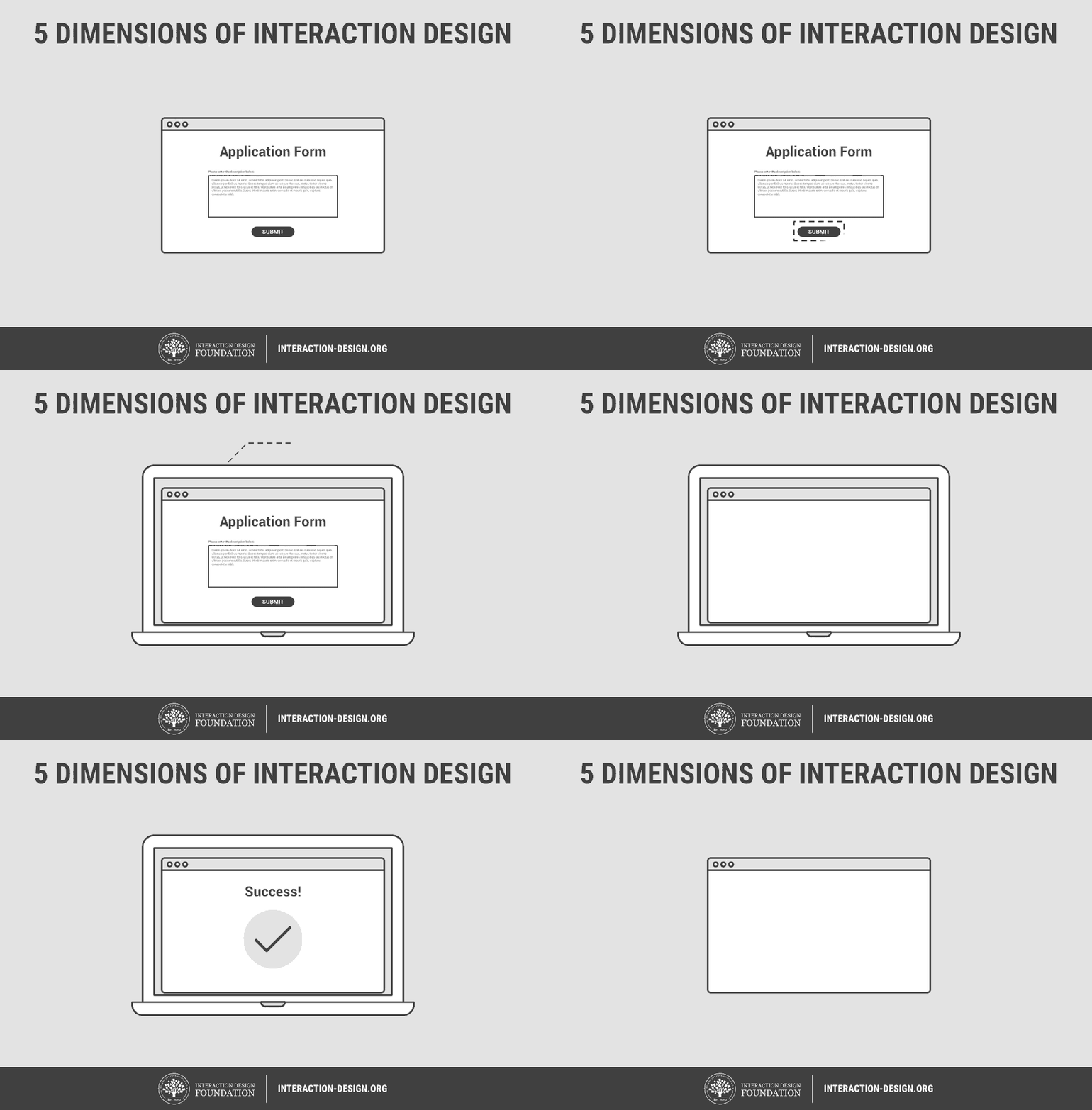
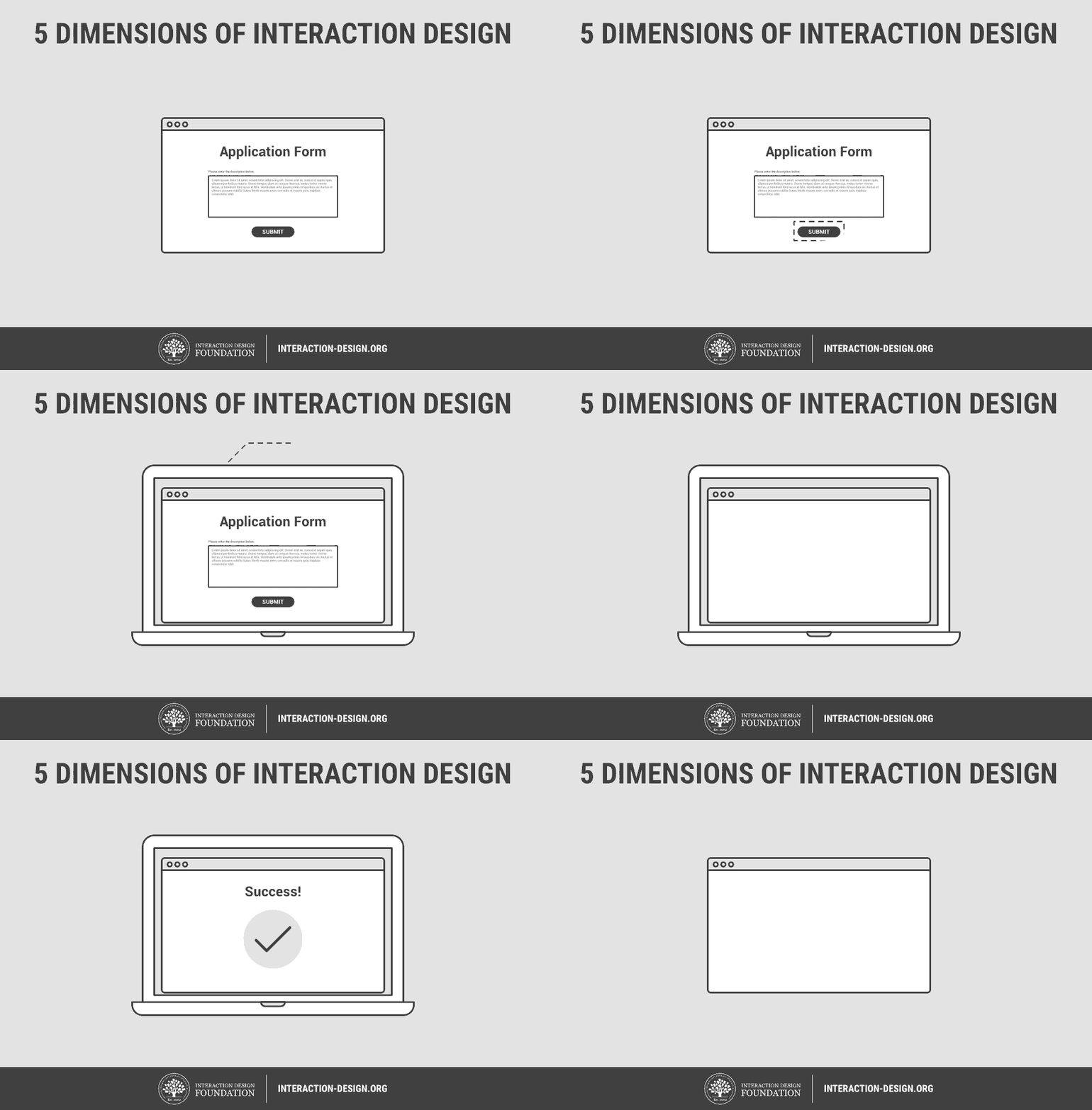
Designers’ work in IxD involves five dimensions: words (1D), visual representations (2D), physical objects/space (3D), time (4D), and behavior (5D).

Transcript

Learn more about the 5 factors of interaction design and the kind of work IxD involves.
IxD’s five dimensions were first defined by a professor at London’s Royal College of Art, Gillian Crampton Smith, and a senior interaction designer, Kevin Silver. The dimensions represent the aspects an interaction designer considers when designing interactions:

  • Words (1D) encompass text, such as button labels, which help give users the right amount of information.

  • Visual representations (2D) are graphical elements such as images, typography and icons that aid in user interaction.

  • Physical objects/space (3D) refers to the medium through which users interact with the product or service—for instance, a laptop via a mouse, or a mobile phone via fingers.

  • Time (4D) relates to media that changes with time, such as animations, videos and sounds.

  • Behavior (5D) is concerned with how the previous four dimensions define the interactions a product affords—for instance, how users can perform actions on a website, or how users can operate a car. Behavior also refers to how the product reacts to the users’ inputs and provides feedback.

Interaction designers utilize all five dimensions to consider the interactions between a user and a product or service in a holistic way. Specifically, we use them to help envision the real-world demands of a usership in relation to a design not yet introduced. For example, designers of an app that must process data at high speed in order to find results inside a mass-transit system (a subway/metro) will face accommodating the constraints of underground commuters – cramped spaces, fast journeys, dead zones, etc.

Interaction Design is a Part of User Experience Design
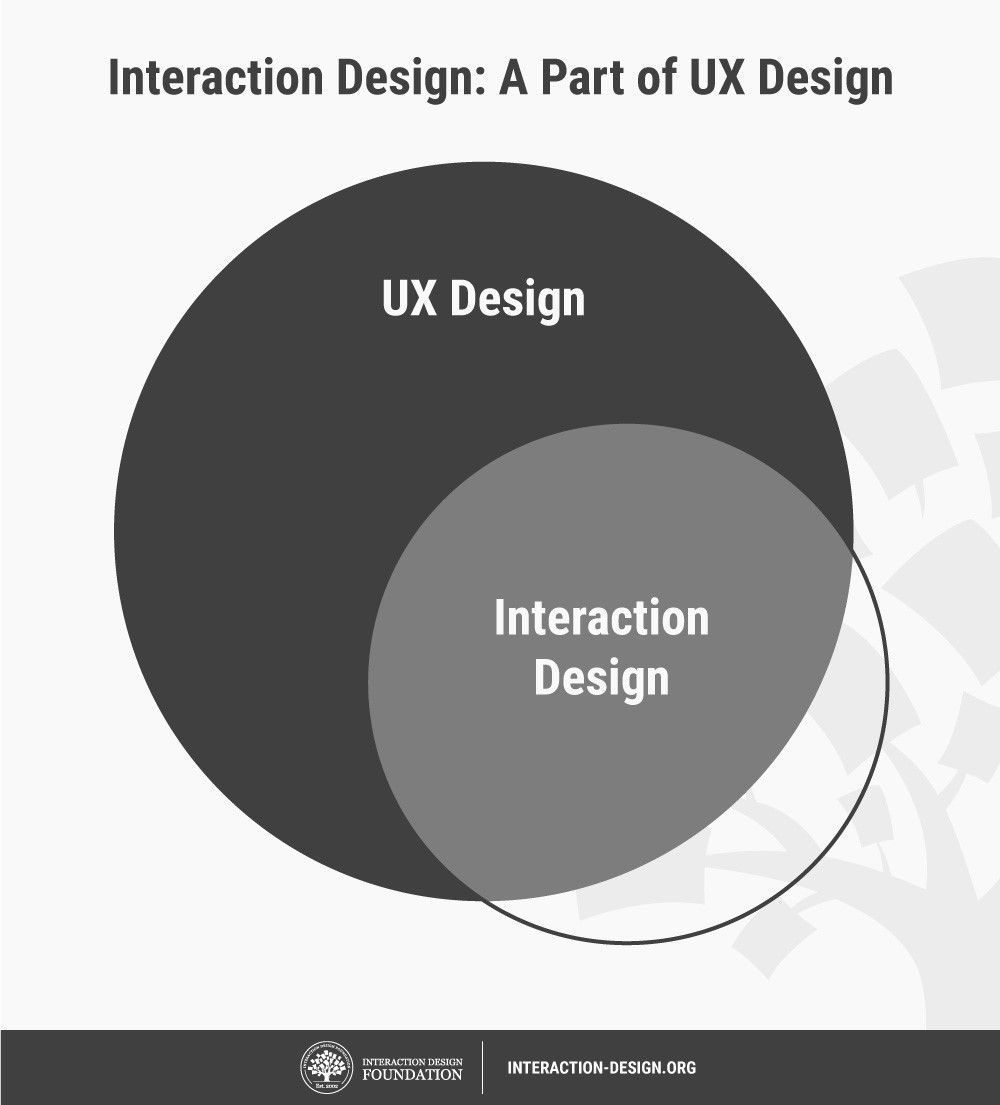
The term “interaction design” is sometimes used interchangeably with “user experience design”. That’s understandable, considering interaction design is an essential part of UX design. Indeed, UX design entails shaping the experience of using a product, and a big part of that experience involves the needed interaction between the user and the product. However, UX design goes far beyond that. UX designers’ working world is concerned with the entire user journey, including aspects of branding, design, usability and function. Conversely, the central role of “interaction designers” targets the moment of use and how to improve the interactive experience. Thus, interaction design, or IxD, is pivotal in the realm of the user experience, since the moment of use is the acid test of a design, where the designer’s manipulation of the five dimensions must offer users a satisfactory—if not better—experience. If users find themselves hindered by impractical features, such as text-heavy notifications or overlong animations, are put off by the aesthetics, or the responsiveness of the design fails to match their needs in the context, the design will fail, regardless of the brand behind it. The IxD of a product reflects its absolute value.

Questions About Interaction Design (IxD)?
We've Got Answers!

How does interaction design compare to more traditional design disciplines?

Interaction design, a pivotal component of user experience design, emphasizes creating engaging products that facilitate user objectives, involving multifaceted elements like aesthetics, motion, sound, and space. It stands out from traditional design disciplines by focusing on user interaction and overall product experience beyond just visual aesthetics. To explore interaction design’s intricate principles, models, and critical role in developing user-centric designs, watch our detailed video and read this comprehensive book chapter.

Transcript

What does an interaction designer do?

An interaction designer crafts the experiences users have with products, focusing on optimizing user interaction and functionality. They utilize various elements like aesthetics, motion, sound, and space, ensuring that products are user-friendly and meet user needs effectively. They consider the Five Dimensions of Interaction Design: words, visual representations, physical objects, time, and behavior, to create meaningful interactions. 

The interaction designer also works with design strategies, wireframes, prototyping and sometimes conducts user research to understand user goals better. For more insights on what interaction designers do, watch our video, which comprehensively explains the role and components of interaction design in detail.

Transcript

What is UX vs UI vs interaction design?

UX, UI, and Interaction Design shape distinct aspects of user interactions. UX, User Experience, is holistic, focusing on users' overall satisfaction and interaction with the company and its products, as explained by Don Norman, the inventor of the term "user experience." More recently, UX has come to refer specifically to the user experience with a solution and customer experience (CX) to the whole relationship with the company.

UID, User Interface Design, deals with the visual components users interact with, such as buttons, icons, and layouts, aiming for aesthetic and functional harmony. Interaction Design orchestrates the user's engagement with these components, ensuring effective, enjoyable interactions. Discover more about the differences and interconnections between user experience and user interface in this video.

Transcript

Stephen Gay, Design Lead at Google, delves deeper into these design roles in this video, helping you to understand UX Roles and choose which one you should go for.

Copyright
Transcript

What are the five dimensions of interaction design?

Our enlightening video on the interaction design process delves into the meticulous steps and considerations inherent to creating user-centric interactions and interventions. While the video primarily focuses on the overarching process, interaction design is often conceptualized through 5 dimensions: 

  • 1D - text

  • 2D - visual representation

  • 3D - physical object/space

  • 4D - time (animation)

  • 5D - behavior (reaction)

These dimensions are pivotal in creating clear, user-friendly, and effective interactions. For a more comprehensive exploration of interaction design processes, watch our video, which provides valuable insights and exemplifications, ensuring a profound understanding of the creation and refinement of interactive systems.

Transcript

What is the difference between interaction design and visual design?

Interaction design and visual design are essential, complementary disciplines in user experience. Interaction design optimizes user interactions with a system, applying usability principles to forge seamless, effective user experiences. Conversely, visual design emphasizes a product's aesthetics, including color, imagery, and typography. Interaction-design.org offers extensive courses in both areas – explore Interaction Design for Usability for a deeper understanding of creating intuitive user experiences. Check out Visual Design: The Ultimate Guide to refine your skills in producing visually striking interfaces. Integrating knowledge from both domains enables the development of cohesive, user-friendly designs.

What is the difference between product design and interaction design?

Product design encompasses creating usable products, including ideation, development, and validation, focusing on the user experience. Interaction design is a subset of product design, specializing in optimizing user interactions with a product prioritizing functionality and usability. To master interaction design, follow our Interaction Designer Learning Path, and explore our Product Manager Learning Path for a comprehensive understanding of constructing user-centric products. By integrating insights from both paths, you can innovate products that are functional and user-friendly and meet market demands.

What is mapping in interaction design?

Mapping in interaction design is a technique for creating visual representations to condense complex processes and user experiences, fostering a unified understanding. 

Transcript

For example, our video explains how mapping can translate intricate details of locations and systems, like the New York Subway, into simplified, understandable visuals. Similarly, a customer journey map outlines users' interactions, lessons, and projects in an IxDF Design Bootcamp, demonstrating the efficiency of mapping in identifying patterns and enhancing navigation. To delve deeper into the concept, refer to our detailed article on the power of mapping.

What is the Interaction Design Foundation?

The Interaction Design Foundation (IxDF) is an educational organization advancing design knowledge and capabilities. We offer over 30 comprehensive courses on user experience (UX) and interaction design, suitable for both novices and experienced designers. Our online, self-paced courses, created by renowned professionals and scholars like Don Norman and Clayton Christensen, provide an Ivy League-level education in design, emphasizing user-centric approaches and design thinking. Learn and evolve with our diverse courses and enhance your design proficiency, earning industry-recognized certifications. 

Watch our founders, Mads Soegaard and Rikke Friis Dam's video, to discover more about our mission to make premium design education affordable, offering unlimited access for a flat rate fee.

Where to learn interaction design?

To learn interaction design, explore the Interaction Design Foundation’s interaction designer learning path, offering a curated selection of courses like User Experience: The Beginner’s Guide, Interaction Design for Usability, and HCI: Foundations of UX Design. These courses, designed by experts, provide comprehensive insights and knowledge, helping you master the core principles and techniques of interaction design to create user-friendly, engaging interfaces.

Earn a Gift Earn a Gift, Answer a Short Quiz!

1
2
3
4
1
2
3
4
Question 1
Question 2
Question 3
Get Your Gift
Interaction Design Foundation logo

Question 1

What is the primary goal of interaction design?

1 point towards your gift

  • To ensure products are visually appealing
  • To facilitate efficient user interaction with products
  • To increase the production speed of digital tools
Interaction Design Foundation logo

Question 2

Which of these is NOT one of the five dimensions of interaction design?

1 point towards your gift

  • Color
  • Time
  • Words
Interaction Design Foundation logo

Question 3

What do interaction designers typically use to define user interactions?

1 point towards your gift

  • Content management systems
  • Data analytics tools
  • Wireframes and prototypes

Learn More About Interaction Design (IxD)

Make learning as easy as watching Netflix: Learn more about Interaction Design (IxD) by taking the online IxDF Course User Experience: The Beginner's Guide.

Why? Because design skills make you valuable. In any job. Any industry.

In This Course, You'll

  • Get excited when you experience how easy it is to transition into tech and land your dream job with User Experience (UX) design skills. No design background? No problem. You already have transferable skills, so it's easy to fast-track your career

  • Learn to combine logical thinking with creativity. Do you enjoy creativity and structure? Do you communicate ideas clearly? UX designers turn ideas into services, experiences, and products. This course helps you structure your existing skills and apply them in an innovative, creative context. You'll use hands-on methods that empower you to continuously test and optimize your products and services from idea to delivery.

  • Make yourself invaluable when you use the very fabric of being human, such as empathy and intuition, to make users and customers smile. More smiles, more impact, greater salary potential. You'll find out what your users need and want, and you'll build products, experiences, and services that help them succeed. You can benefit from UX design in any job, any industry. As AI becomes part of everyday work, timeless human-centered UX design skills help you decide what problems are worth solving and how solutions should actually work for people. This approach turns AI from a tool into your new superpower, keeping your work useful, relevant, and centered around peoples’ needs, even as technologies change.

  • Gain confidence and credibility when you master a range of powerful, real-world UX design skills such as user research, user interviews, personas, customer journey maps, sketching, task analysis, low-fidelity paper prototyping, and usability testing. It's easy with downloadable templates

  • Craft your personal portfolio with step-by-step guidance. It's completely optional. Your portfolio is your gateway to transition into a career in tech or design. You'll be able to apply your new skills immediately in your current job. If you're new to UX design, this course is the best place to start. Your path to tech starts here. UX design is your way in.

It's Easy to Fast-Track Your Career with the World's Best Experts

Master complex skills effortlessly with proven best practices and toolkits directly from the world's top design experts. Meet your experts for this course:

  • Don Norman: Father of User Experience (UX) design, author of the legendary book “The Design of Everyday Things,” and co-founder of the Nielsen Norman Group.

  • Rikke Friis Dam and Mads Soegaard: Co-Founders and Co-CEOs of IxDF. 

  • Mike Rohde: Experience and Interface Designer, author of the bestselling “The Sketchnote Handbook.”

  • Stephen Gay: User Experience leader with 20+ years of experience in digital innovation and coaching teams across five continents.

  • Alan Dix: Author of the bestselling book “Human-Computer Interaction” and Director of the Computational Foundry at Swansea University.

  • Ann Blandford: Professor of Human-Computer Interaction at University College London.

  • Cory Lebson: Principal User Experience Researcher with 20+ years of experience and author of “The UX Careers Handbook.”

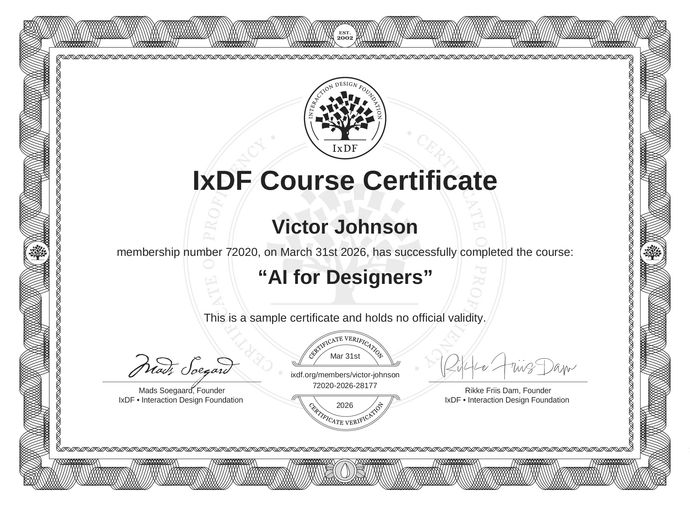
Get an Industry-Recognized IxDF Course Certificate

Increase your credibility, salary potential and job opportunities by showing credible evidence of your skills.

IxDF Course Certificates set the industry gold standard. Add them to your LinkedIn profile, resumé, and job applications.

Course Certificate Example

Be in distinguished company, alongside industry leaders who train their teams with the IxDF and trust IxDF Course Certificates.

Our clients: IBM, HP, Adobe, GE, Accenture, Allianz, Phillips, Deezer, Capgemin, Mcafee, SAP, Telenor, Cigna, British Parliament, State of New York

All Free IxDF Articles on Interaction Design (IxD)

Read full article
What is Interaction Design? - Article hero image
Interaction Design Foundation logo

What is Interaction Design?

Interaction design is an important component within the giant umbrella of user experience (UX) design. In this article, we’ll explain what interaction design is, some useful models of interaction design, as well as briefly describe what an interaction designer usually does.A simple and useful unders

Social shares
1.5k
Published
Read Article
Read full article
Product Thinking is Problem Solving - Article hero image
Interaction Design Foundation logo

Product Thinking is Problem Solving

It can be easy to get bogged down in developing features when we get into user experience design. It’s not that features aren’t important but that they are often secondary to the reason a customer or user buys our product. That reason is simple; the user buys the product to solve a real world proble

Social shares
954
Published
Read Article
Read full article
Recalling Color Theory Keywords: a way to refresh your memories! - Article hero image
Interaction Design Foundation logo

Recalling Color Theory Keywords: a way to refresh your memories!

Choosing the best combination of colors for an interactive design layout is not, as it may appear, a guessing game. Knowing which ones to use will save you time (and headaches). Getting it right will also keep your users connected.Since the early days of art and design, the use of color has followed

Social shares
1.1k
Published
Read Article
Read full article
How to Reduce Cognitive Friction in Mobile - Article hero image
Interaction Design Foundation logo

How to Reduce Cognitive Friction in Mobile

There’s nothing more annoying than when things don’t function the way we expect them to. When users interact with a UI, they make sense of its elements in relation to the “real world”—think of the trash can icon or a button: in essence, they look like their physical world counterparts. Cognitive fri

Social shares
676
Published
Read Article
Read full article
The One Thumb, One Eyeball Test for Good Mobile Design - Article hero image
Interaction Design Foundation logo

The One Thumb, One Eyeball Test for Good Mobile Design

We live in a world of distractions, and so do your users. Hence, your designs must factor in users’ contexts and behaviors amid distractions. Let’s look at a simple, yet effective test to evaluate how quickly and easily users can complete their tasks: the “one thumb, one eyeball” test. Luke Wro

Social shares
728
Published
Read Article
Read full article
Natural User Interfaces – What does it mean & how to design user interfaces that feel naturaly - Article hero image
Interaction Design Foundation logo

Natural User Interfaces – What does it mean & how to design user interfaces that feel naturaly

User interfaces that you interact with using modalities such as touch, gestures or voice are often referred to as Natural User Interfaces (NUI). We consider them interfaces that we find so easy to use that they feel natural. However, what does it mean for an interface to be natural? Also, how do you

Social shares
1k
Published
Read Article

What is Interaction Design?

What is Interaction Design?

Interaction design is an important component within the giant umbrella of user experience (UX) design. In this article, we’ll explain what interaction design is, some useful models of interaction design, as well as briefly describe what an interaction designer usually does.

A simple and useful understanding of interaction design

Transcript

Interaction design can be understood in simple (but not simplified) terms: it is the design of the interaction between users and products. Most often when people talk about interaction design, the products tend to be software products like apps or websites. The goal of interaction design is to create products that enable the user to achieve their objective(s) in the best way possible.

If this definition sounds broad, that’s because the field is rather broad: the interaction between a user and a product often involves elements like aesthetics, motion, sound, space, and many more. And of course, each of these elements can involve even more specialised fields, like sound design for the crafting of sounds used in user interactions.

As you might already realise, there's a huge overlap between interaction design and UX design. After all, UX design is about shaping the experience of using a product, and most of that experience involves some interaction between the user and the product. Both disciplines draw on the same core activities: understanding users through research, developing personas, prototyping, and evaluating designs through usability testing. The difference lies in scope. Interaction design, with its foundations in human-computer interaction, focuses on how people interact with products; designing behaviour, flow, and the quality of those interactions throughout the full design process. UX design takes an even broader view, encompassing every aspect of a person's relationship with a product or organisation: not just the designed interactions, but also service touchpoints, emotional responses, brand perception, and experiences that may involve little or no direct interface.

The 5 dimensions of interaction design

The 5 dimensions of interaction design(1) is a useful model to understand what interaction design involves. Gillian Crampton Smith, an interaction design academic, first introduced the concept of four dimensions of an interaction design language, to which Kevin Silver, senior interaction designer at IDEXX Laboratories, added the fifth.

1D: Words

Words—especially those used in interactions, like button labels—should be meaningful and simple to understand. They should communicate information to users, but not too much information to overwhelm the user.

2D: Visual representations

This concerns graphical elements like images, typography and icons that users interact with. These usually supplement the words used to communicate information to users.

3D: Physical objects or space

Through what physical objects do users interact with the product? A laptop, with a mouse or touchpad? Or a smartphone, with the user’s fingers? And within what kind of physical space does the user do so? For instance, is the user standing in a crowded train while using the app on a smartphone, or sitting on a desk in the office surfing the website? These all affect the interaction between the user and the product.

4D: Time

While this dimension sounds a little abstract, it mostly refers to media that changes with time (animation, videos, sounds). Motion and sounds play a crucial role in giving visual and audio feedback to users’ interactions. Also of concern is the amount of time a user spends interacting with the product: can users track their progress, or resume their interaction some time later?

5D: Behaviour

This includes the mechanism of a product: how do users perform actions on the website? How do users operate the product? In other words, it’s how the previous dimensions define the interactions of a product. It also includes the reactions—for instance emotional responses or feedback—of users and the product.

See how 5 dimensions of interaction design come together in the animation below:

Important questions interaction designers ask

How do interaction designers work with the 5 dimensions above to create meaningful interactions? To get an understanding of that, we can look at some important questions interaction designers ask when designing for users, as provided by Usability.gov(2):

  • What can a user do with their mouse, finger, or stylus to directly interact with the interface? This helps us define the possible user interactions with the product.

  • What about the appearance (colour, shape, size, etc.) gives the user a clue about how it may function? This helps us give users clues about what behaviours are possible.

  • Do error messages provide a way for the user to correct the problem or explain why the error occurred? This lets us anticipate and mitigate errors.

  • What feedback does a user get once an action is performed? This allows us to ensure that the system provides feedback in a reasonable time after user actions.

  • Are the interface elements a reasonable size to interact with? Questions like this helps us think strategically about each element used in the product.

  • Are familiar or standard formats used? Standard elements and formats are used to simplify and enhance the learnability of a product.

Advance Your Career With This Free Template for “Interaction Model”
Interaction Model
We respect your privacy
Get 1 powerful email each week: Design a life you love!

So what do interaction designers do?

Well, it depends.

For instance, if the company is large enough and has huge resources, it might have separate jobs for UX designers and interaction designers. In a large design team, there might be a UX researcher, an information architect, an interaction designer, and a visual designer, for instance. But for smaller companies and teams, most of the UX design job might be done by 1-2 people, who might or might not have the title of “Interaction Designer”. In any case, here are some of the tasks interaction designers handle in their daily work:

Design strategy

This is concerned with what the goal(s) of a user are, and in turn what interactions are necessary to achieve these goals. Depending on the company, interaction designers might have to conduct user research to find out what the goals of the users are before creating a strategy that translates that into interactions.

Wireframes and prototypes

This again depends on the job description of the company, but most interaction designers are tasked to create wireframes that lay out the interactions in the product. Sometimes, interaction designers might also create interactive prototypes and/or high-fidelity prototypes that look exactly like the actual app or website.

Diving deeper into interaction design

If you’re interested to find out more about interaction design, you can read Interaction Design – brief intro by Jonas Lowgren, which is part of our Encyclopedia of Human-Computer Interaction. It provides an authoritative introduction to the field, as well as other references where you can learn more.

References and Where to Learn More

Course: Interaction Design for Usability

Read more of our engaging literature and resources on interaction design

More about What Puts the Design in Interaction Design

Questions to consider when designing for interaction: The What & Why of Usability

Hero Image: Author/Copyright holder: Unsplash.com. Copyright terms and licence: CC0

Feel Stuck?
Want Better Job Options?

AI is replacing jobs everywhere, yet design jobs are booming with a projected 45% job growth. With design skills, you can create products and services people love. More love means more impact and greater salary potential.

At IxDF, we help you from your first course to your next job, all in one place.

See How Design Skills Turn Into Job Options
Privacy Settings
By using this site, you accept our Cookie Policy and Terms of Use.
Customize
Accept all

Be the One Who Inspires

People remember who shares great ideas.

Share on:

Academic Credibility — On Autopilot

Don't waste time googling citation formats. Just copy, paste and look legit in seconds.