The Ikea Effect

Your constantly-updated definition of the Ikea Effect and collection of videos and articles.
Be a conversation starter: Share this page and inspire others!

98 Shares

What is the Ikea Effect?

The IKEA effect is a cognitive bias where consumers put a high value on products they have partially created or assembled. It takes its name from Swedish furniture company IKEA. Designers involve users in the creation or customization process, so users feel more competent and bonded with products. 

‍Why is there an IKEA Effect?

The IKEA experience is famous for consumers assembling a wide range of furniture they buy in flat-packed boxes. IKEA is an extremely popular option for consumers who return to this successful brand for their furniture needs—among other quality goods. However, there’s a deeper aspect to customers building their own chairs, tables and more, and it’s not just about the end product or the amount of time they put into it. This “IKEA effect” can significantly influence a product's—any buildable product’s—perceived value and customer behavior. It suggests that people put higher value on products they’ve had a hand in creating.  

Professor at Harvard Business School, Michael Norton coined the term “Ikea effect” in a 2011 study. Norton and his colleagues conducted a series of experiments where they examined and explored the psychological phenomenon behind the IKEA effect. They found that when individuals put effort into creating or assembling a product, they typically value it more highly than if they’d purchased one that had already been assembled in the store. What’s more, that’s true even if the end result isn’t objectively better than a pre-made alternative. So, the effort that consumers put into completing a product from pieces to its final state transforms into an actual affinity for that product. It’s something that makes its subjective value higher compared to a pre-assembled equivalent product. 

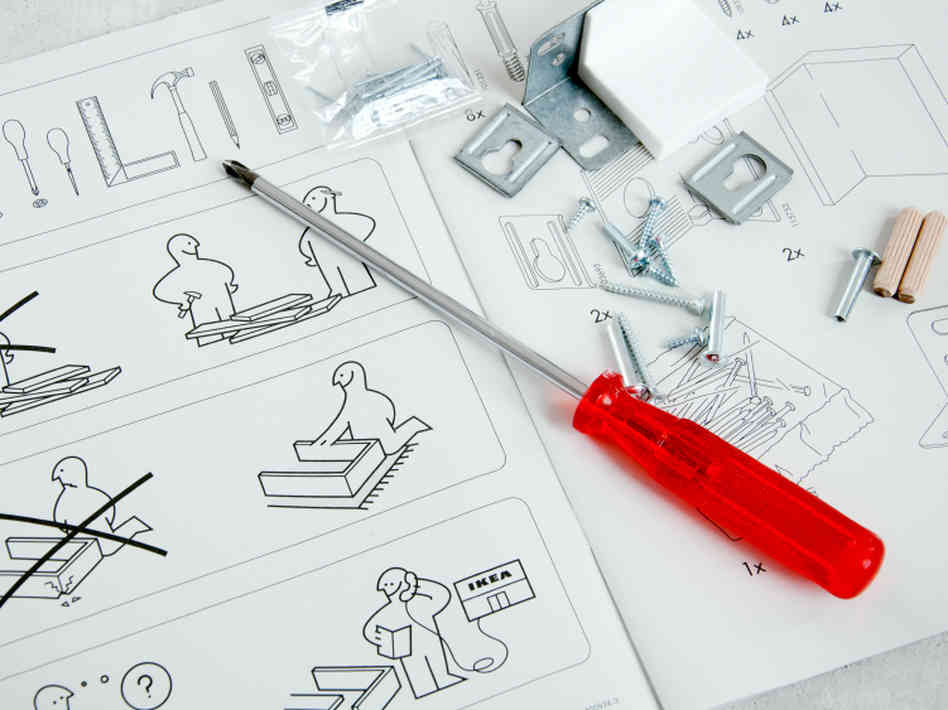
An illustration showing the IKEA effect at work.

Do-it-yourself adds so much more satisfaction – the spirit of the IKEA effect!

© Badis Khalfallah, Fair Use

The IKEA Effect in User Experience (UX) Design

The IKEA effect certainly translates to the real world of user experience (UX) design, user interfaces, and product development. When you involve users in your product’s—or service’s—creation or customization process, it becomes a personal and emotional thing for them. For example, you can do this when you let users: 

  • Personalize their app interfaces. 

  • Build their profiles on a website. 

The basic key is to give users control over aspects of the product and make the execution as simple as possible. You can empower users to do this whether you’re working on an existing product or starting a totally new one. 
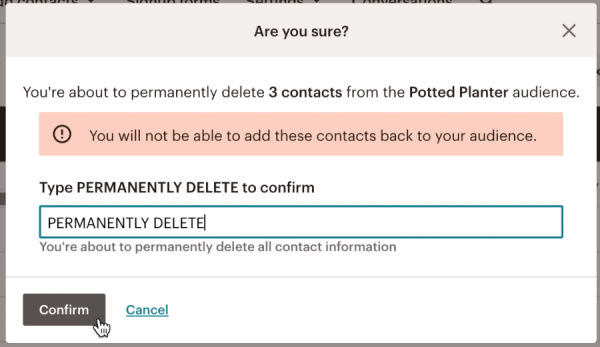
Screenshot of a Mailchimp.com page.

Allowing users to put some effort into a product lets them value it more highly—and more—such as thinking carefully before proceeding.

© Mailchimp, Fair Use

Benefits of the IKEA Effect

Here are some pros of the IKEA effect to users of the products (and services) a designer might set before them.  

  • It gives them a sense of accomplishment and competence when they successfully complete a task. 

  • That “job well done” enhances their experience and satisfaction. It means that products include a high quality of joy and attachment for their target audience—something that boosts the customer experience

  • It can nurture a stronger emotional connection between the brand and its customer base.  

  • Users in the target market will be more loyal. What’s more, the IKEA effect can bolster the final product’s perceived value—and makes it more desirable and enjoyable for the users. 
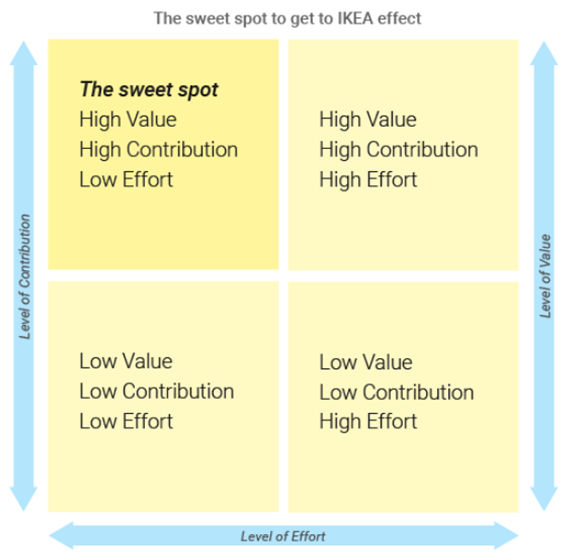
    Chart showing the IKEA effect.

    Aim for the sweet spot to get your users on board with the IKEA effect.

    © Anton Nikolov, Fair Use

Risks of the IKEA Effect

While there are pros, here are some cons of the IKEA effect for designers and product managers to think about: 

The Potential for Bias

When people become emotionally invested in something, they might end up overlooking or downplaying its flaws. That can lead to a biased assessment of its value. This, in turn, can get in the way of objective evaluation and prevent a design team from making improvements or changes it needs to. So, the product or service may need improvements that solid usability testing or an expert evaluation would expose.  

The Tendency to Overestimate Market Demand for a Self-Made Product

Just because an individual values their creation highly, it doesn't mean that others are going to share the same sentiment. That’s something that can lead to unrealistic expectations and difficulties in successfully marketing or selling the product. So, it can put a design team members’ time—and money—invested in the project at risk.  

Complacency and Resistance to Feedback

When people are highly attached to their creation, they may be less open to constructive criticism or suggestions for improvements to it. This can limit growth and innovation—plus, it can hinder collaboration and learning from others. One example of a phenomenon like this might be the Facebook shift to the Timeline format in 2012. As Facebook had let users put so much into their profile pages beforehand, many users weren’t too happy about going along with the new, improved version. 

A Sunk Cost Fallacy

People may feel hesitant to abandon or change a project they’ve invested a lot of time and effort into—and that’s true even if it’s no longer viable or beneficial. This can lead to wasted resources and missed opportunities to go after more promising endeavors. In UX terms, that means if users have had a hand in co-creating a design, they may cling to it even if the user research shows that a change is indeed in order. 
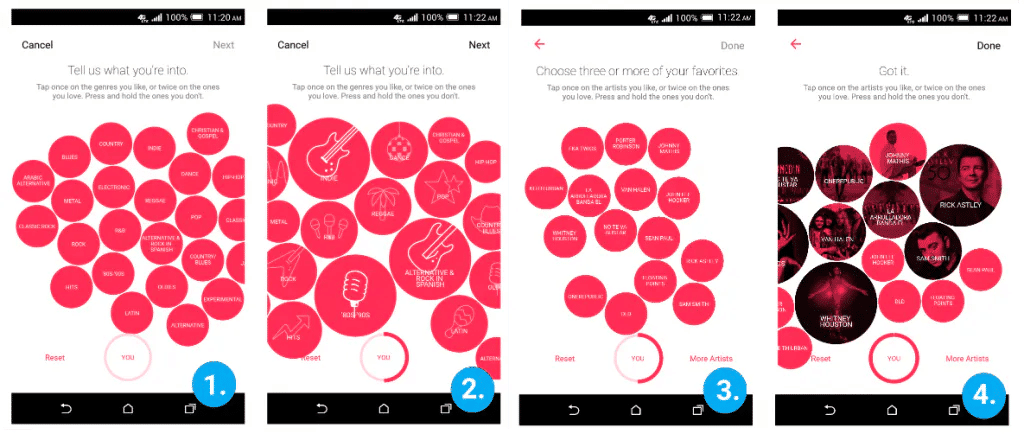
Image of Apple music screens.

Apple leverages the IKEA effect nicely by bringing users in to make good decisions early. 

© Archana Madhavan, Fair Use

How to Leverage the IKEA Effect in UX Design

Designers can factor the IKEA effect into their product development process whenever they create products or services that call for user involvement. Designers can do this if they: 

  • Customize the product or service, engaging users in the design process—or letting them assemble or create a part of the product. A designer could—in fact—have users fully on board in a participatory design approach. This could manifest in many forms—like, for example, potential customers getting involved in the information architecture or visual design of what a designer wants to make for them.  

  • Keep a sharp eye for how to involve users. Aim to create an interaction design product where the level of effort is low but the perceived contribution is high. User feedback should confirm that designers have hit the right formula where their users and product ideas meet. 

  • Use editable templates and sample data to achieve the IKEA effect—and make the app feel dynamic and alive to the users. So, design for simple actions that call for low effort but that make the user feel they've contributed a great deal. It’s something that can lower their fear of dealing with a new product. Do it right and it can lead to users forming loyalty to a brand and product. 
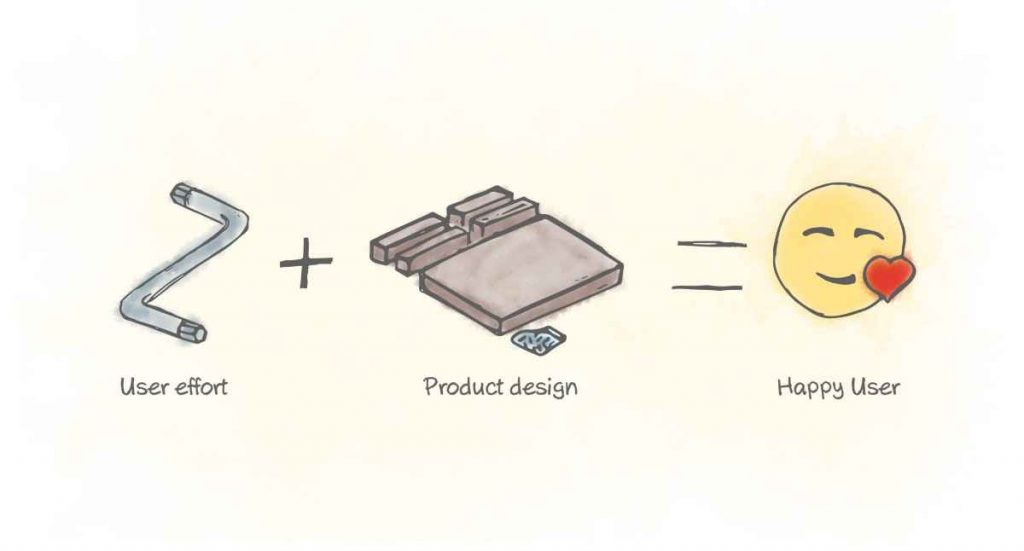
Image of what is behind the IKEA Effect

The formula is simple, although the considerations—and possibilities—are numerous. 

© Anton Nikolov, Fair Use

Best Practices and Tips

Consider the following best practices and tips to make the best of the IKEA effect for your users: 

  • Keep tasks simple: The IKEA effect works best when tasks are simple and straightforward for users to complete. Tasks that are overly complex can frustrate users and might even put them off completing the product. 

  • Provide clear instructions: Users should have clear and concise instructions to make sure they finish tasks successfully. 

  • Balance effort and reward: The level of effort that users need to put in should be in proportion to the perceived value of the finished product. If the effort required of them is too high—or the contribution the brand rewards them with too small—people probably won't complete the task. 

  • Test and iterate: Do solid user testing to understand how users interact with the product—and then iterate based on their feedback. 

Image of a warehouse store.

Think of all the possibilities you can leverage 

© Selim Can Işık, Fair Use

The IKEA Effect in Action: Brands Doing It Right

Several brands have been successful in how they’ve harnessed the power of the IKEA effect. For example, Apple lets customers customize their devices—and that goes from choosing custom configurations to adding personal engravings. This level of personalization instills a sense of ownership in customers and a higher perceived value of the product among them. These are qualities that also can be helpful when it comes to marketing campaigns. 

Remember, it's vital to strike a balance between the level of effort that the user has to put in and the reward they perceive they’ll get. This is where it might be helpful for a product designer to think of LEGO.  By giving customers the chance to construct their own toys, LEGO taps into the satisfaction and sense of accomplishment that comes with creating something from scratch. When UX and UI designers transfer that spirit—and do it well—they can fine-tune engaging and satisfying experiences that keep customers coming back for more. 

Questions About Ikea Effect?
We've Got Answers!

What are IKEA effect examples?

A notable example of the effect in user experience (UX) design—and product development—is when users can customize websites and apps. Users sometimes have the chance to personalize the interface—such as rearranging widgets, choosing themes or setting preferences. That’s how they often form a stronger attachment to the platform and get a higher perceived value of it. It depends on the level of effort that’s required from them. However, this sense of co-creation and ownership is something to enhance your target audience’s overall experience with your product or service. Users are likely to enjoy it more if they can do this through a ready-made template—plus, your conversion rates are more likely to increase. 

There’s another example in user-generated content. Platforms that have encouraged users to contribute content—like user feedback / reviews, comments or designs—trigger the IKEA effect. This helps deliver high-quality customer journeys and customer experiences. Users feel a sense of pride and attachment to their contributions—something that fosters a deeper connection with the website or app. So, product managers of new and existing products can help put this strategy with potential customers to good use.  

Also, the process of gamification in UX design is something that leverages the IKEA effect. When users engage in tasks or challenges and experience a sense of achievement, they become more emotionally invested in the platform. Delivered at the right part of a user journey, this phenomenon can boost user engagement and raise satisfaction levels in the final product. So, it should be a consideration for the product development teams who are behind your product ideas. 

How does the IKEA effect influence user engagement in product design?

The IKEA effect plays a large role in terms of enhancing user engagement in product design. This cognitive bias—where people place a higher value on things they partially create—can be a powerful tool for you as a user experience designer to raise how attached users are to the designs you create and satisfied with them 

When users are involved in creating or customizing a product, they’re more likely to feel a sense of ownership and pride in that final product. This emotional investment leads to higher levels of engagement and a more positive overall user experience. For instance, a user who personalizes a software interface is likely to feel more connected to the digital product than if they’d received it in a finished state. 

How can designers leverage the IKEA effect in creating more engaging products?

You as a designer can get the IKEA effect working for you so you create more engaging products—by involving users in the creation or customization process. The IKEA effect is a cognitive bias; in it, individuals put a higher value on products that they’ve partially created. 

To tap into the IKEA effect, think about ways to involve users in the design process. This could be through DIY kits, customizable features—or even through apps that let users design or personalize their product. This involvement doesn’t just increase the perceived value users see in the product; it serves to boost to user engagement and satisfaction, too. 

For example, let users customize interfaces or features and you can create a sense of ownership and satisfaction among your target audience and customer base. 

What’s more, this approach can lead to a deeper understanding of the users' needs and preferences. That’s vital—and these could be invaluable insights for future product development. It's important, though, to balance the level of user involvement; too much complexity in assembly or customization can end up in the shape of many frustrated users instead of happy engagement. 

What are the psychological principles behind the IKEA effect?

The IKEA effect features several underpinning psychological principles—principles that explain why people value self-assembled or self-created products more than they do ones that others make. When you understand these principles, it can help you make more engaging and valued products for a wide range of users’ experiences.  

Effort justification: This principle is based on cognitive dissonance theory. When people put effort into a task, they rationalize the effort by putting a higher value on the outcome. In the case of the IKEA effect, the effort involved in assembling a product makes a sense of greater appreciation and valuation of the final product. 

Sense of accomplishment: To complete a task—especially one that’s challenging—generates a sense of accomplishment. This positive feeling then transfers to the product itself, increasing its perceived value and the user’s attachment to it. 

Personalization and customization: When people contribute to the creation or customization of a product, they feel it reflects their personal identity and preferences. This personal connection they get is something that enhances the perceived uniqueness and value of the product. 

Control and autonomy: When users participate in the process of creating, it gives them a sense of control and autonomy—and this feeling of being in charge of the outcome leads to a stronger emotional investment from them in the product. 

Learning and skill development: To be part of the assembly or customization process can be a learning experience—and develop a user’s skills. The pride associated with learning and mastering new skills bolsters the value further that users and potential customers put on the product. 

How does the IKEA effect play into gamification in design?

The principles of the IKEA effect are things you can integrate into gamification strategies so you can make them more effective—and here's how: 

Effort and reward: In gamification, you can see the IKEA effect when users put effort into tasks or challenges within a system. The effort they put in makes the rewards or achievements feel more valuable. For instance, users who complete challenging tasks in a gamified app are likely to put higher values on the rewards thanks to the effort they’ve invested. 

Customization and personalization: If you let users customize aspects of their experience in a gamified system, it can make them more emotionally invested—and get a bigger sense of ownership, similar to how the IKEA effect works. This could involve customizing avatars, user interfaces or achieving personalized goals—things that make the experience more engaging and rewarding for them. 

Progression and mastery: The IKEA effect boosts the sense of achievement as users get through different levels or stages in a gamified design. The satisfaction of mastering a level or acquiring a new skill within the game are things you can attribute to the effort and time users invest, and that’s much like the satisfaction they’d get from assembling a product. 

Active participation: Just as the IKEA effect values active involvement in product assembly, gamification benefits from active user participation. Getting users involved in tasks, challenges and interactive activities raises the level of their engagement—and the value they perceive of the experience. 

What's the role of the IKEA effect in the success of customizable products?

The IKEA effect plays a very important role in the success of customizable products because of several factors, and these include: 

Increased perceived value: When users invest time and effort into customizing a product, they tend to value it more than they would a comparable, ready-made product.  

Emotional attachment: Customization lets users imprint a part of their identity onto the product—personalization that gives them a stronger emotional connection, since the product becomes a reflection of the user's choices and creativity. 

Sense of achievement: The process of customizing and creating a unique product gives users a real sense of achievement. They feel proud of their creation—valuing it and enjoying a positive overall experience, too. 

Enhanced user experience: Customizable products cater to individual preferences—so letting users tailor the product to their own specific needs and tastes. That bolsters the user experience and makes the product more relevant and appealing to them. 

Brand loyalty and advocacy: Products that successfully get the IKEA effect to work for them through customization can foster greater brand loyalty among their users. Satisfied customers are more likely to become repeat buyers—and recommend the product to others. 

The Pocket Universal Principles of Design by William Lidwell, Kritina Holden, and Jill Butler: This book describes the IKEA effect as a design principle and how you can use it to create products that are more engaging. 

What are highly cited scientific pieces of research about the IKEA Effect?

Norton, M. I., Mochon, D., & Ariely, D. (2012). The IKEA effect: When labor leads to love. Journal of Consumer Psychology, 22(3), 453-460.  

This seminal paper is the foundational study that coined the term "IKEA effect". It explores how labor enhances affection for its results. The authors conducted several experiments demonstrating that self-made products are valued as highly as those made by professionals. This research is influential as it established a fundamental understanding of how labor and effort investment can alter consumer perception and value attribution. 

Earn a Gift Earn a Gift, Answer a Short Quiz!

1
2
3
4
1
2
3
4
Question 1
Question 2
Question 3
Get Your Gift
Interaction Design Foundation logo

Question 1

What is the IKEA effect?

1 point towards your gift

  • People value products less when they assemble them
  • People value products more when they partially create or assemble them
  • People prefer pre-assembled products over customizable ones
Interaction Design Foundation logo

Question 2

How can the IKEA effect benefit UX design?

1 point towards your gift

  • It leads to faster design iterations
  • It enhances user engagement by involving users in the creation process
  • It eliminates the need for user feedback
Interaction Design Foundation logo

Question 3

Which of the following is a potential risk of the IKEA effect for designers?

1 point towards your gift

  • Users may downplay product flaws
  • Users will demand more features
  • Products become too expensive

Learn More About the Ikea Effect

Make learning as easy as watching Netflix: Learn more about Ikea Effect by taking the online IxDF Course Emotional Design — How to Make Products People Will Love.

Why? Because design skills make you valuable. In any job. Any industry.

In This Course, You'll

  • Get excited as you discover the secret to creating unforgettable products people love! Studies show that 95% of our purchasing decisions are emotional. Emotional design turns functionality into connection and products people want more of. Your favorite pen probably isn't the smoothest or fanciest, yet you chose it every time. Why? Because it's not just a pen. There's a connection, a feeling, and a story. That's what separates iconic products from mediocre ones. Emotional design uses timeless human-centered skills to create meaning, attachment, and trust, turning one-time users into lifelong advocates. These skills are paramount to turn AI from a tool into your new superpower, no matter how much the tech advances. You don't have to start from scratch. You'll build on your existing human skills like empathy, intuition, and storytelling.

  • Make yourself invaluable with design skills that tap directly into emotional decision-making. People naturally recommend and repeatedly use products that make them feel good. With your new emotional design skills, you'll effortlessly inspire action, build loyalty, and increase engagement, conversions, and retention. Whether you're a designer, marketer, or leader, this course gives you a timeless skill set to amplify your impact in any role.

  • Gain confidence and credibility as you master the hidden emotional triggers that make people fall in love with products. It's easier than you think, even if you're completely new to design. Use downloadable templates like the Hierarchy of User Experience (UX) Needs and the 5 Principles of Humanity-Centered Design to fast-track your learning. Directly apply Don Norman's three levels of emotional design—visceral, behavioral, and reflective—to create irresistible products. Leverage tools like Maslow's Hierarchy of Needs and the Triune Brain model to design experiences that win hearts and minds every time. 

It's Easy to Fast-Track Your Career with the World's Best Experts

Master complex skills effortlessly with proven best practices and toolkits directly from the world's top design experts. Meet your expert for this course:

  • Alan Dix: Author of the bestselling book “Human-Computer Interaction” and Director of the Computational Foundry at Swansea University.

Get an Industry-Recognized IxDF Course Certificate

Increase your credibility, salary potential and job opportunities by showing credible evidence of your skills.

IxDF Course Certificates set the industry gold standard. Add them to your LinkedIn profile, resumé, and job applications.

Course Certificate Example

Be in distinguished company, alongside industry leaders who train their teams with the IxDF and trust IxDF Course Certificates.

Our clients: IBM, HP, Adobe, GE, Accenture, Allianz, Phillips, Deezer, Capgemin, Mcafee, SAP, Telenor, Cigna, British Parliament, State of New York

All Free IxDF Articles on the Ikea Effect

Read full article
The IKEA effect and Convivial Tools – Leveraging our human need for creativity - Article hero image
Interaction Design Foundation logo

The IKEA effect and Convivial Tools – Leveraging our human need for creativity

Let’s examine some concepts that involve our users’ worlds. Both concepts inhabit the same scale; understanding them, you’ll be able to appreciate your users far better.AssemblingIKEA is a heavyweight multinational that needs little introduction. Founded in 1943 in Sweden, by early 2008 it had becom

Social shares
579
Published
Read Article

The IKEA effect and Convivial Tools – Leveraging our human need for creativity

The IKEA effect and Convivial Tools – Leveraging our human need for creativity

Let’s examine some concepts that involve our users’ worlds. Both concepts inhabit the same scale; understanding them, you’ll be able to appreciate your users far better.

Assembling

IKEA is a heavyweight multinational that needs little introduction. Founded in 1943 in Sweden, by early 2008 it had become the world’s largest furniture retailer. IKEA’s distinguishing signatures are “ready-to-assemble” and “flat-packed”. From lamps, to beds, desks, to sofas, even houses, IKEA has indelibly imprinted its brand in the popular psyche.

Author/Copyright holder: staroversky . Copyright terms and licence: CC BY-NC 2.0 .

Have you noticed that every product has a name there, such as “Klippan” or “Ludvig”? Have you ever found yourself going there with family/friends for a day out, even if you didn’t need a new bookcase? Was it for lunch, and some window shopping (even if there are few windows in a given IKEA superstore?). Third, did you realize that when you’re inside an IKEA store, you cannot tell the difference between one here and one there? Lastly, did you ever find yourself loving that bookcase you didn’t think you were going to buy so much that you bought it, anyway?

Let’s hold onto that idea. Fellow designers, we have just come across the IKEA effect. The IKEA effect is a recent phenomenon. It even has a Wikipedia entry, wherein it has been defined as a “cognitive bias in which consumers place a disproportionately high value on products they partially created.” That means that someone can deviate from how he/she would normally rationalize or make a judgment to the point that he/she can create his/her own subjective reality around that object. In other words, if, for example, Gary were to go to another furniture store and see a pine-slatted bookcase already assembled, and then go to IKEA, he’d come out with the similar-looking IKEA bookcase but not the same feeling of self-accomplishment. Even if Gary just has to follow a set of – sometimes pretty complicated – step-by-step instructions, the point is that he achieves the IKEA effect because he made the bookcase. Thus, making it much more valuable for him.

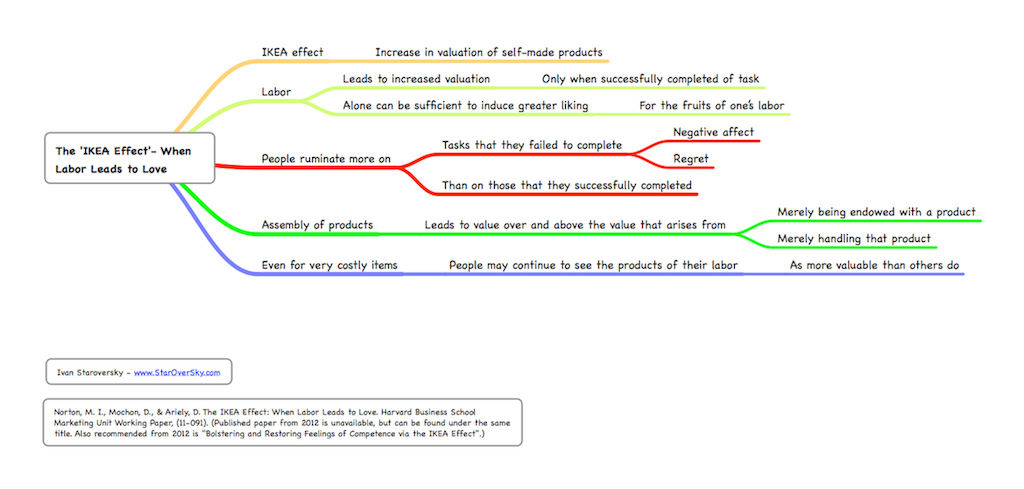
This phenomenon drew the attention of three authors - Michael I. Norton, Daniel Mochon, and Dan Ariely - in 2011. These authors titled their article “The IKEA Effect: When Labor Leads to Love” because the framework for their research was to find out about the value participants attached to their own labor. Their abstract declares their study’s relevance, homing in on one particularly fundamental observation. Norton, Mochon, and Ariely noted that the IKEA effect is as true for consumers who profess an interest in ‘do-it-yourself’ projects as for those who are relatively uninterested. Their paper reflects on how assembling IKEA products connects with people’s sense of well-being and feelings of productivity. Even if they might find the task unlikeable, people still rate this work as rewarding.

Returning to Gary in his lounge, we can still find him admiring his bookcase with its glinting, shiny screw-heads. Imagine, if as designers, we could replicate that effect in every design we composed, we would really satisfy our users’ needs at different levels. If you’re familiar with Maslow’s hierarchy of needs, then this must ring a bell. However, let’s see it from a different approach.

People Need to Feel Creative — Let’s Get Convivial!

The IKEA effect captures the essence of how sometimes users prefer to commune with the designs of others by “completing” them in the comfort of their own home than passively bring home completed goods. “Product becomes project” might sum it up well. However, we can also consider this effect in the light of another piece of scholarship.

Liz Sanders, the founder of MakeTools and author of Convivial Toolbox, writes in her article “Scaffolds for building everyday creativity” (2006) of the growing need of everyday people to achieve more creative ways of living.

Although you may argue about the creativity involved in assembling IKEA furniture, their products do fall into the category of “convivial tools”. This term was coined by Ivan Illich – a radical theorist of the 1960s and author of the book Tools For Conviviality –; who considered that there are two basic types of tools:

Convivial tools allow users to invest the world with their meaning, to enrich the environment with the fruits of their visions, and to use them for the accomplishment of a purpose they have chosen. Industrial tools deny this possibility to those who use them and they allow their designers to determine the meaning and expectations of others.”

According to Illich, people have both a consumptive and creative mindset, and this leads to a need for a balance between consumptive and creative activities. Sanders confirms Illich’s predictions, noting that the balance was heavily stacked in the favor of industrial tools, while convivial tools represented about a tenth of their volume. Sanders predicted that “tomorrow’s” balance would be just that – a true balance between the industrial tools and convivial tools, or, respectively, the consumptive mindset and the creative mindset.

The 4 levels of consumption

These include all the things that you’d expect from a typical shopping experience. Sanders identifies them as shopping, buying, owning, and using.

The 4 levels of creativity

According to Sanders, there are at least four levels of creativity that everyday people seek.

Level of creativity

Motivations

Requirements

Doing

To get something done/ to be productive

Minimal interest

Minimal domain experience

Adapting

To make something on my own

Some interest

Some domain expertise

Making

To make something with my own hands

Genuine interest

Domain experience

Creating

To express my creativity

Passion

Domain expertise

Before we move on, do you see how having these levels in mind can help you in your design practice? Whenever you’re considering different approaches for user experience, you can recall these levels and think about which of your end-user’s levels of creativity you’re targeting.

Going back to our IKEA effect: How does the IKEA assembling fit within these levels?

The IKEA effect authors demonstrated the magnitude of this effect: consumers believe that their self-made products rival those of experts. The curious thing is that this effect is not a product of adapting, making or creating. It is just the result of doing. If we take a quick look back at the levels of consumption, we see straightaway that the IKEA effect has something else — investing the user in the creation of new furniture.


Author/Copyright holder: Unknown. Copyright terms and licence: Unknown.

The motivation behind the doing is to accomplish something through productive activity. Doing requires a minimal amount of interest and the skill requirements are low as well. For Sanders, the doing level is just consuming readymade products. However, for the IKEA effect authors, the results from their research show that a successful assembly of products leads to value over and above the value that arises from merely being endowed with a product, or merely handling that product. There is only one requirement: successful completion is an essential component for the link between labor and liking to emerge.

Therefore, the IKEA effect might just be a new level of consumption from which, as designers, we can also learn. Take the personalization options on a website or app, we know that users value this option but very few use them. In the light of the IKEA effect, users might just be happier picking from a ready-made template and changing the background.

How We Can Design for “Convivial Tools Users”

We can build scaffolds for our users’ experience. This is typically done in co-creation sessions. Applying this method leads to a special type of communicational space that enables, supports and allows for creative behavior. Here, we must ask ourselves questions such as what is too much to put into a design, i.e., what would suppress the user’s creativity rather than help it. How much free rein can we give the user and how much of our own designer’s creativity should feature in the design?

We can work with our users in the experimental phases of our design; we can co-create with them. We are moving away from the traditional design process and into new design spaces. As designers, we can see that we can engineer the creativity of other people in our designs by handing some control over to them.

During a co-creation session, for example, we would give users a toolkit to create a collage of their world. From examining this, we can shape our designs to fit them where they will use our designs. In other words, our scaffolding has come to them, touched their world, and so we can take away priceless data to build their UXs for them. Co-creation is very close to participatory design; we work together with the end users to come up with the design solutions.


Centermost to designing in this new way is understanding “everyday people”. Once, companies designed with oversimplification in mind. Market research was cruder many years ago. If a firm rolled out a design, it would see how it did later. That basically presumed that everyday people were just consumers, not users.

Interestingly, Sanders notes that everyday people “should drive the design process to the extent that they are capable and willing. If they are at a high level of creativity in a domain, then they should drive the design process. If they are at a low level of creativity, on the other hand, they will probably be content to consume what we deliver.” We just need to be aware of the fact that a user is not at the same level of creativity for everything and at all times. Thus, we need to cater for these different levels. These will depend on users’ interest in that specific product, the particular moment in their lives, their contexts, etc. If I just bought a new house, I’ll probably be in a creative mode to decorate it and make it my own. If I just moved temporarily into a rented house, I will probably opt for a functional approach: just consume as it is delivered.

The Take Away

In 2011, authors of a Harvard Business School article identified “the IKEA effect”, arguing and proving that users invest more interest in designs that they get to interact with, in this case, by assembling, even if assembling furniture is not their hobby. People have an innate need to feel productive; they are rewarded when they build an IKEA item, feeling accomplishment and satisfaction of a creative drive.

Creativity in user experience is nothing new. Ivan Illich, a radical 1960s theorist, identified two basic types of tools: convivial tools, which allow users to apply creativity to their world, and industrial tools, which deny this ability and allow the designers of goods free reign to dictate what users should expect.

According to Illich, people have both a consumptive and creative mindset, with the former matching the old industrial tools mindset, while the creative mindset remains relatively tiny. The IKEA effect is an example of a convivial tool, although at a less sophisticated and creativity level; except for IKEA hackers, of course..

In 2006, Liz Sanders, the founder of MakeTools, LLC, built on Illich’s viewpoint with a nonetheless groundbreaking observation that people (users, designers, everyone) need to feel creative. Everyday people are feeling more of a need to get creative in how they interact with and inhabit their worlds. Sanders states that new design spaces are evolving to assist people there, and that one day there will be as many convivial tools as industrial tools. Designers have to meet users using scaffolding; creating a specific communicational space that enables, supports, and allows for creative user behavior.

Users are no longer the faceless consumers of products that companies rolled out regardless. They are experts in their own worlds. Some, because of past experiences, prefer things that others don’t. Listen to them all.

Where to Learn More:

References

Hero Image: Author/Copyright holder: rarye. Copyright terms and licence: CC BY 2.0

Feel Stuck?
Want Better Job Options?

AI is replacing jobs everywhere, yet design jobs are booming with a projected 45% job growth. With design skills, you can create products and services people love. More love means more impact and greater salary potential.

At IxDF, we help you from your first course to your next job, all in one place.

See How Design Skills Turn Into Job Options
Privacy Settings
By using this site, you accept our Cookie Policy and Terms of Use.
Customize
Accept all

Be the One Who Inspires

People remember who shares great ideas.

Share on:

Academic Credibility — On Autopilot

Don't waste time googling citation formats. Just copy, paste and look legit in seconds.