Every project in every business has its stakeholders. These are people who are not necessarily working on the project but have an objective to meet from the outcome of the project. Stakeholders can be internal to the company such as the CEO or the Marketing Manager and they can be external to the company such as clients or shareholders.
Stakeholder analysis enables the project team to track the interests of stakeholders and allows them to determine the priorities when it comes to stakeholder management. In some organizations the internal stakeholders will have a disproportionate influence on the design process thanks to hierarchical management structures and it can be very useful to ensure that the political as well as business objectives of these stakeholders are satisfied whilst delivering the best possible user experience from your design project.
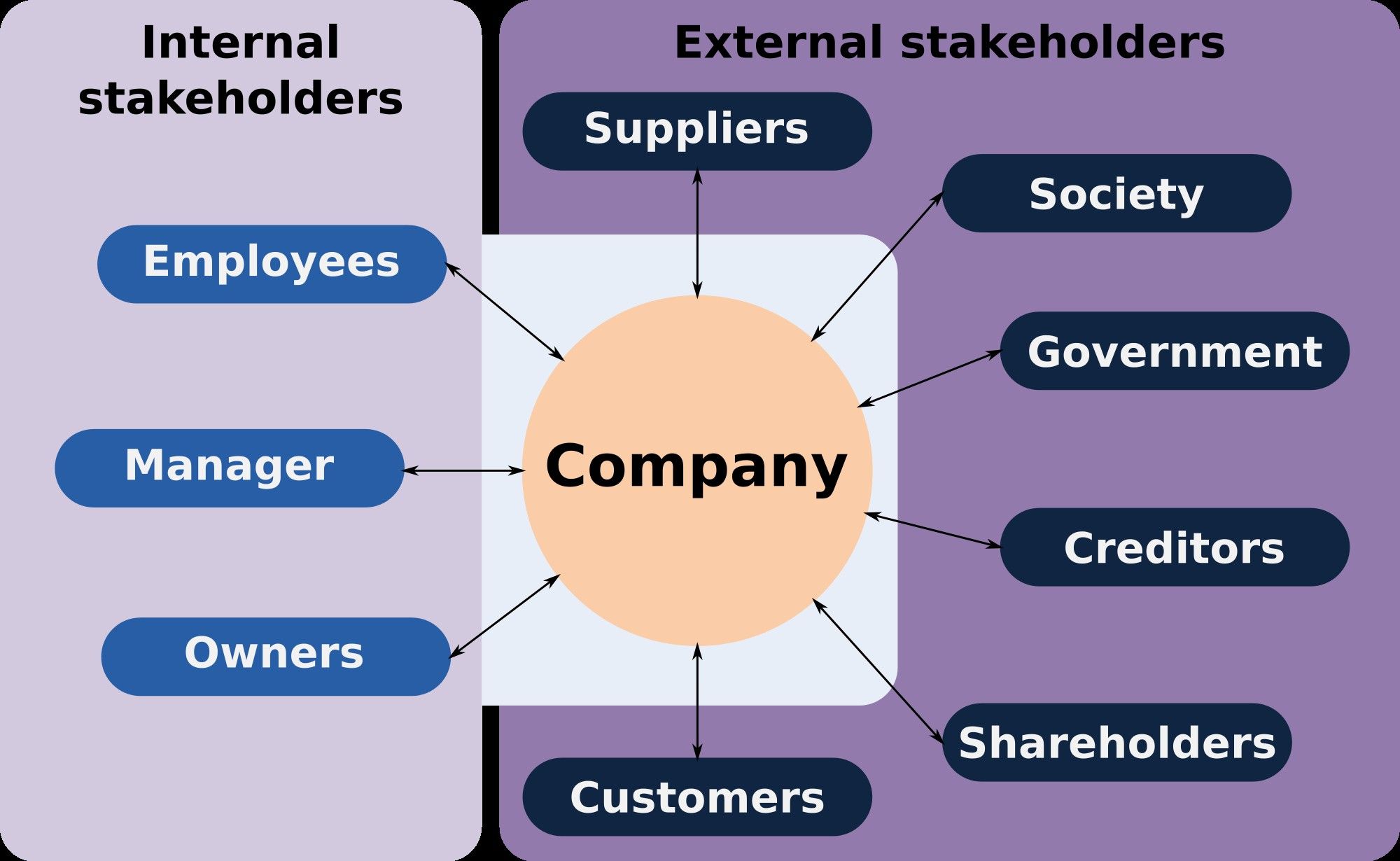
Author/Copyright holder: Grochim. Copyright terms and licence: CC BY-SA 3.0
Stakeholders can be a very diverse group and the better you know your stakeholders – the easy it is to manage their expectations.
Conducting Stakeholder Analysis
Stakeholders are any person or organization that has the capacity to be positively or negatively impacted by the project carry out and outcomes as well as any person or organization that has the capacity to impact on that project.
These may be (but aren’t limited to):
- People within the business
- Government agencies
- Customers
- Suppliers
- Shareholders
- Regulatory authorities
They can generally be put into three simple categories of stakeholder:
- Primary stakeholders – those that are affected positively or negatively by the outcome of the project.
- Secondary stakeholders – those that are indirectly affected by the outcome or progress of the project
- Key stakeholders – those that fall into neither of the other categories but still have significant ability to influence the project or the business
You can brain storm in a team to determine a complete picture of the stakeholders in a project. You may also use the organizational hierarchy chart and any other data sources to enhance this picture.
The purpose of this exercise is to develop a list of stakeholders with the objective of fostering cooperation between them and the project team – to ensure that the project is complete successfully and meets the objectives of the stakeholders.
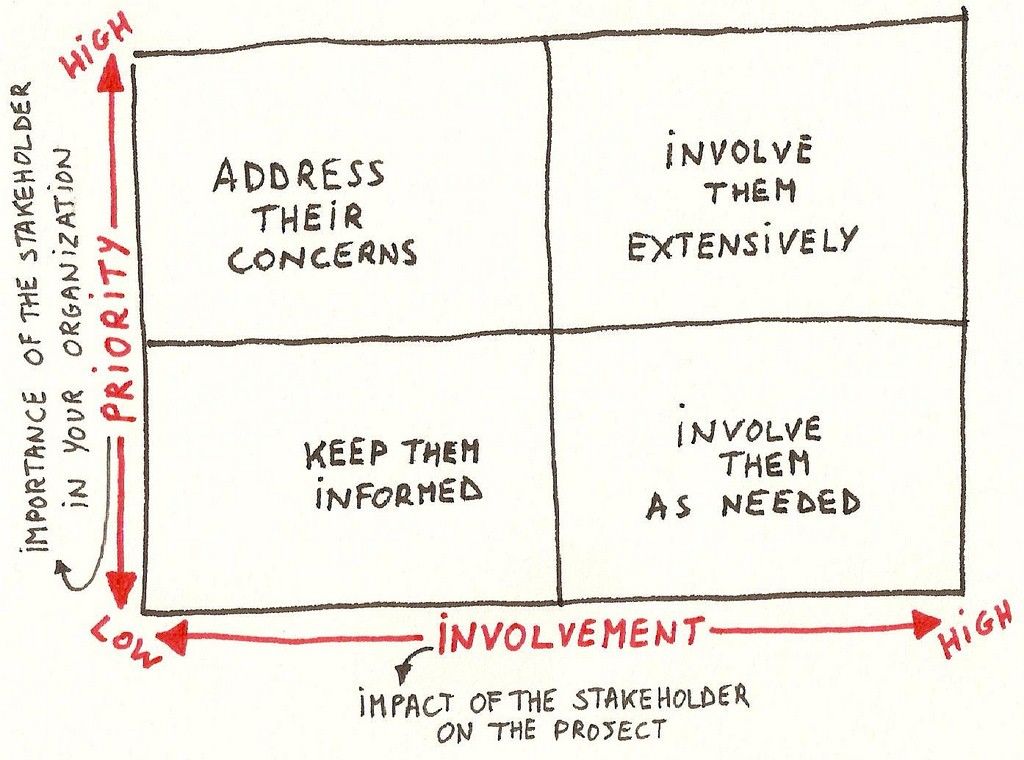
Author/Copyright holder: Luc Galoppin. Copyright terms and licence: CC BY 2.0
A simple and direct stakeholder map that enables management of stakeholders.
Stakeholder Mapping
There are many different ways to map stakeholders and their influence on the project. These may be derived from particular project management approaches or indeed from historical organizational behavior.
However, perhaps the simplest tool is the one proposed by Mitchell, Agle et al. in 1997 which examines the power and influence of each of stakeholder.
The idea of this exercise is to decide which stakeholders require the efforts of the project manager at any given point in time.
The way to conduct this map is to take a sheet of paper and divide it into four equal quarters (split vertically and horizontally on the paper) with a y axis tracking the power of the stakeholder and the x axis tracking their level of interest. You can then label each quadrant based on the following:
- Low interest and low power – apathetic stakeholders – those who should be monitored by the project manager in case their interest or power changes but which require almost no attention at that point in time
- Low interest and high power – latent stakeholders – those who need to be satisfied by the outcome of the project but who may not require regular attention during the project itself
- High interest and low power – defender stakeholders – those who will support the project and its aims and should be given regular updates to keep them included and motivated
- High interest and high power – promoter stakeholders – the group of stakeholders on which the project manager must devote their attention to managing closely. These are the stakeholders with the largest capacity to promote the project within the business but also have the largest capacity to derail it if not carefully handled.
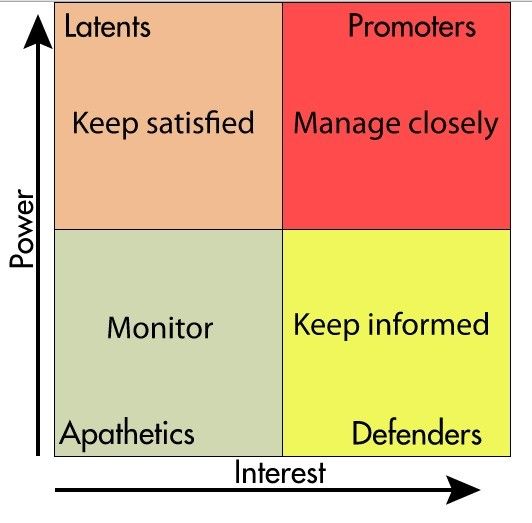
Author/Copyright holder: Zirguezi. Copyright terms and licence: CC0 1.0
The classic breakdown of stakeholders as suggested by Mitchell, Agell et al. back in 1997.
This model is extremely simple to employ though it requires that the project manager by familiar with the stakeholders and their interests and power over the project. If this is not known the project manager will need to determine this prior to conducting the analysis.
The project manager should regularly review their stakeholder map and see if stakeholders have changed positions (e.g. gained or lost power or interest). They can then refocus their attentions as necessary.
The Take Away
Stakeholder mapping is a project management tool that allows project managers to understand who their stakeholders are and to what extent they will need information and management during the course of the project. It recognizes that the relationship between stakeholders and the project is not static and requires regular revisiting to ensure that the project manager is diverting their energies to the right people at the right time.
Resources
Mitchell, R. K., B. R. Agle, and D.J. Wood. (1997). "Toward a Theory of Stakeholder Identification and Salience: Defining the Principle of Who and What really Counts." in: Academy of Management Review 22(4): 853 - 888.
Alternative forms of stakeholder mapping are explored here - http://www.policy-powertools.org/Tools/Understanding/docs/stakeholder_influence_mapping_tool_english.pdf
Hero Image: Author/Copyright holder: Will Richardson . Copyright terms and licence: CC BY-NC 2.0