The Pareto Principle and Your User Experience Work

• 8 min read

805 Shares

There are two things that are always in short supply on any project; time and money. The Pareto Principle can, in the long-term, help you save both. It can also help you make intelligent decisions based on your user research.

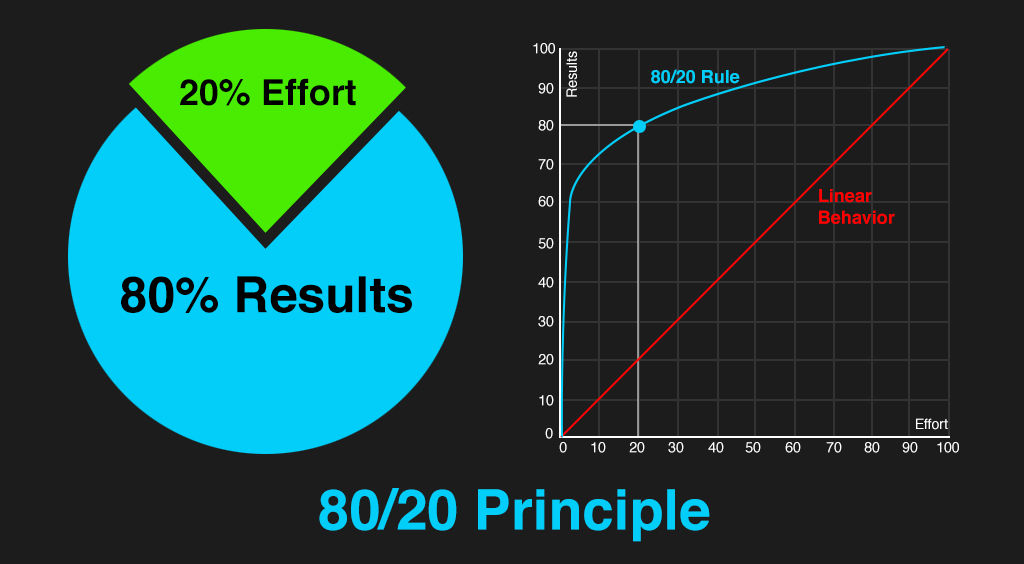
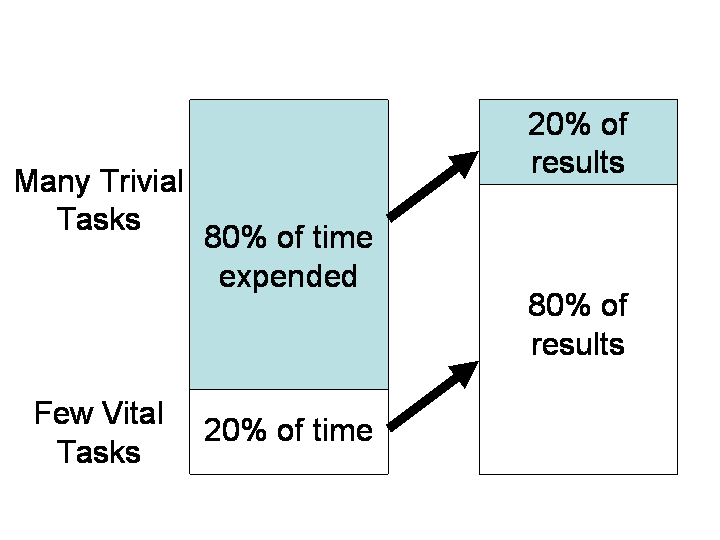
Our story begins with a Management Consultant Joseph M Juran back in the 1940s. He noticed that there is a general rule in business and in life – that 80% of the effects of a process come from just 20% of the inputs. He named this principle the “Pareto Principle” after the Italian Economist Vilfredo Pareto (1848-1923).

Pareto had published “Cours d’economie politique” back in 1896. He had observed that 80% of Italy’s land was owned by 20% of the population. He’d also noticed that 20% of the peapods in his garden contained 80% of the peas.

Why Does This Matter?

The Pareto Principle is useful because it allows us to focus our efforts on the areas that bring the most rewards. It’s used in almost every business discipline. For example, sales people will note that 20% of their accounts bring 80% of their sales. Marketers will find that 20% of their campaigns generate 80% of their leads and so on…

It’s important to note that 80%/20% is not exact. For example, you may find that these numbers change when you examine your own situation. So in the UK at the moment you’ll find that the top 20% of the country owns just over 50% of the wealth of the nation.

What is almost always true is that a small proportion of the efforts (inputs) will generate a larger than expected level of results (outputs).

The Pareto Principle and UX

It doesn’t matter how complex your website or application is, you will find that when you dig down into user analytics – the Pareto Principle will come into play. A small fraction of the functionality (or pages) will receive the majority of user time; this doesn’t mean that the rest of the functionality or content has no value but it does mean that some functionality and content is more important to the majority of your users than some of the rest.

This is important because it enables you to focus your research on the things that matter most and ensuring that you protect these things when you come to revising the user experience. If you degrade or reduce the impact of what most users want from you; you’re going to lose users along the way. Conversely if you can improve the user experience of these core attributes of your product – you’re more likely to win over new users and encourage user loyalty.

Again, if you start to talk to users about what they’d like to see when it comes to enhancing the user experience – you’re going to see the Pareto Principle at play as often as not. The vast majority of users are likely to feel strongly about a narrow range of improvements; again this doesn’t mean that other improvements are not valuable but it does show which improvements you should prioritize.

This can be really useful on projects with tight timescales or small budgets. Focusing on the areas that will bring the largest benefits to the most people is a very sensible way to manage a project in these circumstances.

A note of caution should be applied here – just because a lot of users ask for something, it doesn’t mean that they will value the eventual implementation. You can’t use the Pareto Principle to eliminate ongoing user research; it’s for focusing your attention on what should matter rather than guaranteeing it in this case.

You will find the Pareto Principle in play in other areas of your research too. For example, the customer support/helpdesk function will find that the majority of their calls/e-mails/etc. concern a few simple problems. Again concentrating on fixing these problems will have the greatest impact for the largest portion of your user base.

How to Use the Pareto Principle

Whenever, you have quantitative data – you may be able to apply the Pareto Principle. It’s simply a question of grouping that data and seeing how large a section of your audience is affected by any given unit of data.

Author/Copyright holder: Prezi. Copyright terms and licence: All rights reserved. Img source

It’s important to consider the sample size when you use the Pareto Principle. You need to ensure that your research or analysis covers a sufficient sample size to be statistically relevant. If you base, for example, your customer care analysis on 5 helpdesk calls – you probably don’t have enough data to apply the Pareto Principle sensibly to it.

There’s also another issue to be careful of – one set of figures may be more important than another. Many companies will have a few clients that represent the lion’s share of their revenue. If you are conducting analysis that will lead to a Pareto Principle driven decision making process… you probably want to give these customers more weight than the customers who don’t make you as much money.

So, for example, you have 500 helpdesk calls and 400 of them relate to a problem with Feature A, 80 relate to Feature B and only 20 relate to Feature C – it’s normally a no-brainer at this point to focus your efforts on fixing Feature A but if all the calls relating to B or C come from high revenue clients and the calls relating to Feature A do not… you may still want to focus your efforts on fixing B or C first.

Data should always be used in the largest context available and Pareto Principle decision making is no different.

The Take Away

The Pareto Principle or 80-20 Rule can be very effective in helping you make decisions in your user experience work. From research and analytics to higher level stuff like project management, wherever there is data that can be quantified there’s the possibility that you can use this rule to focus your efforts on the areas of your work that bring the most results.

However, you always need to be mindful of sample sizes and of other forms of data which may override the Pareto Principle in practice.

Resources

Wiki explains the maths and examines multiple applications of the Pareto Principle here: https://en.wikipedia.org/wiki/Pareto_principle

Forbes magazine shows that the Pareto Principle can be used to drive business growth: http://www.forbes.com/sites/davelavinsky/2014/01/20/pareto-principle-how-to-use-it-to-dramatically-grow-your-business/

Pinnacle Management talks about the Pareto Principle here and offers some precautions on how to avoid becoming overly-reliant on it here: http://www.pinnicle.com/Articles/Pareto_Principle/pareto_principle.html

Measuring U looks at some real UX data and how the Pareto Principle might apply to it here: http://www.measuringu.com/blog/pareto-ux.php

Hero Image: Author/Copyright holder: Ana Zdravic. Copyright terms and licence: All rights reserved.Img


Learn More in This Course:

AI for Designers

12 days
13 % booked
View Course

What You Should Read Next

  • Read full article
    What is Interaction Design? - Article hero image
    Interaction Design Foundation logo

    What is Interaction Design?

    Interaction design is an important component within the giant umbrella of user experience (UX) design. In this article, we’ll explain what interaction design is, some useful models of interaction design, as well as briefly describe what an interaction designer usually does.A simple and useful unders

    Social shares
    1.5k
    Published
    Read Article
  • Read full article
    Apple’s Product Development Process – Inside the World’s Greatest Design Organization - Article hero image
    Interaction Design Foundation logo

    Apple’s Product Development Process – Inside the World’s Greatest Design Organization

    Apple’s Product Development Process may be one of the most successful design processes ever implemented. With a valuation that exceeds $2 trillion, there’s a lot that designers can learn from Apple and introduce into their own design environments.Apple is a notoriously secretive business. In Steve J

    Social shares
    1.4k
    Published
    Read Article
  • Read full article
    Shneiderman’s Eight Golden Rules Will Help You Design Better Interfaces - Article hero image
    Interaction Design Foundation logo

    Shneiderman’s Eight Golden Rules Will Help You Design Better Interfaces

    Follow Ben Shneiderman’s 'Eight Golden Rules of Interface Design' if you want to design great, productive and frustration-free user interfaces. Apple, Google and Microsoft are among some of the highly successful companies whose well-designed products reflect Shneiderman’s rules. The characteristics

    Social shares
    1.4k
    Published
    Read Article
  • Read full article
    How to Change Your Career from Graphic Design to UX Design - Article hero image
    Interaction Design Foundation logo

    How to Change Your Career from Graphic Design to UX Design

    If there’s an occupation that is 100% linked with the public’s idea of what design is all about, it’s graphic design. From the familiar golden arches of the McDonald’s brand to the typography and colors of movie posters, graphic designers create some of the most iconic and ubiquitous designs around

    Social shares
    1.4k
    Published
    Read Article
  • Read full article
    The Grid System: Building a Solid Design Layout - Article hero image
    Interaction Design Foundation logo

    The Grid System: Building a Solid Design Layout

    Now that we’ve seen some grids at work in the Rule of Thirds article, let’s examine them a little more deeply. As a concept that deals so fundamentally with the fabric and background of our work as designers, it’s easy to overlook the power of grids and think more about the elements we want to creat

    Social shares
    1.4k
    Published
    Read Article
  • Read full article
    The Key Elements & Principles of Visual Design - Article hero image
    Interaction Design Foundation logo

    The Key Elements & Principles of Visual Design

    Visual design is about creating and making the general aesthetics of a product consistent. To create the aesthetic style of a website or app, we work with fundamental elements of visual design, arranging them according to principles of design. These elements and principles together form the building

    Social shares
    1.4k
    Published
    Read Article
  • Read full article
    The Principles of Service Design Thinking - Building Better Services - Article hero image
    Interaction Design Foundation logo

    The Principles of Service Design Thinking - Building Better Services

    Service design is all about taking a service and making it meet the user’s and customer’s needs for that service. It can be used to improve an existing service or to create a new service from scratch. In order to adapt to service design, a UX designer will need to understand the basic principles of

    Social shares
    1.4k
    Published
    Read Article
  • Read full article
    A Simple Introduction to Lean UX - Article hero image
    Interaction Design Foundation logo

    A Simple Introduction to Lean UX

    Lean UX is an incredibly useful technique when working on projects where the Agile development method is used. Traditional UX techniques often don’t work when development is conducted in rapid bursts – there’s not enough time to deliver UX in the same way. Fundamentally Lean UX and other forms of UX

    Social shares
    1.3k
    Published
    Read Article
  • Read full article
    Dieter Rams: 10 Timeless Commandments for Good Design - Article hero image
    Interaction Design Foundation logo

    Dieter Rams: 10 Timeless Commandments for Good Design

    Let’s pay a virtual visit to a famous industrial designer’s workshop. By examining the principles of his winning approach, we can incorporate vital elements into our designs in the “less is more” age.As user experience practitioners, most of us have worked with Nielsen and Molich’s 10 heuristics or

    Social shares
    1.3k
    Published
    Read Article
  • Read full article
    The 7 Factors that Influence User Experience - Article hero image
    Interaction Design Foundation logo

    The 7 Factors that Influence User Experience

    User Experience (UX) is critical to the success or failure of a product in the market but what do we mean by UX? All too often UX is confused with usability which describes to some extent how easy a product is to use and it is true that UX as a discipline began with usability – however, UX has grown

    Social shares
    1.3k
    Published
    Read Article

Top Articles

Top Topic Definitions

Feel Stuck?
Want Better Job Options?

AI is replacing jobs everywhere, yet design jobs are booming with a projected 45% job growth. With design skills, you can create products and services people love. More love means more impact and greater salary potential.

At IxDF, we help you from your first course to your next job, all in one place.

See How Design Skills Turn Into Job Options
Privacy Settings
By using this site, you accept our Cookie Policy and Terms of Use.
Customize
Accept all

Be the One Who Inspires

People remember who shares great ideas.

Share on:

Academic Credibility — On Autopilot

Don't waste time googling citation formats. Just copy, paste and look legit in seconds.

Feel Stuck? Want Freedom?

Join 326,029+ designers who get one powerful email each week. Learn to design a life you love.

Next email in
1
day
13
hrs
23
mins
2
secs

Free forever. No spam. Unsubscribe anytime.