A book page showing the creationism-evolutionism spectrum

Information Visualization – A Brief Introduction

• 9 min read

873 Shares

Have you ever thought about how much data flows past each of us in an ordinary day? From the newspaper you read at breakfast, to the e-mails you receive throughout the day, to the bank statements generated whenever you withdraw money or spend it, to the conversations we have, and so on?

There is a tidal wave of data associated with each aspect of our lives, and in addition to that personal data, there is data available on nearly every aspect of life.

Over the last few decades computing and the internet have revolutionized our ability to create, store and retrieve information on a whim. A global economy and instant communication have created an explosion in the volumes of data to which we are exposed. Yet, the amount of data leads to a large amount of possible confusion and decision paralysis. There’s more data available than we can comfortably process.

Information visualization, the art of representing data in a way that it is easy to understand and to manipulate, can help us make sense of information and thus make it useful in our lives. From business decision making to simple route navigation – there’s a huge (and growing) need for data to be presented so that it delivers value.

An Example of Everyday Information Visualization

This map, generated in Google maps, offers two simple ways of representing the route from Chiang Mai in Northern Thailand to the capital of Thailand, Bangkok, in the center of the country.


Author/Copyright holder: Google, Inc. Copyright terms and licence: Fair Use.

The first representation consists of written instructions on how to go from Chiang Mai to Bangkok (as you can see it’s a pretty simple drive – though it’s worth noting that it would be more complex if we were to be moving between specific points within each city). The second representation is an image of the route itself imposed on a map.

Both representations represent value to different people. The first, the instructions, is highly useful to people who need to get from Chiang Mai to Bangkok directly. For example, a businessman going to a meeting.

The second, the map data on the other hand, could be really useful to a tourist who intends not to drive straight from A to B but rather wants to know “what’s on the way?” This lets the tourist look for potential break points in the journey and start to research what their options are in those places.

Both of these representations are examples of information visualization. The first relies on clear simple instructions and the minimum of graphical content – it conveys a simple set of useful instructions. The second conveys rather more data and in a visual form that allows for rapid cognitive processing to enable us to quickly digest the information we see.

Common Uses for Information Visualization

There are some very common uses for information visualization and these include:

Presentation (for Understanding or Persuasion)

“Use a picture. It’s worth a thousand words.” Arthur Brisbane, Syracuse Post Standard, 1911.

Journalists have known for a very long time that some ideas are simply too awkward to communicate in words and that a visual representation can help someone understand concepts that might otherwise be impossible to explain.
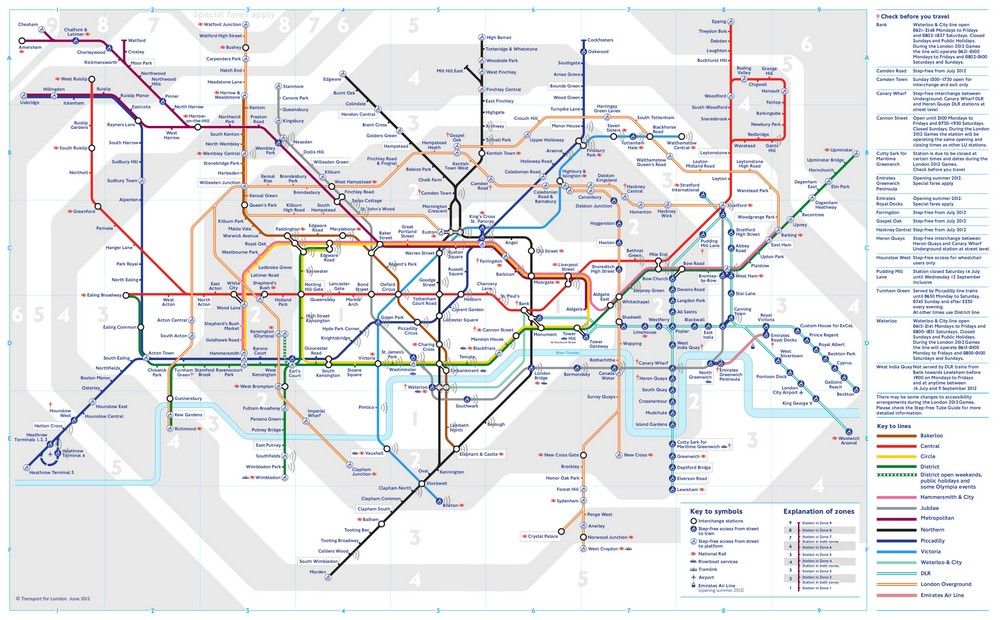

Author/Copyright holder: Lablascovegmenu. Copyright terms and licence: CC BY 2.0

One of the most famous information visualizations in the world is the map of the London Underground. It is only a “map” in the loosest sense of the word; in that the geography above ground is very different to the way it is shown on the underground map. However, it enables pretty much anyone to quickly understand how to get from one point in London to any other using the underground system.

In simple terms, the underground map presents complex data for the purposes of understanding that data to make it useful.

There is a “dark side” to the presentation of information for understanding and it’s the presentation of information to persuade. There are “lies, damned lies and statistics” as the saying (usually attributed to Mark Twain but he attributed it to the British Prime Minister Benjamin Disraeli and there is no trace of Disraeli having said it – the saying has also been attributed to others) goes. By choosing what information to represent and what information to leave out – there are now “lies, damned lies and information visualizations”.

It is up to the presenter to decide where the ethical boundaries are in persuading people through information visualization. For example, you could show a graph that states “70% of people who use homeopathy feel better than those who don’t” but omit the fact that “70% of people who take a placebo feel better than those who don’t”.

Explorative Analysis
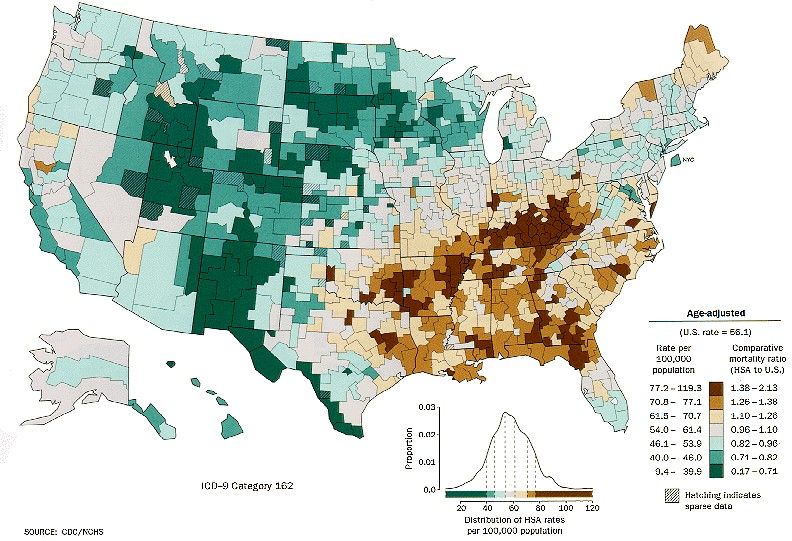

Author/Copyright holder: Centers for Disease Control and Prevention. Copyright terms and licence: Public Domain.

The image above portrays the frequency of lung cancer within the United States by geographic region. Mapping disease data like this enables researchers to explore the relationship between a disease and geography. It’s important to note that this data doesn’t explain why there is a spike in cancer rates in the South East of the United States but it does indicate that there is a spike which is worthy of further investigation.

Explorative analysis through information visualization allows you to see where relationships in data may exist.

Confirmation Analysis

Information visualization can also be used to help confirm our understanding and analysis of data. For example, if you perceive a relationship between two stock prices, you can plot the data and see if the two are related.
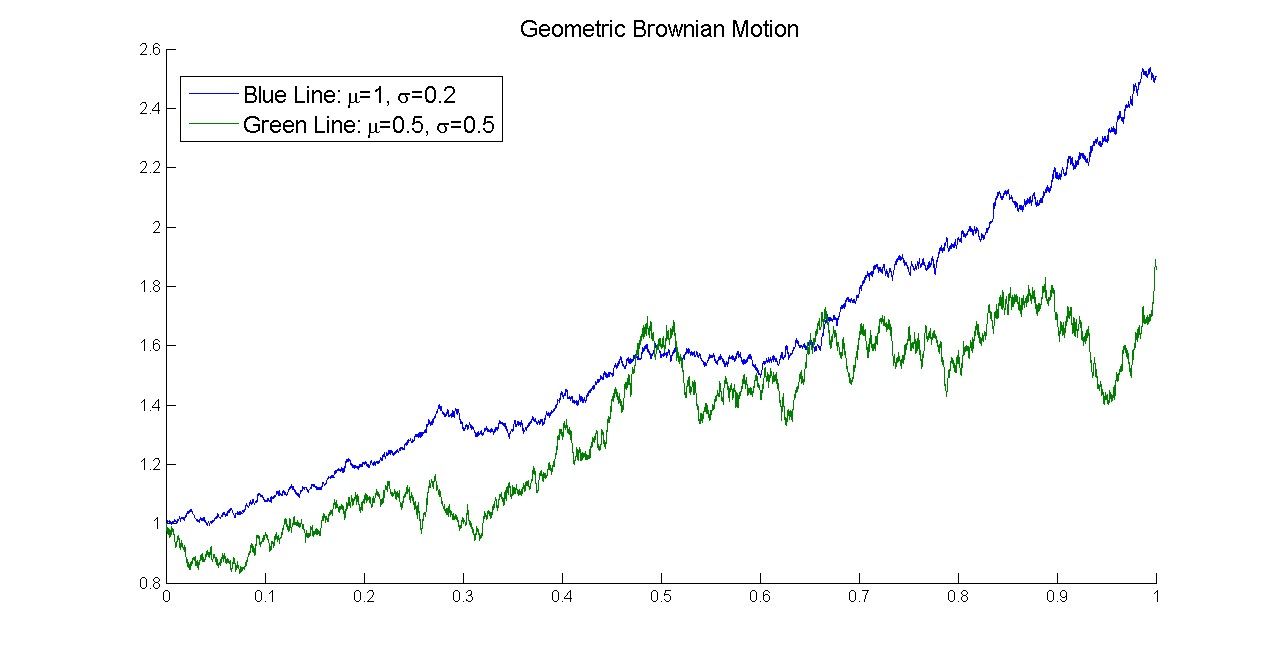

Author/Copyright holder: Arthena. Copyright terms and licence: CC BY-SA 3.0

This graph (above) might be used to show the similarities in Brownian motion between sets of particles or it might be used to question the break in the relationship towards the end of the graph, for example.

The Take Away

Information visualization is designed to help us make sense out of data. It can be used to explore relationships between data, to confirm ideas we hold about data or to explain data in easy to digest manner. It may also be used, rightly or wrongly, to help persuade someone with data.

As the volume of data available to us increases exponentially in every field of endeavor – information visualization is becoming increasingly important as a skill in the workplace and in academia.

References and Resources

Course: “Information Visualization”

Tess Flanders’s original quote was printed in "Speakers Give Sound Advice", Syracuse Post Standard (page 18). March 28, 1911.

You can find some beautiful examples of information visualization here .

Hero Image: Author/Copyright holder: david. Copyright terms and licence: CC BY-NC 2.0

Topics in This Article

Learn More in This Course:

AI for Designers

12 days
13 % booked
View Course

What You Should Read Next

  • Read full article
    Information Overload, Why it Matters and How to Combat It - Article hero image
    Interaction Design Foundation logo

    Information Overload, Why it Matters and How to Combat It

    Designers often need to convey information to the users of their designs. Specialists in information visualization design in particular find themselves presenting data over and over again to their users. However, it’s important when developing your designs that you don’t create “information overload

    Social shares
    1.2k
    Published
    Read Article
  • Read full article
    How to Design an Information Visualization - Article hero image
    Interaction Design Foundation logo

    How to Design an Information Visualization

    Designing information visualizations offers you endless possibilities when it comes to end products, and it would be impossible to provide step-by-step instructions for all these possibilities. However, it is fair to say that while the end products may vary dramatically – the process by which we rea

    Social shares
    984
    Published
    Read Article
  • Read full article
    Preattentive Visual Properties and How to Use Them in Information Visualization - Article hero image
    Interaction Design Foundation logo

    Preattentive Visual Properties and How to Use Them in Information Visualization

    A preattentive visual property is one which is processed in spatial memory without our conscious action. In essence it takes less than 500 milliseconds for the eye and the brain to process a preattentive property of any image. This is good news for information visualization designers and graphic des

    Social shares
    978
    Published
    Read Article
  • Read full article
    How to Visualize Your Qualitative User Research Results for Maximum Impact - Article hero image
    Interaction Design Foundation logo

    How to Visualize Your Qualitative User Research Results for Maximum Impact

    When thinking about visualization of research results, many people will automatically have an image of a graph in mind. Do you have that image, too? You would be right in thinking that many research results benefit from a graph-like visualization, showing trends and anomalies. But this is mainly tru

    Social shares
    966
    Published
    Read Article
  • Read full article
    How to Conduct Focus Groups - Article hero image
    Interaction Design Foundation logo

    How to Conduct Focus Groups

    Focus groups have long been a popular tool in market research and have become more popular in user research in the recent past too. They consist of a group of between 5 and 10 users who work with a moderator/facilitator/researcher. The moderator will pose questions from a script to the group. Their

    Social shares
    926
    Published
    Read Article
  • Read full article
    Visual Mapping – The Elements of Information Visualization - Article hero image
    Interaction Design Foundation logo

    Visual Mapping – The Elements of Information Visualization

    Information visualization requires mapping data in a visual or occasionally auditory format for the user of the visualization. This can be challenging because while some data has a spatial relationship built in (for example, temperatures in cities around a country) many data sets don’t have a tradit

    Social shares
    907
    Published
    Read Article
  • Read full article
    The Properties of Human Memory and Their Importance for Information Visualization - Article hero image
    Interaction Design Foundation logo

    The Properties of Human Memory and Their Importance for Information Visualization

    It is important to know that while neuroscience has progressed dramatically over the last decades; there is no complete understanding of how human memory works. We know, for example, that data in the brain is stored in clusters of neurons but we don’t know how, precisely, it is stored or even how it

    Social shares
    903
    Published
    Read Article
  • Read full article
    Guidelines for Good Visual Information Representations - Article hero image
    Interaction Design Foundation logo

    Guidelines for Good Visual Information Representations

    Information visualization is not as easy as it might first appear, particularly when you are examining complex data sets. How do you deliver a “good” representation of the information that you bring out of the data that you are working with?While this may be a subjective area of information visualiz

    Social shares
    900
    Published
    Read Article
  • Read full article
    How to Show Hierarchical Data with Information Visualization - Article hero image
    Interaction Design Foundation logo

    How to Show Hierarchical Data with Information Visualization

    Hierarchical data is essentially a specialized form of network data – in that while entities within the dataset do not have dependent relationships; they are all related to each other by the principle of containment. They, unlike standard data networks, do not use the principle of connection.A hiera

    Social shares
    846
    Published
    Read Article
  • Read full article
    Information Visualization – An Introduction to Multivariate Analysis - Article hero image
    Interaction Design Foundation logo

    Information Visualization – An Introduction to Multivariate Analysis

    Albert Einstein said; “If you can’t explain it simply, you don’t understand it well enough.” He could easily have been talking about the challenges of creating information visualizations for multivariate analysis.Multivariate analysis takes place when you have a data set with 4 or more dependent var

    Social shares
    816
    Published
    Read Article

Top Articles

Top Topic Definitions

Feel Stuck?
Want Better Job Options?

AI is replacing jobs everywhere, yet design jobs are booming with a projected 45% job growth. With design skills, you can create products and services people love. More love means more impact and greater salary potential.

At IxDF, we help you from your first course to your next job, all in one place.

See How Design Skills Turn Into Job Options
Privacy Settings
By using this site, you accept our Cookie Policy and Terms of Use.
Customize
Accept all

Be the One Who Inspires

People remember who shares great ideas.

Share on:

Academic Credibility — On Autopilot

Don't waste time googling citation formats. Just copy, paste and look legit in seconds.

Feel Stuck? Want Freedom?

Join 326,033+ designers who get one powerful email each week. Learn to design a life you love.

Next email in
1
day
12
hrs
15
mins
28
secs

Free forever. No spam. Unsubscribe anytime.