Guidelines for Good Visual Information Representations

• 8 min read

900 Shares

Information visualization is not as easy as it might first appear, particularly when you are examining complex data sets. How do you deliver a “good” representation of the information that you bring out of the data that you are working with?

While this may be a subjective area of information visualization and, of course, there are exceptions to the guidelines (as with all areas of design – rules are for breaking if by breaking them you achieve your purpose) it’s best to begin with the four guidelines outlined by Edward Tufte.

About Edward Tufte

Edward Tufte is, perhaps, the world’s leading authority on information design and data visualization. He is an American statistician and a Professor Emeritus at Yale University (for political sciences, computer sciences and statistics).

He has authored several books and papers on analytic design and is a strong proponent for the power of visualizing data. In particular his books, Visual Display of Quantitative Information, Envisioning Information, Visual Explanations and Beautiful Evidence are considered to be definitive works in the field of information visualization. The New York Times called him; “The Leonardo da Vinci of data.”

Within his works you can find four essential guidelines for visual information representation:

  1. Graphical Excellence

  2. Visual Integrity

  3. Maximizing the Data-Ink Ratio

  4. Aesthetic Elegance

Tufte’s Criteria for Good Visual Information Representation

The purpose of “good’ representations is to deliver a visual representation of data to the user of that representation which is “most fit for purpose”. This will enable the user of the information to make the most out of the representation. There is no single hard and fast rule for creating good representations because the nature of the data, the users of that data, etc. are enormously varied.

Thus we find ourselves with a set of criteria which can be applied to most visual representations, as suggested by Tufte, to judge their fitness for purpose. It must be acknowledged, however, that these criteria can be bent or even broken if doing so serves a purpose for the user of the information representation.

Graphical Excellence

There could be hours of debate as to what constitutes graphical excellence but Tufte offers that in data representations at least it should provide the user with; “the greatest number of ideas, in the shortest time, using the least amount of ink, in the smallest space.”

In short as with many other areas of user experience – the focus here is on usability; it is completely possible to create beautiful graphical representations of data which fail to deliver on these premises. In fact, it might be said that this occurs so often that the power of data visualization is muted because people have come to expect such visualizations to be decorative rather than valuable.
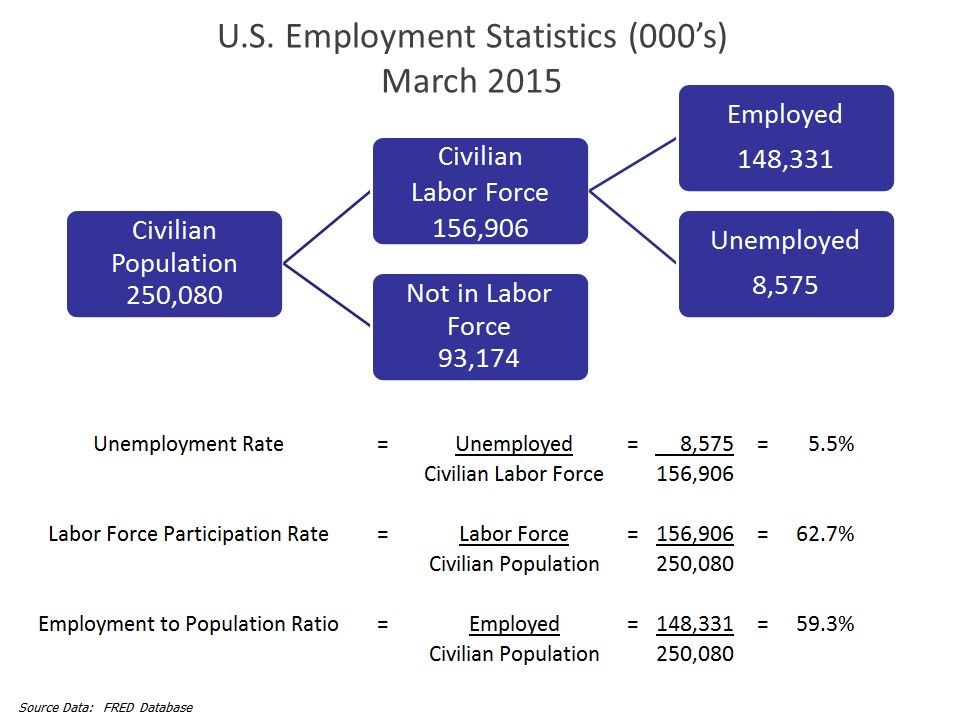

Author/Copyright holder: Farcaster. Copyright terms and licence: CC BY-SA 3.0

The graphic above, relating to US employment statistics in March 2015, offers many ideas in a very small space and is easy to digest. We’d suggest it meets the criteria of “graphical excellence”.

Visual Integrity

This is a confusing term. When Tufte refers to “visual integrity” he is invoking an almost moral position in that the representation should neither distort the underlying data nor create a false impression or interpretation of that data.

In practice this means that numerical scales should be properly proportionate (and not fudged to exaggerate the fall or rise of a curve at a particular point, for example). That variations, when they occur, should relate to the data rather than to the artistic interpretation of that data. The dimensions used within an image should be limited to the dimensions within the data and should never exceed them and finally that the keys (or legends) should be undistorted and unambiguous.
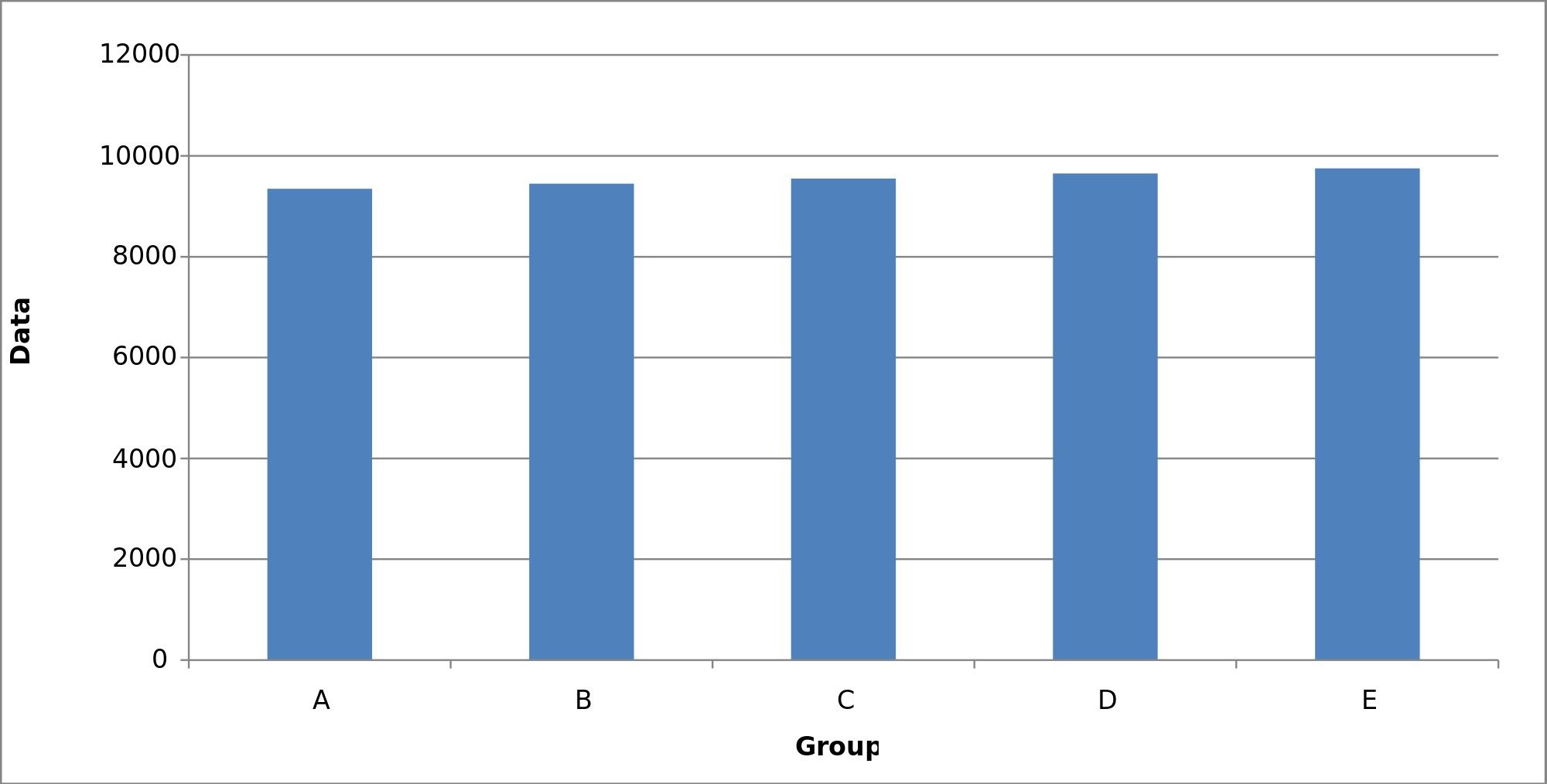

Author/Copyright holder: Smallman12q. Copyright terms and licence: CC0 1.0

This bar graph fails to give us enough information to be useful and thus fails in delivering “visual integrity”.

Maximizing the Data-Ink Ratio

Tufte recommends that we pay attention to the way that a visualization is compiled; in that all superfluous elements (to the user) should be removed. He offers the idea that borders, backgrounds, use of 3D, etc. may do nothing but serve to distract the user from the information itself. He promotes that you give priority to the data and how it will be used and not to the visual appearance of that representation.

He also provides a mathematical formula for a data-ink ratio:

Data-Ink/Total Ink Used

This is simply a comparison of the ink needed to clearly and unambiguously present the data to the ink actually used (including aesthetic considerations). The closer the ratio is to 1 – the less distracting your representation is likely to be and thus the more useful it is likely to be for your user.
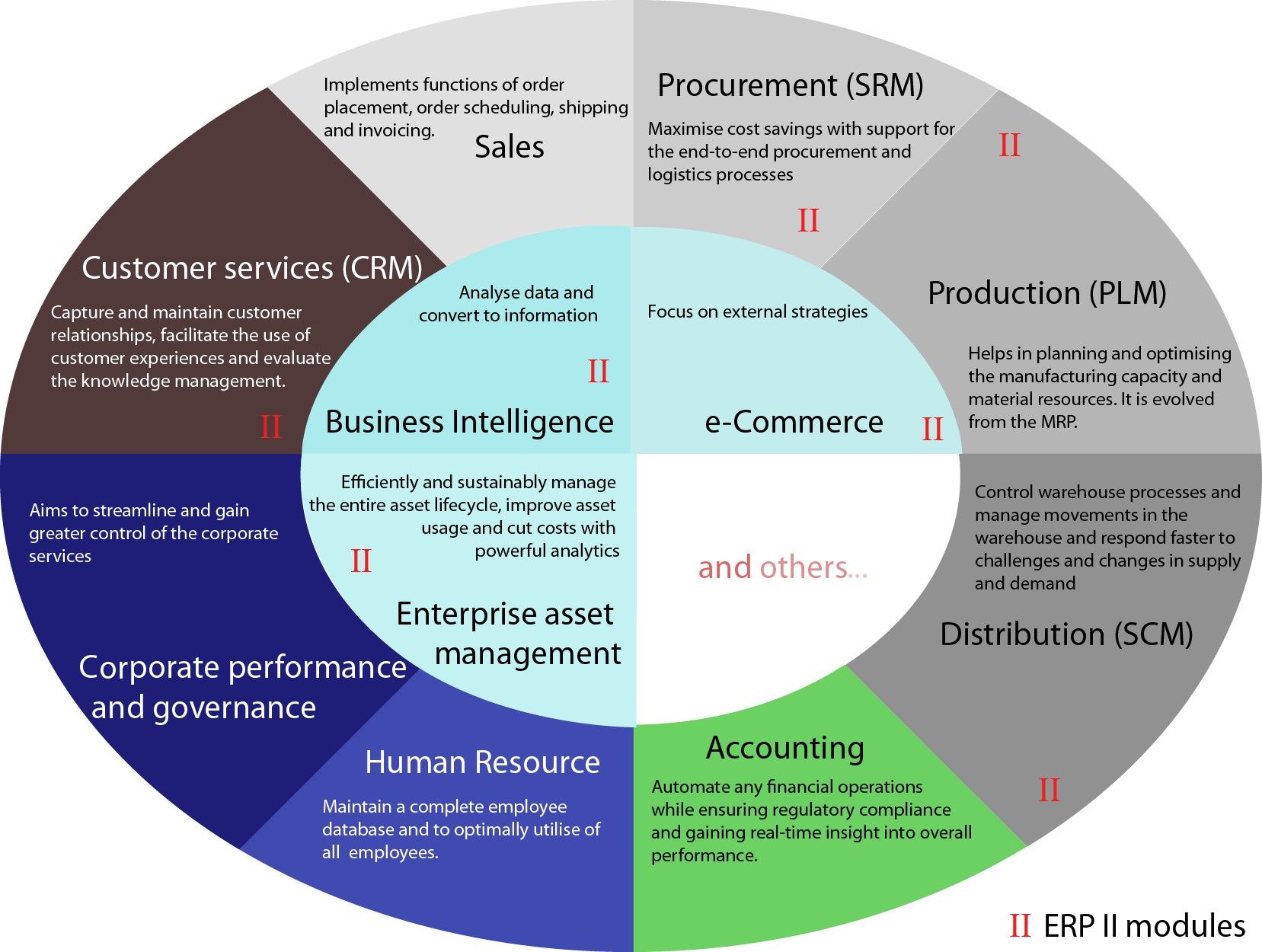

Author/Copyright holder: Shing Hin Yeung. Copyright terms and licence: CC BY-SA 3.0

This image of business processes with an ERP environment is quite good at conveying which business functions are affected by the ERP processes but what purpose does the color scheme serve?

Aesthetic Elegance

Tufte’s interpretation of aesthetic elegance is not based on the “physical beauty” of an information visualization but rather the simplicity of the design evoking the complexity of the data clearly.

He holds up Minard’s visualization (pictured below) of Napoleon’s March in the Russian Campaign as an example of aesthetic elegance.
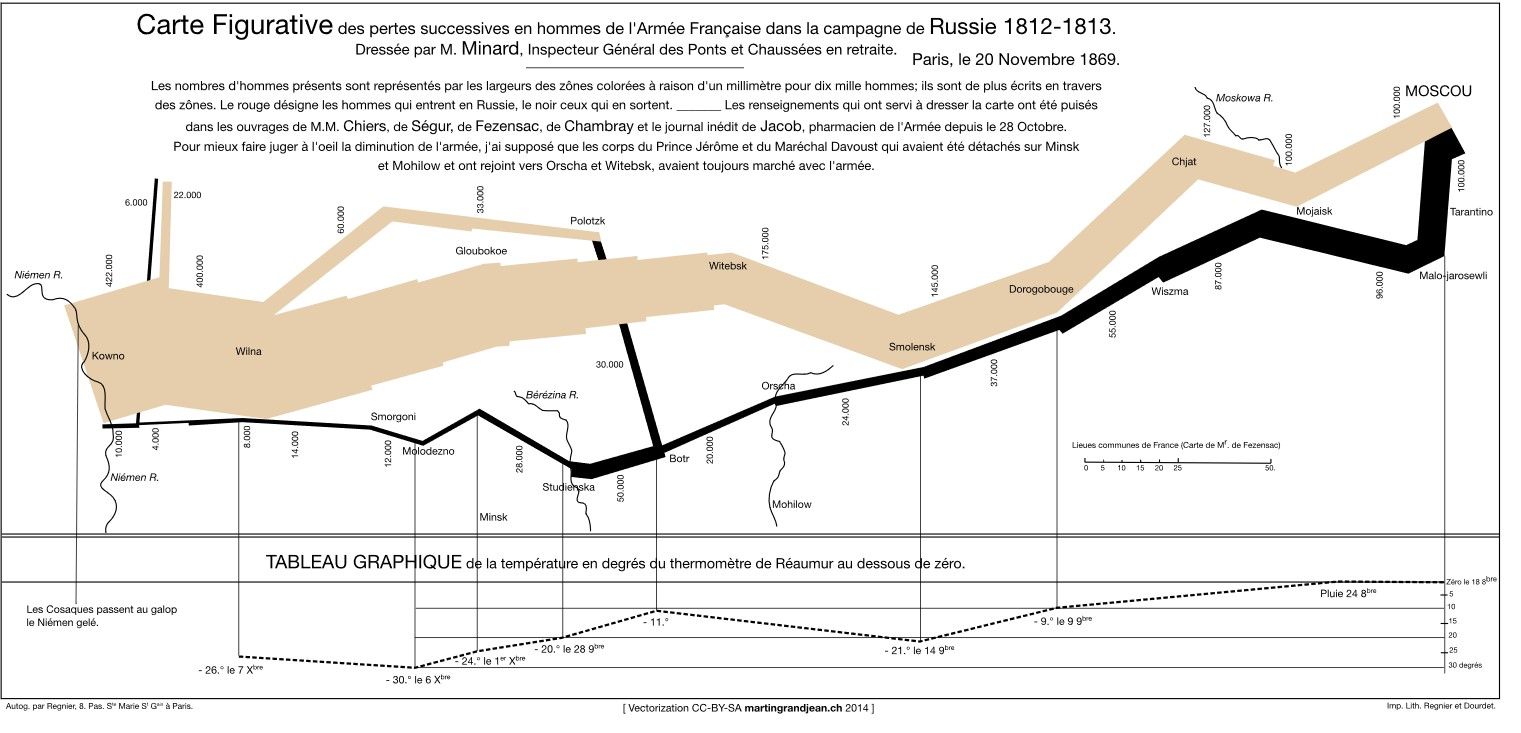

Author/Copyright holder: MartinGrandjean. Copyright terms and licence: CC BY-SA 3.0

The Take Away

Tufte’s guidelines are not prescriptive but rather designed to assist the information visualization professional in creating usable and useful information representations. At their core his rules can be boiled down to keeping things as simple and as honest as possible. The rest simply ensure that you adapt to complexity in the most creative and basic way possible.

UX designers will see clear links between their own design work on products and the design of information representations.

References and Resources

You can find all of Edward Tufte’s work via his website.

Find out more about Charles Joseph Minard and his map of Napoleon’s Russian Campaign.

You can also find an interesting analysis of Minard’s map here.

Hero Image: Author/Copyright holder: Kitware Inc. Copyright terms and licence: CC BY-ND 2.0

Learn More in This Course:

AI for Designers

12 days
13 % booked
View Course

What You Should Read Next

  • Read full article
    User Interface Design Guidelines: 10 Rules of Thumb - Article hero image
    Interaction Design Foundation logo

    User Interface Design Guidelines: 10 Rules of Thumb

    Learn to design with your user’s needs and expectations in mind by applying Jakob Nielsen and Rolf Molich’s Ten User Interface Guidelines. These heuristics have been reflected in many of the products designed by some of the most successful companies in the world such as Apple, Google, and Adobe. Fur

    Social shares
    1.4k
    Published
    Read Article
  • Read full article
    The Key Elements & Principles of Visual Design - Article hero image
    Interaction Design Foundation logo

    The Key Elements & Principles of Visual Design

    Visual design is about creating and making the general aesthetics of a product consistent. To create the aesthetic style of a website or app, we work with fundamental elements of visual design, arranging them according to principles of design. These elements and principles together form the building

    Social shares
    1.4k
    Published
    Read Article
  • Read full article
    Data Analysis: Techniques, Tools, and Processes - Article hero image
    Interaction Design Foundation logo

    Data Analysis: Techniques, Tools, and Processes

    Data analysis is one of those terms that “is what it sounds like,” although there’s more to it than may meet the eye. In any case, it’s a valuable skill for making better decisions—a skill that you can bring to bear on both your professional and personal life, from personal budgeting to analyzing cu

    Social shares
    1.2k
    Published
    Read Article
  • Read full article
    Information Overload, Why it Matters and How to Combat It - Article hero image
    Interaction Design Foundation logo

    Information Overload, Why it Matters and How to Combat It

    Designers often need to convey information to the users of their designs. Specialists in information visualization design in particular find themselves presenting data over and over again to their users. However, it’s important when developing your designs that you don’t create “information overload

    Social shares
    1.2k
    Published
    Read Article
  • Read full article
    How to Develop an Empathic Approach in Design Thinking - Article hero image
    Interaction Design Foundation logo

    How to Develop an Empathic Approach in Design Thinking

    Empathy requires us to put aside our learning, culture, knowledge, opinions, and worldview purposefully in order to understand other peoples’ experiences of things deeply and meaningfully. It requires a strong sense of imagination for us to be able to see through another person’s eyes. It requires h

    Social shares
    1k
    Published
    Read Article
  • Read full article
    6 Common Pitfalls in Prototyping and How to Avoid Them - Article hero image
    Interaction Design Foundation logo

    6 Common Pitfalls in Prototyping and How to Avoid Them

    Prototyping is an indispensable part of the design thinking process. However, it’s crucial to know how to prototype the right way and avoid some common pitfalls. If not, your prototyping efforts might be for nothing as your biases and inefficiencies will lead to a suboptimal design solution. Let’s l

    Social shares
    986
    Published
    Read Article
  • Read full article
    How to Design an Information Visualization - Article hero image
    Interaction Design Foundation logo

    How to Design an Information Visualization

    Designing information visualizations offers you endless possibilities when it comes to end products, and it would be impossible to provide step-by-step instructions for all these possibilities. However, it is fair to say that while the end products may vary dramatically – the process by which we rea

    Social shares
    984
    Published
    Read Article
  • Read full article
    Simple Guidelines When You Design for Mobile - Article hero image
    Interaction Design Foundation logo

    Simple Guidelines When You Design for Mobile

    In mobile user experience (UX) design, it’s important that we respect a user’s task and mindset, as well as the device’s limitations. Here you’ll learn about the general principles that can help you get started with your design.Josh Clark, the author of Tapworthy: Designing Great iPhone Apps, descri

    Social shares
    979
    Published
    Read Article
  • Read full article
    Preattentive Visual Properties and How to Use Them in Information Visualization - Article hero image
    Interaction Design Foundation logo

    Preattentive Visual Properties and How to Use Them in Information Visualization

    A preattentive visual property is one which is processed in spatial memory without our conscious action. In essence it takes less than 500 milliseconds for the eye and the brain to process a preattentive property of any image. This is good news for information visualization designers and graphic des

    Social shares
    978
    Published
    Read Article
  • Read full article
    How to Visualize Your Qualitative User Research Results for Maximum Impact - Article hero image
    Interaction Design Foundation logo

    How to Visualize Your Qualitative User Research Results for Maximum Impact

    When thinking about visualization of research results, many people will automatically have an image of a graph in mind. Do you have that image, too? You would be right in thinking that many research results benefit from a graph-like visualization, showing trends and anomalies. But this is mainly tru

    Social shares
    966
    Published
    Read Article

Top Articles

Top Topic Definitions

Feel Stuck?
Want Better Job Options?

AI is replacing jobs everywhere, yet design jobs are booming with a projected 45% job growth. With design skills, you can create products and services people love. More love means more impact and greater salary potential.

At IxDF, we help you from your first course to your next job, all in one place.

See How Design Skills Turn Into Job Options
Privacy Settings
By using this site, you accept our Cookie Policy and Terms of Use.
Customize
Accept all

Be the One Who Inspires

People remember who shares great ideas.

Share on:

Academic Credibility — On Autopilot

Don't waste time googling citation formats. Just copy, paste and look legit in seconds.

Feel Stuck? Want Freedom?

Join 326,020+ designers who get one powerful email each week. Learn to design a life you love.

Next email in
1
day
15
hrs
23
mins
57
secs

Free forever. No spam. Unsubscribe anytime.