Visual Mapping – The Elements of Information Visualization

• 8 min read

907 Shares

Information visualization requires mapping data in a visual or occasionally auditory format for the user of the visualization. This can be challenging because while some data has a spatial relationship built in (for example, temperatures in cities around a country) many data sets don’t have a traditional spatial relationship (for example, salaries within an organization).

Henry D Hubbard, who was a member of the US Bureau of Standards in the 1920s, said; “There is a magic in graphs. The profile of a curve reveals in a flash a whole situation — the life history of an epidemic, a panic, or an era of prosperity. The curve informs the mind, awakens the imagination, convinces.”

That means the information visualization designer needs to think carefully about the way they intend to represent their data and create structures that support that representation in order to bring out the magic Henry Hubbard spoke of.

There are three elements to define for an information visualization according to Card, Mackinlay and Sheniederman in their text “Readings in Information Visualization: Using Vision to Think”:

  • The Spatial Substrate

  • The Graphical Elements

  • The Graphical Properties

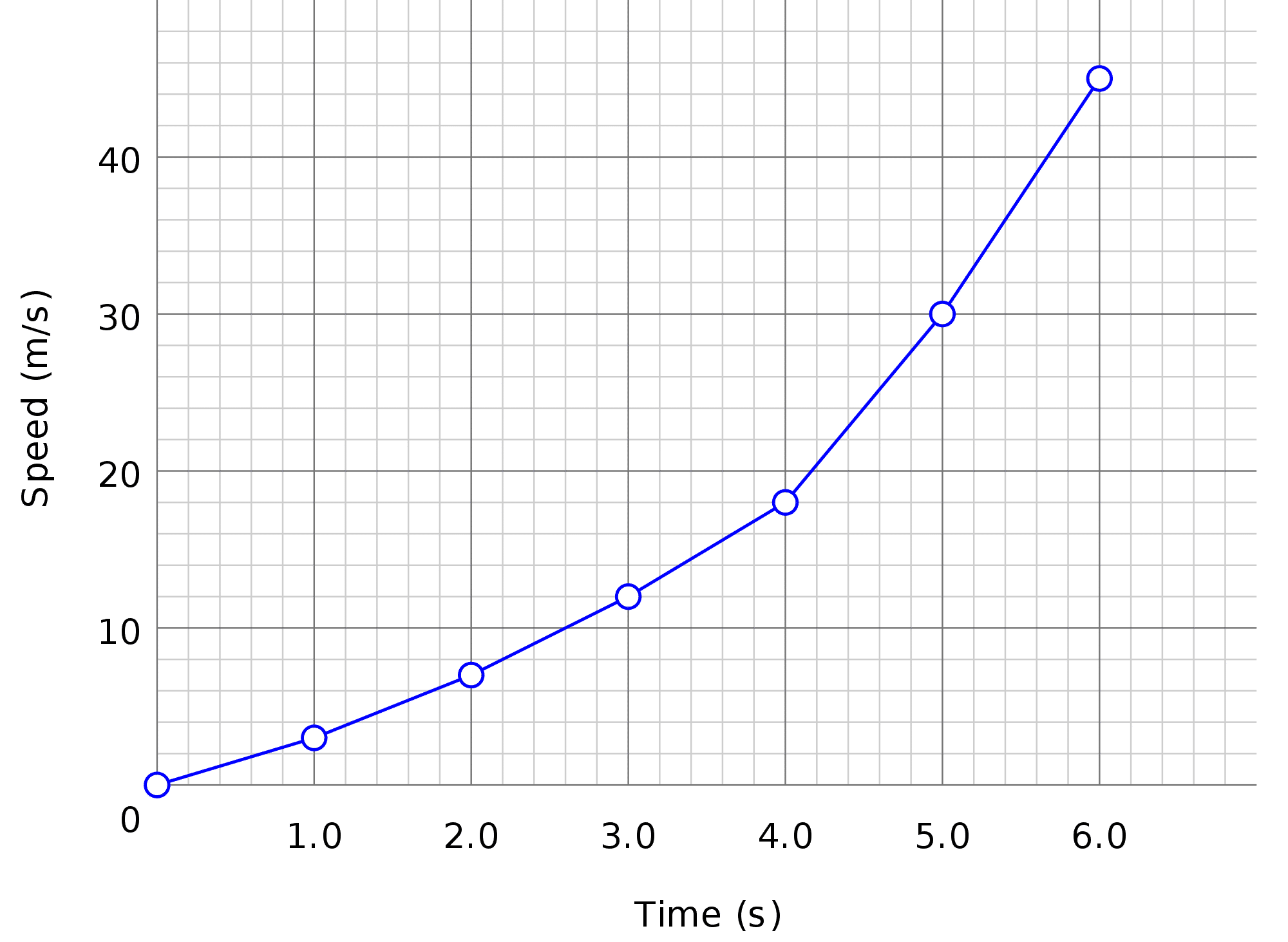
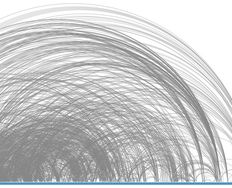
Author/Copyright holder: Urocyon. Copyright terms and licence: Public Domain.

Here the spatial substrate is two dimensional, the graphical elements are points and lines and the properties are the size of points, length of lines, the orientation of the lines and the blue color.

The Three Elements of Visual Mapping for Information Visualization

Defining the three elements we will use within a visual map provides a strong structure for the overall information visualization. It can also help us, as information visualization designers, to gain a better understanding of the data we are trying to portray and how it might be used to deliver value to our users.

The Spatial Substrate

The spatial substrate is the space in which we’re going to create our visualization. The vast majority of information visualization takes place in 2-dimension space – along x and y axes. However, it is possible to create 3-dimensional and even hyper-dimensional (more than 3-dimensions) representations too.

It’s important to consider which axes you will use and what kind of data will map to each individual axis. Data may be:

  • Quantitative. E.g. it has a numerical measurement of some quality of the data set.

  • Ordinal e.g. is not associated with a number but still offers some form of order – for example months in a calendar year.

  • Nominal e.g. the data is a collection of non-numerical and non-ordered data (the names of the members of parliament for example)

The Graphical Elements

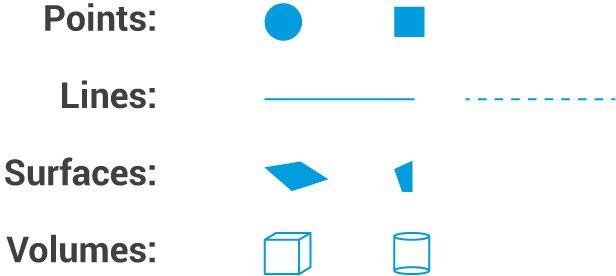
Graphical elements are the visual elements that will appear in the spatial substrate. There are four kinds of visual elements:

  • Points

  • Lines

  • Surfaces

  • Volumes

Graphical elements should be chosen for their clarity when conveying data. Unless, of course, the intention is to deliberately confuse the user to persuade them of something that the data does not represent. This is unethical but it would be naïve to pretend it doesn’t happen. Both corporations and politicians can be especially guilty of this behavior.

The Graphical Properties

Graphical properties are properties that can be applied to the graphical elements which make them more (or indeed less) noticeable to the eye and/or valuable to the user of the representation. There are many possible graphical properties that can be applied to graphical elements but the most commonly used are:

  • Size – the size of a point, surface or volume can convey information about significance or weight

  • Orientation – the orientation of a line or volume in space can help clarify the purpose of the line or volume

  • Color – color coding can be used to provide a visual key to data or to provide a “call to attention” to the eye
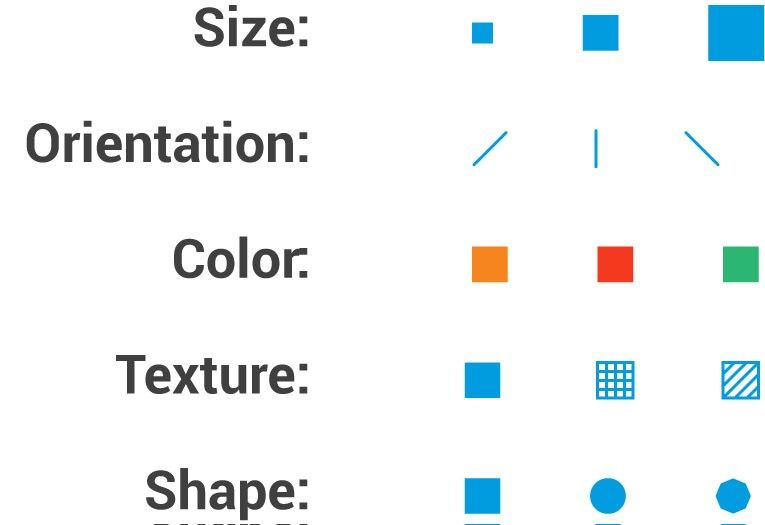
  • Textures – textures can be used to provide visual keys to data

  • Shapes – hexagons, circles, triangles, etc. can be used to provide a visual key to data

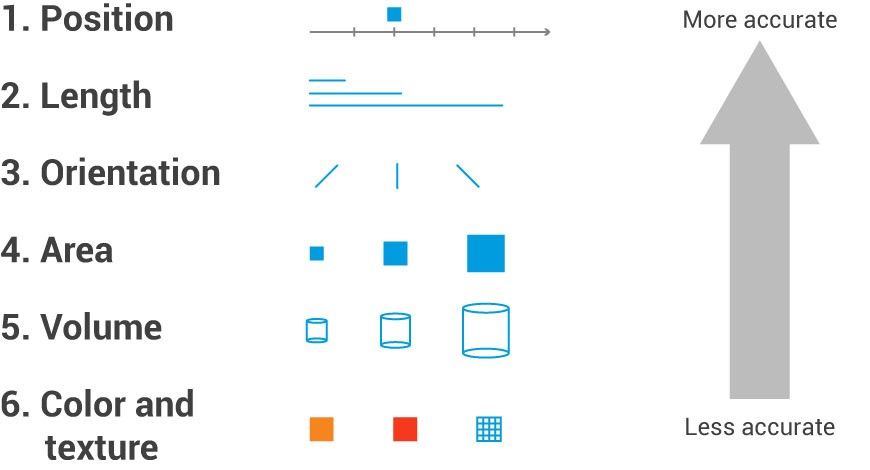
Cleveland and McGill, in their paper, “Graphical perception: Theory, experimentation, and application to the development of graphical methods.” showed that some graphical properties are more effective than others when it comes to conveying information.

They offered (in order of 1 being most accurate and 6 least accurate) the following list in terms of properties and their accuracy:

  • Position on the axis

  • Length of line

  • Orientation of line or object

  • Area of shape

  • Volume of shape

  • Color and textural indicators

Color in particular is a tricky thing to use in information visualization. Firstly, there are cultural and linguistic factors that often come into play with certain colors in certain societies having specific meanings or interpretations already built into their use. (For a cultural example, in China red is considered to be a “lucky” color whereas in many Western societies it is considered to be a “warning” color. For a linguistic example, in the highlands of New Guinea there are only two terms for color “light” and “dark” and in the Piraha language of the Amazon – there are no words for color at all, colors are identified by linguistic comparison to another object such as “this looks like blood” whereas English offers a rich and varied set of terms for many colors).

Then there is the problem of color blindness which affects up to 12% of men and 1 in 200 women. Red-green color blindness is the most common form of color blindness but there are others.

All of which suggests that color should only be used to convey information when all other options have been exhausted.

The Take Away

To conduct visual mapping in order to create an information visualization we must first define the spacial substrate, we can then consider the graphical elements we will use within that substrate and finally which properties we will use to assist these elements in conveying as much meaning as possible to the user.

References & Where to Learn More:

Course: Information Visualization

K. Stuart Card, Jock D. Mackinlay, and Ben Shneiderman. Readings in Information Visualization: Using Vision to Think. Morgan Kaufmann, San Francisco, 1999.

W. S. Cleveland and R. McGill. Graphical perception: Theory, experimentation, and application to the development of graphical methods. Journal of the American Statistical Association, Colours in Culture, Information is Beautiful, 79(387):531–554, 1984.

Hero Image: Author/Copyright holder: marco antonio torres. Copyright terms and licence: CC BY-NC-ND 2.0


Learn More in This Course:

AI for Designers

12 days
13 % booked
View Course

What You Should Read Next

  • Read full article
    Information Overload, Why it Matters and How to Combat It - Article hero image
    Interaction Design Foundation logo

    Information Overload, Why it Matters and How to Combat It

    Designers often need to convey information to the users of their designs. Specialists in information visualization design in particular find themselves presenting data over and over again to their users. However, it’s important when developing your designs that you don’t create “information overload

    Social shares
    1.2k
    Published
    Read Article
  • Read full article
    How to Design an Information Visualization - Article hero image
    Interaction Design Foundation logo

    How to Design an Information Visualization

    Designing information visualizations offers you endless possibilities when it comes to end products, and it would be impossible to provide step-by-step instructions for all these possibilities. However, it is fair to say that while the end products may vary dramatically – the process by which we rea

    Social shares
    984
    Published
    Read Article
  • Read full article
    Preattentive Visual Properties and How to Use Them in Information Visualization - Article hero image
    Interaction Design Foundation logo

    Preattentive Visual Properties and How to Use Them in Information Visualization

    A preattentive visual property is one which is processed in spatial memory without our conscious action. In essence it takes less than 500 milliseconds for the eye and the brain to process a preattentive property of any image. This is good news for information visualization designers and graphic des

    Social shares
    978
    Published
    Read Article
  • Read full article
    How to Visualize Your Qualitative User Research Results for Maximum Impact - Article hero image
    Interaction Design Foundation logo

    How to Visualize Your Qualitative User Research Results for Maximum Impact

    When thinking about visualization of research results, many people will automatically have an image of a graph in mind. Do you have that image, too? You would be right in thinking that many research results benefit from a graph-like visualization, showing trends and anomalies. But this is mainly tru

    Social shares
    966
    Published
    Read Article
  • Read full article
    How to Conduct Focus Groups - Article hero image
    Interaction Design Foundation logo

    How to Conduct Focus Groups

    Focus groups have long been a popular tool in market research and have become more popular in user research in the recent past too. They consist of a group of between 5 and 10 users who work with a moderator/facilitator/researcher. The moderator will pose questions from a script to the group. Their

    Social shares
    926
    Published
    Read Article
  • Read full article
    The Properties of Human Memory and Their Importance for Information Visualization - Article hero image
    Interaction Design Foundation logo

    The Properties of Human Memory and Their Importance for Information Visualization

    It is important to know that while neuroscience has progressed dramatically over the last decades; there is no complete understanding of how human memory works. We know, for example, that data in the brain is stored in clusters of neurons but we don’t know how, precisely, it is stored or even how it

    Social shares
    903
    Published
    Read Article
  • Read full article
    Guidelines for Good Visual Information Representations - Article hero image
    Interaction Design Foundation logo

    Guidelines for Good Visual Information Representations

    Information visualization is not as easy as it might first appear, particularly when you are examining complex data sets. How do you deliver a “good” representation of the information that you bring out of the data that you are working with?While this may be a subjective area of information visualiz

    Social shares
    900
    Published
    Read Article
  • Read full article
    Information Visualization – A Brief Introduction - Article hero image
    Interaction Design Foundation logo

    Information Visualization – A Brief Introduction

    Have you ever thought about how much data flows past each of us in an ordinary day? From the newspaper you read at breakfast, to the e-mails you receive throughout the day, to the bank statements generated whenever you withdraw money or spend it, to the conversations we have, and so on?There is a ti

    Social shares
    873
    Published
    Read Article
  • Read full article
    How to Show Hierarchical Data with Information Visualization - Article hero image
    Interaction Design Foundation logo

    How to Show Hierarchical Data with Information Visualization

    Hierarchical data is essentially a specialized form of network data – in that while entities within the dataset do not have dependent relationships; they are all related to each other by the principle of containment. They, unlike standard data networks, do not use the principle of connection.A hiera

    Social shares
    846
    Published
    Read Article
  • Read full article
    Information Visualization – An Introduction to Multivariate Analysis - Article hero image
    Interaction Design Foundation logo

    Information Visualization – An Introduction to Multivariate Analysis

    Albert Einstein said; “If you can’t explain it simply, you don’t understand it well enough.” He could easily have been talking about the challenges of creating information visualizations for multivariate analysis.Multivariate analysis takes place when you have a data set with 4 or more dependent var

    Social shares
    816
    Published
    Read Article

Top Articles

Top Topic Definitions

Feel Stuck?
Want Better Job Options?

AI is replacing jobs everywhere, yet design jobs are booming with a projected 45% job growth. With design skills, you can create products and services people love. More love means more impact and greater salary potential.

At IxDF, we help you from your first course to your next job, all in one place.

See How Design Skills Turn Into Job Options
Privacy Settings
By using this site, you accept our Cookie Policy and Terms of Use.
Customize
Accept all

Be the One Who Inspires

People remember who shares great ideas.

Share on:

Academic Credibility — On Autopilot

Don't waste time googling citation formats. Just copy, paste and look legit in seconds.

Feel Stuck? Want Freedom?

Join 326,020+ designers who get one powerful email each week. Learn to design a life you love.

Next email in
1
day
16
hrs
10
mins
29
secs

Free forever. No spam. Unsubscribe anytime.