As UX designers, we will be familiar with the need for user research; in gamification, the process is player-research, and we conduct this in a very similar manner. The more analysis you conduct before starting the design process—the better informed you will be to develop gamification that meets the needs of your players.
What’s Going On Around You?
Take a couple of seconds to look around at some of your colleagues; alternatively, consider one or two freelancers you may know. What are they working on right now? What issues are they facing at this moment? What are they enjoying about their current task? What aspects of their current efforts are their managers or clients happy with, and what do they think could be improved?
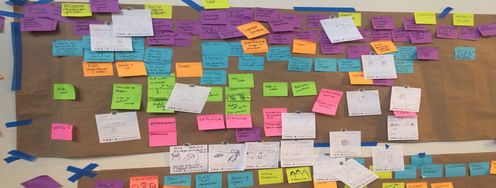
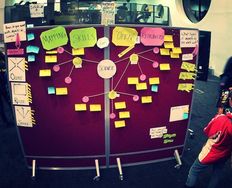
 Author/Copyright holder: Steve Jurvetson. Copyright terms and licence: CC BY 2.0
Observing something isn’t enough to understand in full what is *really* going on – you need to dig deeper.
You can’t answer those questions from a glance, can you? You probably know your colleagues quite well; even so, without psychic insights, it would be impossible to be able to know in that much detail what was going on in their lives in an instant. For one thing, if something’s not going quite right, would that person feel comfortable relating the problem to you?
Hopefully, the office culture isn’t that closed. All the same, imagine that I come up to your desk and proceed to answer all those questions for you. I tell you that Dave’s not performing because he’s not interested; I tell you Tanya is engaged but lacks skills, etc. Are you going to take my word for that? I think not. Why would you accept the words of a stranger concerning your colleagues’ performance and behaviour?
What does this have to do with Analysis for Gamification?
It can be tempting to gloss over analysis. It’s easy to run a quick and poorly thought-out observation exercise in order to understand a situation within the business. It’s easy to accept the words of a single manager about an issue and then act on it. Whatever the rationale for going ahead with that—be it due to a misguided grasp of Occam’s Razor (i.e., the simplest reason is likely the cause) or because a manager tells you he’s “been in this game for 20 years” and so knows everything inside it—we need to slam on the brakes here.
The trouble is, as we’ve just seen, you can’t have very much confidence in this kind of activity. If your gamification mission (i.e., your understanding of the player state now, and the intended state of the player following the gamification intervention) is built on a low level understanding of what is going on, it’s much more likely that the gamification exercise will fail to latch with your players. In fact, they will likely perceive it as a failure when they have it before them. Note that we didn’t say “your understanding” there; you could have the firmest grip of what you believe is going on from the so-called specialists you’re liasing with. Indeed, you’ll want to get as much first-hand knowledge of the matters at hand as you can. However, if they’re dead wrong on any single aspect and you take their advice, your project may well enter the danger zone.
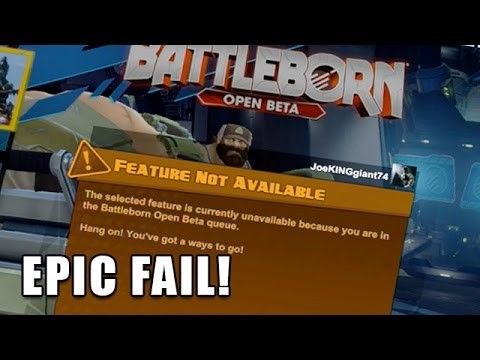
Author/Copyright holder: MrJoekinggiant74. Copyright terms and licence: Fair Use.
Avoiding failure in gamification projects means understanding your players and their needs.
What Tools can We use for Analysis?
Janaki Mythily Kumar and Mario Herger, the authors of Gamification at Work: Designing Engaging Business Software, have suggested some strategies in order to understand the background for gamification missions.
Much depends on whether your customers (players) are internal to your organization or external to it. In the case of external customers, you may need to rely on data collected by other departments. However, all of the following tools may be useful either for your direct use or for use by the departments that interact with customers:
- Observation activities – look at what people are really doing. Does it match the reported situation? If not, why not? What other barriers stand in the way of achieving the required objectives?
- Interviews – with players, the end client (the business unit manager) and others who interact with the players. Is the stated problem in fact the real problem? Is there a more pressing issue that needs resolution that might be addressed as part of the gamification exercise?
- Process familiarization – how is the activity currently conducted? What can be improved in the existing processes as part of the exercise?
- Questionnaires – unlike conducting interviews, you have the ability to reach a larger audience with a well-designed questionnaire in a more cost-effective manner.
 Author/Copyright holder: Pixabay. Copyright terms and licence: CC0
Interviews can be an incredibly effective way of discovering what your players need.
If you can think of other toolsets that may help with the analysis of a problem, feel free to use them. There is no single method for conducting an effective analytical exercise. Whichever way you use to achieve this, though, what does have to remain consistent is your mindfulness of the point that you’re dealing with your players as people.
“Empathy is important to understand users [/players] holistically.”
—Shlomo Goltz, User researcher at Hearsay Social
It is also important to remember that you need to do the analysis in order to develop an accurate understanding of your mission before you commence your gamification project. At this stage, getting everything defined and sorted out—or everything that you can sort out—will spare you many a headache later on. There’s nothing worse than spending valuable time chasing the shadow of an issue while the real thing stays hidden.
The Take Away
Research is the lifeblood of knowledge, but analysis will show the fine details—as long as you do it correctly. It is important to conduct player analysis before commencing any gamification exercise; as with UX design, there are a vast number of tools you can use to conduct your research with. Some of the most popular tools are observations, interviews, process familiarization and questionnaires; however, you can adapt any research tool that you think will yield the insights you need in order to develop a quality product and roll it out as an official gamification piece.
References & Where to Learn More
Janaki Mythily Kumar and Mario Herger, Gamification at Work: Designing Engaging Business Software, The Interaction Design Foundation, 2014
Hero Image: Author/Copyright holder: Eric A. Clement. Copyright terms and licence: Public Domain.