The multiple classifications technique is a convergent ideation method where designers explore the design space to find opportunities for new products. Using matrices, they compare aspects of items to widen their inspiration, spot market gaps, find and analyze trends and rules, and see if related qualities hint at inventive designs.
“Everything is possible. The impossible just takes longer.”
— Dan Brown, Famous thriller novelist
See how the multiple classifications approach helps expose innovative ideas in this video with Alan Dix: Author of the bestselling book “Human-Computer Interaction” and Director of the Computational Foundry at Swansea University.
Explore More Possibilities with Multiple Classifications
A single-classification system (or taxonomy) is ideal for organizing items in libraries, computer folders, etc. Also, it’s easier to list similarities between (e.g.) two types of fish than between fish and birds. The downside to categorizing items this way, though, is the need to put things with similar features in one place. That can obscure other similarities and block insights.
Multiple classifications can help you find and understand how items are similar while you analyze their differences. Consider two circles and two squares – one red, one yellow of each. How would you group them: by shape or color? Using a taxonomy, you’d describe one common attribute at a time. However, with multiple classifications, you can describe both simultaneously. And, in ideation, you can explore and map your design space far more extensively and tap powerful market opportunities.
Enter a Matrix!
You can use several different, but related, methods:
© Yu Siang and Interaction Design Foundation, CC BY-SA 3.0
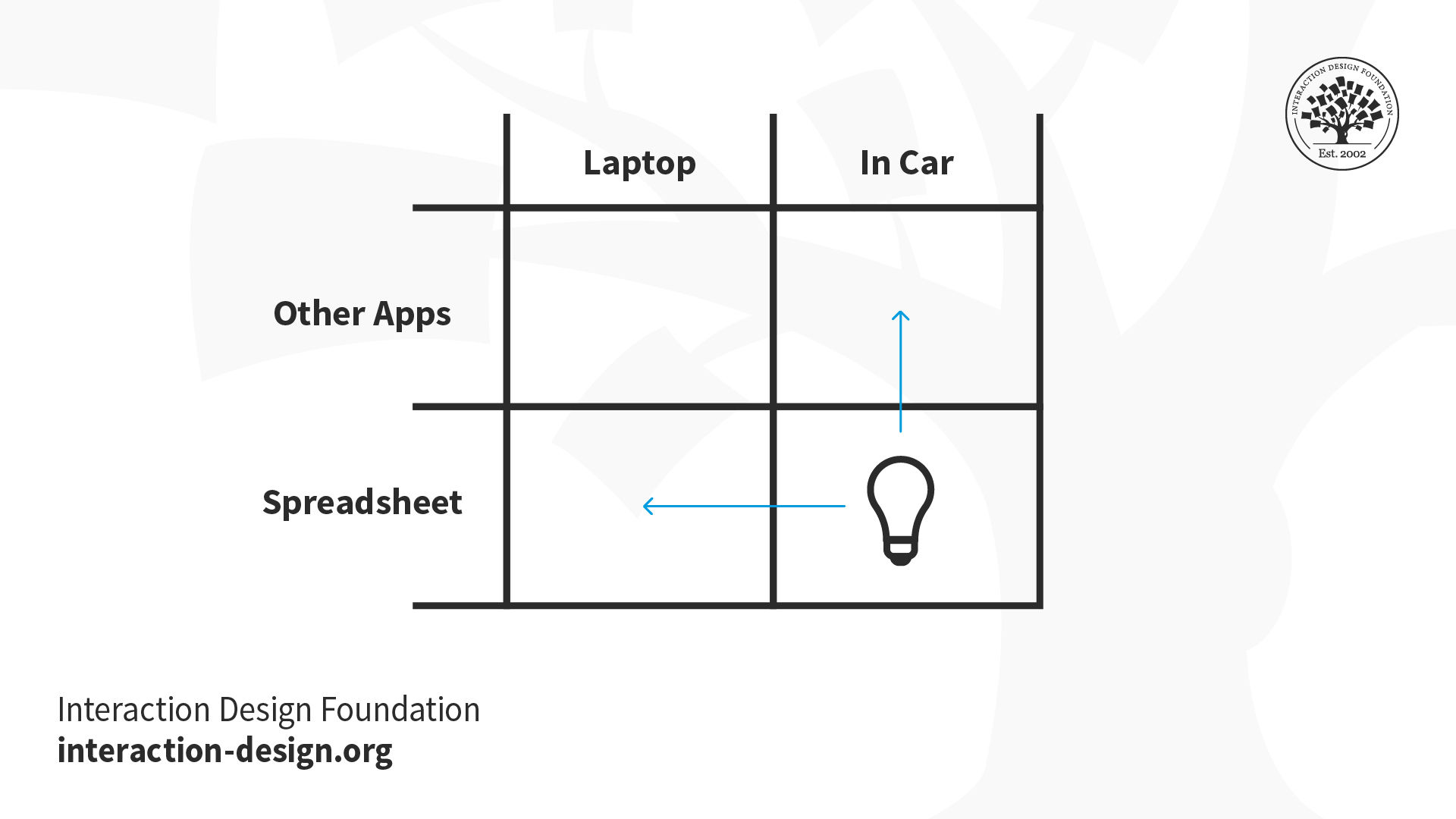
1. Spread your search for inspiration – To develop a new design concept: e.g., productivity apps for autonomous (self-driving) car users:
a. Draw a 2-by-2 matrix – on one axis, write the context you want to design for (here, “car”) and another context that’s different but still relevant.
b. On the other axis, write the type of product you want to design (e.g., “productivity apps/spreadsheets”) and then one that contains all other kinds of products.
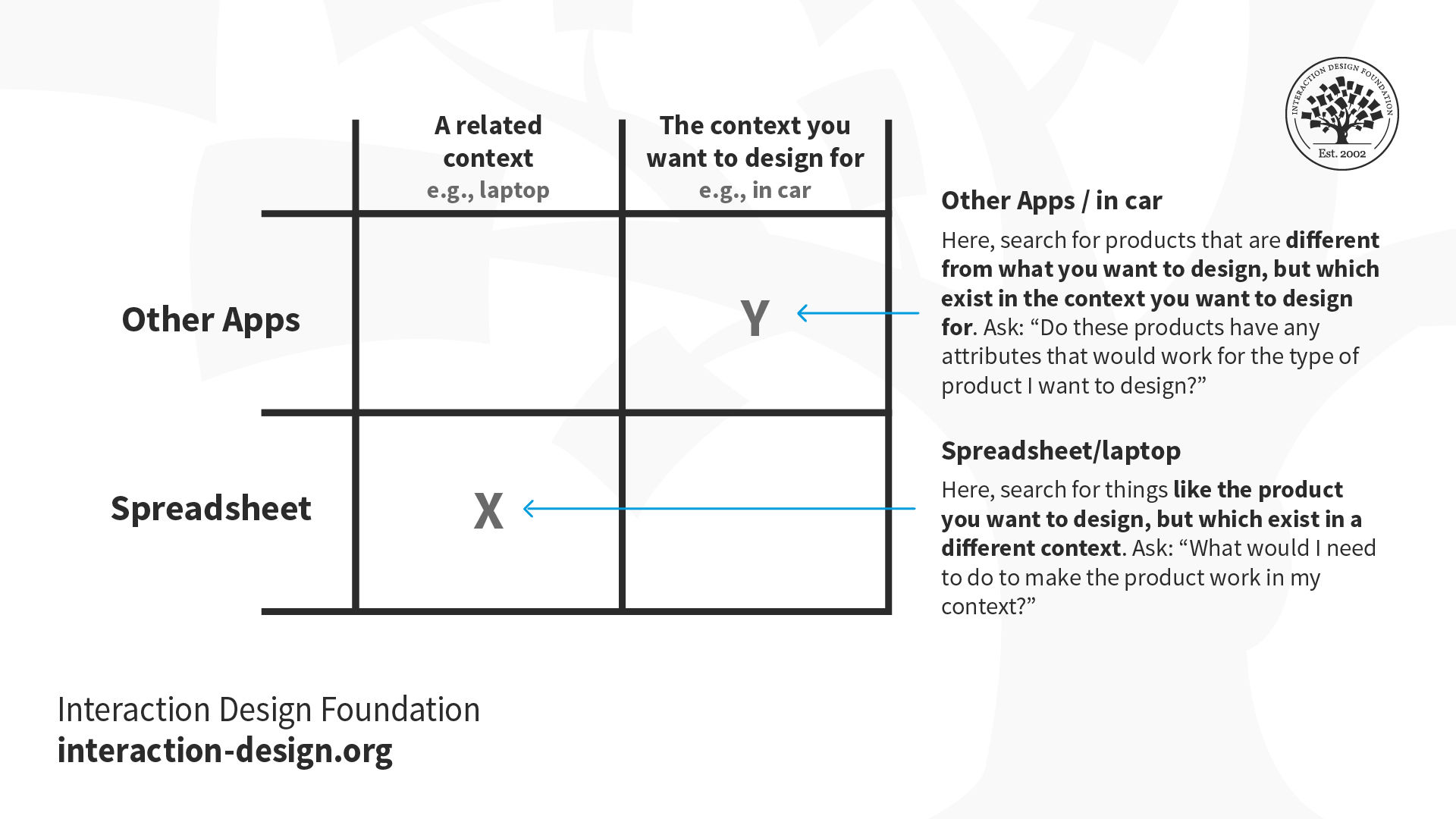
This matrix gives you 4 categories. You’ll want to analyze 2 (“X” and “Y”):
 © Yu Siang and Interaction Design Foundation, CC BY-SA 3.0
2. Identify Gaps – In our example, you could notice that many apps didn’t include spreadsheets. So, you could see if an app that uses spreadsheets might help autonomous car users.
a. Using your matrix, find all the systems (e.g., books) discussing the area you want to research (so, spreadsheet/laptop and other apps/in car).
b. Complete your matrix with the information you’ve found. E.g., you should have items to insert in 3 spaces in the matrix’s category pairs, but now you’ll likely notice a gap (e.g., in the bottom-right corner). This could be a market opportunity.
3. Analyze and Discover Trends and Rules – If you’ve found a pattern in your design space, it’ll be far easier to design relevant products if you find and understand the rules and trends in that space.
 © Yu Siang and Interaction Design Foundation, CC BY-SA 3.0
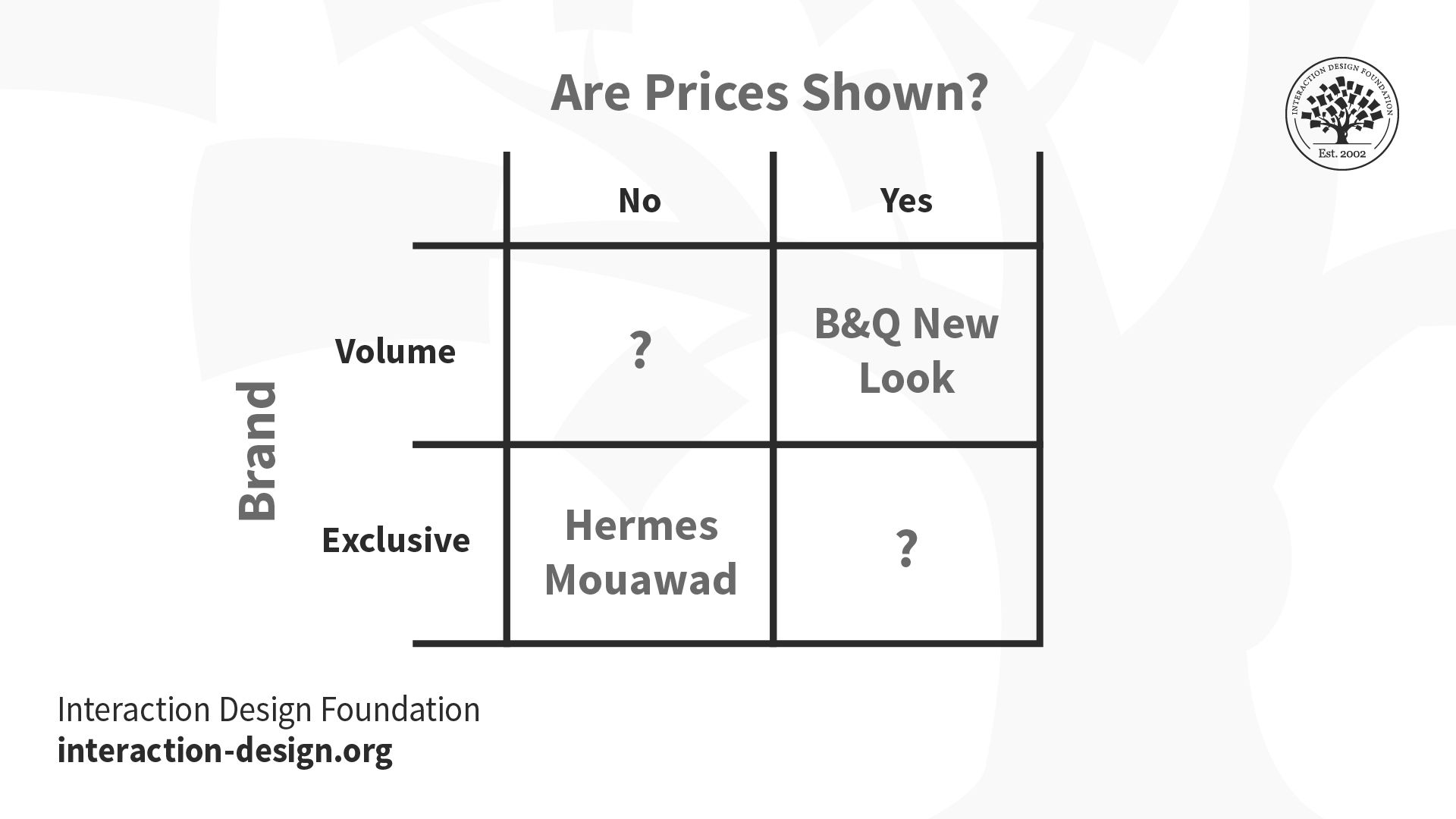
a. Draw a matrix with the categories you expect to find and start to research.
b. E.g., you notice a trend that exclusive brands’ websites don’t advertise prices, but volume brands’ do. So, draw a matrix of whether different website types advertise prices. Research websites and put your findings in the matrix to see if you’re right.
In our example, the pattern is predictable. However, if you find that the pattern looks different from what you expect, ask yourself why. Can you deduce any general rules? What does that mean for your design? You may have discovered a space where no other products exist.
4. Uncover Abstractions – To see if a general rule you’ve spotted might apply for all items (e.g., devices) of that type and, if so, why.
On a 2-by-2 matrix (or larger) mark the categories you’ll compare and explore.
E.g. (below), imagine you’ve spotted a general rule about fitness apps for running and cycling, since specialist devices (e.g., Fitbits) in one column share a property (they show the heart rate) and non-specialist devices such as smartphones share another (they don’t show it). Ask yourself if this generalization holds true for all phones versus specialist devices.
Search for the reason (e.g., because phones lack heart-rate sensors). So, now, having noticed a relationship between types of designs (e.g., devices suitable for a fitness app), you can explore the potential for what one design can do.
This abstracted knowledge is your understanding of why the relationship exists. Then, you can reapply it to see if you can design things on your matrix’s left-hand side (so, generalist devices such as smartphones) that have similar features/capabilities to those on the right-hand side. For example, maybe a phone could track someone’s heart rate in another way (e.g., through its microphone or other sensors).
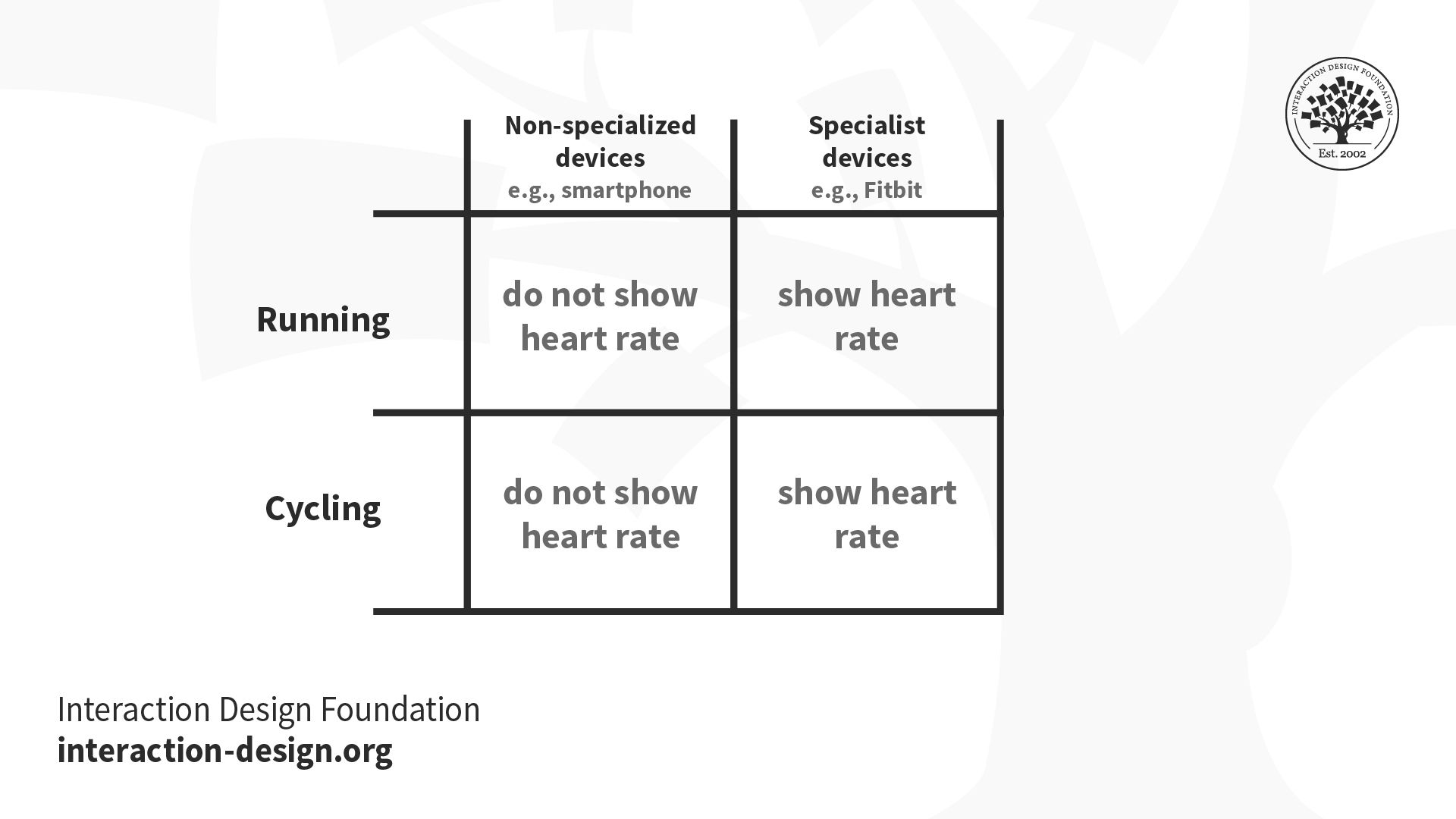
© Yu Siang and Interaction Design Foundation, CC BY-SA 3.0
Overall, good judgment is essential. Sometimes, there’ll be a valid reason a product doesn’t exist (e.g., it would be hazardous). Sometimes, though, you might find you’ve stumbled on a lucrative market gap.