The Multiple Classifications Technique

Your constantly-updated definition of The Multiple Classifications Technique and collection of videos and articles.
Be a conversation starter: Share this page and inspire others!

98 Shares

What is The Multiple Classifications Technique?

The multiple classifications technique is a convergent ideation method where designers explore the design space to find opportunities for new products. Using matrices, they compare aspects of items to widen their inspiration, spot market gaps, find and analyze trends and rules, and see if related qualities hint at inventive designs.

“Everything is possible. The impossible just takes longer.”

— Dan Brown, Famous thriller novelist

See how the multiple classifications approach helps expose innovative ideas in this video with Alan Dix: Author of the bestselling book “Human-Computer Interaction” and Director of the Computational Foundry at Swansea University. 

Transcript

Explore More Possibilities with Multiple Classifications

A single-classification system (or taxonomy) is ideal for organizing items in libraries, computer folders, etc. Also, it’s easier to list similarities between (e.g.) two types of fish than between fish and birds. The downside to categorizing items this way, though, is the need to put things with similar features in one place. That can obscure other similarities and block insights.

Multiple classifications can help you find and understand how items are similar while you analyze their differences. Consider two circles and two squares – one red, one yellow of each. How would you group them: by shape or color? Using a taxonomy, you’d describe one common attribute at a time. However, with multiple classifications, you can describe both simultaneously. And, in ideation, you can explore and map your design space far more extensively and tap powerful market opportunities

Enter a Matrix!

You can use several different, but related, methods:
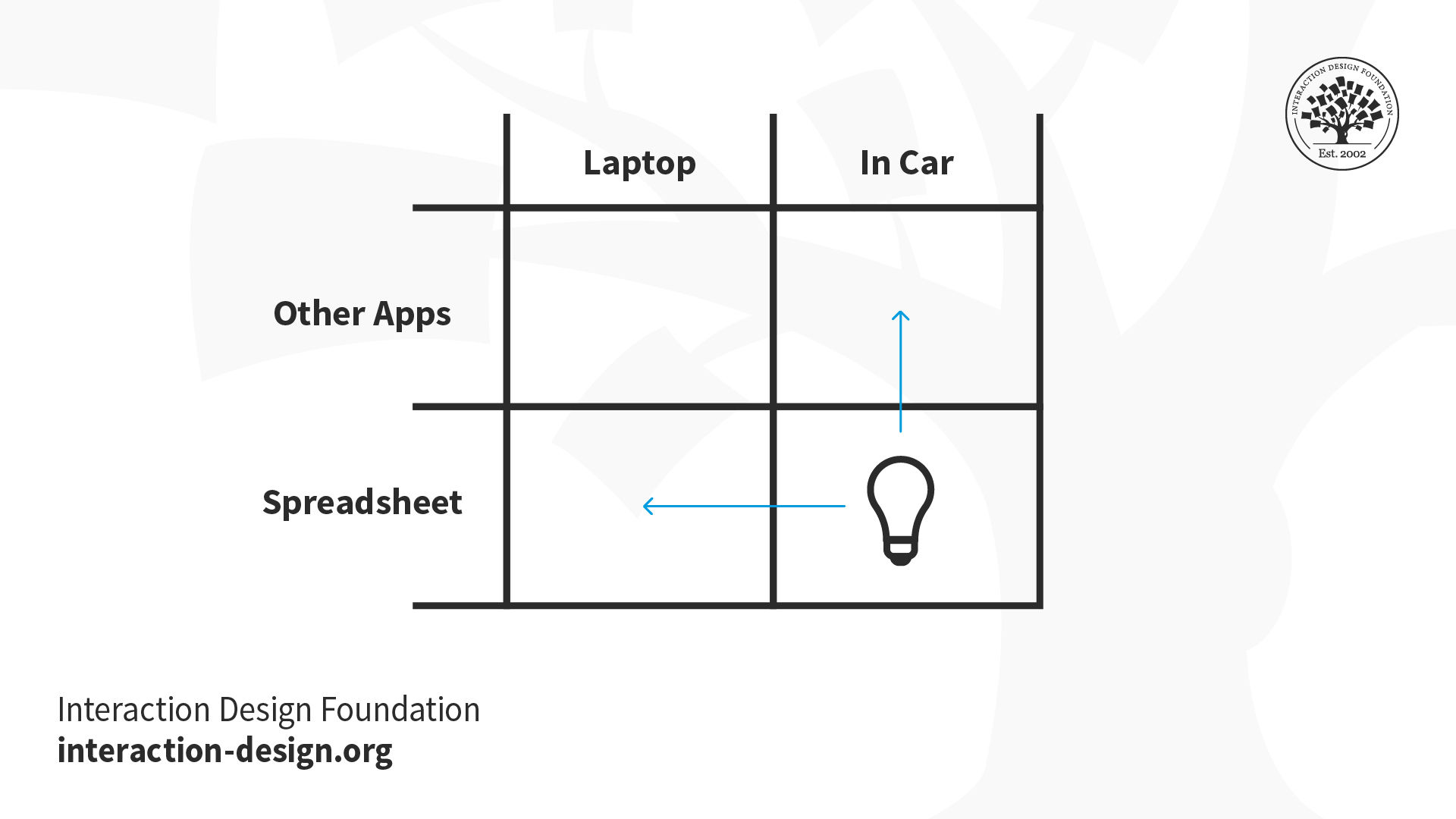
A two-by-two matrix. The first column is laptop and the second is in car. The first row is other apps and the second row is spreadsheet.

© Yu Siang and Interaction Design Foundation, CC BY-SA 3.0

1. Spread your search for inspiration – To develop a new design concept: e.g., productivity apps for autonomous (self-driving) car users: 

a. Draw a 2-by-2 matrix – on one axis, write the context you want to design for (here, “car”) and another context that’s different but still relevant.

b. On the other axis, write the type of product you want to design (e.g., “productivity apps/spreadsheets”) and then one that contains all other kinds of products.

This matrix gives you 4 categories. You’ll want to analyze 2 (“X” and “Y”):
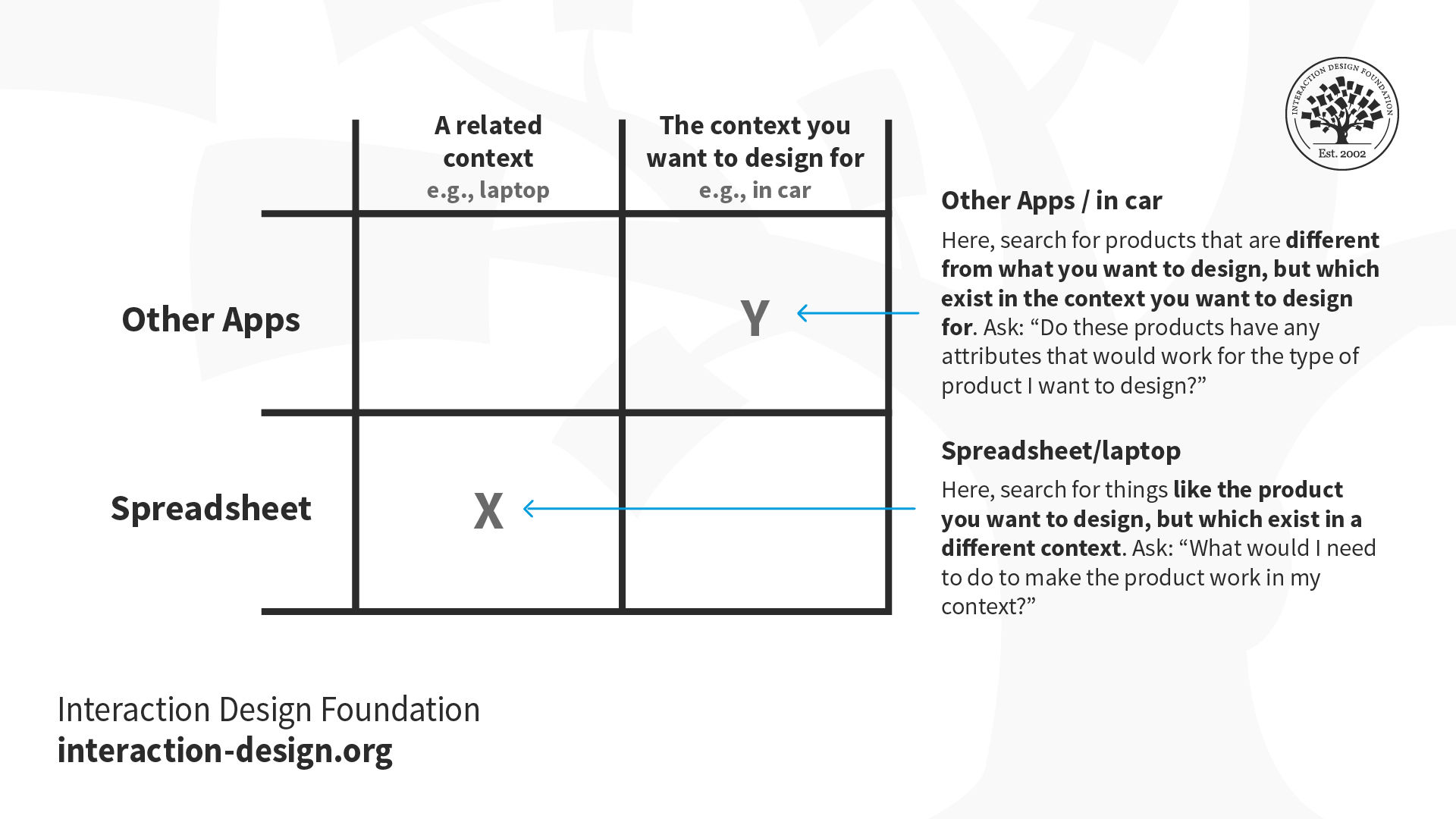
A two-by-two matrix like the previous one, but with a X in the top right and a Y in the bottom left squares.© Yu Siang and Interaction Design Foundation, CC BY-SA 3.0

2. Identify Gaps – In our example, you could notice that many apps didn’t include spreadsheets. So, you could see if an app that uses spreadsheets might help autonomous car users.

a. Using your matrix, find all the systems (e.g., books) discussing the area you want to research (so, spreadsheet/laptop and other apps/in car). 

b. Complete your matrix with the information you’ve found. E.g., you should have items to insert in 3 spaces in the matrix’s category pairs, but now you’ll likely notice a gap (e.g., in the bottom-right corner). This could be a market opportunity.

3. Analyze and Discover Trends and Rules – If you’ve found a pattern in your design space, it’ll be far easier to design relevant products if you find and understand the rules and trends in that space. 
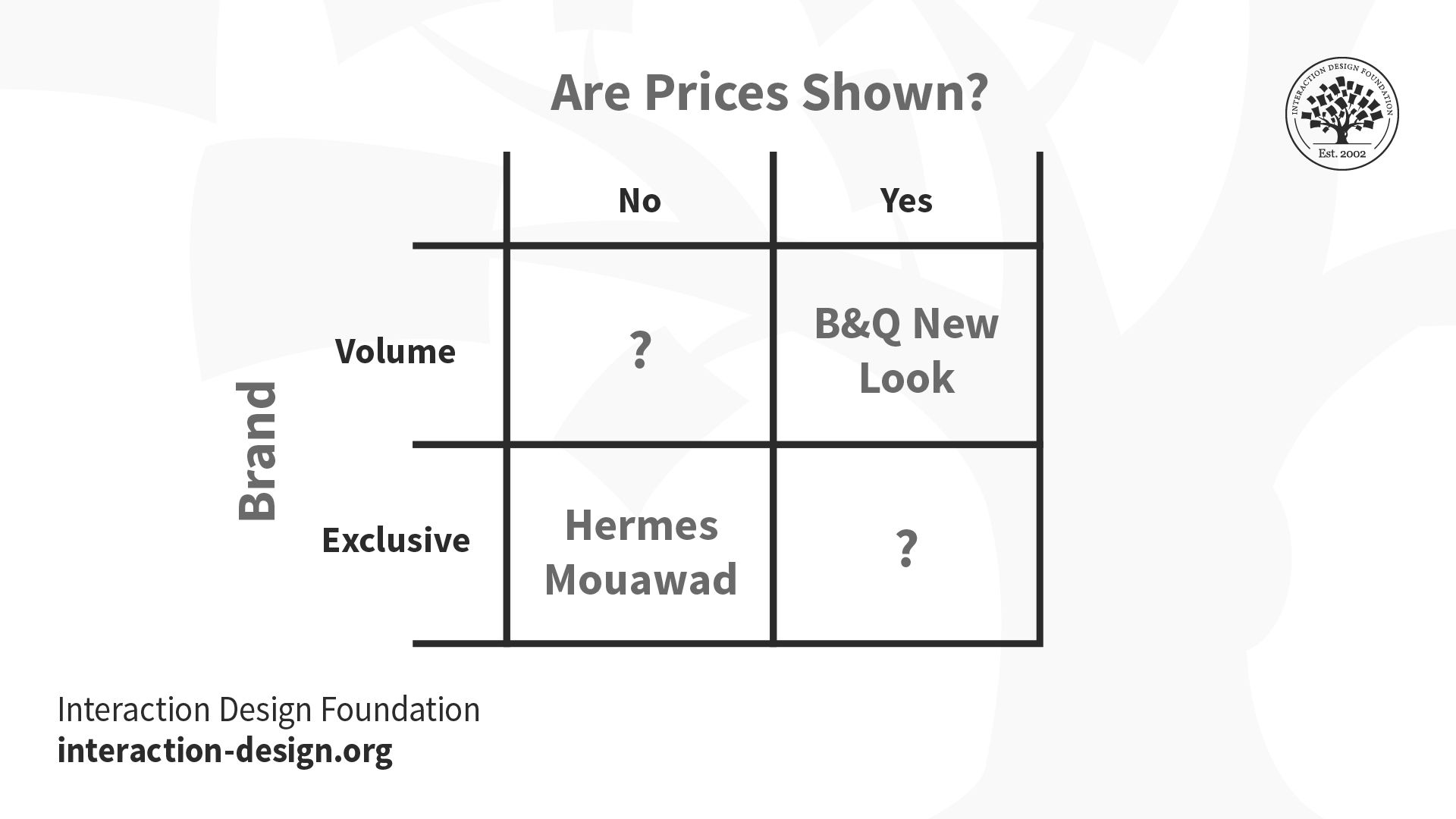
A two-by-two matrix comparing the brand on the x axis and prices shown on the y axis. © Yu Siang and Interaction Design Foundation, CC BY-SA 3.0

a. Draw a matrix with the categories you expect to find and start to research. 

b. E.g., you notice a trend that exclusive brands’ websites don’t advertise prices, but volume brands’ do. So, draw a matrix of whether different website types advertise prices. Research websites and put your findings in the matrix to see if you’re right. 

In our example, the pattern is predictable. However, if you find that the pattern looks different from what you expect, ask yourself why. Can you deduce any general rules? What does that mean for your design? You may have discovered a space where no other products exist.

4. Uncover Abstractions – To see if a general rule you’ve spotted might apply for all items (e.g., devices) of that type and, if so, why. 

  • On a 2-by-2 matrix (or larger) mark the categories you’ll compare and explore.

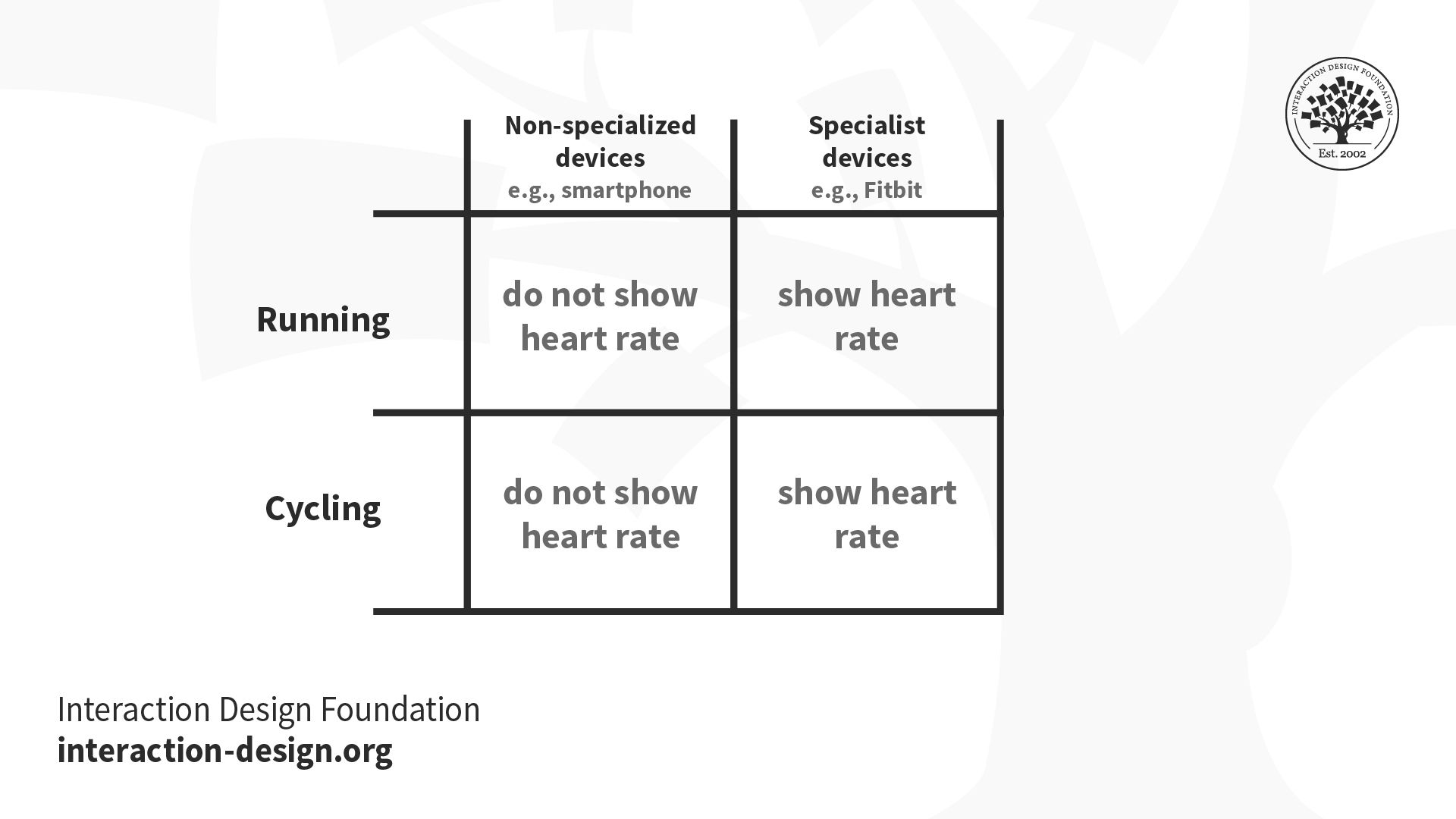
  • E.g. (below), imagine you’ve spotted a general rule about fitness apps for running and cycling, since specialist devices (e.g., Fitbits) in one column share a property (they show the heart rate) and non-specialist devices such as smartphones share another (they don’t show it). Ask yourself if this generalization holds true for all phones versus specialist devices.

  • Search for the reason (e.g., because phones lack heart-rate sensors). So, now, having noticed a relationship between types of designs (e.g., devices suitable for a fitness app), you can explore the potential for what one design can do.

  • This abstracted knowledge is your understanding of why the relationship exists. Then, you can reapply it to see if you can design things on your matrix’s left-hand side (so, generalist devices such as smartphones) that have similar features/capabilities to those on the right-hand side. For example, maybe a phone could track someone’s heart rate in another way (e.g., through its microphone or other sensors).
© Yu Siang and Interaction Design Foundation, CC BY-SA 3.0

Overall, good judgment is essential. Sometimes, there’ll be a valid reason a product doesn’t exist (e.g., it would be hazardous). Sometimes, though, you might find you’ve stumbled on a lucrative market gap.

Questions About Multiple Classifications Technique?
We've Got Answers!

What does “multiple classifications” mean as an ideation technique in UX design?

In UX design, “multiple classifications” is an ideation technique that helps teams explore the design space creatively by organizing ideas across different dimensions. Instead of categorizing concepts singly, designers create matrices that classify ideas using two or more criteria, such as user type vs. task complexity, or emotional tone vs. interaction speed. This approach reveals patterns, gaps, and unexpected connections, sparking innovative solutions.

For example, plotting features by “novelty” and “feasibility” can highlight innovative and practical ideas. This method encourages divergent thinking, helping teams break free from habitual patterns and uncover fresh perspectives. When designers examine ideas through multiple lenses, they can identify opportunities they might miss with a single classification system.

This flexible structure respects diverse ways of thinking and can help meet users where they are.

Discover how divergent thinking helps designers and design teams stretch to find a wealth of helpful ideas.

How does this differ from traditional categorization in UX?

Multiple classifications—as an ideation technique in UX design—differs from traditional categorization by fueling creative thinking instead of organizing content. Traditional categorization sorts information into fixed, often hierarchical “buckets” based on a single lens—like features by type or pages by section. It’s about clarity, not creativity.

In contrast, multiple classifications uses intersecting dimensions—such as urgency vs. emotional tone—to spark new ideas and uncover overlooked connections. It helps teams plot concepts across a matrix to reveal gaps, patterns, or hybrid opportunities that wouldn’t emerge from linear thinking.

Where traditional categorization refines structure, multiple classifications expand possibility. They throw open the doors in the design space instead of narrowing it down, which makes them powerful tools during early ideation.

Learn why linear thinking has a time and a place in the design process, too, and how to use it.

How do I apply multiple classifications to a UX problem?

To apply multiple classifications to a UX problem, begin by defining two distinct dimensions that are relevant to your challenge, such as “user familiarity” and “task urgency” or “emotional tone” and “interaction complexity.” Then, build a matrix using these axes and brainstorm ideas that fit into each quadrant or intersection.

This ideation technique pushes your team to think across different perspectives and avoid settling on one obvious path. For example, when designing a mental health app, classifying features by “support intensity” versus “user mood” can surface unique solutions tailored to varied emotional states.

The key is to select axes that reflect your users’ needs and design goals. This structured yet creative approach helps to expose gaps, challenge assumptions, and inspire richer design directions.

Grab a firmer hold of brainstorming to understand how it can help your team pool massive numbers of ideas, many of them useful for the way ahead with what you might build.

How many classifications should I explore during ideation?

Explore at least two classifications at a time during ideation, but don’t stop there. The power of the multiple classifications ideation technique lies in shifting perspectives, so experiment with different pairings to uncover new insights. Start with one matrix using two dimensions—like “user skill level” and “task frequency”—and then rotate to others, such as “emotional impact” and “ease of implementation.”

While there’s no fixed limit, aim for two to four thoughtful classification sets to balance creativity with focus. Each new matrix can reveal hidden gaps, unexpected ideas, or opportunities you’d miss using a single lens, a helpful way to help you and your team stretch your thinking and break out of predictable design patterns.

Fly at a higher creative “altitude” and enjoy our Master Class: Harness Your Creativity to Design Better Products with Alan Dix, Professor, Author and Creativity Expert.

Should I use the multiple classification technique alone or with a team?

Use the multiple classifications ideation technique with a team whenever possible. Collaboration sparks broader thinking and surfaces perspectives you might miss alone. Each team member brings different mental models, which can help you populate your classification matrix with more diverse and unexpected ideas.

Working as a group also encourages discussion, challenges assumptions, and reveals blind spots—especially when exploring intersections between dimensions like “user motivation” and “task urgency.” It’s ideal for workshops or early-stage design sprints when creative range matters most.

That said, you can use this technique solo to clarify your own thinking. But team sessions tend to produce richer results and more momentum.

Achieve the upper hand on a potential “design derailer” that can creep up and get the better of even the most creative designers: assumptions.

Why do UX designers get stuck in one classification?

UX designers often get stuck in one classification because of habit, time pressure, or past success with a specific mental model. When a single framework, such as “user goals” or “device type,” has worked before, teams default to it. This can create tunnel vision and limit creativity.

Designers also tend to focus on what’s easiest to categorize, which can leave out complex or nuanced user needs. Working solo or skipping structured ideation can deepen this fixation. Over time, one lens might well become the only lens.

The multiple classifications ideation technique helps break that cycle. It forces teams to rethink assumptions and explore the problem space through new, often surprising, angles that can prompt insights that mightn’t come otherwise.

Get a greater grounding of why user needs must be the focal point in any design work.

Is this similar to lateral thinking in UX ideation?

Yes, the multiple classifications ideation technique has much in common with lateral thinking in UX ideation. Both aim to break habitual patterns and generate fresh, unexpected ideas. Instead of moving in a straight line from problem to solution, multiple classifications encourage designers to explore sideways through intersecting dimensions like “user emotions” and “task difficulty.”

Since this technique forces the mind to see relationships it would normally overlook, multiple classifications spark new angles and prevent early fixation. Like lateral thinking, it values quantity and variety in ideation, helping teams escape narrow mental models.

In short, multiple classifications is a structured way to apply lateral thinking—and push UX design beyond the obvious.

Get an extra edge on creativity in UX design with lateral thinking.

What’s a common mistake with multiple classification ideation?

A common mistake with multiple classification ideation is choosing vague or mismatched dimensions. If your axes don’t meaningfully relate to the UX problem—or to each other—you’ll generate weak or scattered ideas. For example, pairing “color scheme” with “user age” might not reveal valuable insights unless those dimensions are indeed central to the design challenge.

Another misstep is rushing to fill the matrix with surface-level ideas without exploring deeper connections. This limits the technique’s creative power.

To avoid these traps, pick dimensions that reflect real user behaviors, emotions, or constraints, and be specific. Thoughtful classifications spark better discussion, highlight edge cases, and unlock innovation.

Find a firmer foundation to ideate when you understand more about user behavior.

What if the team disagrees on which classification makes sense?

If the team disagrees on which classification makes sense, treat it as a creative advantage, not a blocker. Multiple classification ideation thrives on diverse perspectives. Instead of choosing one “right” pair of dimensions, explore several. Run parallel sessions with different axes—like “user motivation” vs. “feature complexity” in one matrix, and “task frequency” vs. “emotional state” in another.

Disagreements can be healthy as they often surface assumptions or reveal overlooked user needs. Let team members explain their reasoning, then test which classifications generate stronger or more insightful ideas. You might even discover that combining inputs leads you to a better framework. Disagreement is fuel in such cases, so use it to widen your view and uncover richer design opportunities.

Discover why disagreement isn’t an enemy when you find some real obstacles in our article 14 Barriers to Ideation and How to Overcome Them.

How can I turn these ideation outputs into design directions?

To turn multiple classification ideation outputs into design directions, look for patterns, clusters, and gaps in the matrix. Identify ideas that consistently appear across different dimensions—these often signal strong, versatile concepts. Moreover, it highlights unexpected intersections that reveal unmet needs or new user behaviors.

Next, group promising ideas by theme or design goal—like accessibility, emotional engagement, or ease of use. Prioritize based on impact, feasibility, and alignment with user needs. Then begin sketching, prototyping, or mapping user flows around these concepts.

Don’t treat the matrix as a final answer; use it as a launchpad instead. Translate its insights into clear design hypotheses you can test and evolve through iteration.

Attain a clear view of why accessibility needs to be a prime design consideration for users with disabilities and what accessible designs can help all users achieve.

Earn a Gift Earn a Gift, Answer a Short Quiz!

1
2
3
4
1
2
3
4
Question 1
Question 2
Question 3
Get Your Gift
Interaction Design Foundation logo

Question 1

What is the main benefit of multiple classifications in design?

1 point towards your gift

  • To explore and analyze design opportunities more comprehensively
  • To limit the design space
  • To simplify the categorization of items
Interaction Design Foundation logo

Question 2

How do multiple classifications improve content organization?

1 point towards your gift

  • They lower the number of categories.
  • They make content retrieval slower.
  • They provide various pathways to locate information.
Interaction Design Foundation logo

Question 3

Why is flexibility important for multiple classifications in information architecture?

1 point towards your gift

  • It allows users to find information through different pathways.
  • It helps keep the classification system static.
  • It reduces the number of categories.

Learn More About The Multiple Classifications Technique

Make learning as easy as watching Netflix: Learn more about Multiple Classifications Technique by taking the online IxDF Course Creativity: Methods to Design Better Products and Services.

Why? Because design skills make you valuable. In any job. Any industry.

In This Course, You'll

  • Get excited as you learn to innovate and get creative, even when you feel blocked! Did you know that creative thinking is the second most important skill hiring managers look for, across all jobs and industries? This course will give you the skills to design innovative solutions and products that stand out. It's easier than you think! No matter your background, you can effortlessly learn to tap into creativity. You'll apply proven methods to break out of habitual thinking, spark new ideas anytime, and capture them before they disappear!

  • Make yourself invaluable with divergent and convergent ideation techniques that have real business impact. In a world where AI can generate endless ideas, you stay in demand when you know which ideas to explore, which to combine, and which to move forward. Timeless human-centered design skills help you focus creativity on real needs, and that’s how you can turn AI from a tool into your new creative superpower. Companies that prioritize creativity achieve 67% more organic revenue growth. Creativity is just as valuable in finance, engineering, and healthcare as it is in creative professions. Every industry thrives on innovative ideas. In this course, you'll use ideation methods like multiple classifications and three-way comparisons to see opportunities others miss and bring bold ideas to life.  

  • Gain confidence and credibility with 15+ downloadable templates to fast-track your creativity! You'll learn how to use busywork to enable your creativity in daily planning and foster a creative team environment. You'll apply step-by-step strategies to beat procrastination, bias, and fixation, and ensure your creative process remains productive—even under pressure. You'll get hands-on experience and walk away with a polished case study for your portfolio if you choose to complete the optional ideation project. If you want to solve big problems, improve lives, and build a better world with innovative solutions people love, then this course is the perfect place to start.

It's Easy to Fast-Track Your Career with the World's Best Experts

Master complex skills effortlessly with proven best practices and toolkits directly from the world's top design experts. Meet your experts for this course:

  • Alan Dix: Author of the bestselling book “Human-Computer Interaction” and Director of the Computational Foundry at Swansea University.

  • Don Norman: Father of User Experience (UX) Design, author of the legendary book “The Design of Everyday Things,” and co-founder of the Nielsen Norman Group.

Get an Industry-Recognized IxDF Course Certificate

Increase your credibility, salary potential and job opportunities by showing credible evidence of your skills.

IxDF Course Certificates set the industry gold standard. Add them to your LinkedIn profile, resumé, and job applications.

Course Certificate Example

Be in distinguished company, alongside industry leaders who train their teams with the IxDF and trust IxDF Course Certificates.

Our clients: IBM, HP, Adobe, GE, Accenture, Allianz, Phillips, Deezer, Capgemin, Mcafee, SAP, Telenor, Cigna, British Parliament, State of New York

All Free IxDF Articles on The Multiple Classifications Technique

Read full article
Ideation Method: Multiple Classifications - Article hero image
Interaction Design Foundation logo

Ideation Method: Multiple Classifications

[[video:92]] As a designer, it’s crucial that you understand your design space. The best way to discover where the interesting opportunities for new products exist is that you develop a good understanding of the design space. Multiple classifications is a great method for mapping your design spac

Social shares
442
Published
Read Article

Ideation Method: Multiple Classifications

Ideation Method: Multiple Classifications
Transcript

As a designer, it’s crucial that you understand your design space. The best way to discover where the interesting opportunities for new products exist is that you develop a good understanding of the design space. Multiple classifications is a great method for mapping your design space, and you can use it in a couple of different, but related, ways. In this video, you’ll learn about four major ways in which multiple classifications can give you additional power to explore, analyze and find inspiration for problems and ultimately synthesize novel solutions.

When you visit a library or a museum, everything has been sorted into its place. Each book or artifact has a single location in the hierarchy sorted by genre and author or civilization and era. However, you'll also have seen those little two-by-two matrices beloved in many disciplines from management to HCI: “urgent/not-urgent” on one axis with “important/not-important” on the other; or “local/remote” on one axis with “synchronous/asynchronous” on the other. Often, these simple multiple classifications—where each item is given a value against two or more schemes—are more powerful than complex single classifications.

Want to Map Your Design space? Use our Multiple Classifications Template

Download our step-by-step guide and learn how to use Multiple Classifications as part of your ideation process.

Advance Your Career With This Free Template for “Multiple Classifications”
Multiple Classifications
We respect your privacy
Get 1 powerful email each week: Design a life you love!

Feel Stuck?
Want Better Job Options?

AI is replacing jobs everywhere, yet design jobs are booming with a projected 45% job growth. With design skills, you can create products and services people love. More love means more impact and greater salary potential.

At IxDF, we help you from your first course to your next job, all in one place.

See How Design Skills Turn Into Job Options
Privacy Settings
By using this site, you accept our Cookie Policy and Terms of Use.
Customize
Accept all

Be the One Who Inspires

People remember who shares great ideas.

Share on:

Academic Credibility — On Autopilot

Don't waste time googling citation formats. Just copy, paste and look legit in seconds.